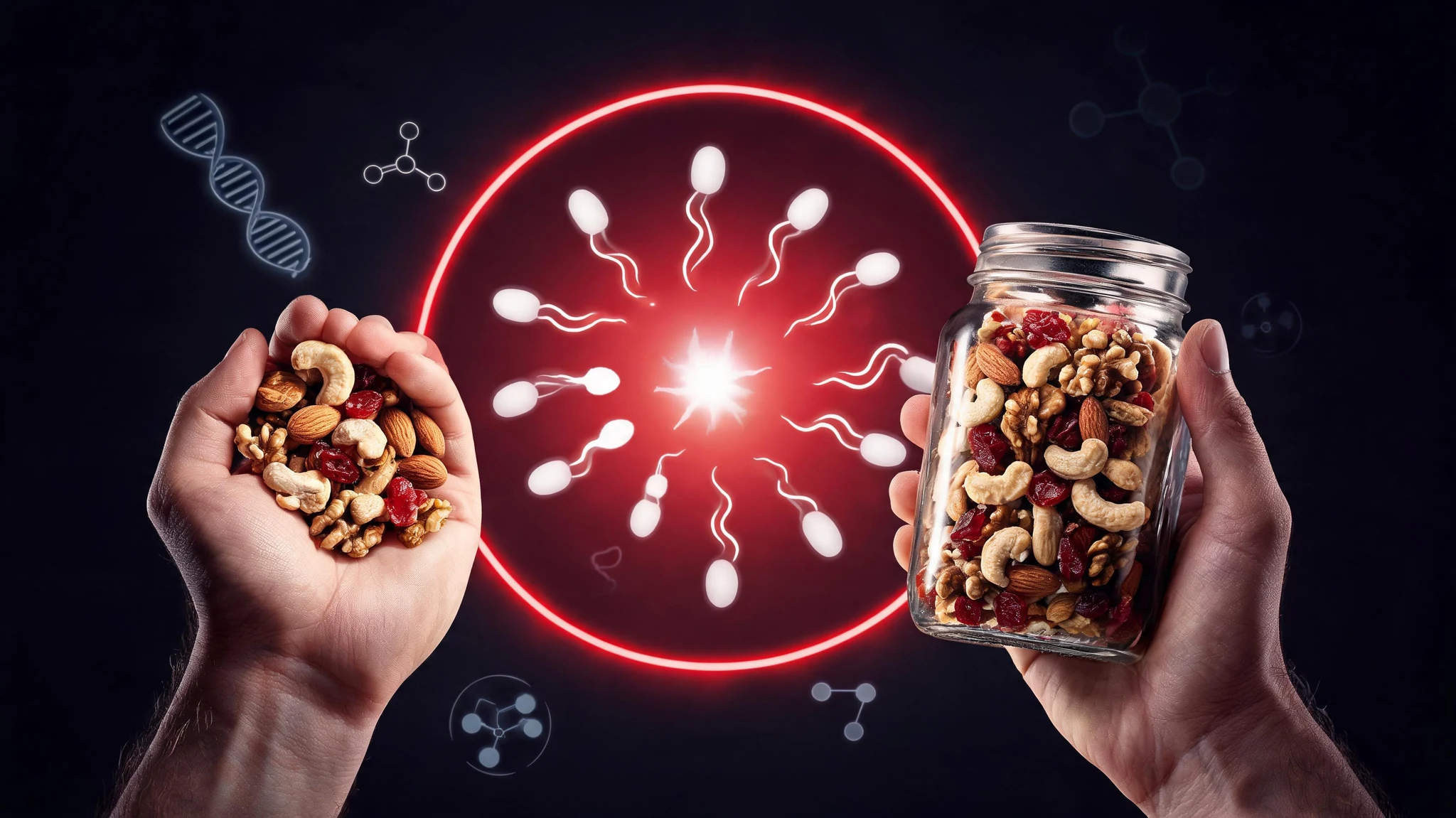
In a 14-week randomized controlled trial of 119 healthy men aged 18 to 35, those who ate 60 grams of mixed nuts every day, roughly two handfuls of walnuts, almonds, and hazelnuts, ended the study with measurably better fertility. Motility went up. Vitality went up. The shape of their reproductive cells improved on standard morphology grading. DNA fragmentation, a marker that fertility clinics treat as a quiet warning sign, went down1.
The trial, published in the American Journal of Clinical Nutrition by Salas-Huetos and colleagues at the Universitat Rovira i Virgili in Spain, is sometimes called FERTINUTS. It is one of the most cited diet-and-fertility experiments of the last decade, and the reason a Facebook post about nuts and fertility has been circulating again. The headline is real. The fine print is more interesting than the headline.
What the trial actually did
The researchers recruited 119 healthy, non-smoking men reporting a typical Western diet, low in fruit and vegetables and heavy on processed foods. None had known fertility problems. They were not couples trying to conceive. The point was to see whether something changed in the reproductive sample of ordinary young men if you adjusted one variable.
Half the men were asked to add 60 grams of mixed nuts a day to whatever they were already eating. The mix was specific: 30 grams of walnuts, 15 grams of almonds, and 15 grams of hazelnuts. The other half were asked to keep eating their usual diet and avoid nuts entirely. Reproductive sample samples were collected at the start of the study and again after 14 weeks, which roughly matches the timeline of one full cycle of fertility production in the testis.
At week 14, the nut group showed a small but statistically significant improvement in total fertility marker count, vitality, motility, and morphology, along with reduced cell DNA fragmentation1. The control group did not. None of the men became markedly more fertile in any clinical sense, because they were not trying to be. What changed was the underlying biology of the sample.

What about the 16 percent figure?
Social media versions of this study sometimes claim a 16 percent jump in fertility marker count from eating nuts. That number can be traced back to a different and earlier study by Robbins and colleagues at UCLA, published in Biology of Reproduction in 20122. In that experiment, 117 men aged 21 to 35 were randomized to eat 75 grams of whole shelled English walnuts a day, or to avoid tree nuts entirely, for 12 weeks while keeping their usual Western diet. The walnut group saw improvements in cell vitality, motility, morphology, and chromosomal integrity, with the largest reported gains in motility and morphology rather than count.
The exact 16 percent number is not the cleanest summary of either study. A 2018 systematic review and meta-analysis of randomized trials looking at nutrients and supplements found that nut interventions consistently improved motility and morphology, with smaller and less consistent effects on total fertility concentration4. So if you are reading a viral post that promises a precise percentage increase in fertility marker count, treat the percentage as approximate. The direction of the effect is well supported. The magnitude varies by study, by population, and by exactly which fertility parameter you measure.
Why nuts, biologically
Fertility cells are unusually vulnerable to oxidative stress. They have very little cytoplasm, which means very little of the cellular machinery that other cells use to neutralize reactive oxygen species. Their membranes are also rich in polyunsaturated fatty acids, which are easy to damage. When oxidative stress wins, the consequences show up as fragmented DNA, sluggish movement, and abnormal cell shapes3.
Nuts happen to be a dense package of exactly the nutrients reproductive cells benefit from. Walnuts contribute alpha-linolenic acid, the plant-based omega-3 that the body partially converts into EPA and DHA. Almonds bring vitamin E, an antioxidant that sits in cell membranes and protects fatty acids from oxidation. Hazelnuts add more vitamin E plus folate. All three contribute zinc, selenium, magnesium, and a range of polyphenols. Zinc plays a structural role in the fertility midpiece, where the energy-producing mitochondria sit. Selenium is a building block of glutathione peroxidase, one of the body’s main antioxidant enzymes3.
None of this is unique to nuts. You can hit the same nutrient profile with fish, leafy greens, legumes, seeds, and shellfish. Nuts are convenient because they bundle the nutrients into a snack that travels well, keeps for weeks, and does not require cooking. That convenience matters for whether a dietary change actually sticks. The trials that show benefit are trials where men actually managed to eat the food for three or four months, not just intend to.
One detail worth pausing on. The benefit in these studies seems to come from the whole nut, not from any single isolated nutrient. Earlier work that gave men high-dose vitamin E pills, or zinc pills, or omega-3 capsules, has produced more modest and less consistent results than the food-based trials4. The packaging of nutrients inside a real food, eaten alongside fiber, fat, and a slow-digesting matrix, is doing something that an isolated supplement does not fully reproduce. That is a recurring theme in nutrition research, and it is worth keeping in mind before reaching for a pill instead of a snack.

How big is the effect, in plain terms
One way to read the FERTINUTS results is that men in the nut group ended the study with fertility parameters roughly five to ten percent better, on average, than men who changed nothing1. That is not enough to turn a clinically infertile man into a fertile one. It is enough, in a population-level sense, to nudge a handful of men whose reproductive sample quality was borderline back into the normal range.
That distinction matters. Diet is a useful lever for the broad middle of the bell curve. It is not a treatment for severe male-factor infertility, where the underlying issues are usually anatomical, hormonal, or genetic. A 2017 systematic review of dietary patterns and male fertility reached the same general conclusion: diets high in fruit, vegetables, fish, whole grains, and nuts are associated with better reproductive sample parameters in observational data, while diets heavy in processed meat, sugar-sweetened drinks, and fried food are associated with worse ones3.
How long does the effect last?
Fertility production runs on a cycle of about 74 days, plus another two weeks or so for the cells to mature and travel through the epididymis. That is why the 14-week design of FERTINUTS was not arbitrary. It is roughly the minimum time needed to see whether something a man eats today shows up in tomorrow’s sample.
Because the production cycle is rolling, the effects of a dietary change are also rolling. Stop eating nuts, and the new fertility being made will reflect whatever you replace them with. There is no reservoir of nut-influenced fertility sitting in storage. The same logic applies to alcohol, smoking, heat exposure, and weight gain. Fertility is, in a sense, a slow-motion record of how a man has been treating his body for the previous three to four months3.

Does this work for older men, smokers, or men with diagnosed infertility?
The honest answer is that the FERTINUTS trial cannot tell you. The participants were 18 to 35, non-smokers, and not selected for fertility problems. Their reproductive sample quality at baseline was already in the normal range for healthy young adults. Effects in older men, in smokers, or in men with conditions like varicocele or hormonal imbalance have not been established in a comparable randomized design1.
A 2025 systematic review and meta-analysis of Mediterranean diet patterns and male fertility, which looked at outcomes including assisted reproduction, found that closer adherence to a Mediterranean-style diet (high in nuts, olive oil, fish, vegetables, and legumes) was associated with better fertility parameters across mixed populations5. The signal held up reasonably well across studies, although the authors noted high heterogeneity in study designs and a shortage of randomized evidence in older men or in couples actively undergoing IVF or ICSI. The takeaway is cautious optimism, not certainty.
What about allergies, calories, and practicalities
Sixty grams of mixed nuts is roughly 360 to 400 calories, depending on the mix. That is not trivial. If a man simply adds two handfuls of nuts on top of an already calorie-dense diet, the long-term result may be weight gain, and obesity is itself a risk factor for poorer reproductive sample quality. The cleaner approach is to swap nuts in for something else, often a snack of comparable calories but lower nutrient density, like chips or a sweetened pastry.
Tree nut allergy is the obvious dealbreaker. About one percent of adults in Western countries have a tree nut allergy, and the reactions can be severe. Anyone with a known allergy should not attempt this on their own, and parents who suspect a tree nut allergy in a son should not generalize from this research to anything outside a doctor’s office.
For everyone else, the practical version of the experiment looks like 30 grams of walnuts, 15 of almonds, 15 of hazelnuts, eaten across the day, raw or dry-roasted, unsalted where possible. There is nothing magical about that exact ratio. It happens to be the one tested. A reasonable substitute, if hazelnuts are hard to find, would be a similar weight of pecans or Brazil nuts, both of which carry a comparable mix of healthy fats and minerals. Two Brazil nuts on their own, in fact, will already meet the daily selenium requirement on most days, which is one reason a few of them slip easily into a useful mix.

Common questions about nuts and male fertility
How many nuts per day did the trial use?
Sixty grams a day, split into 30 grams of walnuts, 15 grams of almonds, and 15 grams of hazelnuts. That is roughly two small handfuls.
Do peanuts count?
Peanuts are technically legumes, not tree nuts, and they were not part of the FERTINUTS or Robbins trials. They have a different fatty acid profile. The studied effect applies specifically to tree nuts.
How long before the effect shows up?
About three months. Fertility production runs on a 74-day cycle, plus maturation, so changes in diet take roughly that long to be visible in a reproductive sample sample.
Will eating nuts improve fertility for couples trying to conceive?
It may improve the underlying biology of the fertility in a measurable way, especially in men whose reproductive sample parameters are borderline. It is not a treatment for diagnosed infertility, and couples who have been trying for more than a year should still see a clinician.
Are there any downsides?
Calorie load is the main one. Tree nut allergy is the absolute one. There are no documented harms from 60 grams a day of mixed nuts in healthy adults, and considerable evidence of cardiovascular benefit at that dose.
The honest bottom line
If a man is healthy, in his twenties or early thirties, eating a fairly Western diet, and curious whether two handfuls of nuts a day will measurably improve his fertility parameters across a few months, the answer from a well-conducted randomized trial is yes, modestly. It will not turn a fertility problem into a non-problem. It will not guarantee a pregnancy. It will probably nudge motility, morphology, and DNA integrity in a useful direction, alongside the other things nuts already do for the heart and the lipid profile.
What it will not do is substitute for the rest of the picture. Sleep, weight, exercise, alcohol, heat, and chronic stress all matter, often more than any single food. Nuts are a small lever among several, and the people getting the largest benefits in these trials were already doing many of the other things right. Treat the finding as a permission slip to add a snack with real evidence behind it, and as a reminder that the body keeps a fairly literal record of what gets fed to it.


Sources
- Salas-Huetos A et al. Effect of nut consumption on reproductive sample quality and functionality in healthy men consuming a Western-style diet: a randomized controlled trial. American Journal of Clinical Nutrition, 2018. PubMed: 30475967
- Robbins WA, Xun L, FitzGerald LZ, Esguerra S, Henning SM, Carpenter CL. Walnuts improve reproductive sample quality in men consuming a Western-style diet: randomized control dietary intervention trial. Biology of Reproduction, 2012. PubMed: 22895856
- Salas-Huetos A, Bullo M, Salas-Salvado J. Dietary patterns, foods and nutrients in male fertility parameters and fecundability: a systematic review of observational studies. Human Reproduction Update, 2017. PubMed: 28333357
- Salas-Huetos A, Rosique-Esteban N, Becerra-Tomas N, Vizmanos B, Bullo M, Salas-Salvado J. The Effect of Nutrients and Dietary Supplements on Fertility Quality Parameters: A Systematic Review and Meta-Analysis of Randomized Clinical Trials. Advances in Nutrition, 2018. PubMed: 30462179
- Agarwal R et al. Mediterranean Diet, Reproductive sample Quality, and Medically Assisted Reproductive Outcomes in the Male Population: A Systematic Review and Meta-Analysis. Advances in Nutrition, 2025. PubMed: 40419219