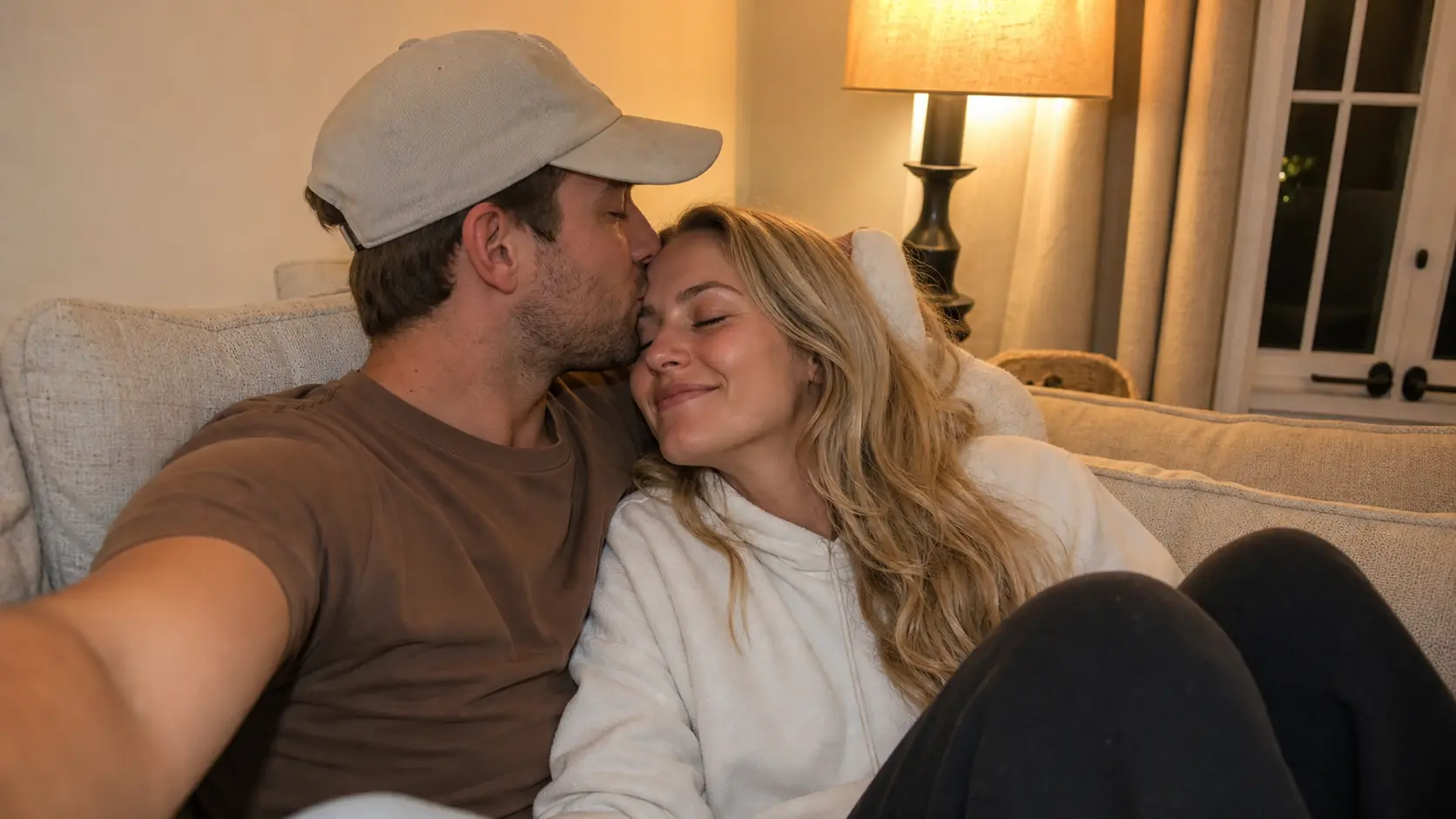
A goodbye kiss before work is a sweet habit. The stronger claim, that men who kiss their partners before leaving live five years longer, is much harder to prove. It is widely repeated, but the public trail behind it is thin, old, and not easy to verify in a peer-reviewed medical database.
The better question is still worth asking. Can small daily signs of affection reflect something real about health? On that point, the evidence is stronger. A 2014 meta-analysis in Psychological Bulletin found that better marital quality was associated with better physical health and lower mortality risk, while a 2010 review of 148 studies linked stronger social relationships with lower risk of death.1,2
The five-year number is not the strongest part
The most shareable version of this story says a morning kiss can add years to a man’s life. That is a tidy line, which is exactly why it travels. Health research is rarely that tidy. A kiss is not a pill. It cannot be separated cleanly from the relationship around it, the person’s income, job strain, sleep, health habits, mental health, or the kind of home they return to at night.
That does not make the idea silly. It means the kiss is better understood as a signal. A partner who leaves the house with a moment of warmth may also live inside a relationship with more emotional safety, less chronic conflict, more touch, and a stronger sense that someone is on their side. Those things have a real research base.
In the marital-quality meta-analysis by Robles and colleagues, higher relationship quality was tied to several health-related measures, including self-rated health, cardiovascular reactivity during conflict, and mortality. The effects were not huge, and they do not prove that marriage itself causes better health. Still, the pattern was consistent enough to matter.1
That is the honest version: a goodbye kiss probably does not magically buy five extra years. It may be one visible piece of a calmer, warmer daily life. That difference is worth keeping.
Affection changes the start of the day
Mornings often push couples into efficiency mode. Alarms, messages, children, traffic, lunches, missed coffee, and the first work problem of the day can crowd out connection before anyone has fully woken up. A goodbye kiss interrupts that rush for a few seconds. It says, in body language, “I see you before the day takes over.”
That matters because the body does not experience relationships as abstract ideas. It responds to tone of voice, facial expression, touch, timing, and whether a partner feels emotionally available. In a 2019 study in Psychosomatic Medicine, Ditzen and colleagues found that observed partner intimacy was linked with reduced cortisol responses to a psychosocial stress test in women, although the result varied by oral contraceptive use.3
Cortisol is not bad by itself. It helps the body respond to challenge. Trouble comes when stress systems stay switched on too often, for too long, with too little recovery. A warm ritual before work will not erase a hard job or a strained bank account, but it may add a small cue of safety at the exact moment the day begins to load pressure onto the nervous system.

Daily affection also works because it is predictable. Grand romantic gestures are pleasant, but they are occasional. Repeated tiny rituals may do more for a couple’s emotional climate because they become part of the body’s expectations. The person leaving for work does not have to wonder whether the relationship is okay that morning. The goodbye gives an answer.
Touch is one of the body’s oldest calming signals
Human touch is not just sentimental. It is part of how people regulate each other. In a 2023 eLife ecological momentary assessment study, Schneider and colleagues followed affectionate touch in daily life and found that, within people, moments of affectionate touch were associated with lower self-reported anxiety, burden, and stress, along with higher oxytocin levels.4
Another study looked at brief warm contact between cohabiting couples before a stress task. Grewen and colleagues reported that warm partner contact was related to lower cardiovascular reactivity, including blood pressure responses, in a sample of healthy adults.5 That does not mean every hug lowers blood pressure in every person. It does suggest that affectionate contact can sit inside the body’s stress-control system.
A goodbye kiss is a very small dose of touch. It is not therapy. It is not a substitute for medical care, sleep, exercise, or solving real conflict. But small does not mean empty. A steady pattern of warm touch may be one way partners remind each other that the relationship is a safe place, not another demand.
The detail many people miss is consent and comfort. Affection helps when it feels wanted. A forced ritual is no longer a ritual of care. Couples differ in touch preferences, cultural habits, trauma histories, and sensory comfort. The useful question is not, “Should every couple kiss before work?” It is, “What small goodbye makes both people feel respected and loved?”
Strong social ties are tied to survival
The wider evidence on social connection is harder to dismiss. Holt-Lunstad, Smith, and Layton reviewed 148 studies with more than 300,000 participants and found that stronger social relationships were associated with a higher likelihood of survival over time.2 The finding does not reduce health to companionship. It places social life beside other serious risk factors that deserve attention.
Close relationships can affect health through several paths. They can buffer stress. They can make it easier to sleep, eat better, seek care, take medication, or recover after illness. They can also hurt health when they are hostile, unsafe, or chronically tense. Relationship quality is the hinge.
This is where the goodbye kiss becomes less about kissing and more about climate. A warm goodbye is usually a symptom of a relationship where both people feel seen. That kind of connection may make daily strain more bearable. For a related look at how rest and recovery affect stress, Beauty Health Page has covered how often vacations may help stress. The same theme shows up in a different form here: bodies need recovery, and people often recover better when they feel supported.

There is another practical angle. People in satisfying relationships often have someone who notices changes. A partner may catch worsening fatigue, a strange cough, a missed appointment, or a mood shift. That kind of ordinary attention can move people toward care earlier. It is quiet health protection, and it rarely looks dramatic from the outside.
Affection is protective only when the relationship is safe
It would be wrong to turn this into pressure. A kiss cannot repair contempt, fear, coercion, or emotional neglect. In a tense relationship, asking for a morning kiss may feel like one more performance. Health advice should never tell someone to accept unwanted touch or smooth over a problem that needs boundaries, counseling, or distance.
The research on marital quality makes this point clearly. Better relationship quality was linked with better health markers, but poor relationship quality and conflict are a different story.1 The healthful part is not the public label of marriage, and it is not the appearance of affection. It is the lived experience of support, respect, repair, and low threat.
For couples who are basically safe and kind to each other, a goodbye ritual can be a low-effort way to protect connection. It might be a kiss, a hand on the shoulder, a real hug, a quick prayer, a sincere “drive safe,” or a text after one person gets to work. The form matters less than the message.
Cohen and colleagues found in a 2015 study that hugging was associated with stress-buffering social support and lower susceptibility to infection-related illness after viral exposure, though the study design cannot prove hugs alone caused the result.6 Still, it fits the broader picture: affectionate contact may be one way people carry support in the body.
How to make a goodbye ritual feel real
The best rituals are small enough to survive normal life. If they require a perfect mood, they will disappear. If they feel like an obligation, they will become hollow. A good ritual is brief, mutual, and specific enough that both people recognize it.
Start with the version that already feels natural. A couple that likes touch may choose a kiss and a ten-second hug. A couple with different touch needs may choose eye contact and a phrase. Parents with chaotic mornings may agree that one partner gets a proper goodbye at the door while the other handles backpacks and cereal. The aim is not romance for an audience. It is a few seconds of contact before separation.
Timing helps. If one partner is always late, a goodbye ritual may need to happen before the final scramble. If mornings are impossible, the ritual can move to bedtime, lunch, or the moment both people come home. The healthful ingredient is repeated warmth, not the clock.

It also helps to treat the ritual as a repair cue after mild conflict. Many couples go to bed or leave the house still irritated. That is normal. A simple “I love you, we’re okay, we’ll talk later” can keep a disagreement from turning into a full day of emotional distance. That sentence will not solve the issue, but it can lower the temperature.
Common questions about goodbye kisses and health
Does kissing before work really make men live five years longer?
There is no strong, easily verifiable medical evidence that a goodbye kiss itself adds five years. The stronger evidence says relationship quality, social support, and affectionate contact are linked with better health and stress regulation.
Is this only about men?
No. The repeated five-year claim is usually phrased around men, but the broader research on social relationships, marital quality, and affectionate contact applies to adults more generally. Some touch and cortisol studies report sex-specific findings, so details vary by study.
What if my partner is not physically affectionate?
Do not force touch. Try a different ritual: a kind phrase, a check-in text, making coffee, a hand squeeze, or a goodbye at the door. The point is felt care.
Can a good relationship replace healthy habits?
No. Sleep, movement, food, medical care, and safety still matter. A warm relationship can support those habits, which may be one reason social connection shows up in health research.
What if affection feels unsafe or pressured?
Then the advice does not apply in the usual way. Unwanted touch is not healthful. Safety, consent, and respect come first.
The small habit is worth keeping, with one caveat
A goodbye kiss is not a longevity treatment. It is a relationship signal. The best evidence does not support treating one kiss as a magic switch, but it does support taking warm, steady connection seriously. People with stronger social ties and better relationship quality tend to have better health patterns, and affectionate touch can be part of stress regulation for some couples.
So kiss your partner goodbye if both of you like it. Hug. Say the sentence. Send the text. Make the small moment real. A few seconds of warmth will not control the future, but it can change the way a day begins.
Sources
- Robles TF et al. Marital quality and health: a meta-analytic review. Psychological Bulletin, 2014. PubMed: 23527470
- Holt-Lunstad J et al. Social relationships and mortality risk: a meta-analytic review. PLoS Medicine, 2010. PubMed: 20668659
- Ditzen B et al. Intimacy as Related to Cortisol Reactivity and Recovery in Couples Undergoing Psychosocial Stress. Psychosomatic Medicine, 2019. PubMed: 30134358
- Schneider E et al. Affectionate touch and diurnal oxytocin levels: An ecological momentary assessment study. eLife, 2023. PubMed: 37252874
- Grewen KM et al. Warm partner contact is related to lower cardiovascular reactivity. Behavioral Medicine, 2003. PubMed: 15206831
- Cohen S et al. Does hugging provide stress-buffering social support? A study of susceptibility to upper respiratory infection and illness. Psychological Science, 2015. PubMed: 25526910