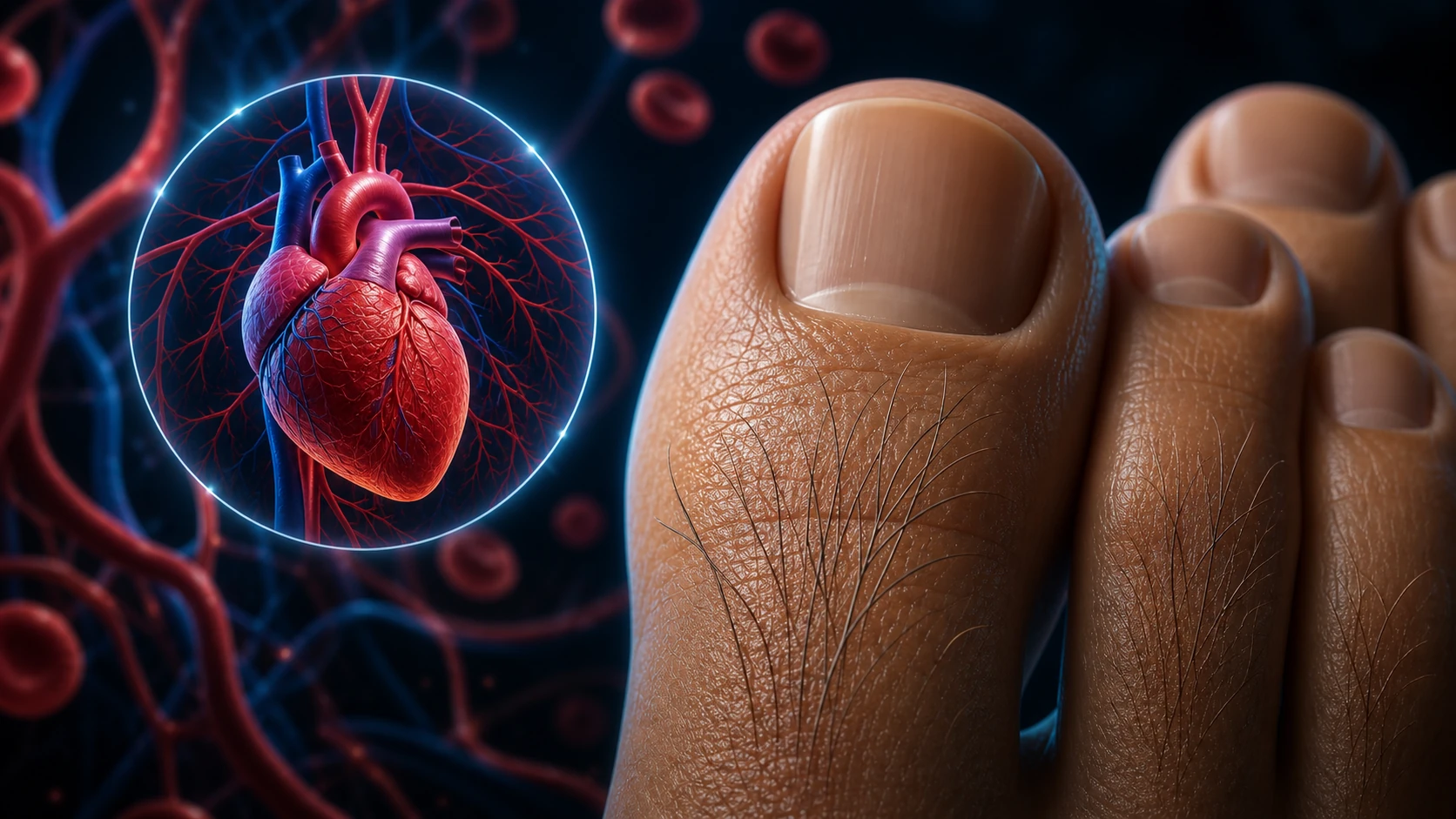
Tiny hairs on toes or fingers are usually normal. They can appear more clearly in some people because of genes, hormones, age, and skin tone. They do not prove the heart is pumping perfectly, but they do point toward a real medical idea: hair growth depends partly on local blood supply, and sudden hair loss on the feet or lower legs can be one clue doctors notice when they assess circulation.1
Follicles are living structures. They need oxygen, nutrients, hormones, and signals from nearby blood vessels. Laboratory research has linked vascular endothelial growth factor, or VEGF, with follicle size and hair growth, which helps explain why blood supply and hair biology are connected.2,3
What toe hair can and cannot tell you
The presence of toe hair by itself is not a health test. Some healthy people have very little body hair. Some have a lot. Hair patterns run strongly through families and are shaped by hormones. Shaving, waxing, friction from shoes, and normal aging can also change what a person sees on the feet.
The sign that deserves more attention is change. If someone used to have hair on the toes or lower legs and it fades along with cold feet, slower wound healing, color changes, numbness, or pain while walking, that is different. Doctors do not diagnose peripheral artery disease from hair loss alone, but they do consider the whole foot and leg exam.
Why doctors examine feet for circulation
Peripheral artery disease, often shortened to PAD, happens when narrowed arteries limit blood flow to the legs or feet. A 2006 JAMA review asked how well parts of the clinical exam predict lower-extremity PAD.1 Findings such as abnormal pulses, bruits, cool skin, and certain skin or nail changes can point a clinician toward more testing.

Hair loss can appear in that neighborhood of signs, but it is weak on its own. A person should not panic over smooth toes. The more useful question is whether the feet feel different, whether walking brings calf pain that eases with rest, whether sores linger, or whether one foot looks paler or colder than the other.
Hair follicles need a local blood supply
Follicles do not live apart from circulation. Studies of hair biology have shown that VEGF can influence follicle blood vessels and growth behavior.2,3 That explains why blood supply and hair growth belong in the same conversation. Good local blood flow is part of healthy skin and hair.
Still, the leap from local follicle support to perfect heart pumping is too large. The heart can pump well while a person has thin toe hair. A person can have visible toe hair while still having blood pressure, cholesterol, glucose, or vascular problems that need attention. Bodies are more complicated than one small clue.
When to ask a clinician
People should consider medical advice if they notice new leg pain with walking, foot wounds that do not heal, a foot that becomes cold or pale, numbness, blue or black skin changes, or a sudden one-sided change in hair, skin, or nails. Those signs are more useful than simply comparing toe hair with a friend’s.

People with diabetes, kidney disease, smoking history, high blood pressure, high cholesterol, or prior cardiovascular disease should be extra careful with foot changes. PAD can be missed because early symptoms may be mild. The goal is not anxiety. It is paying attention early enough to act.
A softer way to read body signs
Beauty Health Page has covered several body-sign topics, including why low muscle mass can matter for long-term health and what CDC obesity data says about cardiometabolic risk. The same editorial rule applies here: a sign is a clue, not a verdict.
A good body clue should lead to better questions. Has this changed? Is there pain? Is there numbness? Are there risk factors? Is it on one side? Those questions turn a small observation into something more useful and less scary.
What this means in real life
Small body signs are easy to overread because they feel personal. A hair on a toe, a cold foot, a patch of dry skin, or a new ache can make people wonder what is happening underneath. The useful move is not to ignore those signs or panic over them. It is to put them in context.
Feet deserve more attention than they usually get. They carry circulation clues, nerve clues, skin clues, and pressure clues. For people with diabetes or vascular risk factors, looking at the feet regularly can be a simple way to notice problems before they become harder to treat.
For everyone else, toe hair is mostly a reminder that the body is full of small variations. Some matter. Some are harmless. The difference usually comes from change, symptoms, and risk factors, not one isolated detail.
That kind of context can make health information less jumpy. Instead of treating every detail as a warning sign, a person can ask whether the detail is new, whether it comes with discomfort, and whether it fits a bigger pattern. Those questions are calmer and more useful.
A clinician can then decide whether a pulse check, ankle-brachial index test, diabetes screening, cholesterol review, or simple reassurance is the right next step. The point is not to self-diagnose from toe hair. The point is to notice the feet as part of whole-body health.
The same approach works for many skin and circulation questions. A single observation rarely gives the whole answer, but a timeline can help. When did it start? Is it getting worse? Does it happen on both sides? Does walking, cold weather, or rest change it? Those details make a medical visit more productive.
It is also worth separating appearance from function. Feet can look unusual and still work normally, while serious circulation problems may begin with symptoms a person could easily dismiss. Pain with walking, slow-healing sores, numbness, and one-sided coldness deserve more attention than a cosmetic difference.
People who already know they have diabetes, high cholesterol, high blood pressure, kidney disease, or a smoking history should treat foot changes with a lower threshold for care. That does not mean fear. It means the feet are one place where vascular risk can become visible.
How to use this wisely
A useful body-sign habit is to notice patterns without diagnosing yourself from one detail. Toe hair belongs in that category. It can be part of a normal pattern. It can also change for reasons that have little to do with arteries. The question is what else is happening.
A person can make a simple foot check part of routine care, especially if they have diabetes or vascular risk factors. Look at skin color, temperature, cracks, sores, nail changes, swelling, and whether both feet look roughly similar. This takes less than a minute and can catch problems earlier.
Footwear matters in a less glamorous way. Tight shoes, rubbing sandals, and constant friction can change skin and hair locally. That is another reason a smooth patch should not be treated as a direct circulation diagnosis. Context keeps a small sign from becoming a scary story.
It is tempting to turn one body clue into a grand promise because certainty feels comforting. Medical exams work differently. Clinicians gather several clues, compare sides, ask about symptoms, and use tests when the pattern deserves it.
The best home response is not to stare at toes in alarm. It is to know the warning signs that need care: pain while walking, numbness, wounds, coldness, color changes, and sudden changes on one side. Those are worth more attention than whether a few hairs are visible.
If toe hair makes someone pay attention to foot health, that is useful. If it makes someone believe a few hairs prove perfect circulation, it needs correction. The body speaks in patterns, not single-word answers.
People can also support circulation in the unflashy ways clinicians have repeated for years: avoid smoking, manage blood pressure, treat diabetes carefully, move regularly, and follow cholesterol advice when risk is high. None of those habits are as shareable as a toe-hair fact, but they matter far more.
The same goes for skin care. Moisturizing dry feet, trimming nails safely, wearing shoes that fit, and checking blisters early can prevent small problems from growing. For people with diabetes or known vascular disease, routine foot checks are practical medicine, not vanity.
Common questions about toe hair and circulation
Does toe hair mean good circulation?
It can be consistent with normal local circulation, but it does not prove the heart or arteries are perfectly healthy.
Is lack of toe hair bad?
Not by itself. Genetics, hormones, grooming, shoes, and age can all affect hair on the feet.
What foot signs are more concerning?
Coldness, color change, wounds that do not heal, numbness, and calf pain with walking deserve medical attention.
Can poor circulation cause hair loss?
Reduced blood flow can be one factor in skin and hair changes, but doctors look at the full exam and may order tests.
What to take from this
Toe hair is a small clue with a narrow message. It can fit with healthy local skin and follicles, but it cannot grade a person’s circulation by itself.
The practical rule is calmer: do not treat body hair as a scorecard. Watch for changes, notice symptoms, and let a clinician connect the dots when the pattern looks off.
Sources
- Khan NA et al. Does the clinical examination predict lower extremity peripheral arterial disease?. JAMA, 2006. PubMed: 16449619
- Yano K et al. Control of hair growth and follicle size by VEGF-mediated angiogenesis. The Journal of clinical investigation, 2001. PubMed: 11181640
- Lachgar S et al. Vascular endothelial growth factor is an autocrine growth factor for hair dermal papilla cells. The Journal of investigative dermatology, 1996. PubMed: 8592070