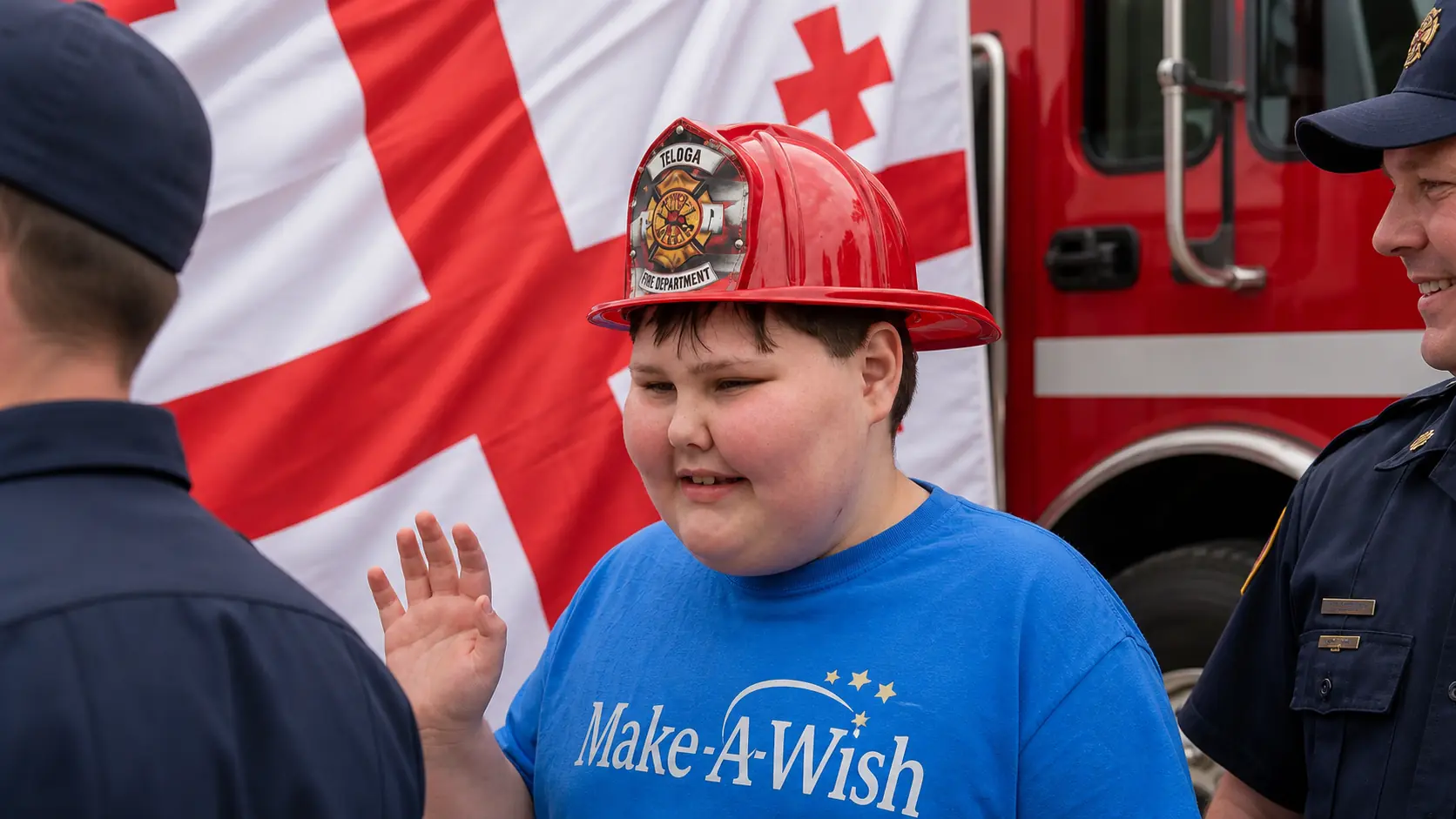
Jude Baker was 14 when he used a wish most children would spend on a dream trip to do something very different. After surviving Ewing sarcoma, the Georgia teen asked Make-A-Wish to help him feed more than 300 people experiencing homelessness and give them backpacks, sleeping bags, and basic supplies.
The choice landed because it was so plain. A teenager who had been through cancer looked at people carrying their own hard days and decided his wish should make those days a little less lonely. Science cannot measure the full meaning of that moment. It can, however, tell us something useful: helping others is linked in research with stress buffering, social connection, and well-being, especially when the help is grounded in real care rather than performance.1,4
A wish turned outward
For many families, Make-A-Wish means a trip, a celebrity meeting, or one beautiful break from treatment. Those wishes matter. Serious illness can shrink a child’s world to appointments, scans, needles, fatigue, and waiting rooms. Joy is not a small thing in that context.
Jude’s wish followed a different path. He had lived through Ewing sarcoma, a rare cancer that most often affects children, teens, and young adults. The National Cancer Institute describes Ewing sarcoma as a tumor that can arise in bone or nearby soft tissue, with care usually led by pediatric cancer specialists and often involving several treatments over time. That kind of illness can take over a family’s calendar and a child’s sense of normal life.
His answer was to give other people a meal, a bag, and some warmth. The supplies were practical. Food matters. A sleeping bag matters. A backpack matters when a person owns little enough that carrying it becomes part of daily survival. But the human signal may have mattered too: someone saw them.
That is the part readers feel first. The story is not about a child becoming saintly after cancer. That would flatten him. It is about a teenager making a specific choice after a painful chapter, and that choice reached hundreds of strangers in a direct way.
Why helping can feel powerful after illness
Illness often puts a person in the role of receiver. Doctors decide the next scan. Nurses place the line. Parents manage medication. Friends bring meals. Even when everyone is loving, the patient may feel that life is happening to them.
Giving can restore a sense of agency. It lets a person say, “I still have something to offer.” That matters for adults, and it can matter for children and teens too. The research does not say that helping others cures trauma or erases fear. It does suggest that prosocial behavior, the broad term for actions meant to benefit other people, can support well-being in some settings.
In a 2013 study in the American Journal of Public Health, Poulin and colleagues examined stress, helping behavior, and mortality among older adults. They found that stressful events were associated with higher mortality risk among people who had not helped others, but that association was not seen among those who had helped friends, neighbors, or relatives.1 The study was observational, so it cannot prove that helping caused longer life. Still, it points toward a useful idea: caring action may change how stress lands in the body.

There is also a psychological difference between pity and solidarity. Pity looks down. Solidarity stands beside. Jude’s wish reads like solidarity because it begins with the idea that everyone is fighting something, even if the struggle is not visible. That is not medical data. It is moral attention, and it is rare enough to stop people.
Kindness is healthiest when it is real, not forced
Research on helping is often more careful than the slogans around it. It does not say that giving endlessly is always good. It does not say people should ignore their own needs. It does not say service is a cure for grief, cancer recovery, depression, or burnout.
A 2021 study in Proceedings of the National Academy of Sciences looked at giving and receiving social support in a national U.S. sample over a long follow-up period. The authors found that a moderate amount of instrumental support given to others was associated with lower all-cause mortality, while very low and very high levels did not show the same pattern.2 That word “moderate” matters. Human beings are not built to pour from an empty cup forever.
That distinction protects the story from becoming a demand. A teen who has survived cancer should not be expected to prove gratitude through service. A sick person does not owe the world inspiration. The beauty of Jude’s wish is that it appears chosen. He saw a need and wanted to meet it.
That kind of giving has a different texture from obligation. It can connect the helper with other people, give shape to a hard experience, and create a moment where pain is not the only story being told.
People experiencing homelessness need more than a kind day
Meals and supplies are not a policy. They do not create housing, medical care, addiction treatment, mental health care, living wages, or a safer shelter system. It is important to say that plainly because feel-good stories can accidentally make huge public problems look solvable by one generous act.
People experiencing homelessness face higher risks because exposure, crowded settings, poor sleep, limited sanitation, chronic illness, trauma, and barriers to care stack on top of each other. The CDC notes that homelessness is linked with higher risks for infectious and noninfectious diseases, and that barriers to health care and social services can lead to worse outcomes, including severe illness or death.
That does not make a meal unimportant. It makes the meal immediate. A person who is hungry today needs help today. A person sleeping outside tonight needs warmth tonight. The larger system still needs repair, but direct kindness can keep a person safer while that work remains unfinished.

This is where small action and structural action should meet. A backpack is not enough, and it is still useful. A sleeping bag is not housing, and it can still protect someone from cold. A hot meal does not fix poverty, and it still treats hunger as urgent rather than theoretical.
Volunteering has a mixed but hopeful evidence base
A 2020 systematic review in Campbell Systematic Reviews examined voluntary work for the physical and mental health of older volunteers. The authors found that evidence was limited in some areas, but volunteering may reduce mortality among older adults. They were also careful about uncertainty, which is exactly how health research should be read.3
A newer 2023 systematic review and meta-analysis in JAMA Network Open looked at prosocial interventions and health outcomes across many studies. Byrne and colleagues reported that prosocial interventions were associated with improved psychological, social, and physical health outcomes, while also noting variation across studies and the need for more rigorous work.4
For Beauty Health Page readers, the takeaway is simple but not simplistic. Helping others can be good for the helper, especially when it creates connection, purpose, and manageable action. It is less likely to be good when it becomes self-erasure, pressure, or a way to avoid receiving care.
That same balance shows up in other health topics. Recovery needs both action and rest. In another piece, Beauty Health Page looked at how vacations may help stress. The lesson overlaps here: the nervous system needs relief, connection, and time to come down from survival mode. Giving can be part of that, but it should not become another form of strain.
What children notice about hardship
Adults often assume children are protected by not knowing too much. Sometimes that is true. Sometimes children notice more than anyone says out loud. A child in treatment sees fear on adult faces. A teen who has been seriously ill may recognize vulnerability quickly in other people.
That recognition can become heavy. It can also become empathy. The difference often depends on support. When adults help a young person act on compassion in a safe, bounded way, the young person learns that pain does not have to close them off. It can sharpen their attention to other people.
Jude’s wish worked because adults and an organization helped turn the idea into something concrete. That matters. Teen generosity needs logistics: food, transportation, safety, planning, and grown-ups who can carry the complicated parts. The child should not have to hold the entire weight of the problem.

For families, this is a useful model. A child who wants to help does not need to solve homelessness. They can pack hygiene kits, write cards for hospital patients, help choose pantry donations, or volunteer in age-appropriate ways. Small service teaches that compassion is a practice, not a mood.
How to help without turning kindness into a performance
The best help starts with listening. Ask local shelters, food banks, mutual aid groups, and outreach teams what they actually need. Many groups need socks, shelf-stable food, water, menstrual products, phone chargers, hand warmers, sunscreen, or transit cards more than random donated items.
Give in ways that preserve dignity. New or clean items are better than things no one in your own home would use. Avoid filming people receiving help unless they clearly consent and there is a real reason. A person’s hardest day should not become someone else’s content.
Make it sustainable. A one-time meal is good. A monthly donation, a recurring volunteer shift, or a neighborhood supply drive may be better. If you are recovering from your own illness or stress, choose a form of help that does not drain what you need to heal.
And if you are the one who needs help, receiving it is not failure. Social support runs both ways. The PNAS study on giving and receiving support is a useful guardrail here: health is not about being the helper all the time. It is about living in networks where care can move in more than one direction.2
Common questions about kindness and health
Does helping others really improve health?
Some studies link helping, volunteering, or prosocial interventions with better health or lower mortality risk, but much of the evidence is observational. It is fair to say helping may support well-being, especially when it is manageable and connected.
Can kindness reduce stress?
It may. The 2013 study by Poulin and colleagues found that helping others appeared to buffer the link between stressful events and mortality risk in older adults. That does not prove a direct stress cure, but it supports the idea that caring action can change the stress experience.
Is it wrong to choose a personal wish instead?
No. A child with a serious illness deserves joy, rest, and delight. Jude’s choice is moving because it was his choice, not because every child should make the same one.
What is the best way to help people experiencing homelessness?
Work with local groups that already serve the community. Ask what is needed, give useful items, respect privacy, and support long-term housing and health services when possible.
A generous wish does not erase the hard parts
Jude Baker’s wish was not powerful because it solved homelessness. It was powerful because it met real people with real needs and did something concrete. Food. Warmth. A backpack. A little comfort from a teenager who understood that hardship is not always visible.
The science around helping is careful, and the public problem is large. Both can be true. A single act of kindness is not enough, but it can still matter to the person who receives it and to the person who gives it. Sometimes the most decent response to suffering is not a speech. It is showing up with dinner.
Sources
- Poulin MJ et al. Giving to others and the association between stress and mortality. American Journal of Public Health, 2013. PubMed: 23327269
- Chen E et al. The balance of giving versus receiving social support and all-cause mortality in a US national sample. Proceedings of the National Academy of Sciences of the United States of America, 2021. PubMed: 34099550
- Filges T et al. Voluntary work for the physical and mental health of older volunteers: A systematic review. Campbell Systematic Reviews, 2020. PubMed: 37016617
- Byrne M et al. Prosocial Interventions and Health Outcomes: A Systematic Review and Meta-Analysis. JAMA Network Open, 2023. PubMed: 38064214