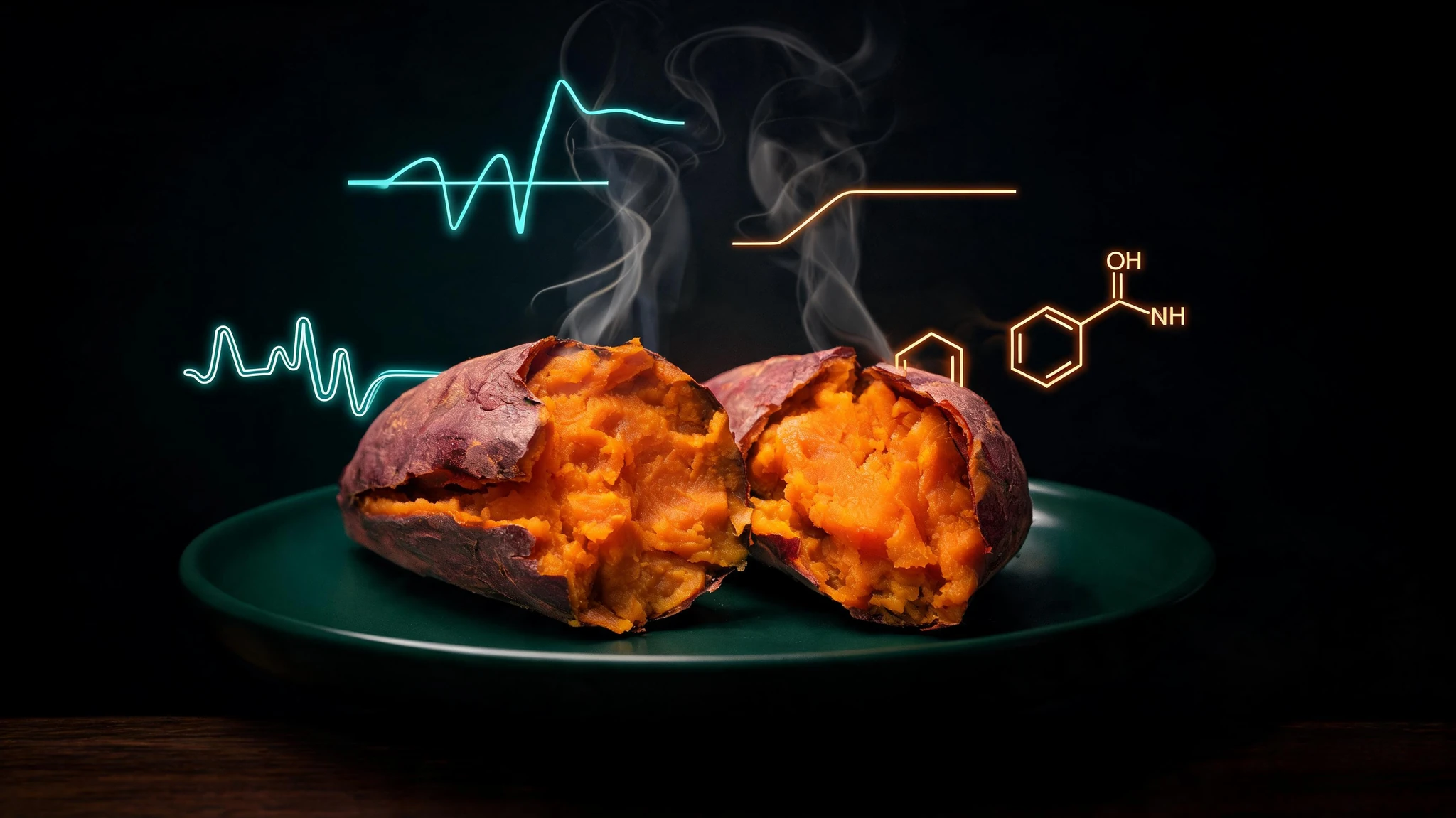
A baked sweet potato eaten about three hours before bed may be one of the more underrated evening foods for sleep. The reason is not exotic. It is mostly about steady blood sugar, a handful of nutrients your body uses to wind down, and timing that gives your stomach room to do its job.
The evidence here is uneven. There is no large clinical trial that put sweet potatoes head to head with white rice and measured how people slept. What does exist is a fairly consistent body of research linking the type of carbohydrate you eat at dinner, the micronutrients you get across the day, and your overnight glucose pattern with how well you sleep1,2. Sweet potatoes happen to land on the right side of most of those variables.
What does the research actually say about carbs and sleep?
Diet and sleep are linked in both directions. Poor sleep nudges people toward more refined carbs and sugar the next day, and meals that swing blood sugar hard can fragment the night that follows3. A 2016 review in Advances in Nutrition by St-Onge and colleagues looked across the available trials and observational data and found a recurring pattern. Diets higher in fiber and lower in simple sugars were associated with more slow-wave sleep, fewer night wakings, and shorter time to fall asleep1.
A 2021 systematic review in Sleep Medicine Reviews echoed this. Across dozens of studies, the diets that consistently tracked with better sleep quality were the ones rich in plants, whole grains, vegetables, and unsaturated fats. The diets that tracked with worse sleep were heavy in refined carbs, added sugar, and ultra-processed foods2. Sweet potatoes sit in the first camp on every measure.
One mechanism worth understanding is glycemic stability. When you eat a meal that spikes glucose fast, your body answers with a sharp insulin response. A few hours later, blood sugar can drop below baseline. That swing is one of the things your brain notices in the middle of the night. Cortisol and adrenaline can rise to lift glucose back up, and that surge does not pair well with deep sleep.
Continuous glucose monitor data has made this easier to see. Healthy adults wearing CGMs often show a small dip in glucose during the second half of the night, and a meaningful subset of those dips line up with brief awakenings or shifts out of deep sleep. The mechanism is not fully nailed down, but the pattern is consistent enough that sleep researchers now talk openly about overnight dysglycemia as a sleep variable, not just a metabolic one.
Why a low glycemic index matters at night
Sweet potatoes have a moderate to low glycemic index depending on how they are cooked. Boiled and steamed sweet potatoes test lower than baked, and a baked Beauregard sweet potato lands considerably lower on the glycemic scale than white potato or white rice. The fiber in the flesh, plus the slowly digested starch, drags the glucose curve into a gentler shape.

That gentler curve is the part that may matter for sleep. In the 2016 St-Onge review, meals with a lower glycemic load before bed were linked to less awakening during the night and a more stable overnight glucose profile1. The connection is not magical. It is metabolic. A flatter glucose line means fewer counter-regulatory hormone spikes at 3 a.m., which means fewer reasons for your nervous system to jolt you toward consciousness.
A note on portion size. Sweet potatoes are still carbohydrate. Half a small to medium sweet potato, roughly the size of your palm, is enough for most adults at dinner. Two huge ones drowned in butter and brown sugar are a different food entirely.
The nutrients that quietly help
One medium baked sweet potato delivers more than 400 percent of the daily value for vitamin A as beta-carotene, plus meaningful amounts of vitamin B6, vitamin C, potassium, manganese, and a useful dose of magnesium. Tryptophan is present in small amounts, as in most plant foods. None of these on their own put you to sleep. Together, they overlap with several pathways your body uses to wind down.
Magnesium is the clearest case. A 2019 analysis of NHANES data by Ikonte and colleagues found that adults who slept fewer than seven hours were significantly more likely to be inadequate in several micronutrients, with magnesium, calcium, vitamin D, and vitamin K showing the strongest gaps4. The data cannot tell you whether short sleep causes the gap or the gap helps cause the short sleep. The point is that the same micronutrients show up over and over in the sleep literature, and a sweet potato puts a few of them on the plate without effort.
Vitamin B6 is a cofactor in the conversion of tryptophan into serotonin, which the pineal gland then converts into melatonin. Potassium and magnesium together support smooth muscle relaxation and a calmer cardiovascular tone in the evening. None of this is a sleeping pill in vegetable form. It is a food that makes a few small things easier for your body at the end of the day.

Tryptophan, serotonin, and the GABA question
The source post claims sweet potatoes may help raise GABA, a calming neurotransmitter. The evidence here is thinner than the headline suggests. A few in-vitro and animal studies have looked at sweet potato extracts and found shifts in GABA-related pathways, but these are not the same as a controlled human trial. Treat the GABA angle as plausible mechanism, not established fact.
The tryptophan-to-serotonin path is on firmer ground. Serotonin is the precursor to melatonin, and melatonin is the hormone that pulls down body temperature and signals night to your suprachiasmatic nucleus. The catch is that tryptophan needs to compete with several other amino acids at the blood-brain barrier. A meal that pairs a moderate amount of carbohydrate with a small amount of protein gives tryptophan the metabolic edge it needs to cross. A baked sweet potato with a piece of fish or a few black beans hits that ratio neatly.
It is worth keeping perspective. Whole-food meals influence sleep at the margins. They do not override caffeine, screens, alcohol, or a stressful argument at 10 p.m. What they can do is stop sabotaging the night quietly from the inside.
That said, the small things compound. A reasonable evening meal, paired with a dark bedroom and a consistent bedtime, often produces a noticeable improvement within a couple of weeks. People underestimate how much of “I just don’t sleep well” is really three or four small choices stacked badly.
Why the three-hour timing rule
The original post says nutritionists recommend eating sweet potatoes about three hours before sleep. There is no single landmark study that picked the number, but the logic is sound and most clinical sleep dietitians cite a similar window for any larger evening meal.
Digestion of a starchy carbohydrate plus some protein takes roughly two to four hours to clear most of the way out of the stomach. Lying down with a still-full stomach raises the chance of reflux, which is a meaningful sleep disruptor. It can also keep core body temperature higher than it should be, since digestion itself burns calories and warms you slightly. Body temperature has to drop for sleep onset to feel easy. A meal eaten too close to lights-out works against that drop.
If you eat later than ideal, the source post offers a reasonable workaround: keep the portion to about half a small potato. Smaller portions clear the stomach faster and load the glucose curve less steeply. This matches what the broader evidence on late eating suggests3.

What about the gut?
Sweet potatoes contain both soluble and insoluble fiber. The soluble fraction is the more interesting part for sleep. Soluble fibers ferment in the colon and feed the microbes that produce short-chain fatty acids, particularly butyrate. There is a growing body of work suggesting that the gut microbiome and the circadian system talk to each other, and that fiber intake plays a meaningful role in that conversation5.
A 2020 review by Matenchuk and colleagues in Sleep Medicine Reviews mapped the bidirectional relationship between gut bacteria and sleep. People with more diverse microbiomes tended to have better sleep efficiency, and disrupted sleep tended to shift microbial communities in less favorable directions5. None of this proves that one sweet potato will fix anyone’s gut. It does suggest that fiber-rich plant foods on a regular basis quietly stack the deck.
One practical note. If you are not used to fiber, ramping up too fast at dinner can backfire. Bloating and gas are not a sleep aid. Build the habit gradually. A reasonable starting point is a half cup of cooked sweet potato a few evenings a week, paired with water and a short walk after dinner. Most people adapt within ten days or so, at which point a slightly larger portion lands without trouble.
How to actually cook them
Preparation method changes both the nutrient profile and the glycemic response. Boiling and steaming preserve the most beta-carotene and produce the lowest glycemic effect. Roasting is excellent for flavor but pushes the glycemic index a little higher because some of the starch caramelizes. Frying adds fat that delays gastric emptying, which sounds useful in theory but tends to introduce other downsides at night.
A simple evening sweet potato might look like this. Bake or steam half a medium sweet potato. Add a teaspoon of olive oil, a pinch of salt, and a small protein like a soft-boiled egg, a piece of grilled fish, or a few black beans. Eat it around three hours before bed. Drink water. That is the whole protocol.
Skip the marshmallows. The Thanksgiving casserole is its own genre and does not belong in this conversation.

Common questions about sweet potatoes and sleep
Will eating a sweet potato actually put me to sleep?
No. It can support the conditions for better sleep through steadier blood sugar and a small contribution of magnesium, B6, and tryptophan. It is not sedating.
Are white potatoes just as good?
Not quite. White potatoes have a higher glycemic index in most preparations and lack the beta-carotene and anthocyanins that sweet potatoes provide. They are not bad for sleep, but sweet potatoes are the better evening pick.
Is purple sweet potato different from orange?
The purple varieties are higher in anthocyanins, which are the same family of antioxidants found in blueberries. The sleep-relevant differences are small. Pick whichever you actually enjoy eating.
Can diabetics eat sweet potatoes at night?
Often yes, in measured portions and in consultation with their care team. Steamed or boiled is the gentler option. A continuous glucose monitor is the fastest way to see how your own body responds.
What if I am on a low-carb plan?
A small portion still fits most low-carb approaches if you account for it. A half cup of mashed sweet potato is roughly 13 grams of carbohydrate. Strict ketogenic plans will not have room for it.
The honest bottom line
Sweet potatoes are not a sleep cure. The research that matters here is not about sweet potatoes specifically. It is about what kind of carbohydrate you put on the plate at dinner, what micronutrients your body has to work with, and how close to lights-out you eat. On all three of those, sweet potatoes do well.
If your sleep is already broken by stress, screens, alcohol, or shift work, a vegetable will not fix it. If your sleep is mostly fine and you are looking for a small dietary nudge that is also delicious and cheap, a baked half sweet potato three hours before bed is a defensible move. The downside risk is essentially zero. The upside is a steadier night and a little more vitamin A. That is a fair trade.
Sources
- St-Onge MP, Mikic A, Pietrolungo CE. Effects of Diet on Sleep Quality. Advances in Nutrition. 2016. PubMed: 27633109
- Godos J, Grosso G, Castellano S, Galvano F, Caraci F, Ferri R. Association between diet and sleep quality: A systematic review. Sleep Medicine Reviews. 2021. PubMed: 33549913
- St-Onge MP, McReynolds A, Trivedi ZB, Roberts AL, Sy M, Hirsch J. Sleep restriction leads to increased activation of brain regions sensitive to food stimuli. American Journal of Clinical Nutrition. 2012. PubMed: 22357722
- Ikonte CJ, Mun JG, Reider CA, Grant RW, Mitmesser SH. Micronutrient Inadequacy in Short Sleep: Analysis of the NHANES 2005-2016. Nutrients. 2019. PubMed: 31581561
- Matenchuk BA, Mandhane PJ, Kozyrskyj AL. Sleep, circadian rhythm, and gut microbiota. Sleep Medicine Reviews. 2020. PubMed: 32668369