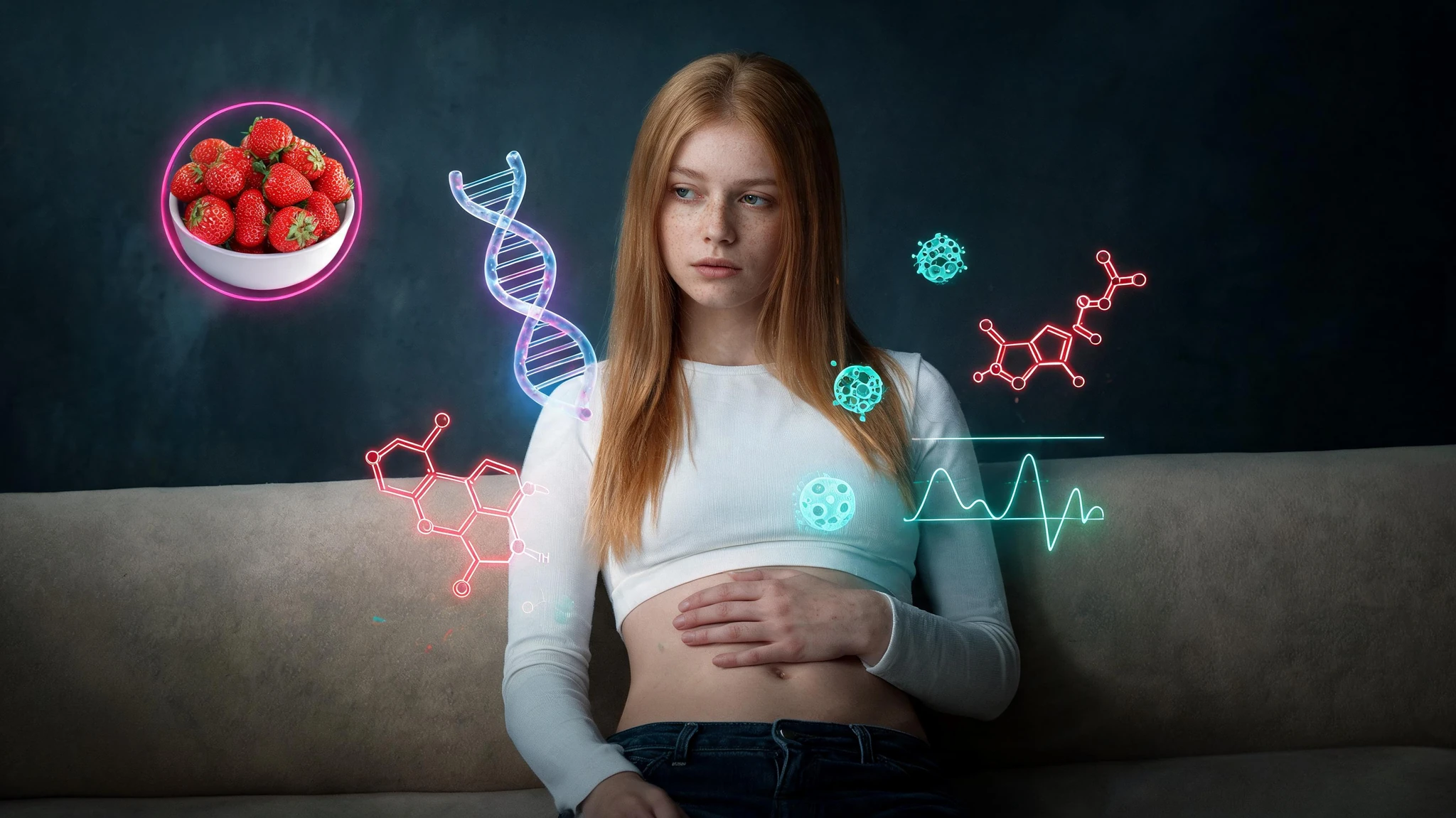
Adults with prediabetes who ate roughly 2.5 servings of freeze-dried strawberries every day for 12 weeks showed measurable improvements in insulin sensitivity and several cardiometabolic markers, according to a randomized crossover trial led by Arpita Basu and colleagues, published in The Journal of Nutrition in 2025.1 The participants did not change anything else about how they ate. They just added strawberries.
That is the headline finding, and it is worth pausing on. Insulin resistance sits underneath a lot of modern metabolic trouble, including type 2 diabetes risk, polycystic ovary syndrome, and non-alcoholic fatty liver disease. A common, cheap, slightly sweet fruit nudging that biology in the right direction is the kind of small, repeatable shift that actually fits into a real life.
What did the 2025 strawberry trial actually measure?
The Basu group ran a randomized controlled crossover study in adults with prediabetes. Each participant cycled through two phases: 12 weeks of daily freeze-dried strawberry powder providing the polyphenol equivalent of about 2.5 servings of fresh strawberries, and 12 weeks of a matched control powder, with a washout period in between.1 Crossover designs are useful here because every person serves as their own comparison, which trims out a lot of the noise that comes from differences in age, body composition, and habits.
During the strawberry phase, participants showed improvements in insulin resistance, measured by the HOMA-IR index, along with changes in cardiometabolic markers like total cholesterol and inflammatory signals. The effect was not dramatic the way a drug might be. It was the kind of modest, biologically coherent shift you would hope to see from a food intervention. When the same people went onto the control phase, those gains faded.
One detail people miss: the trial used freeze-dried strawberries, not fresh. Freeze-drying preserves polyphenols at a high concentration in a small dose. Two and a half servings of fresh fruit is closer to about a heaping cup and a half, every single day, without skipping. That distinction matters when you start translating the result into a grocery list.
Why anthocyanins keep showing up in metabolic research
Strawberries owe their red color to anthocyanins, a class of flavonoids found across the berry family. Anthocyanins are not a single molecule but a group, including pelargonidin, cyanidin, and their glycosides. They are the part of the plant most consistently linked to cardiometabolic benefit.
A 2023 systematic review and meta-analysis in European Journal of Nutrition by Araya-Quintanilla and colleagues looked at randomized trials of anthocyanin-rich foods in adults with metabolic syndrome. Across studies, regular intake was associated with reductions in fasting blood glucose, total cholesterol, and inflammatory markers like C-reactive protein and interleukin-6.4 The effects were not enormous, but they were consistent across different anthocyanin sources, which is the kind of pattern that makes a mechanism story plausible rather than a fluke.
How does that translate to insulin? Chronic low-grade inflammation is one of the well-mapped routes to insulin resistance. When tissues like muscle, liver, and fat are bathed in inflammatory cytokines, the insulin receptor signaling cascade gets jammed, and cells stop responding well to the hormone. Anything that quietly cools that fire tends to make insulin work better. Anthocyanins seem to do that, partly by acting on NF-kB signaling and partly by supporting the gut microbiome that produces short-chain fatty acids.

It is not just one study
If the Basu paper sat alone, it would be interesting and not much more. It does not sit alone. A 2013 randomized double-blind controlled trial by Moazen and colleagues in Annals of Nutrition and Metabolism tested freeze-dried strawberry supplementation in adults with type 2 diabetes and found improvements in lipid markers and atherosclerosis-related biomarkers compared with placebo.5 Different population, similar direction of effect.
Step back further and you see the same story in observational data. Zhang and colleagues, working with NHANES data from 1999 to 2014 and publishing in The Journal of Nutrition in 2024, found that higher consumption of berries and dietary flavonoids was associated with lower all-cause and cardiovascular mortality in U.S. adults.2 Observational data cannot prove causation. It can show whether the people who eat more of these foods, even after adjusting for the obvious confounders like income and exercise, tend to live a little longer. The answer keeps coming back yes.
And it is not only metabolic. A 2017 trial in Nutrients by Schell and colleagues found that obese adults with knee osteoarthritis who consumed strawberry powder for 12 weeks reported less pain and lower levels of inflammatory markers than during the placebo phase.3 Joints are not pancreas, but the inflammation pathway is shared.
Does this connect to PCOS or fatty liver disease?
The Facebook post that prompted this article made a strong claim: that strawberries can reverse insulin resistance, the root cause of diabetes, PCOS, and non-alcoholic fatty liver disease. Let’s be careful here. Insulin resistance is a contributor to all three conditions. It is not the single root cause of any of them. PCOS involves hormone signaling and ovarian biology beyond insulin alone. Fatty liver disease is shaped by diet pattern, alcohol, body composition, and genetics.
That said, the polyphenol story does extend. A 2022 systematic review and meta-analysis by Yang and colleagues in Frontiers in Immunology pooled randomized trials of dietary polyphenol supplementation in non-alcoholic fatty liver disease. The pooled data suggested improvements in liver enzyme markers and insulin resistance indices in people receiving polyphenols compared with control groups.6 Strawberry-specific data in PCOS is thinner, and any reader should treat the PCOS claim as an extrapolation rather than a tested result.
What you can fairly say: the same biological levers that strawberries appear to nudge, glucose handling and inflammation, are levers that show up across these conditions. That is not a guarantee. It is a reason to be interested.

Fresh, frozen, or freeze-dried: does it matter?
Most of the trial data uses freeze-dried strawberry powder. That is partly for blinding (it can be matched against a placebo powder) and partly because it standardizes the polyphenol dose. A cup of fresh strawberries varies wildly in anthocyanin content depending on variety, ripeness, season, and how long they have been sitting in the fridge.
For a person at home, fresh and frozen strawberries are still a good bet. Frozen berries are picked closer to ripeness and flash-frozen, which preserves a lot of the anthocyanins. Fresh strawberries lose some compounds over a week in storage but eaten in season they are excellent. The often-repeated worry that cooking destroys all the value is overstated for berries; gentle preparation, like blending into a smoothie or stirring into yogurt, retains most of what matters.
If you want to roughly mirror the trial dose without buying powder, think a heaping cup and a half of fresh or frozen strawberries every day. That is a real commitment of fridge space and grocery budget, and it is the honest version of what the research tested.
What about the sugar in strawberries?
This question comes up every time. A cup of strawberries holds about 7 grams of natural sugar and about 3 grams of fiber, with a glycemic index in the low 40s, which is considered low. The sugar arrives wrapped in fiber, water, and polyphenols, which is metabolically very different from the same grams in a soda.
Several controlled feeding studies have shown that adding berries to a meal blunts the postprandial glucose spike compared with the same meal without berries, especially when the meal is starchy. The fiber slows gastric emptying and the polyphenols appear to inhibit some carbohydrate-digesting enzymes in the gut. None of this means strawberries are calorie-free or that you can ignore portion. It does mean that for most people, including most people with prediabetes, fitting in two cups a day is unlikely to spike blood sugar in a problematic way.
People with diagnosed type 2 diabetes managing tight glucose targets should still check their own continuous glucose monitor or fingerstick response. Individual variation in postprandial glucose is real, and a food that suits one person at breakfast may behave differently for another at the same meal.
How quickly do the effects appear and how fast do they fade?
In the Basu trial, the metabolic improvements were measured at the end of 12 weeks of daily intake. Some smaller trials have found shifts in inflammatory markers within four to eight weeks, but the insulin sensitivity changes seem to need a longer runway. Polyphenols are not pharmaceuticals. They work by accumulating their effects on inflammation, gut bacteria, and vascular tone over time.
The reverse is also true, and it is the part the Facebook post got right. When the trial participants stopped eating strawberries, the metabolic gains drifted back toward baseline within a similar timeframe. This is a habit, not a one-time intervention. There is no version of this where you eat a lot of strawberries for a month, declare yourself fixed, and stop.
That framing actually makes strawberries more practical, not less. You are not signing up for a heroic protocol. You are deciding whether two cups of berries a day is the kind of thing you can cheerfully keep up. For most people who like strawberries, the answer is yes for several months at a time, with shifts in season toward blueberries, raspberries, or blackberries that share much of the same anthocyanin profile.
Common questions about strawberries and insulin resistance
Can strawberries replace my diabetes medication?
No. The published trials show modest improvements in markers of insulin sensitivity and inflammation alongside standard care, not in place of it. Anyone on a prescribed medication should keep taking it and discuss any major dietary change with the clinician who is following their numbers.
Are organic strawberries meaningfully better?
For polyphenol content, the evidence is mixed and the differences are small. The bigger pesticide-residue case for choosing organic strawberries is well documented, and washing helps. Conventionally grown strawberries still deliver the anthocyanin and fiber benefit covered in the trials.
What if I cannot eat 2.5 servings a day?
You probably still get some benefit from less. The dose-response curve in nutrition is rarely all-or-nothing. A cup most days, mixed in with other berries and colorful fruit, lines up with the broader observational evidence on flavonoid intake and cardiometabolic health.
Does this work for children or pregnant people?
Strawberries are a normal, safe food in both contexts and a good source of vitamin C and folate. The clinical trials covered here were in adults, and the specific insulin-resistance findings should not be extrapolated to children or pregnancy without separate evidence. Allergy is the only common caveat.
Is the freeze-dried powder worth buying?
If you want to mirror the trial dose without eating cups of fresh fruit daily, a quality freeze-dried strawberry powder is a reasonable shortcut. Read the label and avoid products that have added sugar or fillers.
So, what should you do with this
The honest summary is that strawberries are not a miracle cure for insulin resistance, and they are not just a nice snack either. A growing body of randomized and observational evidence puts them in a useful middle category: a food that, eaten consistently, appears to push several metabolic markers in the right direction in adults at risk for or living with cardiometabolic disease.
If you have prediabetes, PCOS, or a fatty liver diagnosis, the right way to use this article is as one more reason to make berries a regular feature of your week, not as permission to skip the rest of the plan. Sleep, movement, fiber from beans and whole grains, and a clinician you trust still do most of the heavy lifting. Strawberries are a delicious, evidence-aware addition to that picture, which is more than you can say for most things in the produce aisle.
Sources
- Basu A et al. Strawberries Improve Insulin Resistance and Related Cardiometabolic Markers in Adults with Prediabetes: A Randomized Controlled Crossover Trial. The Journal of Nutrition, 2025. PubMed: 40250566
- Zhang L et al. Consumption of Berries and Flavonoids in Relation to Mortality in NHANES, 1999-2014. The Journal of Nutrition, 2024. PubMed: 38184200
- Schell J et al. Strawberries Improve Pain and Inflammation in Obese Adults with Radiographic Evidence of Knee Osteoarthritis. Nutrients, 2017. PubMed: 28846633
- Araya-Quintanilla F et al. Effectiveness of anthocyanins-rich foods on cardiometabolic factors in individuals with metabolic syndrome: a systematic review and meta-analysis. European Journal of Nutrition, 2023. PubMed: 37042998
- Moazen S et al. Effects of freeze-dried strawberry supplementation on metabolic biomarkers of atherosclerosis in subjects with type 2 diabetes: a randomized double-blind controlled trial. Annals of Nutrition and Metabolism, 2013. PubMed: 24334868
- Yang K et al. Efficacy and safety of dietary polyphenol supplementation in the treatment of non-alcoholic fatty liver disease: A systematic review and meta-analysis. Frontiers in Immunology, 2022. PubMed: 36159792