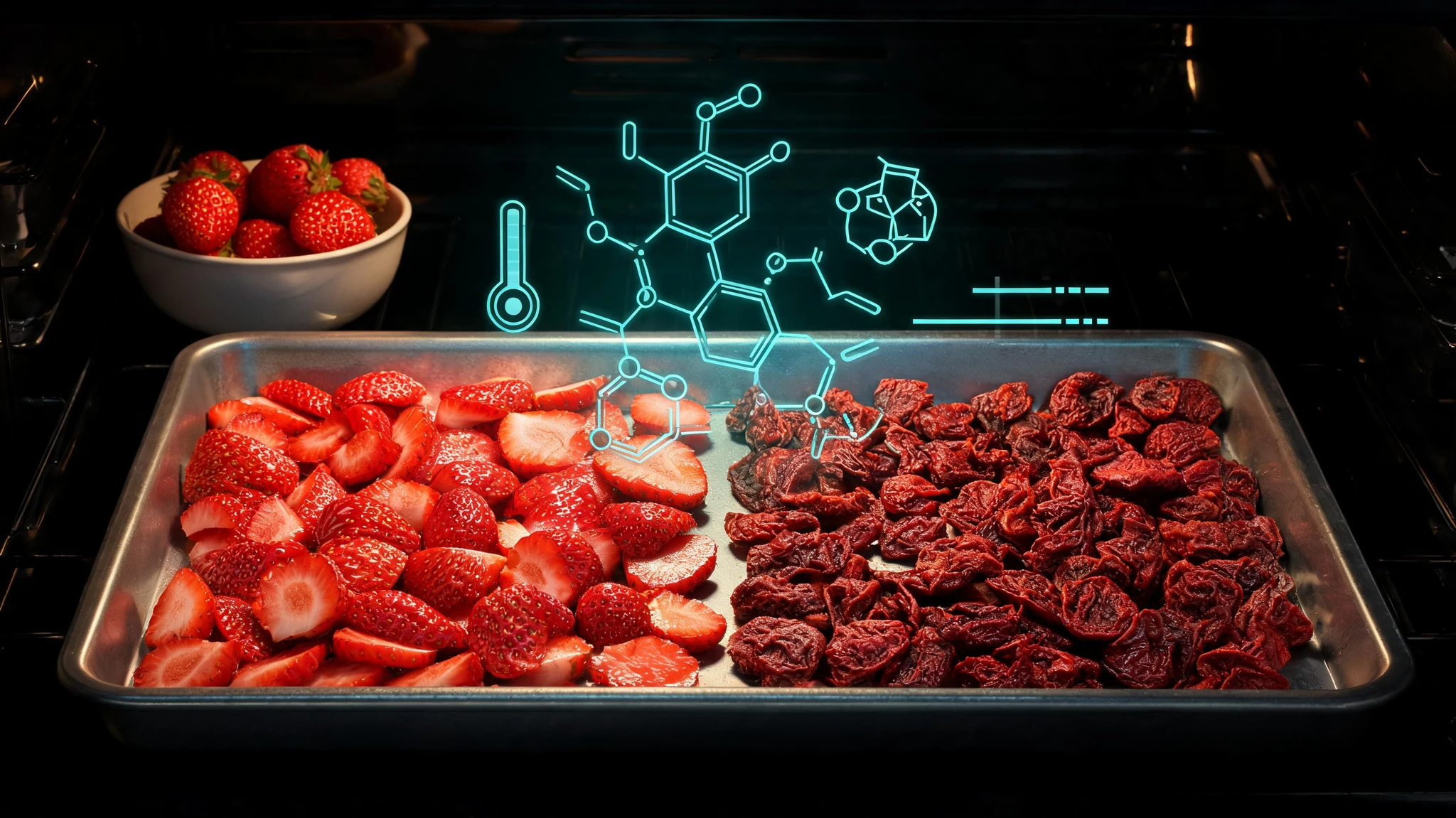
Oven-dried strawberries, the chewy, candy-sweet snack lighting up food feeds this winter, keep most of their fiber and minerals but can lose roughly 30 to 40 percent of their vitamin C during a long bake, according to a 2018 study by Nemzer and colleagues in Food Chemistry.1 The same study compared four berries dried by hot air, vacuum-belt drying, and freeze-drying, and found freeze-drying preserved ascorbic acid more reliably than methods that lean on heat.1
That gap matters because vitamin C is the nutrient people most often imagine they’re getting from a strawberry. The mineral content barely budges. The fiber survives. The antioxidants mostly hold up. Vitamin C is the soft target, and it is the one a 200°F oven quietly chips away at for four hours.
What actually happens when you bake a strawberry
Set a strawberry slice on parchment at 200°F and two things happen in slow motion. Water leaves. The rest stays.
That’s the part the trend videos describe correctly. As moisture evaporates, the slice shrinks, the sugars left behind become more concentrated per gram, and the flavor turns intense and almost confectionery. Researchers Kowalska and colleagues, writing in Food Science and Biotechnology in 2018, measured this directly: dried strawberries pack much higher sugars, organic acids, and minerals per 100 grams than the fresh fruit they came from, simply because the water has been removed.3 Per bite, you really are getting more potassium, more manganese, more dietary fiber, and yes, more sugar.
The catch is that “everything left behind” is not quite true. A few of the more delicate compounds in the berry don’t survive the slow heat. Vitamin C is the headline casualty. It’s water-soluble and unusually heat-sensitive, and it degrades through oxidation when it’s exposed to air at warm temperatures for long stretches. A two-hour, then flip, then two-hour-more bake gives ascorbic acid plenty of time to break down. So does any drying method that uses sustained heat, including most home dehydrators run hot.

How big is the vitamin C loss, really?
The honest answer is that it depends on temperature, time, slice thickness, and whether the fruit was pretreated, but the published numbers cluster in a range you can plan around.
In Nemzer’s strawberry trial, hot-air-dried fruit retained noticeably less ascorbic acid than freeze-dried fruit across the four berries tested.1 A separate comparison by Orak and colleagues in 2012, working with arbutus berries (the strawberry tree fruit) in Food Science and Technology International, found that hot-air drying caused larger losses in vitamin C and total phenolics than freeze-drying, with antioxidant activity also taking a measurable hit under heat.2 A 2024 paper by Jiang and colleagues in Food Chemistry X, focused specifically on strawberry slices and infrared hot-air drying, reached a similar conclusion: pretreatments that shorten time at temperature meaningfully improve vitamin C retention compared with longer, hotter runs.5
Roll those numbers together and the social-media claim that oven drying retains “60 to 80 percent” of nutrients lands roughly in the right neighborhood for many compounds, with vitamin C usually sitting at the lower end of that band. Anywhere from 20 to 50 percent of the original ascorbic acid can be lost in a long, sustained-heat bake, which is why “30 to 40 percent loss” is a fair midpoint to quote at a kitchen counter, not a guarantee for any specific recipe.
Worth saying out loud: a strawberry chip that has lost 40 percent of its vitamin C is still not a vitamin-C-free food. A cup of fresh strawberries delivers more than the daily reference value for vitamin C in most adults, so even a heavily reduced version still contributes. It just contributes less than you might assume from the bright red color.
Why freeze-drying keeps so much more
Freeze-drying, also called lyophilization, takes the same goal (remove water) and reaches it from a very different direction.
The fruit is frozen first. Then it goes into a vacuum chamber. Under low pressure, the ice doesn’t melt; it sublimates, going straight from solid to vapor without ever passing through a liquid phase. The strawberry never gets warm. Heat-sensitive compounds, vitamin C very much included, are spared the slow oxidative grind they get in an oven.

That is why most studies that compare freeze-drying to hot-air drying find a clear retention edge for the freeze-dried product. In the Orak study on arbutus berries, freeze-dried fruit kept significantly more vitamin C and phenolic content than hot-air-dried fruit at every temperature tested.2 Xu and colleagues, writing in Ultrasonics Sonochemistry in 2021, examined vacuum freeze-dried strawberry slices and confirmed that the method protects color, structure, and nutritional quality far better than thermal drying, especially when paired with mild pretreatments.4 The “90 to 95 percent retention” figure that floats around social media is a reasonable rule of thumb for vitamin C in well-run freeze-drying, though precise numbers vary by berry and protocol.
The trade-off is obvious to anyone who has shopped for freeze-dried fruit. The equipment is expensive. The process is slow, often a full day or more per batch. And the texture is different: freeze-dried strawberries are crisp, almost styrofoam-light, with a flavor that’s bright and tart rather than candy-sweet. Some people love them. Others miss the chewy, jammy quality of an oven slice.
There is also a less obvious advantage to freeze-drying that food scientists like to point out: the cellular structure of the fruit stays mostly intact. Hot-air drying collapses cell walls and squeezes pigments and flavor compounds together into the leathery slab you recognize as a fruit chip, while sublimation leaves a porous, sponge-like network behind. That porous structure is part of why freeze-dried berries rehydrate so quickly when you stir them into oatmeal or yogurt, and part of why they taste closer to the original fruit than their oven-baked cousins.4
Are oven-dried strawberries actually unhealthy?
Not by any reasonable standard.
An oven-dried strawberry chip is still, fundamentally, a strawberry. The fiber is intact. The minerals are concentrated. The anthocyanins, the pigments responsible for the deep red color and a chunk of the antioxidant activity, are reasonably heat-tolerant and survive an oven bake better than vitamin C does, though they too take some hits at higher temperatures.1 Compared with the snack a strawberry chip is most likely replacing (a fruit-flavored candy, a granola bar, a packet of gummy fruit snacks), the homemade version usually wins on most fronts: less added sugar, no high-fructose syrups, no processed oils, and a real-food fiber base.
Two practical caveats. First, dried fruit is calorie-dense by volume. A handful of oven-dried strawberry chips contains the sugars of several whole strawberries, which is fine in moderation and easy to overdo while watching a movie. Second, the candy-like sweetness is, biochemically, candy-like: the same naturally occurring sugars, just more of them per bite. If you’re managing blood sugar carefully, that matters.

Tips that actually improve nutrient retention at home
If you do bake your own strawberry chips and you’d like to keep more of the vitamin C, the levers worth pulling are the ones the food-science literature keeps highlighting. Drying time and temperature matter most. So does air exposure.
A few things that help, drawn from the patterns in the studies cited above:
- Slice thinly and uniformly. Thinner slices finish faster, which shortens the time vitamin C spends at temperature.5
- Run the oven as low as your appliance reliably allows, often around 170 to 200°F. Lower and slower is gentler on color and antioxidants than a hotter, shorter bake at 250°F or above.
- Don’t over-bake. Pull the chips when they are leathery and pliable rather than crisp and snappable; that final hour of crisping costs disproportionate vitamin C.
- Eat them within a couple of weeks. Vitamin C continues to slowly degrade in storage, especially with light and oxygen exposure, so an airtight jar in a dark cupboard beats a clear bag on the counter.
For people who really want the maximum vitamin C number, fresh berries are the simplest answer. They’re cheaper than freeze-dried, they don’t require equipment, and they’re available year-round in most supermarkets. The freeze-dried version is mostly worth its price if you want a stable, packable, lightweight snack that survives a hike or a school lunchbox without going mushy.
What about minerals, fiber, and antioxidants?
This is where the trend videos are pretty close to right. Oven drying does very little to fiber, and the mineral content (potassium, manganese, magnesium, calcium) survives almost completely because minerals don’t break down under household-oven temperatures.3 A drying step actually concentrates them per gram, which is why nutrition labels on dried fruit often look impressive next to the fresh equivalent.
Antioxidant capacity is more nuanced. Anthocyanins, the deep red pigments, hold up reasonably well at moderate temperatures, but they do degrade with prolonged heat and in the presence of oxygen.1,2 Polyphenols overall track the same pattern: less time at temperature, less loss. Freeze-drying once again has the edge, but oven-dried strawberries still retain a substantial fraction of their antioxidant activity and remain a meaningfully phenolic-rich food.4
Common questions about drying strawberries
Are dehydrator strawberries the same as oven-dried strawberries?
Nutritionally, very close. A home dehydrator usually runs at lower temperatures (around 125 to 145°F) than a low oven, which is gentler on vitamin C, but the total drying time is longer, which partially offsets the gain. Both are heat-based, both lose some ascorbic acid, both keep most other nutrients.
Can I freeze-dry strawberries at home?
You can, but only with a dedicated home freeze-dryer, which costs roughly the same as a small chest freezer. There is no DIY oven workaround that mimics sublimation under vacuum. If you don’t have the equipment, your best option for maximum vitamin C is fresh or frozen whole berries.
Do oven-dried strawberries have more sugar than fresh?
Per gram, yes, considerably more, because the water is gone and everything else is concentrated. Per whole strawberry’s worth, the sugar is the same; you just eat more strawberries’ worth in a single handful of chips.
How long do homemade dried strawberries last?
Stored airtight in a cool, dark cupboard, two to three weeks is a safe window for best flavor and nutrient retention. Refrigerated or vacuum-sealed batches keep longer. Properly freeze-dried fruit, by contrast, can sit shelf-stable for many months.
Is the post on social media wrong, then?
Mostly right, slightly oversold. The “60 to 80 percent” and “90 to 95 percent” retention numbers are reasonable ballparks for the average across nutrients, with vitamin C usually doing worse than that average for oven drying and similar to it for freeze-drying.
The takeaway you can put on a sticky note
If you make oven-dried strawberries this weekend, enjoy them. They’re a fiber-rich, mineral-dense, mostly real-food snack, and they almost certainly beat the alternative on the supermarket candy aisle. Just don’t count on them as a vitamin C source the way fresh fruit is.
The published comparisons keep landing in the same place: heat is the enemy of ascorbic acid, freeze-drying sidesteps the problem, and home oven drying sits somewhere in the middle, useful and tasty but lossy. Pick the method that fits the snack you actually want to eat. If you want concentrated sweetness and chew, the oven is fine. If you want the vitamin C number on the label to mean something, reach for the fresh berries first and the freeze-dried bag second.
Sources
- Nemzer B, Vargas L, Xia X, Sintara M, Feng H. Phytochemical and physical properties of blueberries, tart cherries, strawberries, and cranberries as affected by different drying methods. Food Chem. 2018;262:242–250. PubMed: 29751916
- Orak HH, Aktas T, Yagar H, Isbilir SS, Ekinci N, Sahin FH. Effects of hot air and freeze drying methods on antioxidant activity, colour and some nutritional characteristics of strawberry tree (Arbutus unedo L) fruit. Food Sci Technol Int. 2012;18(4):391–402. PubMed: 22522307
- Kowalska J, Kowalska H, Marzec A, Brzezinski T, Samborska K, Lenart A. Dried strawberries as a high nutritional value fruit snack. Food Sci Biotechnol. 2018;27(3):799–807. PubMed: 29937683
- Xu B, Chen J, Sylvain Tiliwa E, Yan W, Roknul Azam SM, Yuan J, Wei B, Zhou C, Ma H. Effect of multi-mode dual-frequency ultrasound pretreatment on the vacuum freeze-drying process and quality attributes of the strawberry slices. Ultrason Sonochem. 2021;78:105714. PubMed: 34411845
- Jiang DL, Wang QH, Huang C, Sutar PP, Lin YW, Okaiyeto SA, Lin ZF, Wu YT, Ma WM, Xiao HW. Effect of various different pretreatment methods on infrared combined hot air impingement drying behavior and physicochemical properties of strawberry slices. Food Chem X. 2024;22:101299. PubMed: 38559442