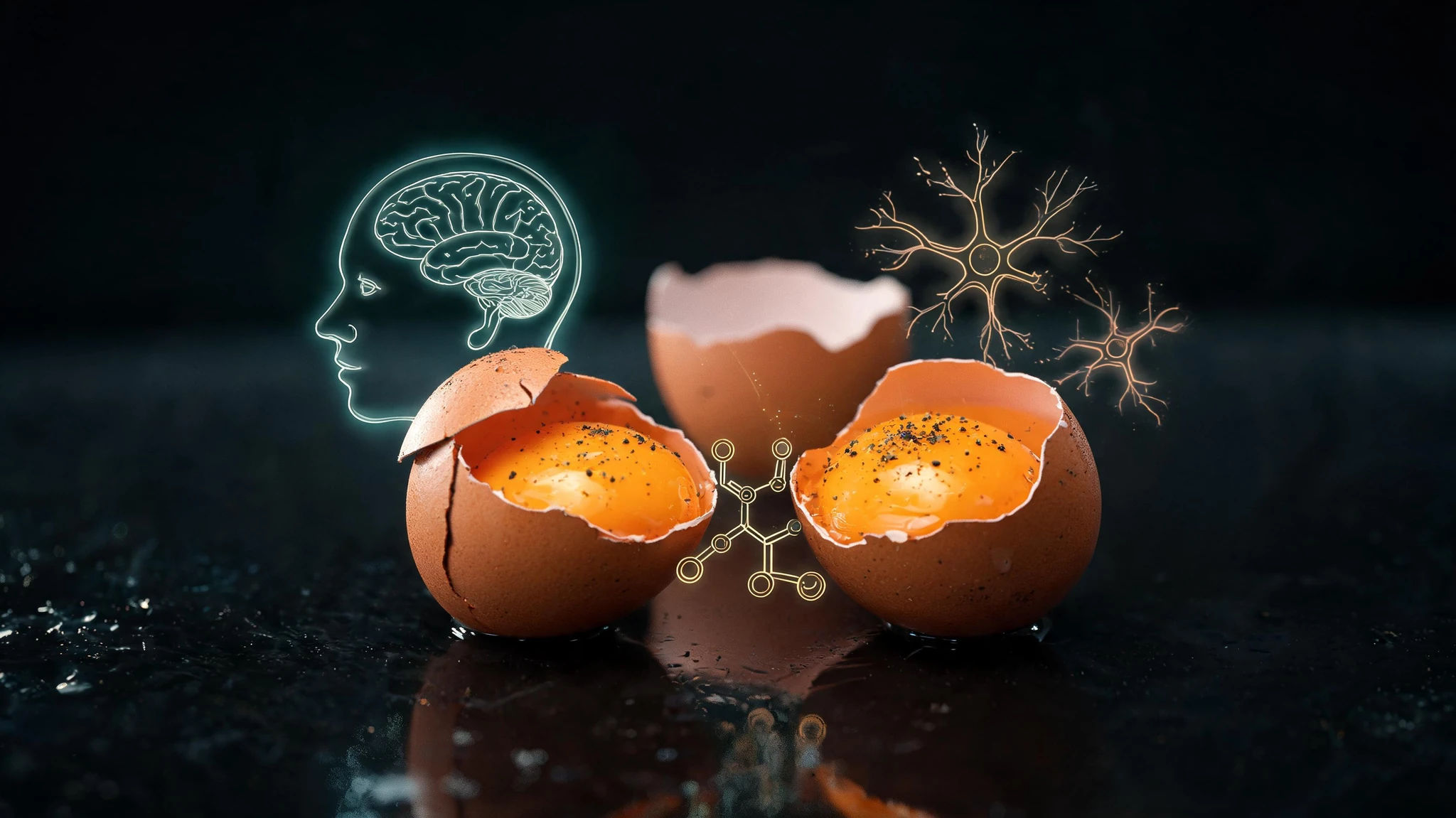
Older adults who ate one or more eggs a week had a 47% lower risk of developing Alzheimer’s dementia than those who almost never ate eggs, according to a 2024 analysis of more than 1,000 participants in the Rush Memory and Aging Project, published in The Journal of Nutrition.1 Curiously, eating two eggs a week did not lower the risk much further. The benefit appeared to plateau at a modest amount.
That ceiling matters. It suggests the helpful nutrients in eggs reach a saturation point quickly, and it lines up with a separate finding from the same paper: roughly 39% of the protective association with eggs was statistically explained by dietary choline, a nutrient eggs happen to be unusually rich in.1
What the Rush study actually measured
The Rush Memory and Aging Project is a long-running cohort of older adults living in retirement communities and subsidized housing across the Chicago area. Participants are followed annually with cognitive testing, dietary questionnaires, and, when they pass away, brain autopsies. It is one of the better aging cohorts in the country for this kind of question, partly because the brain donations let researchers confirm Alzheimer’s pathology rather than guessing from symptoms alone.
For this analysis, Pan and colleagues followed 1,024 participants with a mean age of 81 over an average of nearly seven years. Egg intake was self-reported on a food frequency questionnaire. The researchers grouped participants by how often they ate eggs, then tracked who developed clinically diagnosed Alzheimer’s dementia. After adjusting for age, sex, education, calorie intake, and a long list of other dietary and lifestyle variables, the people in the higher egg-intake groups had substantially lower rates of an Alzheimer’s diagnosis.1
A subset of participants also had post-mortem brain tissue analyzed. In that group, more frequent egg eaters were less likely to meet the pathological criteria for Alzheimer’s disease, not just the clinical criteria. That is a useful signal. It means the link is not simply about people with subtle early symptoms quietly avoiding eggs.
Why choline keeps showing up in brain research
Choline is an essential nutrient. The body makes a small amount on its own, but most of what you have at any given moment came from food. Eggs (specifically the yolk), liver, soybeans, and certain fish are among the densest sources. A single large egg delivers about 147 milligrams of choline, roughly a quarter of the adequate intake the National Academies set for adults.
Inside the brain, choline is the raw material for acetylcholine, a neurotransmitter heavily involved in memory and learning. It is also a building block for phosphatidylcholine, a structural fat that helps make up the membranes of every neuron. When researchers study Alzheimer’s pathology, two findings come up over and over: a loss of neurons that release acetylcholine, and damage to the lipid scaffolding of brain cells. Choline supply touches both.

The Rush paper is not the only data point here. In the Framingham Offspring Cohort, participants in the highest quartile of dietary choline intake performed better on certain memory tests than those in the lowest quartile, and they showed less white-matter hyperintensity volume on MRI, a marker often associated with vascular contributions to cognitive decline.2 The effect sizes were modest, and the study was observational, but the direction of the finding is consistent.
None of this proves that boosting choline by eating eggs reverses or prevents Alzheimer’s. What it suggests is that low choline intake may be one of several quiet, fixable contributors to a brain that ages less gracefully than it could.
The omega-3 angle
Egg yolks also carry small amounts of omega-3 fatty acids, in particular DHA, which is the dominant fatty acid in the gray matter of the human brain. Eggs are not as concentrated a source as oily fish, and conventional supermarket eggs vary considerably in their omega-3 content depending on what the hens were fed. But the DHA in eggs is in a phosphatidyl form that the body absorbs efficiently, and even modest amounts add up over years.
One of the better-known trials on DHA and cognition is the MIDAS study, which gave 485 healthy older adults with age-related memory complaints either 900 milligrams of algal DHA per day or a placebo for 24 weeks. The DHA group improved on a paired associate learning task, with the difference roughly equivalent to having the cognitive performance of a person three years younger.3 That is a small effect on one specific test in healthy adults, not a dementia treatment, but it is a real signal that DHA supports cognitive function during aging.

Pan and colleagues note that people who develop Alzheimer’s disease tend to show lower levels of both choline and DHA in autopsy tissue and in some blood markers.1 Whether those deficiencies are a cause of disease, a consequence of disease, or simply a marker of poor diet earlier in life is still being worked out. What is harder to argue with is that eggs deliver both nutrients in a single, cheap, accessible food.
How big is a 47% risk reduction, really?
A relative risk reduction of 47% sounds dramatic, and it is worth being careful about what that number means. In the Rush sample, the absolute Alzheimer’s incidence over the follow-up period was on the order of a few percent per year. Cutting that by nearly half is meaningful, but it is not the same as preventing half of all Alzheimer’s cases in the general population.
Observational nutrition studies are also vulnerable to a particular kind of bias known as residual confounding. People who eat eggs regularly may differ from those who do not in ways the questionnaire never captured. They may cook more at home, eat fewer ultra-processed meals, or simply have steadier daily routines, any of which could nudge dementia risk on its own. The Rush authors adjusted for many such variables, including overall diet quality and physical activity, and the egg association held up. Still, an observational finding cannot rule out every hidden variable.
And the participants were specific: U.S. retirement-community residents, mean age 81, predominantly white, with above-average willingness to fill out long dietary questionnaires every year. The result may not transfer cleanly to a 55-year-old in Lagos or a 70-year-old in Mumbai. Replication in different populations is the obvious next step, and as of this writing it has not happened on a large scale.1
What about cholesterol and the heart?
Eggs spent most of the late twentieth century on a public-health blacklist because of their dietary cholesterol. That picture has softened considerably. Multiple large meta-analyses over the last decade have found that, for most adults, moderate egg intake (up to about one a day) does not meaningfully raise the risk of cardiovascular disease, and dietary cholesterol turns out to be a much weaker driver of blood cholesterol than saturated fat is.
That said, individual responses vary. A subset of people, sometimes called hyper-responders, do see a noticeable rise in LDL cholesterol when they eat more eggs. People with familial hypercholesterolemia, advanced kidney disease, or certain forms of diabetes have a different risk calculus. So the answer to “are eggs safe for my heart” is genuinely “it depends,” and that conversation belongs in a doctor’s office, not on a blog.

For the average healthy older adult, the current weight of evidence suggests that one to a few eggs per week is benign at minimum, and possibly modestly helpful for cognition.
How to read this study without overreacting
It is tempting, after a finding like Pan 2024, to start eating eggs daily and consider Alzheimer’s checked off the worry list. That is not what the data say. A few practical caveats keep the picture honest.
First, eggs are not a stand-alone intervention. The same Rush cohort has produced strong evidence for the MIND diet, a Mediterranean-DASH hybrid that emphasizes leafy greens, berries, fish, nuts, beans, and whole grains. Eggs sit comfortably inside that pattern, but they do not substitute for it. A weekly egg in an otherwise ultra-processed diet is unlikely to do much.
Second, the choline ceiling cuts both ways. If eggs help mostly by topping up choline (and to a lesser degree DHA), then once intake is adequate, more eggs are not better. That is roughly what the plateau at two eggs implies. Adequate intake of choline for adults is around 425 to 550 milligrams per day, easily reachable with a varied diet that includes eggs, soy, fish, and some animal protein.
Third, sleep, exercise, hearing care, social connection, blood pressure control, and not smoking remain the heavy hitters of dementia prevention in the Lancet Commission framework. Diet matters, but it is one lever among many. Eggs are useful insurance, not magic.
Common questions about eggs and brain health
Do brown eggs work better than white eggs?
No. Shell color reflects the breed of hen and has no bearing on nutrient content. Choline and DHA come from the yolk, and yolk composition is driven mostly by what the hen was fed, not the shell color.
Are pasture-raised or omega-3-enriched eggs worth the extra cost?
Probably yes if your budget allows it, mostly for the omega-3 content. Eggs from hens fed flaxseed or algae can contain three to five times more DHA than conventional eggs. The choline content does not change much.
What if I have high cholesterol?
Talk to your doctor. Most people with mildly elevated LDL tolerate one egg a day without trouble, but hyper-responders and people with familial hypercholesterolemia are exceptions. A short trial with a follow-up lipid panel is the cleanest way to find out where you sit.
Can I get the same benefit from a choline supplement?
Possibly, but it is not the same. Whole eggs deliver choline alongside protein, B vitamins, lutein, zeaxanthin, and small amounts of DHA. Trials of isolated choline supplements for cognitive outcomes have been mixed. If you do not eat eggs, soybeans and certain fish are better starting points than a pill.
Does cooking method matter?
Mildly. Choline is stable across most cooking methods. DHA is more sensitive to high-heat oxidation, so soft-boiled, poached, or gently scrambled eggs preserve a bit more of the fragile fats than long-fried eggs do. The difference is small.
The honest bottom line
The Pan 2024 paper is a single observational cohort, with all the limits that implies. It does not prove that eggs prevent Alzheimer’s, and the press-release framing of “eggs cut your dementia risk in half” overstates what the data can carry on its own. What the study does show is that older adults who ate eggs at least once a week were noticeably less likely to be diagnosed with Alzheimer’s during follow-up, and that a substantial slice of that association tracks with choline intake. Both findings are biologically plausible and consistent with a wider literature on choline and DHA in aging brains.1,2,3
For a healthy older adult who is not already eating eggs, adding one or two a week is cheap, easy, and unlikely to cause harm. It is also unlikely to be the single thing that protects your memory at 85. The interesting part of this study is not the headline number. It is the quiet reminder that boring foods, eaten consistently over decades, may matter more than the latest supplement on the shelf.
Sources
- Pan Y, Wallace TC, Karosas T, Bennett DA, Agarwal P, Chung M. Association of Egg Intake With Alzheimer’s Dementia Risk in Older Adults: The Rush Memory and Aging Project. The Journal of Nutrition, 2024. PubMed: 38782209
- Poly C, Massaro JM, Seshadri S, Wolf PA, Cho E, Krall E, Jacques PF, Au R. The relation of dietary choline to cognitive performance and white-matter hyperintensity in the Framingham Offspring Cohort. The American Journal of Clinical Nutrition, 2011. PubMed: 22071706
- Yurko-Mauro K, McCarthy D, Rom D, Nelson EB, Ryan AS, Blackwell A, Salem N Jr, Stedman M; MIDAS Investigators. Beneficial effects of docosahexaenoic acid on cognition in age-related cognitive decline. Alzheimer’s & Dementia, 2010. PubMed: 20434961