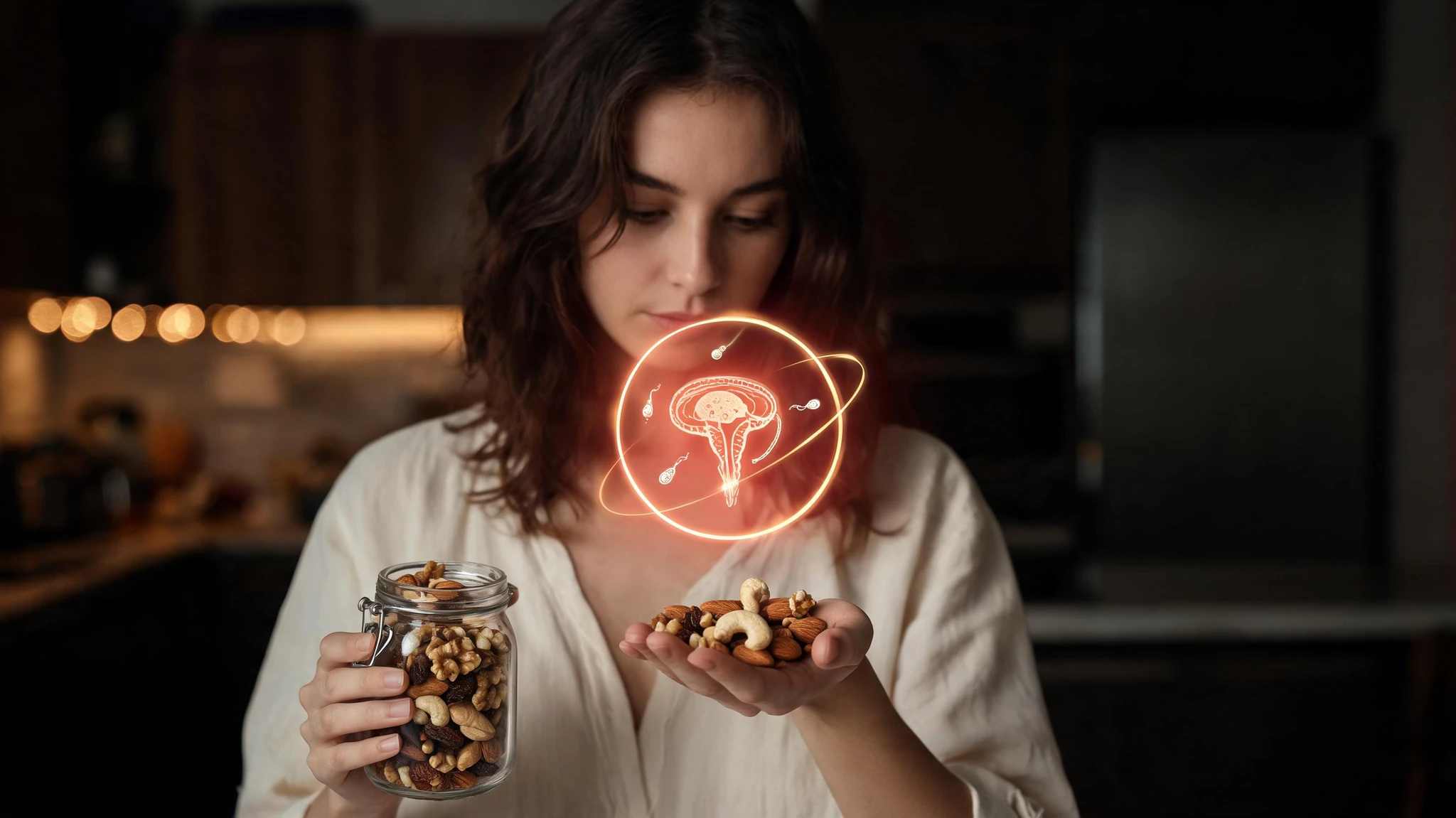
Healthy young men who ate 60 grams of mixed nuts every day for 14 weeks ended the trial with measurably better fertility. Their fertility swam better, looked more typical under a microscope, and survived longer in a lab dish. The finding comes from a 119-man randomized controlled trial published in the American Journal of Clinical Nutrition by Salas-Huetos and colleagues in 2018.1
That study did not stand alone. A separate trial out of UCLA, published in Biology of Reproduction by Robbins and colleagues in 2012, asked 117 men aged 21 to 35 to add 75 grams of whole walnuts to their daily diet for 12 weeks. The walnut group’s cell motility, vitality, and morphology improved, while the control group’s did not.2 Two trials, two different protocols, and roughly the same direction of effect.
What the FERTINUTS trial actually showed
The 2018 paper, often called FERTINUTS, is the most cited piece of evidence here, and it is worth slowing down on. Researchers in Reus, Spain recruited 119 healthy non-smoking men between 18 and 35. Half were randomly assigned to add 60 grams of mixed nuts (almonds, hazelnuts, walnuts) to their usual Western-style diet every day. The other half were told to keep eating exactly what they normally ate, and to specifically avoid nuts. Both groups stuck to their assignment for 14 weeks.1
At the end, the nut group’s total fertility marker count, vitality, motility, and morphology had all improved compared with the control group. The size of the changes was modest in absolute terms, but consistent across the four parameters that matter most when fertility clinics evaluate a reproductive sample sample. The authors also reported a drop in cell DNA fragmentation in the nut group, which is the metric most closely tied to a fertility cell’s ability to fertilize an egg and produce a viable embryo.1
One detail in the original paper rarely makes it into the social-media version of this story. The men were asked, in plain language, to keep their lifestyle the same. No new gym routine. No quitting drinking. Just adding the nuts. That matters because it isolates what the nuts were doing from a halo of other healthy choices that often travel with people who change their diet voluntarily.
The trial was funded in part by the International Nut and Dried Fruit Council, which is something a careful reader should weigh. Industry-funded nutrition research is not automatically wrong, but it earns extra scrutiny. In this case, the protocol was registered in advance, the analysis was pre-specified, and an independent group at UCLA had reached compatible findings six years earlier with a different funding source. That convergence is what gives the result some weight.
Why walnuts on their own seem to work
The Robbins UCLA trial, published six years earlier, used 75 grams of whole walnuts daily and only walnuts. After 12 weeks, the walnut group showed improved cell vitality, motility, and morphology, plus a more favorable fatty-acid profile inside the reproductive cells themselves.2 Researchers measured the omega-3 content of the fertility membrane and found it had risen in the walnut group. That is a useful clue. It means the dietary fat was not just floating around in blood plasma; it was being incorporated into the cells that the trial was trying to improve.
Walnuts are unusual among common nuts because they are rich in alpha-linolenic acid, a plant-based omega-3 that the body can partly convert to longer-chain omega-3s. Almonds and hazelnuts contribute different things, mainly vitamin E, monounsaturated fat, and polyphenols. Mixing the three, as the Spanish trial did, hits a wider set of pathways than a single nut would.

What is happening at the cellular level
Fertility cells are unusually vulnerable to a process called oxidative stress. They are stripped down for speed, with very little cytoplasm and almost no internal repair machinery. Their membranes are also packed with polyunsaturated fatty acids, which makes them flexible and fast but also highly susceptible to lipid peroxidation. When reactive oxygen species attack those membranes, the damage cascades into the DNA tightly packed inside the fertility head.
Antioxidants in food can offset that damage. A 2019 PRISMA systematic review by Falsig and colleagues looked across 16 studies of omega-3 supplementation and found broadly favorable effects on reproductive sample quality markers in infertile men, including motility and concentration, although the authors were careful to note study heterogeneity and small sample sizes in many of the included trials.5 A 2023 network meta-analysis in Aging that pooled non-pharmaceutical interventions for fertility quality reached a similar conclusion, with omega-3 supplementation and antioxidant-rich diets ranking among the more effective non-drug options.4
Mixed nuts deliver several of these compounds in one food. Vitamin E sits in the cell membrane and intercepts free radicals before they hit the lipid layer. Selenium is a cofactor for glutathione peroxidase, an enzyme that neutralizes hydrogen peroxide inside the testis. Zinc supports the structural proteins that keep cell DNA tightly packaged. Polyphenols from walnut skins and almond skins act as a backup antioxidant pool. None of these on their own is a fertility cure, but together, eaten daily, they shift the redox balance in a tissue that desperately needs the help.
The DNA fragmentation question
The most interesting and most quietly important finding from the FERTINUTS work is what happened to cell DNA. A follow-up paper from the same Spanish group, published in Andrology in 2021, looked at cell DNA methylation patterns in the men who had finished the original trial. They found that nut consumption was associated with changes in methylation at 36 specific genomic regions, several of which sit in or near genes involved in embryonic development.3
Methylation is one of the ways the body decides which genes are switched on and off. Fertility carry their methylation patterns into the embryo, which is why diet at the time of conception is increasingly understood as a small but real input into the next generation’s biology. The 2021 paper does not prove that nut-related methylation changes are good or bad. It shows that they happen and that they are detectable within months of a dietary change. That is a finding worth taking seriously without overselling.

Who these results apply to, and who they don’t
Both trials recruited healthy young men eating a Western-style diet. Not men with a fertility diagnosis. Not men over 40. Not men with varicoceles, hormone problems, or chemotherapy histories. The results say something specific: in young men whose reproductive sample parameters were already in the normal range, adding nuts nudged several measures upward. They do not say that nuts will reverse infertility, restore fertility marker count after cancer treatment, or substitute for an evaluation by a urologist.
This distinction is easy to miss when a finding gets compressed into a Facebook caption. A meaningful improvement in cell motility on average across 60 men in a trial is not the same as a clinical cure for one man with azoospermia. Both can be true at once. The trials are useful for what they are, and they are unhelpful when stretched past their evidence.
It is also worth saying that fertility marker count specifically, the headline number, did not improve consistently across all the trials and follow-ups. The Spanish trial reported a small improvement; some pooled analyses have not. Motility, vitality, and morphology held up better. If you read about nut studies promising a doubling of fertility marker count, treat that as embellishment.
How long does the effect take, and how long does it last
Fertility production runs on a roughly 74-day cycle. From the moment a spermatogonial stem cell divides to the moment a mature fertility cell is ejaculated, about two and a half months pass. That is why the fertility-diet trials all run at least 12 weeks. Anything shorter cannot capture a full turnover of the fertility population.
By the same logic, no one should expect a single weekend of nut-eating to do anything measurable. The Robbins trial ran 12 weeks. The Salas-Huetos trial ran 14 weeks. Improvements were only assessed at the end. The question of how long the effect lasts after men stop eating nuts has not been thoroughly tested, but biologically it would fade as untreated cohorts of new fertility cycle through. Fertility is a flow, not a reservoir.

What a sensible weekly portion looks like
Sixty grams of mixed nuts is roughly two small handfuls, or about a third of a cup. That is also about 380 calories. For most adult men, the daily energy load fits inside a normal diet without weight gain, especially if it replaces something less useful, like crackers or chips. The Spanish protocol used roughly equal parts walnuts, hazelnuts, and almonds. There is no good evidence that the precise ratio matters; what seems to matter is that walnuts contribute the alpha-linolenic acid and the other two contribute vitamin E and monounsaturated fat.
Raw or dry-roasted nuts beat heavily salted or candied versions because the salt does not help and the sugar coating displaces the actual food. People who are allergic to tree nuts should not eat tree nuts under any circumstance, and this article is not advice to do so. For everyone else, the cost of trying this is low, the upside is plausible, and the downside is some extra grocery spending.
Storage matters more than most people realize. Walnuts in particular go rancid quickly because their high omega-3 content is exactly what oxidizes when exposed to air, light, and warmth. A package of walnuts that has sat on a shelf for a year is no longer the same food the trial participants were eating. Buying smaller quantities, keeping them in the fridge or freezer, and tasting before serving will all help preserve what the studies were actually measuring.
Common questions about nuts and fertility quality
Do I need to eat exactly 60 grams every day?
The trials used that amount because it is dietary research, and dietary research has to standardize a dose. In real life, eating roughly two small handfuls most days of the week is closer to what the evidence supports than a precise gram count.
Are walnuts better than almonds or cashews?
For fertility specifically, walnuts have the most direct trial evidence and the most omega-3 content. A mix that includes walnuts captures most of the upside without giving up the vitamin E from almonds or the magnesium and zinc from cashews.
What about peanuts?
Peanuts are legumes, not tree nuts. They have not been tested in the same way. Their fat profile is different, with much less alpha-linolenic acid. Trial evidence does not extend to them.
If I have a known fertility issue, will nuts fix it?
Probably not on their own. Nuts may be a useful piece of a broader plan that includes proper medical evaluation, weight management if relevant, and avoiding heat exposure to the testes. Talk to a urologist or fertility specialist before assuming a dietary change is enough.
Is there any downside to eating nuts daily?
For people without nut allergies, the main risks are calorie load and digestive discomfort if the increase is sudden. Build up over a week or two rather than starting at 60 grams on day one.

Where this leaves things
The evidence on nuts and fertility quality is more solid than most viral health claims, and more limited than most viral headlines admit. Two well-designed randomized trials, one Spanish and one American, agree that adding nuts to a Western-style diet for about three months produces measurable improvements in how fertility move, look, and survive.1,2 Follow-up work has added the wrinkle that cell DNA itself appears to respond to the dietary change.3 Pooled analyses across other nutrition trials point in the same direction without claiming a clinical cure.4,5
For a man trying to give his reproductive biology a small, cheap, evidence-supported boost, a daily handful of mixed nuts is a reasonable thing to add. It is not a substitute for medical care if something is wrong. It is also not nothing.
Sources
- Salas-Huetos A et al. Effect of nut consumption on reproductive sample quality and functionality in healthy men consuming a Western-style diet: a randomized controlled trial. Am J Clin Nutr. 2018. PubMed: 30475967
- Robbins WA et al. Walnuts improve reproductive sample quality in men consuming a Western-style diet: randomized control dietary intervention trial. Biol Reprod. 2012. PubMed: 22895856
- Salas-Huetos A et al. Fertility DNA methylation changes after short-term nut supplementation in healthy men consuming a Western-style diet. Andrology. 2021. PubMed: 32966683
- Chen Z et al. Effectiveness of non-pharmaceutical intervention on fertility quality: a systematic review and network meta-analysis. Aging (Albany NY). 2023. PubMed: 37199654
- Falsig AL et al. The influence of omega-3 fatty acids on reproductive sample quality markers: a systematic PRISMA review. Andrology. 2019. PubMed: 31116515