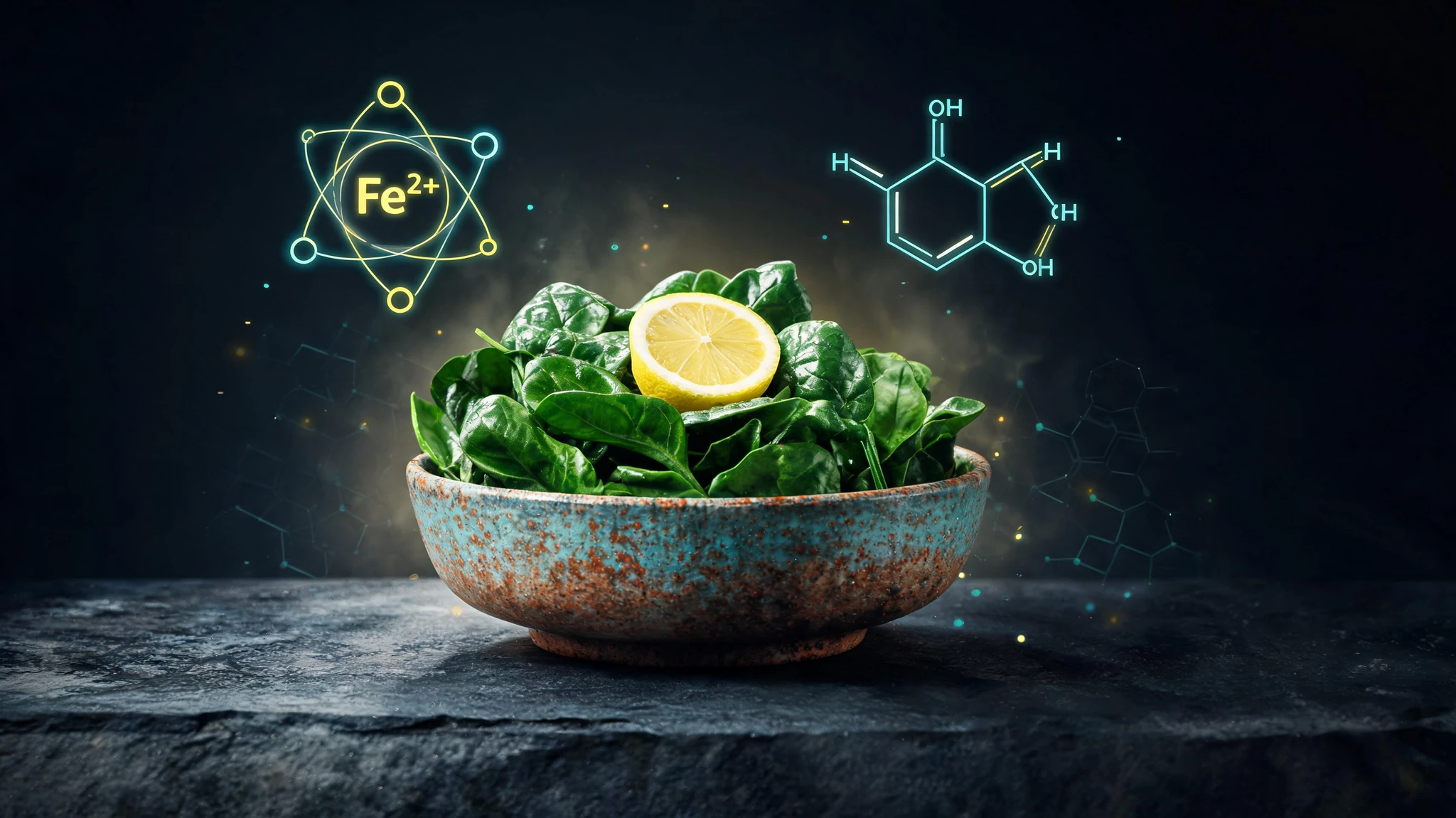
That squeeze of lemon you flick over a spinach salad is doing more than waking up the leaves. In controlled human studies going back decades, adding vitamin C to a plant-based meal has roughly doubled or tripled how much iron the body actually takes in, sometimes by far more than that1,2. The effect is dose dependent, which is the polite way of saying a tiny squeeze does a little and a real squeeze does a lot.
The classic demonstration comes from a 1989 review by Lars Hallberg and colleagues at Sahlgrenska University Hospital in Gothenburg, who pooled radioisotope absorption data from healthy adults eating a range of meals. With ascorbic acid added, non-heme iron uptake rose in a stepwise pattern up to around a six-fold increase at higher doses1. That number sounds dramatic, and it is, though the absolute amounts are still small. The point is the slope, not the headline.
Why plant iron is so hard to absorb in the first place
Iron in food comes in two flavors. Heme iron, found in meat, fish, and poultry, comes pre-packaged inside a porphyrin ring that the gut absorbs almost as a single bite-sized parcel. Non-heme iron, the kind in spinach, lentils, beans, tofu, fortified cereals, and just about every plant source, has to be unwrapped first. It arrives bound to other compounds, mostly in the ferric (Fe3+) state, and the small intestine can only really pull it across the gut wall after it has been reduced to the ferrous (Fe2+) form. That conversion is where vitamin C earns its keep3.
Plants make this harder on themselves by also producing molecules that grab iron and refuse to let go. Phytate, the storage form of phosphorus in whole grains and legumes, is the most studied culprit. Polyphenols in tea, coffee, and red wine are next in line. Calcium, in dairy or fortified foods, can also drag absorption down. And then there are oxalates, which spinach happens to contain in spectacular quantities4. The leaf is a green pharmacy of iron blockers.
This is why the iron content printed on a nutrition label can be misleading. A cup of cooked spinach lists about 6.4 milligrams of iron, comparable to a small steak. The fraction your body actually absorbs from that spinach without any help is closer to two or three percent. From the steak it is roughly fifteen to thirty-five percent. The label is honest about what is in the food. It cannot tell you what makes it past the gut wall.
What vitamin C does at the chemistry level
Ascorbic acid is a reducing agent, which is the textbook way of saying it likes to give away electrons. In the acidic environment of the stomach it donates an electron to ferric iron, flipping it to the ferrous form the duodenum can take up3. That alone would help. But it does a second thing that matters more in a real meal: it forms a soluble complex with iron and keeps it from precipitating out as insoluble hydroxides as the chyme moves into the more neutral pH of the small intestine.
Phytates and polyphenols normally bind iron and pull it out of solution before absorption can happen. Vitamin C effectively gets in line first. It chelates the iron itself, holds onto it through the pH shift, and walks it down to the absorption site. The technical term in the literature is “luminal stabilization.” Hallberg’s group showed that the enhancing effect of ascorbic acid scales almost linearly with the amount of phytate or tannin in the meal. The more inhibitors are present, the more dramatic the rescue5.

How much of a difference does a squeeze of lemon actually make?
James Cook and Manju Reddy at Kansas Medical Center addressed exactly this question in 2001. They fed twelve adult women complete daily diets, ranging from low to high in ascorbic acid (about 51 mg up to 247 mg per day), and measured iron absorption with stable isotopes. Across this range, vitamin C intake had no significant effect on iron absorption from the diet as a whole2. That finding caught a lot of people off guard.
It was not a contradiction of Hallberg. It was a scoping result. The earlier studies that found big jumps were single-meal experiments, where a defined dose of vitamin C was added to a defined dose of iron at the same sitting. Cook and Reddy were measuring whole-day intake against whole-day absorption, with food spread across breakfast, lunch, and dinner. Vitamin C added at one meal does not help iron eaten six hours later. The molecule is short-lived in the gut, and timing is most of the game.
The practical implication is unromantic but useful. To get the boost, the vitamin C and the iron need to be in the same meal, ideally in the same bite. A glass of orange juice with breakfast does nothing for the lentil soup at dinner.
How much vitamin C do you need at one meal?
Hallberg’s earlier dose-response work suggests the curve starts to bend around 25 to 50 milligrams of ascorbic acid per meal and keeps climbing well past 100 milligrams1,5. There is no clean threshold below which it does nothing or above which it stops helping. The effect is graded.
For frame of reference: a medium orange has roughly 70 mg of vitamin C. Half a red bell pepper, about 75 mg. A cup of strawberries, about 85 mg. A generous squeeze from half a lemon, roughly 20 to 25 mg, sits at the low end of the active range but still nudges absorption upward. Steamed broccoli, kiwi, papaya, and raw red cabbage all clear the 50 mg per serving bar. None of these are exotic ingredients. They are most of what people already cook with.

Heat is the catch. Ascorbic acid is fragile and breaks down with prolonged cooking, especially in water. A bell pepper sliced raw onto a salad keeps most of its vitamin C. The same pepper boiled for ten minutes loses a substantial fraction of it. If the goal is iron absorption, raw or lightly cooked sources work better, and the vitamin C is best added near the end of cooking or just before eating.
Who actually benefits from this
The people most likely to notice are the ones whose diets lean heaviest on plant iron and whose iron stores are already on the low end. That includes a lot of menstruating women, vegetarians and vegans, endurance athletes, frequent blood donors, and adolescents going through growth spurts. The World Health Organization estimates that around a quarter of the global population has anemia, and iron deficiency accounts for roughly half of those cases. Plant-based diets are not the cause; inadequate absorption from any diet is.
For someone with normal iron stores eating a varied diet, the effect of vitamin C at any single meal probably gets buffered out across the day. The body up-regulates absorption when it needs more and down-regulates when it does not, mostly through the hormone hepcidin. This is why the Cook and Reddy study found a flat line at the whole-diet level. Healthy bodies adjust the dial.
For someone whose iron stores are depleted, the dial is already cranked up. In that state, every meal counts more, and the boost from co-ingested vitamin C lands on a more responsive system. This is the population in whom the practical benefit is most likely real, and where dietitians have leaned on the strategy for decades4.
What blocks the boost
Tea is the famous one. The polyphenols in black and green tea can cut non-heme iron absorption from a meal by half or more, and enough vitamin C in the same meal does not always fully cancel it out6. The advice from Hurrell and colleagues is straightforward: separate tea and iron-rich meals by an hour or two. Coffee is in the same category, slightly less potent. Red wine, similar story.
Calcium is more complicated. Dairy at the same meal modestly reduces iron uptake, but the effect averages out over a varied week and most clinicians do not flag it for healthy adults. People being treated for diagnosed iron deficiency get stricter advice, often to take iron supplements on an empty stomach with a glass of orange juice and to keep dairy and tea away from that window.
Antacids and proton-pump inhibitors deserve a mention because they raise stomach pH, and ascorbic acid needs an acidic environment to work its reducing trick. People on long-term acid-suppression therapy can absorb less iron from food even with vitamin C present. If iron status is a concern, that is a conversation for a doctor, not a salad.

Easy combinations that line up the chemistry
None of these are recipes so much as habits. Spinach salad with sliced strawberries and a lemon vinaigrette. Black beans and brown rice with salsa, lime, and chopped raw red pepper. Lentil soup finished with a squeeze of lemon at the table. Tofu stir fry with broccoli and a side of orange wedges. Hummus with red bell pepper sticks and a few drops of lemon. Oatmeal with kiwi and strawberries instead of milk. Each of these puts a meaningful dose of ascorbic acid alongside the iron source at the same sitting.
What does not work, despite popular belief: iron-rich green smoothies hours after a coffee, or a multivitamin chased by a cup of tea, or a fortified cereal in milk eaten in front of a glass of orange juice that finishes ten minutes too early. The dose has to land in the gut at the same time as the iron, not bracketing it.
Common questions about vitamin C and iron
Will an orange with breakfast cover my iron all day?
No. The effect is local to the meal. Vitamin C breaks down quickly in the body and only enhances absorption of iron eaten alongside it. A varied day of meals, each with some vitamin C, works better than one big citrus hit.
Does cooked vitamin C still count?
Partly. Ascorbic acid degrades with heat, especially in water and over long cooking times. Adding lemon juice at the end, eating raw produce alongside, or briefly steaming rather than boiling preserves more of it.
Can I just take a vitamin C supplement?
Yes, and studies have used pure ascorbic acid pills to demonstrate the effect. Around 50 to 100 mg taken with a plant-based meal mimics the food-based response. Going far above that gives diminishing returns and, at gram-level doses, can cause stomach upset.
Will this fix iron deficiency anemia?
Probably not on its own. Diagnosed deficiency usually requires a workup to find the cause and, often, supplemental iron under medical supervision. The vitamin C trick is a useful tool inside that broader plan, not a substitute for it.
Does it work the same for kids?
The mechanism is the same and pediatric guidance follows the same logic, but children have different total iron needs and different diet patterns. A pediatrician is the right person to ask about specifics.
The honest takeaway
The lemon-on-spinach habit is one of those rare bits of food advice that is both folk wisdom and well-supported by isotope tracer studies. The size of the boost depends on what else is in the meal, what shape your iron stores are in, and how much vitamin C actually lands at the same time as the iron. For someone leaning into more plant-based meals, it is a small adjustment that consistently nudges the math in the right direction.
It is also not magic. The body has its own absorption thermostat, and a squeeze of citrus does not override it. What it can do is reduce the friction in a system that, for plant iron, is already working hard. That is enough to be worth doing, and modest enough to be worth being honest about.
Sources
- Hallberg L, Brune M, Rossander L. The role of vitamin C in iron absorption. Int J Vitam Nutr Res Suppl. 1989;30:103–108. PubMed: 2507689
- Cook JD, Reddy MB. Effect of ascorbic acid intake on nonheme-iron absorption from a complete diet. Am J Clin Nutr. 2001 Jan;73(1):93–98. PubMed: 11124756
- Lynch SR, Cook JD. Interaction of vitamin C and iron. Ann N Y Acad Sci. 1980;355:32–44. PubMed: 6940487
- Hurrell R, Egli I. Iron bioavailability and dietary reference values. Am J Clin Nutr. 2010 May;91(5):1461S–1467S. PubMed: 20200263
- Hallberg L, Brune M, Rossander L. Iron absorption in man: ascorbic acid and dose-dependent inhibition by phytate. Am J Clin Nutr. 1989 Jan;49(1):140–144. PubMed: 2911999
- Hurrell RF, Reddy M, Cook JD. Inhibition of non-haem iron absorption in man by polyphenolic-containing beverages. Br J Nutr. 1999 Apr;81(4):289–295. PubMed: 10999016