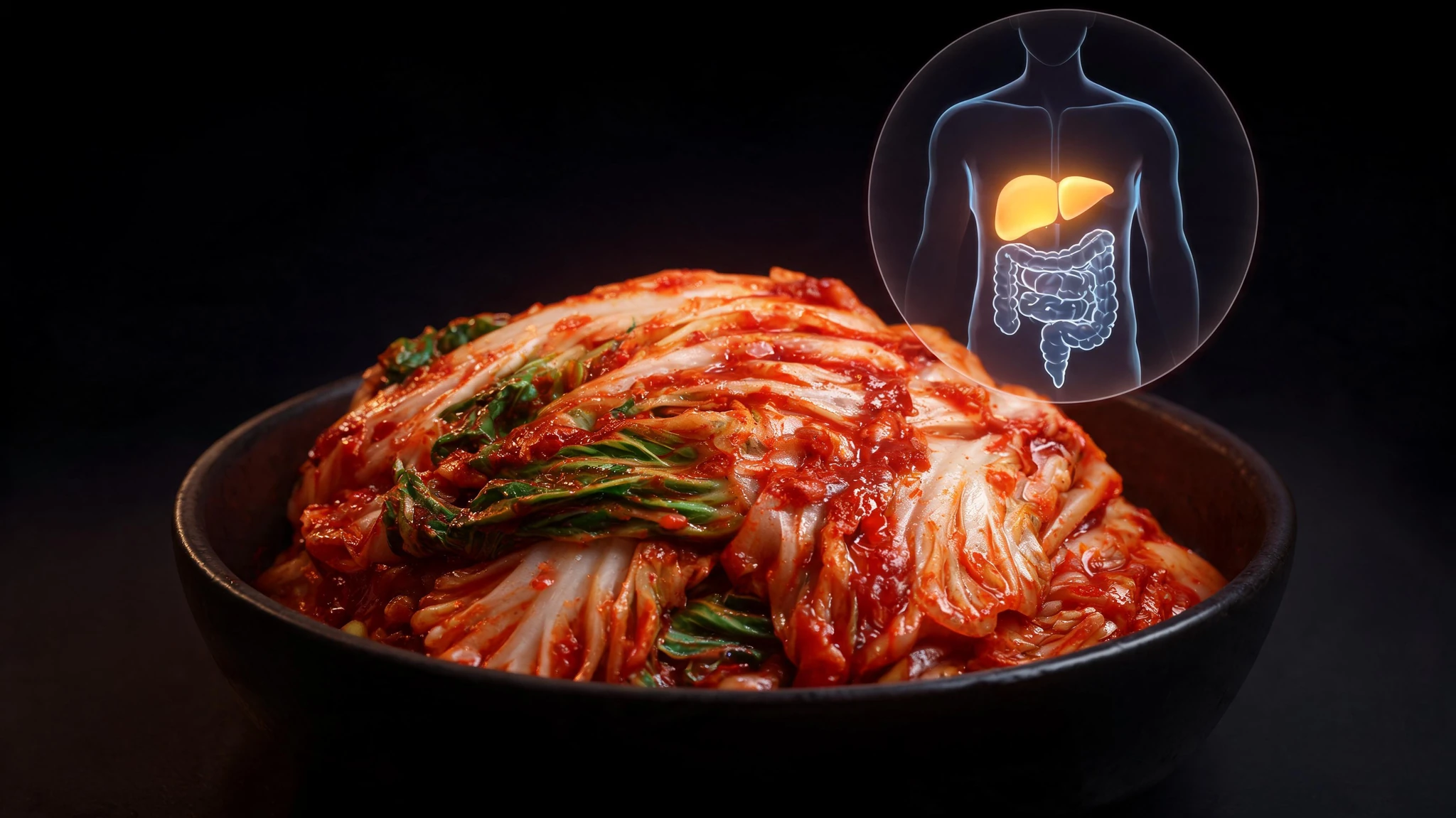
In a small Korean trial published in 2011, 22 overweight adults who ate fermented kimchi every day for four weeks lost a modest amount of body weight, shrank their waist-to-hip ratio, and saw their fasting blood sugar and blood pressure drift downward.1 The fresh, unfermented version of the same dish nudged some of those numbers too, but the fermented batch did more, and that gap is the part the researchers found most interesting.
The headline finding is real. The size of it is the part most social posts get wrong. The Kim 2011 study reported reductions in body weight, body fat percentage, blood pressure, and fasting glucose that were statistically meaningful but small in absolute terms, on the order of a pound or two and a few millimeters of mercury, after a month of daily kimchi.1 What follows is what the evidence actually says, what it does not say, and how to think about a daily fermented side dish that has been part of Korean meals for centuries.
What did the original kimchi study actually measure?
The 2011 trial out of Pusan National University followed 22 overweight, prediabetic Korean adults through two separate four-week periods. In one period, they ate 100 grams of fresh kimchi twice a day. In the other, they ate the same amount of kimchi that had been fermented for two weeks at four degrees Celsius, long enough to develop a mature population of lactic acid bacteria.1 Both kimchi types produced small reductions in body weight, BMI, and body fat percentage. The fermented version pulled ahead on systolic and diastolic blood pressure, fasting blood glucose, and total cholesterol.
The numbers were modest. Average body weight came down by roughly a pound. Waist-to-hip ratio shifted by a few hundredths of a point. Nobody dropped a clothing size in a month. What the study suggested, carefully, is that fermentation does something the raw vegetable does not do on its own. The same cabbage, the same chili, the same garlic, but with a few weeks of microbial work behind it, behaved differently in the body.
That is a finding worth taking seriously. It is also a finding from 22 people. The authors said as much in their own discussion, calling for larger trials before any clinical claims could be made.1 Fifteen years later, those larger trials are still arriving in pieces.
Why does fermentation matter so much?
Kimchi starts as napa cabbage, radish, scallions, garlic, ginger, and chili paste packed into a jar. Within hours, the lactic acid bacteria already present on the vegetables start eating the sugars in the cabbage and producing lactic acid, carbon dioxide, and a slate of small molecules that did not exist in the raw ingredients. Within a few weeks, the dominant species are typically Leuconostoc, Lactobacillus, and Weissella, with Lactobacillus sakei and Lactobacillus plantarum often showing up in mature batches.2
Those bacteria are not just along for the ride. A 2014 review in the Journal of Medicinal Food catalogued the changes fermentation makes to kimchi’s chemistry: higher levels of certain B vitamins, new bioactive peptides released as proteins break down, increased antioxidant activity, and a rising population of probiotic bacteria that survive the acidic environment of the stomach better than many supplement strains do.2 The review’s authors framed kimchi as something close to a probiotic food in the technical sense, meaning it delivers live cultures with documented effects.

This matters because the gut microbiome is not just a digestive curiosity. A 2021 Stanford trial published in Cell put 36 healthy adults on either a high-fiber diet or a high-fermented-food diet for ten weeks. The fermented-food group, eating things like yogurt, kefir, kimchi, and kombucha, ended the study with greater microbial diversity and lower levels of 19 inflammatory markers, including interleukin-6.3 The fiber group, perhaps surprisingly, did not see the same anti-inflammatory shift in this short window. That does not mean fiber is unhelpful. It means the fermented-food signal was specific and measurable.
The Lactobacillus sakei spinoff
One of the more interesting follow-ups to the 2011 kimchi study isolated a single bacterial strain from kimchi and tested it on its own. In 2020, researchers at Seoul National University Bundang Hospital ran a 12-week randomized controlled trial of Lactobacillus sakei OK67, a strain originally cultured from kimchi, in 114 Korean adults with obesity.4 The probiotic group showed a small but statistically significant reduction in body fat mass compared with the placebo group, along with a drop in waist circumference.
The mechanism the authors proposed was not glamorous. Lactobacillus sakei appears to influence how the gut handles fat absorption and how white adipose tissue stores it, possibly by modulating short-chain fatty acid production and lowering chronic low-grade inflammation in the gut wall.4 A 2021 systematic review in Nutrients pulled together 23 randomized trials of probiotics and synbiotics in overweight and obese adults and concluded that, on average, probiotic supplementation produced small reductions in body weight and BMI, with the strongest effects coming from multi-strain blends taken for at least eight weeks.5
“Small” is the operative word in every one of these papers. Probiotics, including the ones that grow naturally in fermented foods, are not weight loss drugs. They appear to give the body a slight metabolic edge, and that edge stacks on top of whatever else a person is doing with food and movement. Take the rest of the picture away and the edge mostly disappears.

What about the garlic, ginger, and chili?
Kimchi is not a single ingredient. The supporting cast does work too. Garlic contains allicin, formed when the cloves are crushed, which has been linked to small improvements in blood lipid profiles in clinical trials. Ginger contributes gingerol, which appears to influence digestion and post-meal blood sugar in modest ways. Chili peppers bring capsaicin, the compound responsible for both the heat and a brief, well-documented bump in metabolic rate after a spicy meal.2
The Park 2014 review noted that these compounds do not vanish during fermentation. Some are slightly modified by the bacteria, others are made more bioavailable, and a few new metabolites appear that did not exist in any of the starting ingredients.2 A serving of fermented kimchi is, in chemical terms, a cocktail of fiber, live bacteria, organic acids, polyphenols, allicin derivatives, gingerol, and capsaicin, all delivered in a few hundred calories of cabbage.
None of this means kimchi cures anything. It means a small bowl of kimchi at dinner is doing more in the body than a small bowl of plain cabbage would. That is a low-stakes observation, and it is the only kind of observation the evidence really supports.
How honest do we need to be about the 22 people?
Pretty honest. A 22-person crossover trial is not a flimsy thing on its own; crossover designs are statistically efficient because each participant serves as their own control.1 But it is one trial, in one country, with one cuisine context, in adults who already grew up eating kimchi several times a week. Whether the same effects would show up in someone in Stockholm or Saskatoon eating their first jar of kimchi is a question the data cannot fully answer.
What the broader literature suggests is that the direction of the effect is plausible and replicates in adjacent studies. The Stanford fermented-foods trial saw microbiome and inflammation changes in healthy American adults eating a mix of fermented foods that included kimchi.3 The Lactobacillus sakei trial saw body fat changes in Korean adults taking a kimchi-derived probiotic capsule.4 The 2021 Nutrients meta-review saw small but consistent weight effects across 23 different probiotic trials.5 None of these studies prove the others. Together, they sketch a picture in which fermented foods, including kimchi, do something real and small.

How to actually eat kimchi if you want the effect
The kimchi in the 2011 study was traditional baechu kimchi, fermented for two weeks at four degrees Celsius before being eaten.1 That matters. Kimchi sold pasteurized for shelf stability has had its lactic acid bacteria killed off, which removes the probiotic component while leaving the fiber, the spices, and the polyphenols intact. If the goal is the bacterial half of the story, a refrigerated jar from the cold case is closer to the version studied than a shelf-stable one.
Sodium is the practical caveat. A 100 gram serving of kimchi can carry 600 to 900 milligrams of sodium depending on the recipe, which is not trivial for anyone managing blood pressure. The 2011 study saw blood pressure go down despite that sodium load, possibly because the other compounds in fermented kimchi outweighed the salt effect in those participants.1 For most people, eating kimchi as a side at one meal a day rather than as the centerpiece keeps the sodium in a sensible range.
Heat is another consideration. Cooking kimchi, as in kimchi jjigae or kimchi fried rice, kills the live bacteria. The fiber and the bioactive compounds survive, but the probiotic angle does not. Eating it raw, straight from the jar or alongside grain, is what preserves the live cultures.
Age of the jar matters too. Younger kimchi, fresh out of the fridge after a few days, has a milder flavor and a smaller bacterial population. Kimchi that has fermented for two to four weeks tends to be the sweet spot for live cultures, with the punchy, sour edge that long-time kimchi eaters tend to prefer. Past about six weeks, it keeps getting more sour and the bacterial profile shifts again, which is fine for cooking but less interesting for the gut. The 2011 trial used kimchi at the two-week mark for a reason.1
None of this requires a Korean grandmother in the kitchen. A spoonful next to eggs in the morning, a few forkfuls on top of a grain bowl at lunch, a small dish next to dinner. The cumulative serving across a day adds up to roughly what the trial used, without anyone having to plan a kimchi diet.
Common questions about kimchi and weight
How much kimchi did people eat in the study?
Two hundred grams a day, split between lunch and dinner, for four weeks. That is roughly one cup of kimchi total, eaten as a side dish.1
Is store-bought kimchi as good as homemade?
If it is refrigerated and unpasteurized, the live cultures are intact and the difference from homemade is small. Pasteurized shelf-stable kimchi has lost the probiotic bacteria.
Can people with high blood pressure eat kimchi?
Most can, in moderate amounts. The 2011 trial actually showed blood pressure decreasing slightly in overweight adults eating kimchi twice a day.1 Anyone on a strict low-sodium diet should still check the label.
Does kimchi help if I am not overweight?
The weight numbers in the original trial only apply to overweight participants. The microbiome and inflammation changes seen in the Stanford fermented-foods trial showed up in healthy adults too, so the gut effects do not appear to require excess weight as a starting point.3
Are there people who should avoid kimchi?
Anyone with a histamine intolerance, severe acid reflux, or a need to limit FODMAPs may not tolerate fermented foods well. Pregnant people sometimes get conflicting advice on unpasteurized ferments. Talking to a clinician is the cleanest answer there.

What the evidence supports, and what it does not
The evidence supports a small claim, made carefully. Daily fermented kimchi, eaten as part of an otherwise reasonable diet, appears to nudge body weight, body fat, blood pressure, blood sugar, and inflammation in the right direction in overweight adults, with effects on the order of a pound and a few percentage points after about a month.1,4 The mechanism plausibly involves the live Lactobacillus species produced during fermentation, the fiber from cabbage, and the bioactive compounds in garlic, ginger, and chili.2,3
The evidence does not support kimchi as a weight loss intervention on its own, a treatment for metabolic disease, or a substitute for sleep, movement, and the rest of what a person eats in a day. A jar of kimchi in the fridge is a small good thing. Calling it more than that is where the social posts tend to lose the plot.
Sources
- Kim EK, An SY, Lee MS, Kim TH, Lee HK, Hwang WS, Choe SJ, Kim TY, Han SJ, Kim HJ, Kim DJ, Lee KW. Fermented kimchi reduces body weight and improves metabolic parameters in overweight and obese patients. Nutrition Research. 2011. PubMed: 21745625
- Park KY, Jeong JK, Lee YE, Daily JW 3rd. Health benefits of kimchi (Korean fermented vegetables) as a probiotic food. Journal of Medicinal Food. 2014. PubMed: 24456350
- Wastyk HC, Fragiadakis GK, Perelman D, et al. Gut-microbiota-targeted diets modulate human immune status. Cell. 2021. PubMed: 34256014
- Lim S, Moon JH, Shin CM, et al. Effect of Lactobacillus sakei, a probiotic derived from kimchi, on body fat in Koreans with obesity: a randomized controlled study. Endocrinology and Metabolism (Seoul). 2020. PubMed: 32615727
- Alvarez-Arrano V, Martin-Pelaez S. Effects of probiotics and synbiotics on weight loss in subjects with overweight or obesity: a systematic review. Nutrients. 2021. PubMed: 34684633