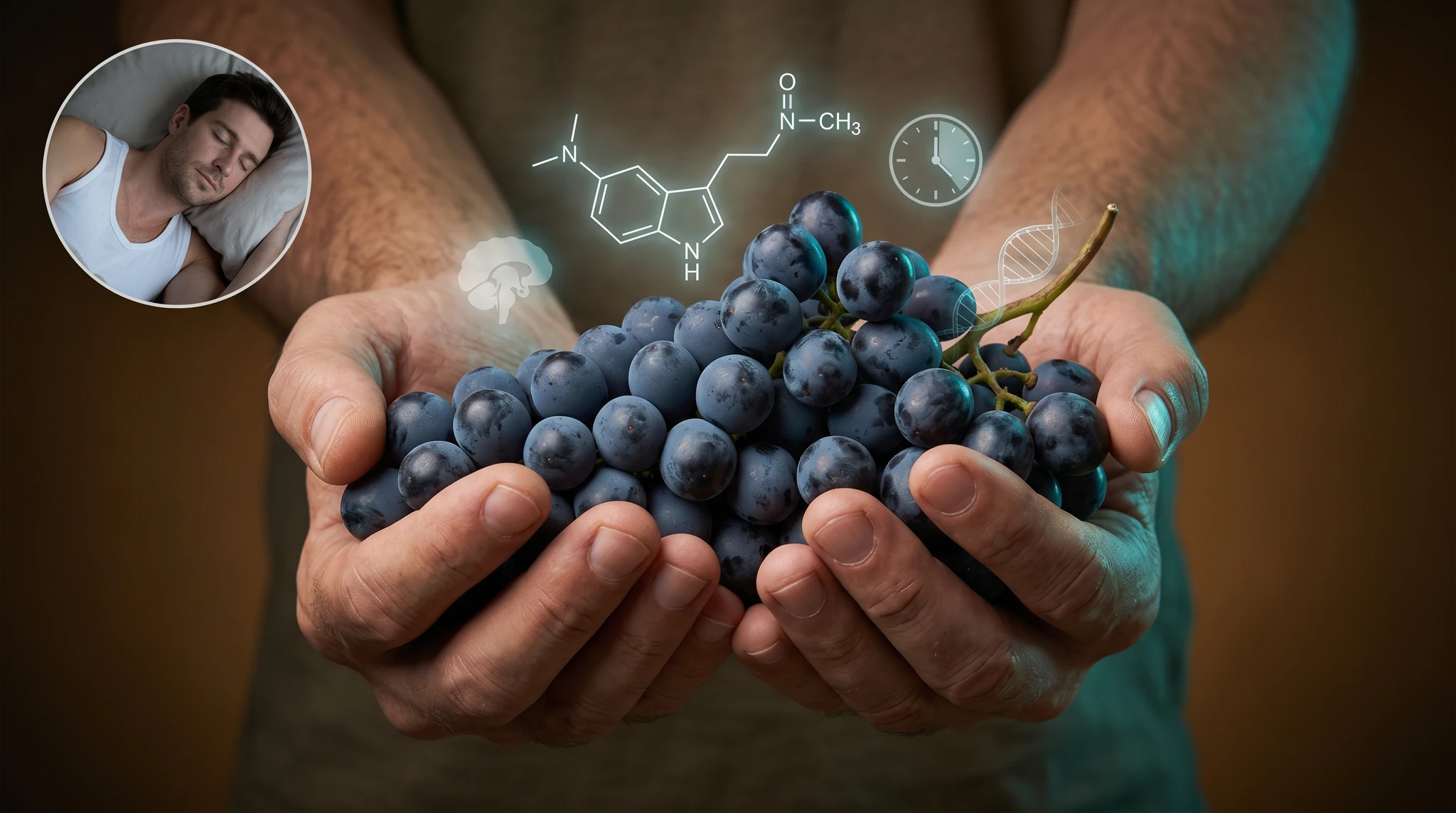
A small handful of dark grapes after dinner is one of those habits that sounds too simple to do anything. New analytical chemistry says it might do a little more than nothing. Italian researchers reporting in the Journal of Pineal Research in 2012 measured melatonin in several wine-grape varieties and found that Nebbiolo grapes carried roughly 200 times the melatonin of Cabernet Franc, with smaller but still measurable amounts in Croatina, Sangiovese, Marzemino, and Barbera.1
That single comparison is the spark behind every “eat grapes before bed” post you have probably scrolled past. The chemistry is real. The sleep claim around it is more cautious than the captions usually admit. Here is what the studies actually say, and what to make of it on a Tuesday night when you are deciding between grapes and a biscuit.
What is melatonin, and why is it in a grape at all?
Melatonin is the hormone your pineal gland releases as evening light fades. It does not knock you out; it tells the rest of the body that night has begun, nudging core temperature down, slowing alertness, and shifting the timing of dozens of small internal rhythms. The compound is ancient. A 1995 paper in Biochemistry and Molecular Biology International, with Russel Reiter as senior author, was among the first to identify melatonin in edible plants and to show that eating those plants raised plasma melatonin in vertebrates afterwards.5 Tomatoes had it. Cherries had it. So did barley, rice, and a list of leafy greens.
The reason is mostly antioxidant. Plants make melatonin to mop up reactive oxygen species in tissues that face heavy ultraviolet exposure or pathogen pressure. Grape skins are a high-stress neighborhood: thin layer, sun-blasted all summer, exposed to fungi like Botrytis. Italian work led by Marcello Iriti and Franco Faoro proposed that grapes pile melatonin and resveratrol into the skin precisely because that is where the plant needs chemical defense.2 Iriti’s follow-up letter in 2009 made the same point in plainer language. Melatonin in grapes was not folklore. It was real, measurable, and concentrated in the skin.3

Why Nebbiolo and not Cabernet Franc?
The 200-fold figure comes from a single careful experiment by Laura Mercolini and colleagues at the University of Bologna, published in 2012.1 They pulled grape samples directly from vineyards in Italy’s Oltrepo Pavese and Modena regions, hand-prepared them, and ran the extracts through a HPLC method with fluorescence detection (MEPS-HPLC-F, if you like the acronym). The instrument can detect melatonin at the picogram level, which matters because the amounts in fruit are tiny.
Their headline numbers, in nanograms of melatonin per gram of grape skin, looked roughly like this. Nebbiolo, the red grape behind Barolo and Barbaresco, sat at the top. Croatina and Sangiovese were in the middle. Cabernet Franc was at the bottom by a wide margin. The ratio between the highest and lowest variety came out at about 200 to 1.1 Mercolini’s team also looked at table grapes from the supermarket and found measurable melatonin there too, though usually less than in the wine grapes that had been left longer on the vine.
Why the spread? Probably a mix of genetics, climate, harvest timing, and how stressed the vine was during the growing season. Iriti’s work suggests sun exposure, fungal pressure, and even ultraviolet flux can push grape vines to crank out more melatonin in self-defense.3 A vine on a hot, dry slope in Piedmont is a more nervous plant than one in a sheltered nursery, and its skins seem to reflect that.
How much melatonin actually ends up in your bloodstream?
This is where honest writing has to slow the breathless captions down. The amounts in fruit are small. The Hattori 1995 paper showed that feeding rats edible plants did raise plasma melatonin, with detectable rises measurable a few hours later, but the rise was modest and the experiment used quantities of plant material that, scaled to a human, would mean a serious bowlful.5 Mercolini’s grape-skin numbers translate to perhaps a few nanograms of melatonin per gram of skin, which means a typical evening serving of grapes contributes far less melatonin than a 1-milligram tablet from a pharmacy.
That is not a knockdown criticism. The body is sensitive to small melatonin shifts at the right time of evening, and food-derived melatonin appears to be absorbed and to circulate, which is what Hattori’s plasma measurements suggested decades ago.5 Tart cherry juice, kiwi fruit, and pistachios have all been studied for the same reason. Grapes belong on that list. They are not, however, equivalent to a supplement, and any honest recap should say so.

Does melatonin even work for sleep?
That question has its own evidence base, separate from the grape question. The most cited synthesis is a 2013 meta-analysis by Eduardo Ferracioli-Oda, Ahmad Qawasmi, and Michael Bloch, published in PLoS One. They pulled 19 randomized trials covering 1,683 adults with primary sleep disorders. Across the pool, melatonin reduced the time it took to fall asleep by about seven minutes on average, increased total sleep time by about eight minutes, and improved overall sleep quality scores compared with placebo.4
Seven minutes is not a miracle. The authors are clear about that. The effect was, in their words, smaller than what most prescription sleep medications produce, but real, consistent across studies, and present without the dependence and morning-after grogginess that often shadow benzodiazepines or Z-drugs.4 For people whose problem is genuine difficulty initiating sleep, especially if their internal clock is shifted (think jet lag, late shift work, or a delayed sleep phase), melatonin moves the needle. For someone who falls asleep fine and wakes up at 3 a.m. anxious, it is less impressive.
Plug that finding back into the grape question and the picture sharpens. Even if a bowl of Nebbiolo skins delivered a meaningful melatonin dose (which it does not, quite), the upper bound of effect is small, on the order of minutes faster sleep onset rather than a transformed night. Worth knowing. Not worth marketing as a cure.
It is not just one study, but the human evidence is thin
The chemistry literature on melatonin in grapes is now reasonably deep. There are papers on melatonin biosynthesis in Vitis vinifera, on how grape variety and ripeness affect content, and on how wine-making processes preserve or destroy it. The human-trial literature, where someone actually feeds people grapes and measures their sleep, is much thinner. Most of what circulates online is an extrapolation from a small chemistry paper to a personal recommendation. The gap is filled with optimism.
The honest summary, then, is layered. Grapes contain melatonin, confirmed by multiple independent labs.1,3,5 The amount varies wildly by variety, with Nebbiolo at the top and Cabernet Franc near the bottom of the wine-grape range.1 Eaten foods that contain melatonin do raise circulating melatonin in animal experiments and likely in people too, though the rise is small.5 Melatonin supplementation, at the doses sold in pharmacies, produces a modest improvement in sleep onset and quality.4 Whether grapes alone deliver enough to matter has not been directly tested in a well-designed sleep trial. If someone tells you it has, ask for the citation.

What about red wine?
Mercolini’s team measured wines too, not just whole grapes, and the answer is a small qualified yes. Reds contain detectable melatonin, with Nebbiolo-based wines toward the higher end, although fermentation, aging, and clarification all chip away at the original level.1 The melatonin you get in a glass of Barolo is real but very small.
This is where it pays to be careful. Alcohol in any meaningful quantity worsens sleep. It speeds sleep onset for some people, then fragments the second half of the night, suppresses REM, and tends to wake you up dehydrated at 4 a.m. Anyone hoping that a glass of red wine is a clever hack for sleeping better is fighting the alcohol effect with a microscopic melatonin dose. The math does not work. If sleep is the goal, eat the grapes and skip the wine. The skins are where the melatonin lives anyway.2
How to use this without overdoing it
A practical takeaway looks something like this. A small bowl of dark grapes, ideally with the skin on and ideally a thin-skinned red variety, is a pleasant and minor addition to an evening wind-down. It is unlikely to do harm. It contains real melatonin, real polyphenols, real antioxidants, and a fairly low sugar load if the portion is reasonable.2 If it nudges you out of a habit of late ice cream, that alone is a win.
Pair it with the things that actually do most of the work. Dim the overhead lights an hour before bed, keep your bedroom cool, and avoid heavy screen time in the last 30 minutes. If sleep is consistently broken, talk to a clinician rather than self-treating with fruit. Grapes are a supporting actor. The lead role goes to consistent sleep timing, daylight in the morning, and a calm pre-bed routine.
One quiet upside is worth naming. Reaching for a small bowl of fruit in the evening, instead of a sleeve of cookies or a late glass of wine, will improve most people’s sleep on its own merit, melatonin or no melatonin. Lower sugar surge, lower alcohol load, fewer late calories. Even if every chemistry paper turned out to be a wash tomorrow, that swap would still be a quiet win on its own terms, and that is the most defensible reason to keep the habit.

Common questions about grapes and sleep
Are darker grapes always better than green?
On average, yes, because more of the melatonin sits in the pigmented skin. Red and purple varieties tend to have more pigment-rich skins than green table grapes, and Nebbiolo is one of the higher-melatonin reds in the data so far.1
Should I take a melatonin supplement instead?
That depends on the problem. For shift work, jet lag, or a clearly delayed sleep phase, low-dose melatonin (often 0.3 to 1 mg, taken a couple of hours before target bedtime) has the strongest evidence.4 For ordinary “I had coffee at 4 p.m.” sleeplessness, the supplement is usually overkill.
Can grapes replace a sleep medication?
No. Anyone on a prescription sleep aid should not change anything based on a fruit bowl. The studies on melatonin in supplement form found a small effect on sleep onset and quality, and food sources are weaker still.4
Is there a best time to eat them?
Roughly an hour before lights out is sensible, both for digestion and to align with the body’s natural melatonin rise. Eating a heavy meal close to bedtime can itself disrupt sleep, so portion matters more than timing precision.
Are organic grapes meaningfully different?
For melatonin content, the better predictor seems to be variety and growing conditions, not whether the vine was managed organically. Stressed vines on hot slopes appear to push more melatonin into their skins regardless of the certification on the box.3
Where this leaves us
The viral version of this story flattens it. The careful version is more interesting. A specific group of researchers, working in a specific Italian lab, used a sensitive instrument to show that one wine grape variety carries roughly 200 times the melatonin of another, and that the compound concentrates in the skin where the plant fights off sun and fungus.1,3 A separate body of work shows that supplemental melatonin produces a small, real improvement in sleep, on the order of minutes faster onset and slightly better quality.4 Connecting the two is reasonable, but the connection is a thread, not a rope.
Eat the grapes if you like grapes. Pick the dark ones. Notice if you feel any different over a couple of weeks. Keep your expectations modest, your bedroom cool, and your phone out of the bed. Sleep mostly belongs to habits, not to a single food. A good evening snack can still be quietly supportive without having to carry the whole night on its skin.
Sources
- Mercolini L, Mandrioli R, Raggi MA. Content of melatonin and other antioxidants in grape-related foodstuffs: measurement using a MEPS-HPLC-F method. J Pineal Res. 2012;53(1):21–28. PubMed: 22017461
- Iriti M, Faoro F. Grape phytochemicals: a bouquet of old and new nutraceuticals for human health. Med Hypotheses. 2006;67(4):833–838. PubMed: 16759816
- Iriti M. Melatonin in grape, not just a myth, maybe a panacea. J Pineal Res. 2009;46(3):353. PubMed: 18624956
- Ferracioli-Oda E, Qawasmi A, Bloch MH. Meta-analysis: melatonin for the treatment of primary sleep disorders. PLoS One. 2013;8(5):e63773. PubMed: 23691095
- Hattori A, Migitaka H, Iigo M, et al. Identification of melatonin in plants and its effects on plasma melatonin levels and binding to melatonin receptors in vertebrates. Biochem Mol Biol Int. 1995;35(3):627–634. PubMed: 7773197