A small five-week clinical trial reported by Nazari and colleagues in 2022 found that women drinking about 100 grams of grape juice each day experienced improvements in specific sleep disturbances, particularly physical fatigue and night-time disruption, compared with a control group. The headline finding is narrower than the share-friendly version going around social feeds. Overall sleep quality scores did not change dramatically. Specific symptoms did.
That difference matters, and so does the population. The participants were women undergoing radiotherapy for breast cancer, a group already living with sleep that has been shaken loose by treatment. Whether grape juice does the same thing for a tired parent, a stressed graduate student, or someone in their sixties with stubborn early-morning waking is a separate question, and one the trial cannot answer on its own.
What the grape juice trial actually showed
The protocol was simple. Roughly 100 grams of grape juice, every day, for five weeks. Researchers tracked sleep using the Pittsburgh Sleep Quality Index, a standard questionnaire that breaks sleep into seven components, including sleep latency, duration, disturbances, and daytime fatigue. The grape juice group did better on some of those components than controls, but the global score, the headline number people usually quote, did not move very much.
If that sounds underwhelming, sit with it for a moment. A modest, specific improvement in one population is exactly the kind of result a careful reader should respect. It is not nothing. It is also not a sleeping pill. The women in the trial were dealing with a form of cancer treatment that disrupts circadian rhythm, raises inflammation, and increases anxiety. A simple food intervention nudging some of those symptoms in the right direction is genuinely interesting, even if it does not rewrite the science of sleep.
One more thing to notice. The control group still drank something, and the trial was not blinded the way a pharmaceutical trial would be. That always leaves a small door open for placebo and expectation effects. So when you see a headline that says grapes fix sleep, the honest version is: in a small specific group, daily grape juice was associated with a real but modest improvement in some sleep symptoms.
Do grapes really contain melatonin?
Yes, in small amounts. Melatonin is the hormone your pineal gland releases as evening falls, and it is best known as the body’s internal “time to wind down” signal. It also turns up in plants, where it appears to act as an antioxidant and a stress-response molecule. Grapes and grape products are among the foods where it has been detected and quantified.
One of the more rigorous measurements comes from a 2020 paper in ACS Omega, where Romanian researchers used HPLC-MS/MS, a sensitive analytical technique, to map melatonin and its biochemical precursors across a range of wines made from different grape varieties.3 Concentrations varied with cultivar, fermentation, and processing. The amounts were small in absolute terms, far below what you would get from a melatonin supplement, but they were real and reproducible across samples.

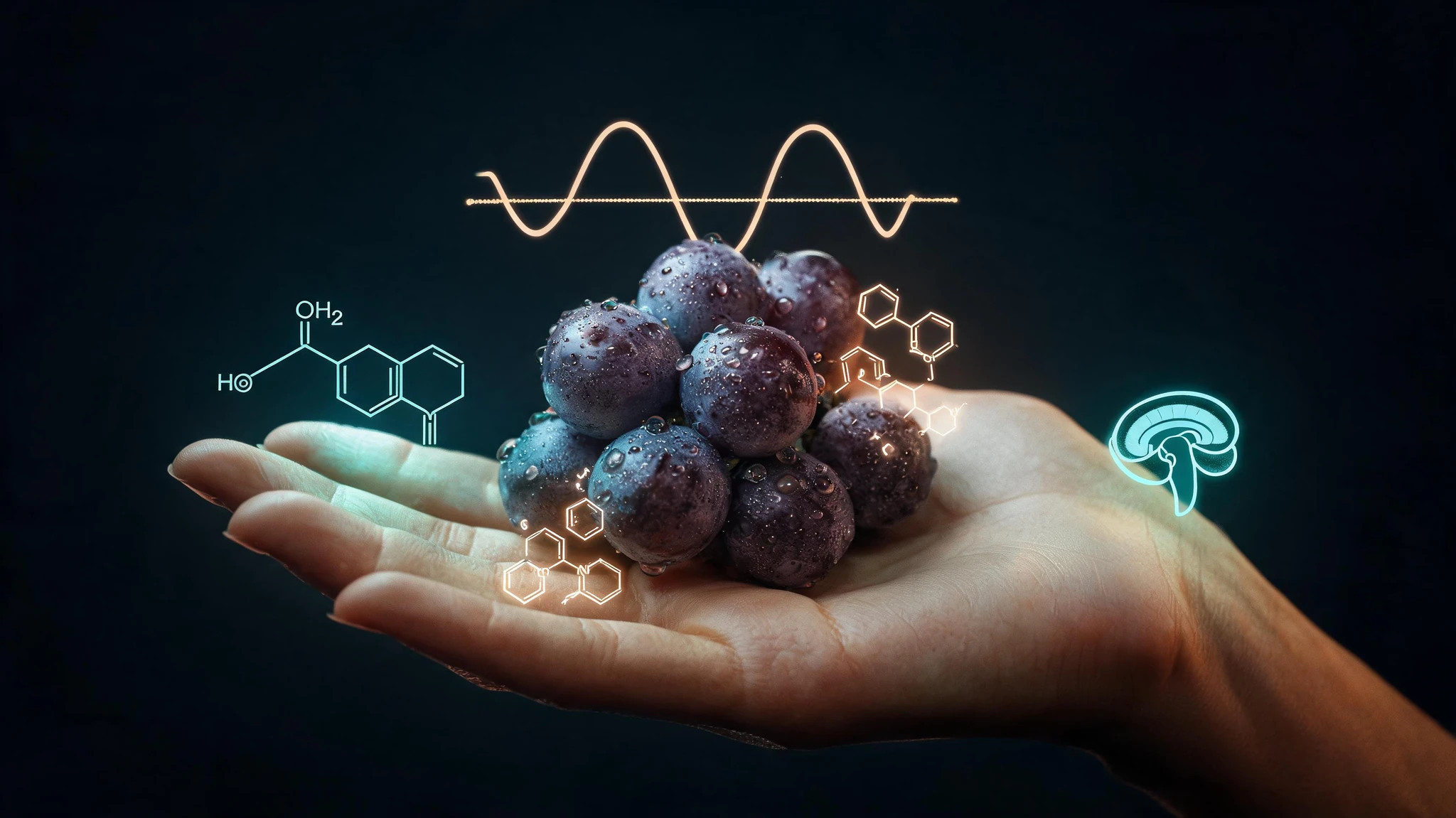
Why the gap between “real and reproducible” and “useful at the bedside?” Because the dose in a glass of grape juice is on the order of nanograms, and a typical over-the-counter melatonin tablet delivers a few milligrams, roughly a million times more. The case for grapes nudging sleep is not that they replace a melatonin pill. It is that they deliver a small dose of melatonin alongside polyphenols that may interact with the body’s antioxidant and circadian systems in ways researchers are still mapping out.
Polyphenols, resveratrol, and the rest of the entourage
Grapes are not just sugar water with a trace of melatonin. The skin of a dark grape carries anthocyanins, the same family of pigments that give blueberries and red cabbage their color. The seeds and skins also carry resveratrol, the much-discussed polyphenol that briefly became a wellness celebrity in the 2000s. Whole grapes and minimally processed juices preserve more of these compounds than clear, heavily filtered juice.
Animal evidence suggests these molecules can interact with circadian biology. In a 2012 study in Chronobiology International, Pifferi and colleagues fed dietary resveratrol to gray mouse lemurs, small primates with measurable sleep-wake cycles, and reported shifts in their activity rhythms compared with controls.4 Lemurs are not humans, and a feeding study is not a clinical trial, but the result lines up with the broader hypothesis that grape polyphenols can talk to the systems that regulate when we feel awake and when we feel drowsy.
Polyphenols also lower oxidative stress and dial down some inflammatory signaling. People who sleep poorly, especially those dealing with chronic illness or treatment, often have higher background inflammation. A daily dose of antioxidants is not a cure, but it is plausibly part of why a glass of dark grape juice did something in the Nazari trial that water would not.

How does this compare with tart cherry juice?
If you have read about food and sleep before, you have probably bumped into tart cherries. The evidence base there is small but more developed than for grapes. In a 2012 trial published in the European Journal of Nutrition, Howatson and colleagues gave healthy adults a tart Montmorency cherry concentrate twice a day for seven days and measured a rise in urinary 6-sulfatoxymelatonin, a marker of melatonin output, along with longer total sleep time and improved sleep efficiency.1
An earlier pilot in the Journal of Medicinal Food by Pigeon and colleagues tested tart cherry juice in older adults with chronic insomnia and found modest improvements in sleep diaries.2 Both studies were small, and tart cherries appear to contain more melatonin per serving than table grapes. So when people say “grapes work like tart cherries,” they are extrapolating from a stronger neighbor. The grape evidence is less complete, but the underlying mechanism, plant melatonin plus polyphenols, is the same family of ideas.
The pragmatic read is this. Tart cherry juice has the better evidence for sleep right now. Grape juice has a smaller, narrower trial and a plausible mechanism. Treat them as cousins, not twins.
Why food-based melatonin matters at all
Melatonin supplements are wildly popular in the United States, and the dosing is often far higher than the body’s own production. A 2023 systematic umbrella review in the Journal of Sleep Research by Ell and colleagues looked across complementary and alternative therapies for insomnia, including melatonin, herbal blends, and dietary approaches, and concluded the evidence is uneven, with some interventions modestly helpful and many overhyped.6 Food-derived melatonin sits at the gentle end of the spectrum: very small doses, embedded in a matrix of other plant compounds, taken as part of a meal.

That gentle profile is part of what makes a glass of grape juice an interesting bedtime ritual. It is unlikely to flatten you the way a 5-milligram supplement can. It is also unlikely to disrupt your morning. For someone who wants to nudge sleep without taking a pill, food is a reasonable starting point, especially when paired with the rest of what we know about evening routines.
What else moves the needle (and probably more than juice)
Sleep responds to a stack of inputs, and food is only one of them. A 2019 review in Nutrients by Doherty and colleagues, focused on athletes but broadly applicable, summarized how diet, meal timing, and specific nutrients shape sleep architecture.5 The pattern that holds across studies is familiar. Late heavy meals fragment sleep. Caffeine after the early afternoon delays it. Alcohol shortens deep sleep even when it makes you fall asleep faster. Adequate carbohydrate, tryptophan-rich protein, and consistent meal timing all help.
None of that is glamorous. It is also where most of the real gains live. If you are sleeping six hours, drinking three coffees a day, and looking at a phone in bed, a glass of grape juice is not going to rescue you. If you have already cleaned up the basics, then a small evening ritual involving a melatonin-containing food might be one of those low-effort tweaks that pays for itself.
How to try grape juice for sleep, sensibly
If you want to test the idea on yourself, here is a reasonable approach. Pick a 100 percent grape juice, ideally Concord or another dark variety, with no added sugar. About a small glass, in the hour before bed, is in line with the trial dose. Do it for three weeks before deciding anything, and keep a simple sleep diary. Note what time you go to bed, when you fall asleep, how often you wake, and how you feel in the morning.
Two cautions. Grape juice is calorically dense, and 100 grams a day adds up over time, particularly if you are watching blood sugar. Whole grapes deliver the same compounds with fiber attached, which is gentler on glucose. People with diabetes or anyone on glucose-lowering medication should talk with a clinician before adding a daily glass of juice to their routine. People taking blood thinners or specific medications metabolized by the liver should also check, because grape products can interact with some drugs.

Pairing the juice with the obvious sleep-hygiene moves does more than juice alone. A consistent bedtime, a cool dark room, no screens for the last half hour, and morning daylight to anchor the circadian system, those are the structural pieces. Grape juice, if it does anything for you, is a small extra nudge inside a routine that is already pulling its weight.
Common questions about grapes, melatonin, and sleep
Does eating whole grapes work the same as drinking grape juice?
Probably similar in spirit and gentler on blood sugar, since the fiber slows absorption. The studies cited here used juice, so direct evidence for whole grapes is thinner, but the relevant compounds are present in the fruit itself.
How much melatonin is actually in a glass of grape juice?
On the order of nanograms, far less than a melatonin tablet. The proposed effect comes from the combination of trace melatonin plus polyphenols and anthocyanins, not from the melatonin alone.
Is grape juice better than tart cherry juice for sleep?
Tart cherry juice currently has the stronger published evidence, including small trials in healthy adults and older adults with insomnia. Grape juice has a narrower trial in a specific patient population. Either is a reasonable food experiment.
Can children drink grape juice for sleep?
The trial discussed here was in adults. Children should not be given any melatonin-containing food or supplement as a sleep aid without speaking to a pediatrician, because their circadian systems and dosing needs are different.
How long should I try it before deciding?
The cited trial ran five weeks. Three to four weeks of consistent nightly use, alongside a sleep diary, is a fair self-test. If nothing changes, it likely is not the missing piece for you.
Where this leaves you
The honest summary of the grape-juice-and-sleep story is that a small trial in a specific group of women found a modest, specific benefit, and the underlying biology, plant melatonin plus polyphenols, is plausible enough to take seriously without overselling. If you sleep well, a glass of grape juice is a snack, not a treatment. If you sleep poorly, it is one of the gentler things you can try, and one of the few that comes with antioxidants and a pleasant taste rather than a label warning.
Persistent insomnia, especially the kind that drags on for months, is not something to manage with juice alone. Talk to a clinician, look at the bigger picture of stress, light exposure, alcohol, and screen time, and treat any food intervention as a small ingredient in a larger plan. Sleep responds to consistency more than to clever foods, and the studies behind this article quietly say the same thing.
Sources
- Howatson G, et al. Effect of tart cherry juice (Prunus cerasus) on melatonin levels and enhanced sleep quality. European Journal of Nutrition, 2012. PubMed: 22038497
- Pigeon WR, et al. Effects of a tart cherry juice beverage on the sleep of older adults with insomnia: a pilot study. Journal of Medicinal Food, 2010. PubMed: 20438325
- Albu C, et al. Assessment of melatonin and its precursors content by a HPLC-MS/MS method from different Romanian wines. ACS Omega, 2020. PubMed: 33134687
- Pifferi F, et al. Effects of dietary resveratrol on the sleep-wake cycle in the non-human primate gray mouse lemur (Microcebus murinus). Chronobiology International, 2012. PubMed: 22390239
- Doherty R, et al. Sleep and nutrition interactions: implications for athletes. Nutrients, 2019. PubMed: 30979048
- Ell J, et al. Complementary and alternative treatments for insomnia disorder: a systematic umbrella review. Journal of Sleep Research, 2023. PubMed: 37527850