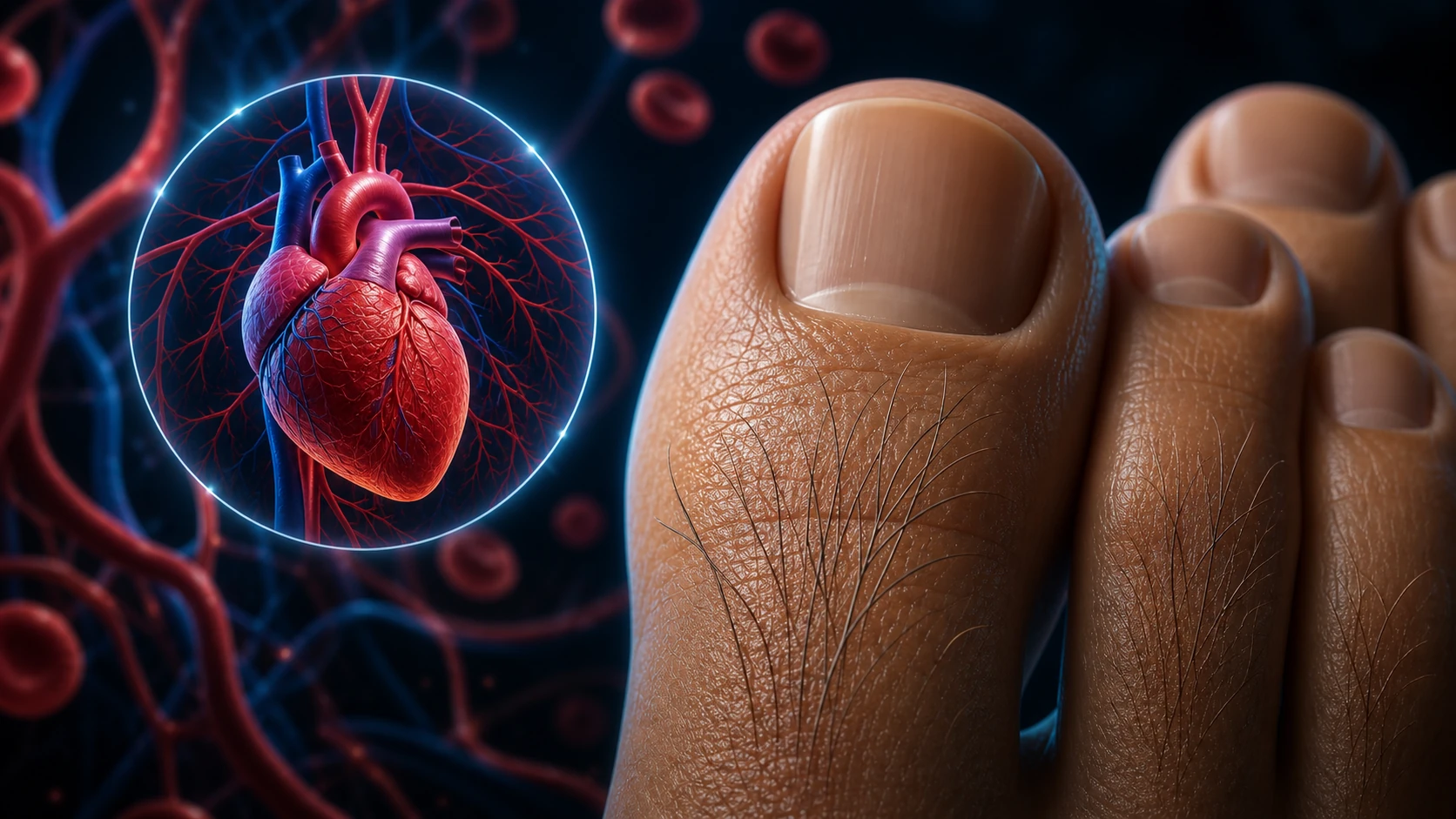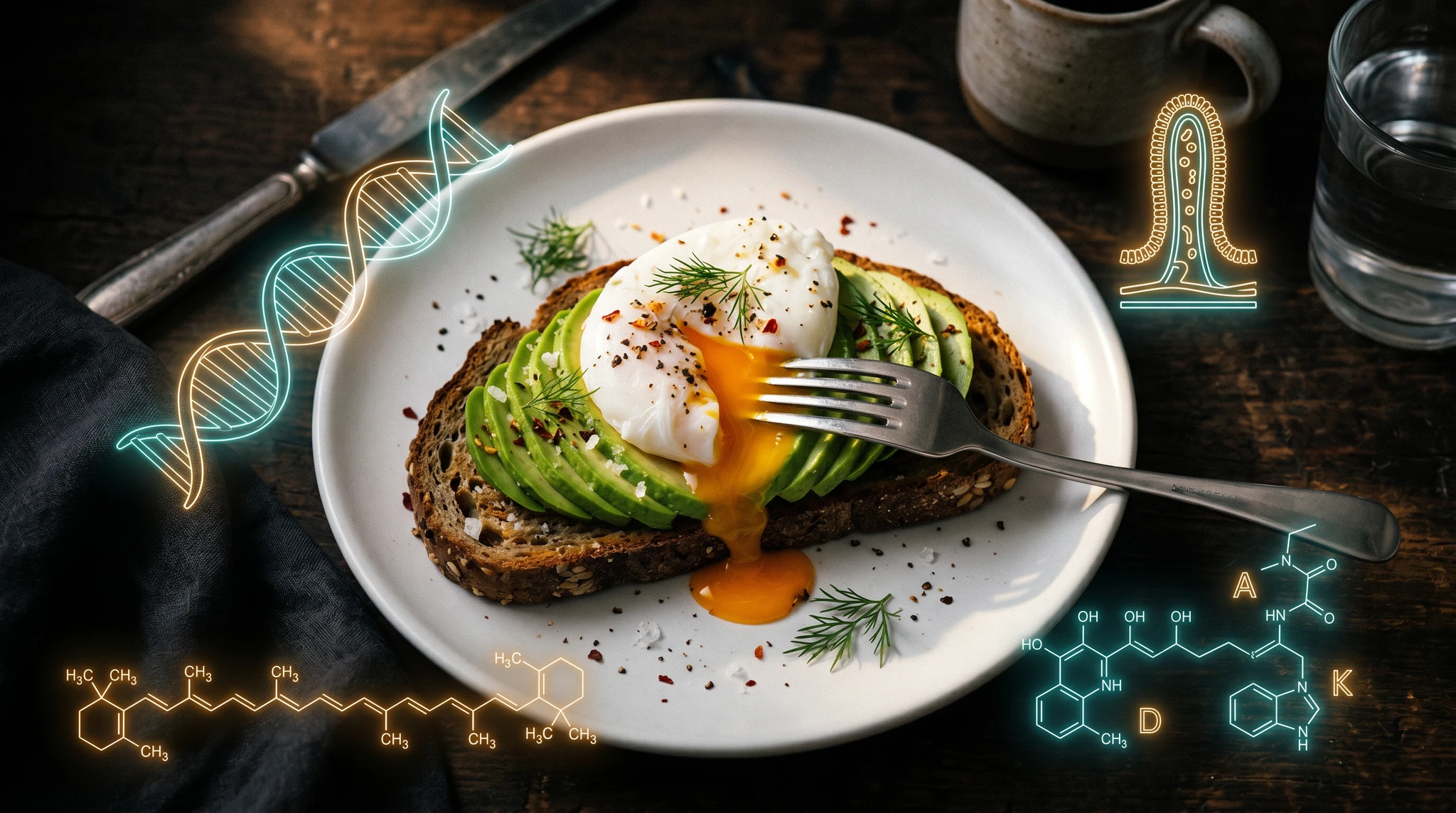
The breakfast plate of avocado on toast with a soft poached egg is doing more than feeding you. In a 2015 randomized trial led by Jung Eun Kim at Purdue University, adults who ate three whole eggs alongside a raw mixed salad absorbed three to nine times more carotenoids from the same salad than people who ate the salad on its own.1 The same study tracked vitamin E and reported a four to seven fold rise.1
That is the small, specific finding behind a much bigger idea. Some nutrients in plant foods are fat-soluble, which means your body can only pull them out of food when fat is present in the same meal. Eggs and avocado happen to bring fat in two different forms, plus complete protein, plus a few vitamins of their own. The pairing turns a single breakfast into a more efficient delivery system. It is not a miracle, and it does not melt fat off your hips. The science is more interesting than that.
What actually happens in your gut when fat shows up
Vitamins A, D, E and K are called fat-soluble for a reason. They will not dissolve in water, and the cells that line your small intestine cannot scoop them up directly. They have to be packaged inside tiny droplets of fat called micelles, which form during digestion when bile salts mix with dietary fat. Once inside a micelle, a vitamin A molecule from a carrot or a vitamin E molecule from spinach can drift to the gut wall, cross into the cells of the intestinal lining, and ride a lipoprotein particle called a chylomicron through the lymphatic system into the bloodstream.
If you eat a salad with no fat at all, that whole pipeline backs up. The vitamins are sitting on the conveyor belt with no truck to carry them. Some still get through. Most do not. They pass out of you the next day, intact and unused. This is the boring, well-established biochemistry behind the headline numbers, and it is also why nutrition researchers have spent the last twenty years quietly campaigning against the fat-free salad dressing aisle.
Eggs and avocado both bring trucks. A large egg has about five grams of fat, most of it in the yolk. A half avocado brings around fifteen grams, mostly oleic acid, the same monounsaturated fat that makes olive oil what it is.5 Together they give a salad or a slice of toast more than enough fat to put a full fleet on the road.

How big is the effect, really?
The Kim trial is the most cited number on this topic for a reason. Sixteen healthy young adults ate the same raw vegetable salad on three different mornings, with zero, one and a half, or three whole cooked eggs added in. The researchers drew blood for ten hours afterwards and measured how much of each carotenoid showed up in the chylomicron-rich fraction. Beta-carotene, alpha-carotene, lycopene, lutein and zeaxanthin all rose in step with the egg dose. Vitamin E followed the same pattern.1
The standout was lutein and zeaxanthin, the yellow pigments found in leafy greens that concentrate in the retina and may help protect aging eyes. Adding three eggs raised lutein absorption by roughly seven fold. Adding nothing left most of it behind.1
Avocado does the same job through a slightly different door. In a 2014 trial at Ohio State, Rachel Kopec and colleagues fed people salsa with or without fresh Hass avocado. Avocado increased absorption of beta-carotene from the salsa by about two and a half fold and tripled the conversion of that beta-carotene into active vitamin A in the bloodstream.2 A second arm of the same study used carrots instead of tomato. Avocado boosted carrot beta-carotene absorption by more than six fold.2
Two trials, two foods, same direction. The fat is not just sitting there as a calorie bystander. It is doing chemistry.
Eggs are doing more than supplying fat
It would be neat if the entire effect came down to grams of fat. It does not. Researchers have known for years that pure oil added to a salad raises carotenoid absorption, but the size of the effect from whole eggs in the Kim trial was larger than what the egg’s fat alone can explain.1 The yolk also contains phospholipids, particularly phosphatidylcholine, which form a more efficient micelle than triglycerides do on their own. Phospholipids are essentially natural surfactants. They bring oil and water together, the way egg yolk does in a homemade mayonnaise.
Eggs also bring their own carotenoids. Pasture-raised yolks are tinted yellow-orange because hens deposit lutein and zeaxanthin from their feed straight into the egg. So when you eat eggs with a salad you are not only absorbing more of the salad’s pigments, you are getting an extra dose from the yolk itself.
Then there is protein. A large egg supplies about six grams, and unlike most plant proteins it carries all nine essential amino acids in roughly the proportions a human body needs. Protein at breakfast slows gastric emptying, which in turn keeps blood sugar steadier through the morning and dampens the mid-morning hunger spike. None of this is unique to eggs, but the package is unusually convenient.

What avocados bring to the same table
An avocado is mostly water and oleic acid, with a surprising amount of fiber for a fruit. A medium Hass has roughly ten grams of fiber, more potassium per gram than a banana, and useful amounts of folate, vitamin K, vitamin E and several B vitamins.5 The fat profile, dominated by monounsaturated oleic acid, is the same broad pattern that runs through the Mediterranean dietary research.
In a 2015 randomized trial published in the Journal of the American Heart Association, Penny Kris-Etherton’s group at Penn State put 45 overweight adults on three diets in turn for five weeks each. One was a typical American diet. Two were moderate-fat diets with the same calorie and macronutrient targets, but one of them swapped roughly the calories of a single Hass avocado a day in place of other fats. The avocado-containing diet produced the largest reduction in LDL cholesterol of the three, and shifted the LDL particle profile away from the small, dense subtype most associated with heart disease.3
Avocado also seems to nudge satiety. In a smaller 2013 crossover study, Mary Wien and colleagues at Loma Linda fed overweight adults a standard lunch with or without half an avocado added. Adding the avocado increased self-reported fullness over the next three to five hours by about 23 to 26 percent and reduced the desire to eat by a similar amount.4 Blood glucose and insulin curves were essentially unchanged, which is unusual for a meal that adds calories.4
None of those results are dramatic on their own. Strung together they describe a food that punches above its weight: more fullness per bite, a calmer blood sugar response, a friendlier lipid profile over weeks, and a fat package that pulls vitamins out of the rest of the meal.

Will eggs raise your cholesterol?
This is the question that follows eggs around like a stray cat. The short answer is that for most healthy adults, eating one or two whole eggs a day does not meaningfully raise heart disease risk in long-term cohort studies. The longer answer is that some people are hyper-responders, meaning their LDL rises noticeably with dietary cholesterol, and a small subset of those have a particle profile that probably is not great. If you have known high cholesterol, especially high LDL particle number, talk to your clinician before treating eggs as a free food.
The interesting wrinkle is what happens when eggs and avocado share a plate. Avocado’s monounsaturated fat appears to lower LDL.3 Egg yolks raise it modestly in some people. The two are not perfect cancellations, but they are not pulling in opposite directions as hard as the old wisdom suggested. The original source post for this article paraphrased the Kris-Etherton trial accurately on this point.
The picture on the post is not telling the whole truth
The image that has been circulating with this idea, the one that shows poached egg on avocado toast with a banner reading that the combination accelerates cell growth and allows the body to eliminate fat, is overstating what the evidence shows. There is no published trial that found eating eggs with avocado burns body fat. The metabolic effects are real but small. They look like better vitamin absorption, slightly steadier blood sugar, longer fullness, and a friendlier blood lipid profile after weeks of repeated meals. They do not look like weight loss in days, or accelerated cell growth in any clinically meaningful sense.
The honest version of the headline is duller. Eat your fat-soluble vitamins with some fat, ideally fat that brings other useful things along, and your body will use more of what you paid for at the grocery store.

How to actually build a meal that does this
If the goal is to absorb more of the carotenoids and fat-soluble vitamins in your salad or your breakfast, the practical rules are simple, and not many of them require willpower.
Pair raw or lightly cooked vegetables with a fat source in the same meal. Whole eggs and avocado both work. So do olive oil, full-fat yogurt, nuts, seeds and oily fish. The Kim trial used three eggs, but the dose response curve flattened sharply between one and a half and three eggs.1 One egg is probably enough for most people most of the time.
Eat your egg yolks. The vitamin and phospholipid story falls apart with whites only. If you are restricting cholesterol on medical advice, that trade-off is yours to make, but understand that an egg-white omelet on a fat-free salad is one of the worst possible vehicles for the vitamins in the greens.
Skip the fat-free dressing. Decades of supermarket marketing pushed fat-free as automatically healthier, but on a salad it is the opposite. A vinaigrette made with olive oil, or a couple of tablespoons of mashed avocado stirred into yogurt as a creamy dressing, will do the job.
Spread the absorption work across the day. Carotenoids and fat-soluble vitamins do not all dump into the bloodstream at once after a single meal; they keep arriving for hours. Eating some greens at lunch and some at dinner, both with a little fat, gives you a steadier supply than one giant salad.

Common questions about eating eggs with avocado
Is one egg enough, or do I need three like in the study?
One whole egg gives you most of the benefit. The Kim trial saw the largest jump going from zero eggs to one and a half eggs, with diminishing returns at three.1 A single egg with breakfast is plenty for the absorption effect.
Does it have to be a raw salad, or does cooked work too?
Cooked vegetables work. In some cases, gently cooking carrots or tomatoes actually frees more carotenoids from the plant cell walls. The fat partner still matters; sauteing in olive oil or finishing with avocado does the same job for cooked produce as adding eggs to a raw salad.
Are eggs safe to eat every day?
For most adults without a specific lipid disorder or familial hypercholesterolemia, current evidence supports eating up to one or two whole eggs a day with no clear increase in cardiovascular risk. People with high LDL or known sensitivity to dietary cholesterol should talk to a clinician about their personal numbers.
Does avocado really lower cholesterol?
In the Kris-Etherton trial, swapping the calories of one Hass avocado per day into an otherwise moderate-fat diet lowered LDL cholesterol and shifted the LDL particle profile in a favorable direction over five weeks.3 The effect is modest but consistent across several smaller trials.
Will eggs and avocado help me lose weight?
Not directly. They will not burn fat. They may make weight management easier by improving fullness and steadying blood sugar, which together can reduce snacking later in the day.4 Calories still count.
The takeaway worth keeping
The breakfast plate is doing real work. Not the work of a miracle, and not the work that a viral caption claims, but the slow, daily work of getting more of the vitamins you already eat past your gut wall and into your bloodstream. The trial numbers are small, the effects are measured in chylomicron concentrations rather than dress sizes, and yet they add up across years of meals.
If you already love avocado toast with a runny egg on top, the science is, for once, on the side of breakfast. If you do not, almost any pairing of greens with a real fat will accomplish the same thing. The point is not the eggs and not the avocado. The point is not eating your vitamins on a dry plate.
Sources
- Kim JE, Gordon SL, Ferruzzi MG, Campbell WW. Effects of egg consumption on carotenoid absorption from co-consumed, raw vegetables. American Journal of Clinical Nutrition. 2015;102(1):75–83. PubMed: 26016861
- Kopec RE, Cooperstone JL, Schweiggert RM, Young GS, Harrison EH, Francis DM, Clinton SK, Schwartz SJ. Avocado consumption enhances human postprandial provitamin A absorption and conversion from a novel high-β-carotene tomato sauce and from carrots. The Journal of Nutrition. 2014;144(8):1158–1166. PubMed: 24899156
- Wang L, Bordi PL, Fleming JA, Hill AM, Kris-Etherton PM. Effect of a moderate fat diet with and without avocados on lipoprotein particle number, size and subclasses in overweight and obese adults: a randomized, controlled trial. Journal of the American Heart Association. 2015;4(1):e001355. PubMed: 25567051
- Wien M, Haddad E, Oda K, Sabaté J. A randomized 3×3 crossover study to evaluate the effect of Hass avocado intake on post-ingestive satiety, glucose and insulin levels, and subsequent energy intake in overweight adults. Nutrition Journal. 2013;12:155. PubMed: 24279738
- Dreher ML, Davenport AJ. Hass avocado composition and potential health effects. Critical Reviews in Food Science and Nutrition. 2013;53(7):738–750. PubMed: 23638933