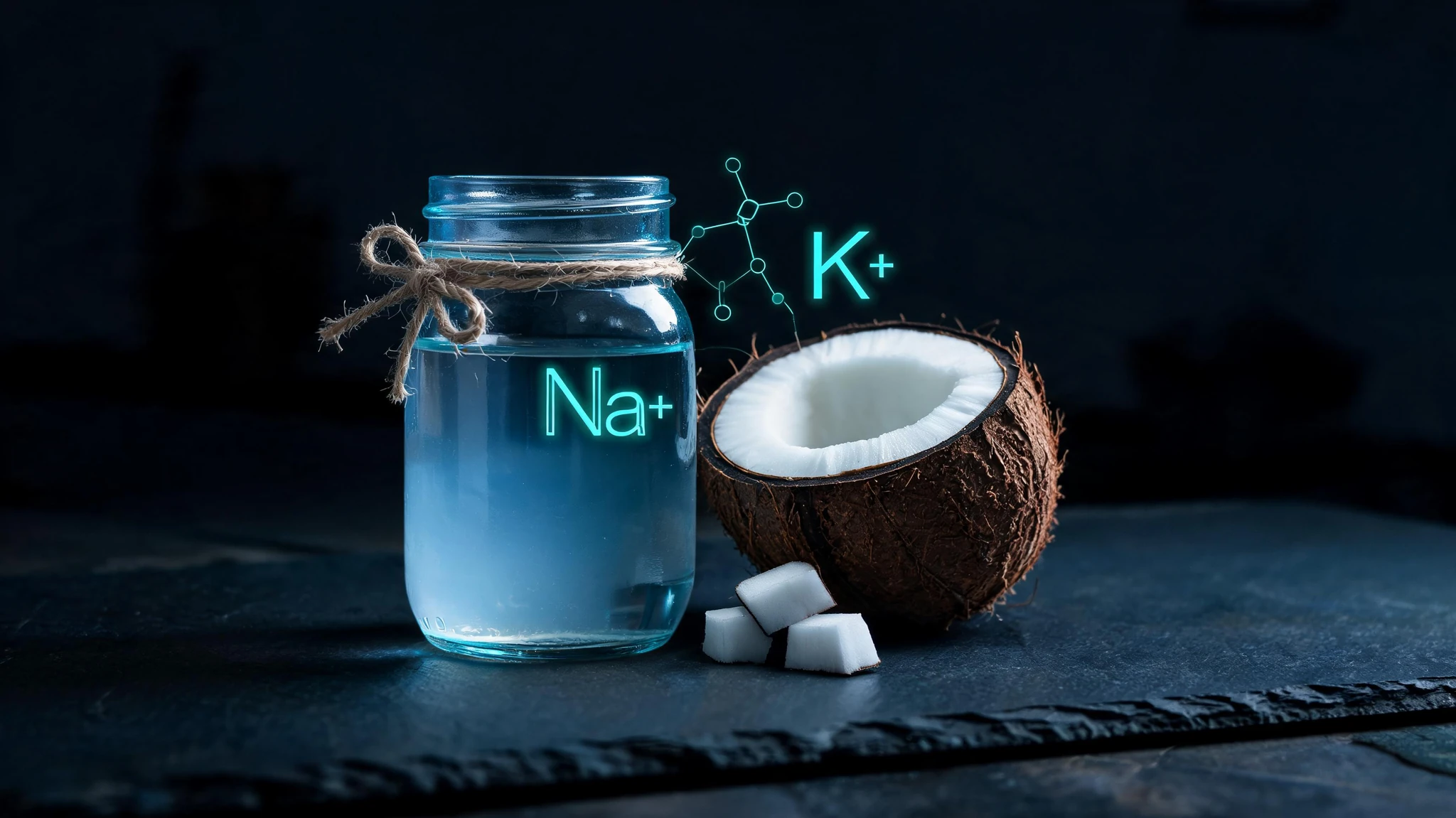
Coconut water hydrates about as well as a standard carbohydrate-electrolyte sports drink during moderate exercise, but it carries far less sodium than what the body actually loses through heavy sweating. That finding comes from a 2012 randomized trial by Kalman and colleagues, published in the Journal of the International Society of Sports Nutrition, which compared coconut water, sodium-enriched coconut water, a typical sports drink, and bottled water in twelve exercise-trained men.1 The drinks performed similarly. The differences only showed up when the test got harder.
That nuance has been buried under marketing for the better part of a decade. Coconut water is a fine drink. It is not a magic one. The science says it earns its place at your morning yoga mat, and probably not in the bottle you take into a two-hour summer ride.
What the science actually says about coconut water and hydration
Coconut water is the clear liquid inside a young green coconut, harvested before the meat fully matures. It is roughly 95 percent water, with small amounts of natural sugars and a mineral profile dominated by potassium. A serving carries about 600 milligrams of potassium, somewhere between 250 and 600 milligrams depending on the source and brand. Sodium content, by contrast, is modest, often in the range of 30 to 250 milligrams per cup. That ratio is the key to everything that follows.
In a 2002 trial led by Saat and colleagues at Universiti Sains Malaysia, eight men exercised in the heat until they had lost roughly two percent of their body weight, then drank either fresh young coconut water, a sports drink, or plain water for two hours of recovery. Coconut water restored fluid volume as well as the sports drink, and noticeably better than plain water. Participants also reported less nausea and stomach upset with coconut water than with the sports drink.2 That single trial is doing a lot of the heavy lifting for the “natural sports drink” claim. It is small. It is also real.
Kalman’s 2012 study went further. Across four trial arms, hydration markers (urine specific gravity, plasma osmolality, treadmill time to exhaustion) were broadly similar between coconut water and the carbohydrate-electrolyte beverage. Neither beverage outperformed the other in any meaningful way during 60 minutes of treadmill exercise.1 If you are doing 30 to 60 minutes of moderate work and you happen to enjoy the taste of coconut water, you are not handicapping yourself.
Where the comparison breaks down
Sweat is mostly water, but it is salty water, and the salt is mostly sodium chloride. A 2007 review by Valentine in Current Sports Medicine Reports lays out the basic numbers: athletes can lose somewhere between 460 and 1,840 milligrams of sodium per liter of sweat, with high-sweat individuals (and salty sweaters in particular) sitting at the upper end of that range.4 Run hard for two hours in summer heat and you might lose two to three liters of sweat. The sodium math becomes uncomfortable fast.
A standard sports drink delivers roughly 450 to 500 milligrams of sodium per liter, by design, because that is what athletes lose. A typical serving of unsweetened coconut water might give you 100 to 250 milligrams of sodium per cup, sometimes less. For a yoga session, that is plenty. For a marathon, it is not.
This was the precise question that Ismail and colleagues tested in 2007 in the Southeast Asian Journal of Tropical Medicine and Public Health. They had ten men cycle until dehydrated, then rehydrate with plain water, regular coconut water, or coconut water enriched with added sodium chloride. Plasma volume was restored faster, and stayed restored longer, with the sodium-enriched coconut water than with plain coconut water alone.3 Adding salt fixed the gap. The plain stuff did not bridge it.

Does coconut water actually improve performance?
Hydration and performance are related, but they are not the same thing. The most rigorous test of coconut water’s performance benefits came in 2017, when Peart and colleagues at Northumbria University ran a randomized trial in the International Journal of Sport Nutrition and Exercise Metabolism. Eight male cyclists completed 60 minutes of sub-maximal cycling followed by a time trial, drinking either coconut water or plain bottled water. The result was clear and slightly inconvenient: coconut water did not improve any marker of hydration during the sub-maximal effort, and it did not improve time-trial performance compared with plain water.5
That study is small, like most studies in this space, and it tested one specific scenario. But it lands in the same neighborhood as the others. Coconut water is competitive with a sports drink at moderate intensity. It is competitive with plain water at low and moderate intensity. It does not appear to outperform either across the studies that have actually been done.
Read the takeaway carefully. “Does not outperform” is not the same as “does not work.” If you like the drink and you are working out for an hour or less, hydrate with whatever you will actually drink. Compliance beats theoretical optimality every time. The claim worth letting go of is the one that says coconut water has some special edge over the alternatives. The studies do not show that.
The potassium question
Coconut water’s potassium content is genuinely impressive. A cup can deliver more potassium than a medium banana. Potassium plays a role in fluid balance, muscle contraction, and nerve signaling, and the typical American diet runs a little low on it (the Dietary Guidelines target is 4,700 milligrams a day, and average intakes hover well below that).
That said, exercise does not deplete potassium the way it depletes sodium. Sweat is roughly ten times richer in sodium than in potassium. So while coconut water’s potassium load is a real nutritional plus over the course of a day, it is not the missing piece for endurance recovery. If you are choosing a post-workout drink purely on the merit of replacing what you sweated out, sodium is the limiting nutrient, not potassium.
For everyday use, the potassium argument is more interesting. People with adequate kidney function and no specific medical contraindication generally benefit from getting more potassium from whole-food sources. A glass of unsweetened coconut water as part of a varied diet contributes meaningfully to that goal. Just be mindful if you take potassium-sparing diuretics, ACE inhibitors, or have chronic kidney disease, in which case extra potassium from any source warrants a conversation with your doctor.

What about weight loss, cramps, and heart health?
The image circulating with the original Facebook post claimed coconut water “helps you lose weight, reduce cramps, and improves heart, while providing you with vitamins and minerals.” Two of those claims are not supported by direct human evidence, and one is partially true with caveats.
On weight loss, no controlled trial has shown that drinking coconut water causes weight loss in humans. It is lower in calories than fruit juice or soda, around 45 calories per cup, so swapping it in for those drinks would reduce caloric intake. That is a substitution effect, not a property of coconut water itself. If you replace a 240-calorie soda with a 45-calorie coconut water every day, you will likely lose weight slowly. The same logic works for water, unsweetened tea, or sparkling water with lime.
On cramps, exercise-associated muscle cramps are not fully understood, and the long-running theory that they are caused by electrolyte depletion has competition from a neuromuscular fatigue model. Some athletes report that salty drinks help cramps; others swear by pickle juice (the leading hypothesis there involves a reflex from salt receptors in the mouth, not actual mineral replacement). Coconut water has been used in this context, but the evidence is anecdotal. A drink with more sodium would, in theory, be a better candidate.
On heart health, the supporting evidence in humans is thin. Some small studies have looked at blood pressure responses to coconut water, with mixed results. The potassium content theoretically supports healthy blood pressure (the DASH dietary pattern leans on high-potassium foods for that reason), but pinning a heart-health claim on a single beverage outruns the evidence. Treat coconut water as one of many potassium-rich choices in a balanced diet, not as a cardiac intervention.
How to actually use it
Start with what you are doing. A 30-minute walk, a yoga class, an easy bike commute, a hot afternoon at the desk: coconut water is a reasonable choice if you enjoy it. So is water. So is iced tea. Pick the one you will actually drink, and drink enough of it.
For longer or harder efforts, especially anything that has you visibly sweating for more than 60 to 90 minutes, you want sodium in the 300 to 700 milligrams per liter range, and probably some carbohydrate. Most commercial sports drinks land in that zone. You can also salt your coconut water (a quarter teaspoon per liter adds roughly 580 milligrams of sodium and turns it into something closer to what Ismail and colleagues tested), or pair it with a salty snack. Both work.
Watch the label. “Coconut water beverages” with added sugar, fruit juice, or flavorings can carry as much sugar as a soda. The closer the ingredient list is to “coconut water,” the better. Tetra-pak coconut water is fine; the heat treatment changes flavor more than nutrition.
And do not overdo the potassium. Cases of hyperkalemia from extreme coconut water intake are rare but documented, generally in people drinking liters per day, sometimes alongside other risk factors. A glass or two a day is well within normal.

Common questions about coconut water
Is coconut water better than plain water for hydration?
For light to moderate activity, coconut water and plain water hydrate similarly, with coconut water adding some potassium and a small amount of sodium. For long or hard exercise, neither is ideal on its own; both benefit from added sodium.
Can coconut water replace a sports drink during a long run?
Probably not, on its own. Sodium is the limiting electrolyte during heavy sweating, and coconut water carries less sodium than a typical sports drink. Sodium-enriched coconut water performs better in the studies that have tested it.
How much coconut water is too much?
Most adults can comfortably drink one to two cups a day. People with kidney disease or those taking medications that raise potassium should check with a doctor before regularly drinking large amounts, because the potassium load can add up.
Is coconut water good for hangovers?
It can help. Alcohol dehydrates you, and coconut water replaces fluid and a small amount of electrolytes. Plain water with a salty snack does roughly the same job. There is no specific clinical evidence that coconut water cures hangovers.
Should I drink coconut water every day?
You can, if you enjoy it and your diet does not already include a lot of potassium-rich foods. It does not have any unique daily-required nutrient, so think of it as a tasty option, not a supplement.
The honest bottom line
Coconut water is a real drink with a small but real evidence base behind it. The studies that exist are small, mostly on young trained men, and they consistently land in the same place: coconut water hydrates roughly as well as a sports drink for moderate exercise, and it falls short for heavy sweating because it does not carry enough sodium.
If you like it, drink it. Enjoy it for what it is, a tasty beverage with a decent mineral profile and fewer additives than most. Just match the drink to the workout, salt your bottle when the sweat is serious, and keep your expectations grounded in what the research actually shows rather than what the label promises.
Sources
- Kalman DS et al. Comparison of coconut water and a carbohydrate-electrolyte sport drink on measures of hydration and physical performance in exercise-trained men. Journal of the International Society of Sports Nutrition, 2012. PubMed: 22257640
- Saat M et al. Rehydration after exercise with fresh young coconut water, carbohydrate-electrolyte beverage and plain water. Journal of Physiological Anthropology and Applied Human Science, 2002. PubMed: 12056182
- Ismail I et al. Rehydration with sodium-enriched coconut water after exercise-induced dehydration. Southeast Asian Journal of Tropical Medicine and Public Health, 2007. PubMed: 17883020
- Valentine V. The importance of salt in the athlete’s diet. Current Sports Medicine Reports, 2007. PubMed: 17617999
- Peart DJ et al. Coconut Water Does Not Improve Markers of Hydration During Sub-maximal Exercise and Performance in a Subsequent Time Trial Compared with Water Alone. International Journal of Sport Nutrition and Exercise Metabolism, 2017. PubMed: 27768399