A small kitchen tweak, a teaspoon of coconut oil added to boiling water before the rice goes in, followed by a long rest in the refrigerator, may cut the calories your body absorbs from a serving of white rice by 10 to 15 percent. The claim comes from Sudhair James and colleagues at the College of Chemical Sciences in Sri Lanka, who presented the work at the 249th National Meeting of the American Chemical Society in March 2015.
The mechanism is not magic. It is a slow, well-documented chemical change called retrogradation, in which cooked starch molecules rearrange themselves during cooling and become harder for human digestive enzymes to break apart. Lab work on cooled white rice has confirmed that chilling cooked rice for roughly 24 hours and then reheating it raises the resistant starch fraction and lowers the glycemic response in healthy adults.1
What is resistant starch, in plain terms?
Most of the carbohydrate in white rice is starch, and most of that starch is digested in the small intestine into glucose. Resistant starch is the fraction that escapes that fate. Instead of being broken down by amylase enzymes and absorbed as sugar, it travels intact into the large intestine, where gut bacteria ferment it into short-chain fatty acids like butyrate.
That distinction matters for two reasons. First, starch that you do not absorb cannot raise your blood sugar. Second, starch that feeds gut microbes behaves more like dietary fiber than like a calorie-dense carbohydrate. Estimates of the energy value of resistant starch typically land around 2 kilocalories per gram, compared with about 4 for fully digested starch.
Resistant starch comes in several forms. The kind made by cooling cooked rice is called type 3, or retrograded resistant starch, and it forms specifically because of how amylose molecules behave when they lose heat. Amylose is the long, mostly straight-chain version of starch found alongside the more branched amylopectin in every rice grain.
Why does coconut oil change the rice?
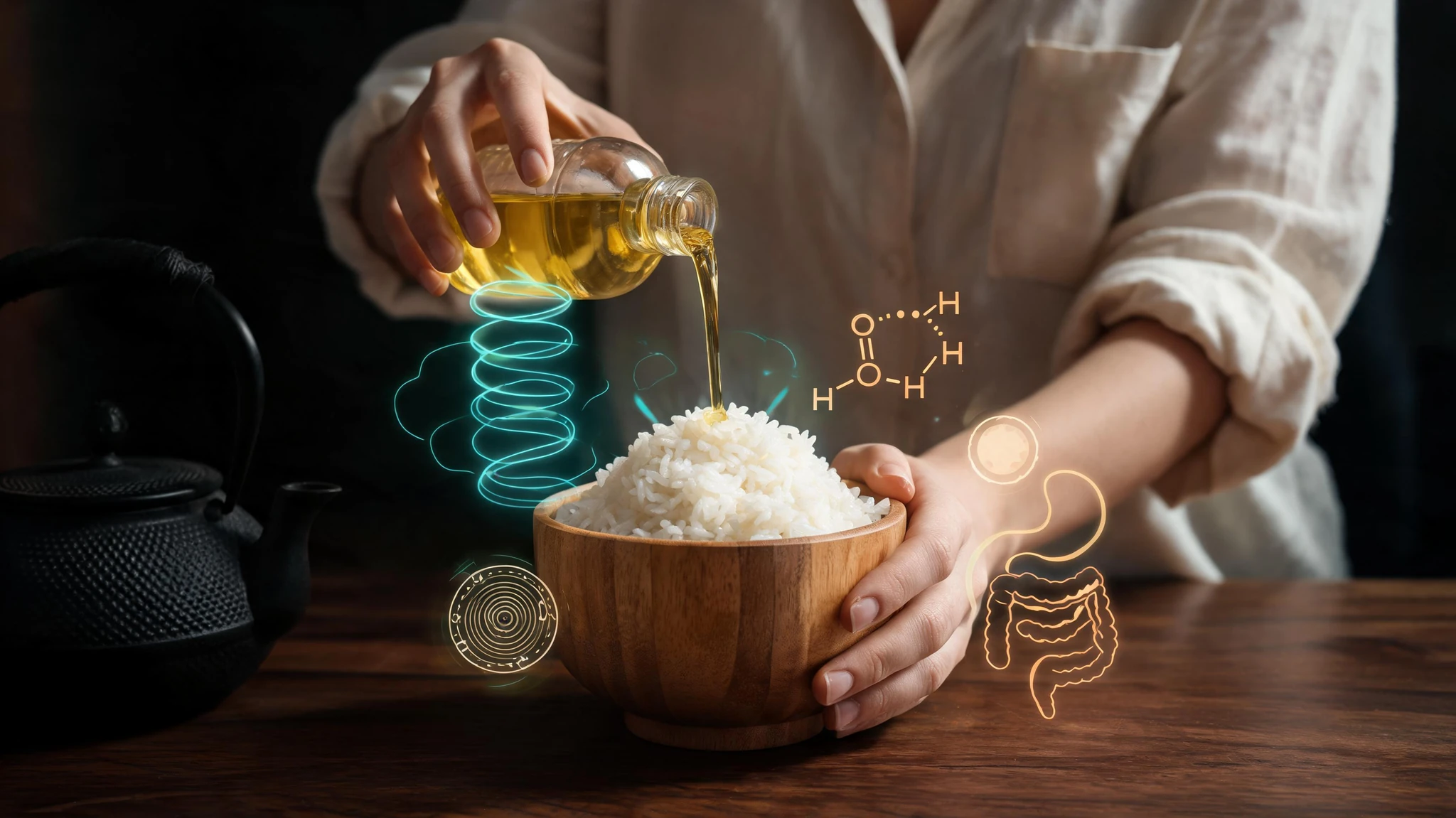
The James team’s hypothesis is that fatty acids from coconut oil, especially the medium-chain lauric acid, slip inside the helical structure of amylose during cooking. Lipids tucked into amylose helices are known in cereal chemistry as amylose-lipid complexes, and they are notoriously hard for digestive enzymes to break down. In wheat, maize, and rice systems, complexes between amylose and free fatty acids consistently slow enzyme access to the starch surface.4
Coconut oil was chosen partly because it is widely used in Sri Lankan cooking and partly because it contains a high proportion of medium-chain triglycerides, which are short enough to thread into the amylose coil. The researchers also tested other oils with broadly similar effects in their preliminary screen.
So the oil sets the stage. It does not, on its own, do the heavy lifting. The bigger shift happens after the rice comes off the stove.

The cooling step is doing most of the work
When rice cooks, water rushes into each starch granule and the tightly packed amylose chains uncoil and disperse. This is called gelatinization. It is what makes cooked rice soft and edible. As the rice cools, those chains start to find each other again, forming new hydrogen bonds and gradually crystallizing into a tougher, more compact structure that human amylase has trouble cracking open. Food scientists have measured this exact transition in cooked rice using rapid visco-analyzer testing, and they can track how the texture and internal pasting properties change hour by hour as a cooked rice sample cools and ages.3
In the James protocol, the cooling lasts about 12 hours in a household refrigerator. In the Sonia and colleagues study, which used standard cooked white rice without added oil, the cooling lasted 24 hours and produced a measurable jump in resistant starch and a meaningfully lower postprandial glucose response in healthy volunteers.1 The two studies differ in detail, but they point in the same direction. Cooled rice is metabolically calmer rice.
An interesting practical point: reheating the rice does not appear to undo the change. Once those amylose chains have re-bonded into their crystalline lattice, gentle reheating does not fully melt them back. That is why the cold rice trick survives the trip from refrigerator to lunchbox to microwave, at least according to the lab work done so far.
What does this mean for calories?
The headline figure of 10 to 15 percent fewer absorbed calories comes from the James presentation, where the team estimated the change based on resistant starch content and standard energy-conversion factors. That number has not yet been replicated in a fully peer-reviewed human trial with weight as an endpoint, and it is the kind of figure that should be held loosely. Real-world calorie absorption depends on chewing, transit time, the presence of fat and protein in the same meal, and the unique composition of each person’s gut microbes.
What has been replicated is the underlying physiology. Cooled cooked white rice, eaten reheated, raises blood glucose less than the same rice eaten freshly cooked.1 Animal studies of retrograded rice have shown lower body fat gain and improved blood lipid profiles compared with freshly cooked rice fed in equivalent portions, which is consistent with a real reduction in net energy intake.2
Put plainly, you should not expect a magic 15 percent off your dinner. You should expect a small, real, repeatable nudge in the right direction.

It is not just calories: the gut angle
Resistant starch is sometimes called the most important prebiotic you have never heard of. When it reaches the colon undigested, the bacterial communities living there break it down into short-chain fatty acids, mainly acetate, propionate, and butyrate. Butyrate is the preferred fuel for the cells lining the colon and is associated with anti-inflammatory effects on the gut barrier.
Recent animal work has tested whether feeding resistant starch can blunt the harmful changes that high-fat diets produce in the colon. In a 2025 mouse model, animals fed a high-fat diet supplemented with resistant starch showed reduced expression of several markers tied to colon cancer initiation, alongside shifts in their microbial communities.5 Mice are not people, and a single study is a single study, but the finding fits a pattern. Diets richer in fermentable starches keep colon ecology in better shape.
The cooled-rice tweak is not going to deliver the dose of resistant starch used in those research diets. It will, however, shift the dose in the right direction at every meal where you would have eaten plain white rice anyway. Over a week of weekday lunches, that adds up.
How to do it without overthinking it
The recipe James and colleagues described is unfussy. Bring water to a boil, stir in roughly one teaspoon of coconut oil per half cup of dry rice, add the rice, and cook for 20 to 25 minutes as usual. Spread the cooked rice on a plate or shallow container so it cools quickly to room temperature, then move it to the refrigerator for at least 12 hours. Reheat in the microwave or a covered pan with a splash of water before eating.
Two practical notes. The first is hygiene. Cooked rice can grow Bacillus cereus spores if it is left at room temperature for too long, so cool the rice quickly, refrigerate it within an hour, and reheat it thoroughly before eating. The second is taste. Coconut oil leaves a faint sweetness and a soft fragrance that pairs well with curries, stir-fries, and rice bowls. Fans of plain steamed rice may find it noticeable. A neutral oil like rice bran or sunflower will produce a similar amylose-lipid effect with less perfume, although the published data is strongest for coconut oil specifically.
You can apply the same logic to other starches. Cooked and cooled potatoes, pasta, oats, and beans all gain measurable resistant starch through retrogradation. Rice is just the most studied because it is the staple grain for billions of people and the easiest place to test a small kitchen change with a big public-health footprint.

Common questions about the rice and coconut oil trick
Does it have to be coconut oil?
No. Any oil with a reasonable share of medium- or short-chain fatty acids will form some amylose-lipid complexes during cooking. Coconut oil is the version tested in the James presentation, so the headline number is tied to it. Olive oil, butter, and ghee will likely produce a smaller but similar effect.
How long does the rice need to cool?
At least 12 hours in a refrigerator at standard fridge temperatures. The Sonia 2015 study used 24 hours and reported a clear effect. Anything beyond about a day produces diminishing returns.1
Will reheating destroy the resistant starch?
Most of it survives. Once amylose chains have crystallized during cooling, gentle reheating in a microwave or steamer does not fully melt them back. Frying on very high heat for a long time may unwind more of the structure, so a quick toss in a hot pan is fine, but a long, dry blast is less ideal.
Is this a weight-loss strategy?
Treat it as a small adjustment, not a strategy. A 10 to 15 percent reduction in absorbed calories from rice, if it holds up in larger trials, is meaningful only when the rest of the diet is already roughly in order. It will not offset a 1,500-calorie takeout binge.
Is it safe for people with diabetes?
For most people with type 2 diabetes, swapping freshly cooked white rice for the cooled and reheated version is likely to produce a smaller blood sugar spike, which is generally desirable. Anyone using insulin should check with their clinician before changing the carbohydrate behavior of a staple food, because medication doses are often calibrated to expected glucose responses.

What to take from this
The James 2015 presentation is preliminary. The 10 to 15 percent figure deserves a careful, well-funded human trial before it earns a place in dietary guidelines. What is not preliminary is the underlying chemistry. Cooking starch and then cooling it changes the molecule into something the human gut treats more like fiber and less like sugar, and the effect has been measured in cooked rice specifically using calibrated lab methods and human postprandial glucose tests.1,3
For a household that eats rice three or four times a week, the cost of the experiment is one teaspoon of oil and one extra step the night before. The likely upside is a slightly steadier blood sugar curve, a slightly happier colon, and a small reduction in total absorbed energy from one of the most reliably bland staples in the kitchen. That is a fair trade for the inconvenience of cooking rice the day before you plan to eat it.
Sources
- Sonia S et al. Effect of cooling of cooked white rice on resistant starch content and glycemic response. Asia Pacific Journal of Clinical Nutrition, 2015. PubMed: 26693746
- Ha AW et al. Effect of retrograded rice on weight control, gut function, and lipid concentrations in rats. Nutrition Research and Practice, 2012. PubMed: 22413036
- Nakamura S et al. Evaluation of hardness and retrogradation of cooked rice based on its pasting properties using a novel RVA testing. Foods, 2021. PubMed: 33946449
- Zhu F et al. Physical properties and enzyme susceptibility of rice and high-amylose maize starch mixtures. Journal of the Science of Food and Agriculture, 2013. PubMed: 23526376
- Zeng H et al. Resistant starch inhibits high-fat diet-induced oncogenic responses in the colon of C57BL/6 mice. The Journal of Nutritional Biochemistry, 2025. PubMed: 39788163