A small randomized trial published in Nutrition Research and Practice in 2017 found that adding seven grams of chia seeds to a yogurt breakfast significantly reduced short-term food intake and increased satiety in healthy adults compared to a control yogurt2. That single finding, run by Ayaz and colleagues at Hacettepe University, is the strongest piece of human evidence behind the wellness claim that a glass of chia seed water in the morning helps you eat less the rest of the day.
It is also more modest than what most social media posts suggest. The seeds did not melt fat. They did not detoxify anything. They made breakfast more filling, for a few hours, in a small group of people. That is the honest version of the story, and it is still useful.
What is chia seed water, really?
Chia seeds come from Salvia hispanica, a flowering plant native to central and southern Mexico. The Aztec and Maya cultivated it for centuries, and the seeds were a staple ration for runners and warriors. The modern wellness version is simpler: stir a tablespoon or two of dry seeds into a glass of water, wait ten to fifteen minutes, and drink the gelatinous result.
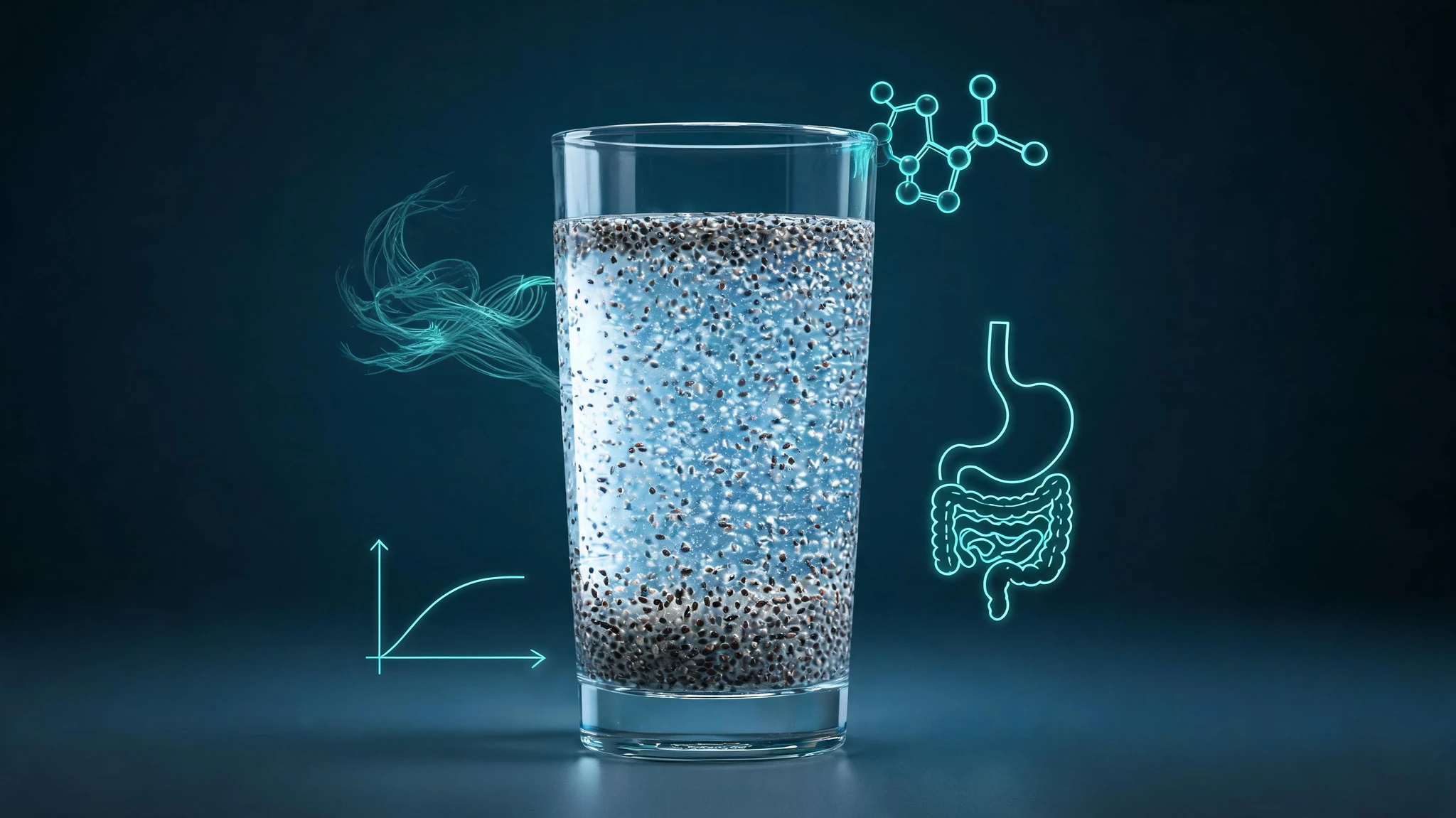
That gel is not a marketing trick. When chia seeds hit water, the outer hull releases soluble fiber called mucilage, which traps water against the seed and forms a transparent jelly. Lab analyses cited in a 2023 review in Food Science and Nutrition describe water absorption ratios of roughly ten to twelve times the seed’s dry weight, depending on temperature and time4. A single tablespoon of dry seeds, about twelve grams, ends up looking like a small bowl of frogspawn. Drinking it on an empty stomach is the version most often promoted, though the published research rarely tested that exact timing.

Does it really keep you fuller for longer?
This is the claim with the cleanest study behind it. In the Ayaz trial, twenty-four healthy young women ate a yogurt breakfast on four separate mornings. One yogurt was plain. The others contained seven, fourteen, or twenty-one grams of chia seed. The fourteen-gram and twenty-one-gram doses both lowered hunger ratings on a visual analogue scale, raised fullness, and reduced calories eaten at the next ad libitum meal2. The effect was not huge, but it was statistically real and dose-dependent.
The probable mechanism is mechanical. Soluble fiber slows gastric emptying. Food sits in the stomach longer, stretch receptors signal fullness for longer, and ghrelin (the hunger hormone) takes longer to rebound. A 2023 mechanistic review summarized the same pattern across several soluble-fiber sources, including chia, oats, and psyllium4.
What chia seed water seems not to do, on its own, is cause meaningful weight loss. Nieman and colleagues at Appalachian State University ran a twelve-week trial in seventy-six overweight adults, giving half of them fifty grams of chia per day. There were no significant differences in body mass, body composition, blood pressure, or inflammation markers compared to the placebo group1. The chia did not hurt anyone. It also did not move the scale. If you are hoping a morning glass will quietly do the work of a calorie deficit, the Nieman data is the polite version of “it will not.”
What about blood sugar?
Soluble fiber’s other well-documented trick is flattening the glucose response to a meal. The gel slows the speed at which carbohydrates reach the small intestine, which means glucose enters the blood as a long gentle hill instead of a sharp peak. The 2023 review compiled small clinical trials in adults with type 2 diabetes showing reduced postprandial glucose and lower HbA1c after several weeks of daily chia consumption, generally in the range of fifteen to forty grams per day4.
These are not enormous studies. Most had fewer than fifty participants and short follow-up windows. The direction of the effect is consistent, but the magnitude is modest, and chia is not a substitute for medication or for a broader dietary change. If you have diabetes or take glucose-lowering drugs, talk to your doctor before adding daily chia, since stacking effects can sometimes nudge fasting glucose lower than intended.

The omega-3 question: ALA is not fish oil
Chia seeds are unusually rich in alpha-linolenic acid, a plant-based omega-3 fatty acid. Roughly sixty percent of the fat in chia is ALA, the highest concentration in any common food crop. Marketing copy often translates this into “chia is a great source of omega-3s,” which is true on a label and incomplete in the body.
ALA is the parent omega-3. Your liver can convert it into the longer-chain omega-3s, EPA and DHA, that show up in oily fish and that drive most of the documented cardiovascular benefits of fish oil. The conversion rate in humans is famously poor: estimates from controlled feeding studies put it at roughly five to ten percent for EPA and under one percent for DHA. ALA still has independent effects, including a mild reduction in inflammatory markers in some trials, and it sits within a complex balance between dietary omega-3 and omega-6 intake that researchers like Innes and Calder have spent two decades mapping5.
An animal study from 2007 by Ayerza and Coates fed rats chia in three forms (ground seed, whole seed, and oil) and measured plasma fatty acids. ALA and EPA both rose; DHA did not3. That mirrors the human picture. Chia delivers ALA reliably, raises EPA modestly, and is not a replacement for a fatty fish habit if your goal is DHA.
This matters for how you talk about the morning glass. Saying “chia gives you omega-3s” is fair. Saying “chia replaces salmon” is not.
Fiber, gut bacteria, and the bathroom question
Two tablespoons of chia seeds, around twenty-four grams, contain roughly ten grams of fiber. Most American adults eat about fifteen grams of fiber a day total, against a recommended twenty-five to thirty. A daily glass of chia water can close a meaningful chunk of that gap by itself.
The fiber is mostly insoluble (about eighty percent) with the rest soluble mucilage. Insoluble fiber adds bulk and water to stool, which speeds transit and can help with mild constipation in people who are not already getting enough plant matter. Soluble fiber feeds gut bacteria; the 2023 review notes increases in short-chain fatty acid production after sustained chia intake, particularly butyrate, which colonocytes use as fuel4.
If you currently eat a low-fiber diet, ramp up gradually. Going from three grams of fiber a day to thirteen overnight is a recipe for gas, bloating, and a couple of unhappy afternoons. Start with a teaspoon of seeds, work up to a tablespoon, and drink water alongside.

The one safety story worth taking seriously
In 2014, gastroenterologists at the American College of Gastroenterology presented a case of a thirty-nine-year-old man who swallowed a tablespoon of dry chia seeds and then drank a glass of water. The seeds expanded in his esophagus, formed a single dense bolus, and he ended up in the emergency department needing endoscopic removal. Several similar case reports have appeared since.
The number of cases is small relative to the millions of people eating chia daily without incident, but the mechanism is real and easy to avoid. Hydrate the seeds first. Stir them into water, milk, or yogurt, wait ten to fifteen minutes, and then drink or eat the mix. People with a history of swallowing difficulties (dysphagia), strictures, or motility disorders should be especially careful, and probably skip dry seeds entirely.
The original Facebook post that inspired this article put it cleanly: “Pre-soaking your seeds is actually the safer approach.” That is the entire safety message. Soak first.
Does the empty-stomach, morning timing matter?
Honestly, the published evidence does not say. The Ayaz trial used chia at breakfast2. Most diabetes trials in the 2023 review used chia distributed across meals4. The Nieman trial used a daily dose with no specific timing constraint1. None of these tested fasted morning chia against the same dose at lunch or dinner.
The mechanistic case for morning timing is plausible but soft. A fiber-rich first food can blunt the glucose curve from the rest of the day’s meals, and an early satiety boost may translate to fewer calories at lunch. None of this has been proven to outperform the same chia eaten later. If a morning glass is what you will actually do, do it in the morning. The timing matters less than the consistency.

What a sensible daily protocol looks like
Across the human studies, doses ranged from seven grams (about a teaspoon) up to fifty grams (about four tablespoons) per day. Effects on satiety appeared at the lower end. Effects on blood lipids and glucose tended to require fifteen to twenty-five grams or more, sustained over weeks4.
A reasonable starting point for most adults is one tablespoon (about twelve grams) stirred into a glass of water, plant milk, or kefir, soaked for at least ten minutes, taken once a day. Some people prefer chia pudding the night before; others sprinkle pre-soaked seeds into oatmeal or yogurt. The biology does not care about the vessel. It cares that the seeds are hydrated, the dose is steady, and the rest of your diet is not built on ultra-processed food.
Skip chia, or check with a clinician, if you are on blood thinners (ALA can have a mild antiplatelet effect at high doses), if you have a history of swallowing problems, or if you are on glucose-lowering medication and not monitoring trends.
Quality matters less than people assume. Black and white chia seeds are nutritionally near-identical; the color difference is cosmetic. Organic seeds are not noticeably more nutritious than conventional ones, though some buyers prefer them for pesticide-residue reasons. Storage matters more: ALA oxidizes when exposed to heat, light, and air over months, so keep an opened bag in a sealed container in a cool dark cupboard, and use it within a year. Rancid chia smells faintly like old paint. If yours does, throw it out.
Common questions about chia seed water
Do you have to drink it on an empty stomach for benefits?
No. The strongest human trials measured chia at meals or as a daily total dose, not specifically fasted. A morning glass is fine; an evening one will likely work just as well.
How long before chia seed water shows results?
Satiety effects can show up the same day. Changes in blood lipids and HbA1c took eight to twelve weeks of daily intake in published trials.
Can chia seed water help with weight loss?
Indirectly, by helping you feel full and eat less. The one twelve-week randomized trial of chia alone found no weight change without a calorie deficit1. Chia is a tool, not a treatment.
Is it safe to eat chia seeds dry?
It is generally safe but carries a small, real risk of esophageal blockage if dry seeds are swallowed and water is then chased on top. Soak first.
How much chia per day is too much?
Most studies cap at fifty grams a day, around four tablespoons. Beyond that, gastrointestinal side effects (gas, loose stools) start outweighing benefits for most people.
The honest bottom line
Chia seed water is a quiet, useful habit with a small evidence base behind a few specific claims. It can take the edge off morning hunger, it adds meaningful fiber to a typical Western diet, it nudges blood sugar curves and lipid profiles in the right direction over weeks, and it delivers ALA that your body will use, mostly as ALA. It will not undo a poor diet, melt belly fat, or do anything dramatic in three days.
If a glass of soaked chia in the morning makes the next twelve hours easier, that is a real win, even if it is a smaller one than the captions suggest. The seeds have been around for three thousand years. They are not going anywhere, and they are not magic. Both can be true.
Sources
- Nieman DC et al. Chia seed does not promote weight loss or alter disease risk factors in overweight adults. Nutrition Research, 2009. PubMed: 19628108
- Ayaz A et al. Chia seed (Salvia Hispanica L.) added yogurt reduces short-term food intake and increases satiety: randomised controlled trial. Nutrition Research and Practice, 2017. PubMed: 28989578
- Ayerza R Jr et al. Effect of dietary alpha-linolenic fatty acid derived from chia when fed as ground seed, whole seed and oil on lipid content and fatty acid composition of rat plasma. Annals of Nutrition & Metabolism, 2007. PubMed: 17356263
- Khalid W et al. Chia seeds (Salvia hispanica L.): A therapeutic weapon in metabolic disorders. Food Science & Nutrition, 2023. PubMed: 36655089
- Innes JK et al. Omega-6 fatty acids and inflammation. Prostaglandins, Leukotrienes, and Essential Fatty Acids, 2018. PubMed: 29610056