For 14 years, Krista Richard of Moncton, Canada, has been collecting, fixing, and giving away bicycles and tricycles to children whose families could use the help. Good News Network reported that the effort has reached thousands of children and grew from one person’s kindness into a local volunteer rhythm.
The science angle is modest but real. A bike is transportation, play, coordination practice, outdoor time, and a reason to meet neighbors. Studies link children’s physical activity with better mental-health outcomes and emotional adjustment, although a donated bicycle is only one possible doorway into that larger pattern.1,2
The story behind the bikes
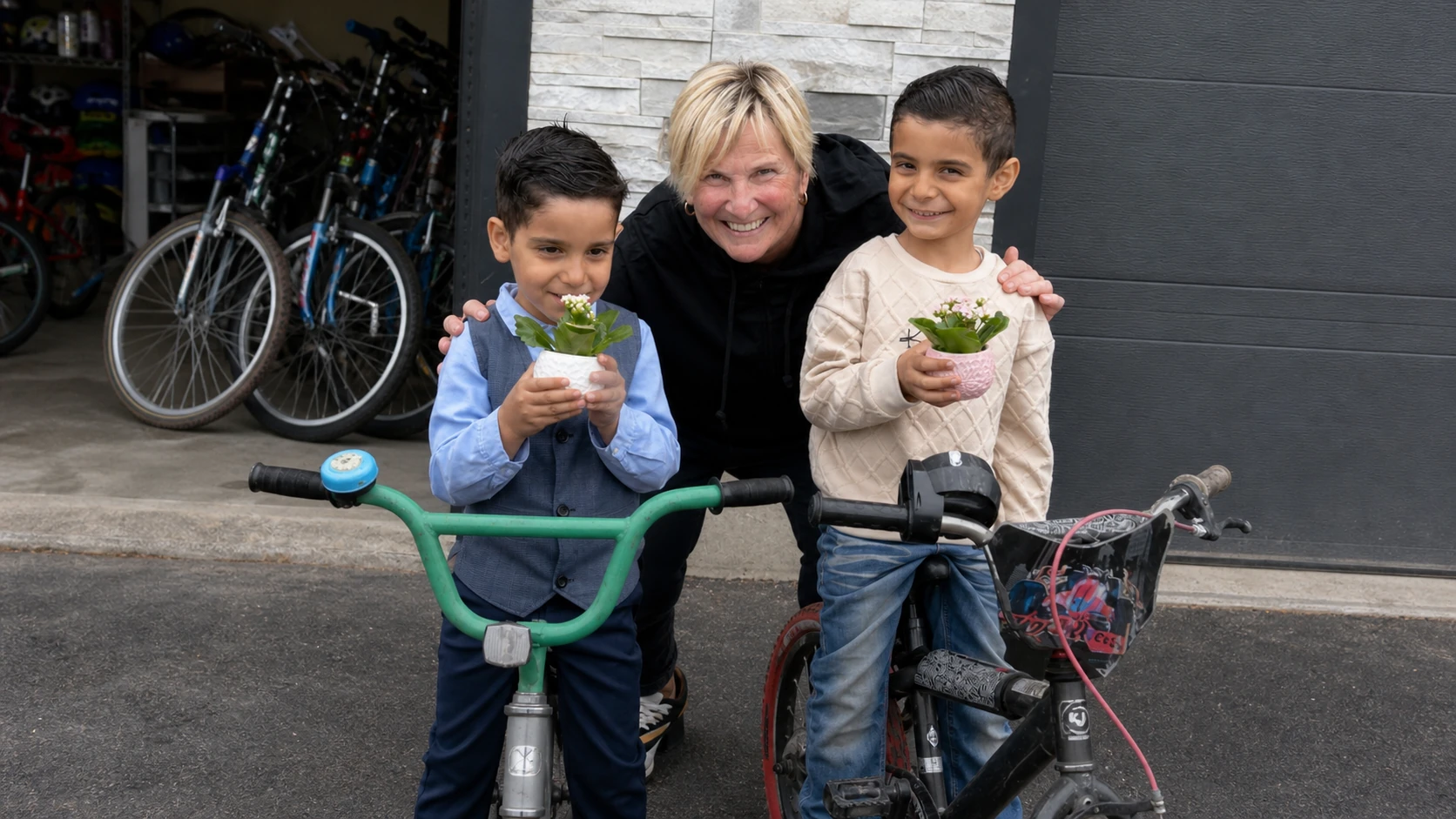
Richard collects bicycles through the year, repairs what she can, and holds giveaways during warmer months. One photo from the project shows her smiling between two young boys, Younis and Aws, with children’s bikes close by. It is the kind of scene that explains the appeal of the story faster than a statistic can: a repaired bike, a child waiting to ride, and an adult who decided the work was worth doing.
Richard’s project is simple in form. People donate bikes. Volunteers help collect and repair them. Families who might not be able to buy a new bike get one. The result is practical, but the emotional part matters too. A child with a bike has a way to explore the block, visit a friend, practice balance, and join the ordinary childhood traffic of sidewalks and driveways.
Why a bike can feel bigger than a bike
For many children, learning to ride is a body lesson. Steering, braking, scanning, balancing, and pedaling all happen at once. A 2022 paper on bicycle riding in children with and without developmental disabilities describes sensory-motor, social, and emotional benefits from learning to ride.3 That does not mean every donated bike creates the same outcome. It does mean the object itself can become a practice space.

There is a confidence piece as well. Children often remember the first time they ride without help because it feels like proof. They can move under their own power. They can keep up. They can be part of the group. For families with tight budgets, that ordinary milestone can be delayed by cost. A repaired bicycle narrows that gap.
Outdoor play still matters
The mental-health research around children and movement is broad, not bike-specific. A 2019 systematic review and meta-analysis found physical activity was associated with better mental health in children and adolescents, while more sedentary behavior was linked with poorer outcomes.1 That does not turn every ride into therapy. It does make a strong case for keeping active play within reach.
A bicycle also changes the social map. Kids ride to the same patch of pavement, wait their turn, copy older riders, and learn small rules without calling them rules. Parents meet other parents. Neighbors see children outside. Richard’s work points to something simple that many communities miss: outdoor play helps children and families know each other again. That part is hard to measure, but easy to recognize.
A volunteer project with a low-tech genius
Many good community ideas fail because they need too much paperwork, money, or expertise. A bike giveaway has a clearer path. It asks for used equipment, basic repair, storage, and people willing to show up. That does not make it easy. It does make it understandable, which is one reason such projects can last.

The generosity here is not abstract. Someone has to pick up the bike. Someone has to check the chain, brakes, tires, seat height, and handlebars. Someone has to match a child with a ride that fits. That ordinary labor is the difference between a garage full of rusting metal and a child pedaling away.
The health lesson hiding inside a good-news story
Beauty Health Page has covered exercise and the brain many times, including the piece on walking and older adult brain health. This story sits at a gentler angle. It is about access before outcomes. Kids cannot build active habits with equipment they never receive and safe spaces they never enter.
For readers drawn to family wellbeing, the related article on early screen exposure and child development is another reminder that childhood health is shaped by daily environments. A bike is one small environmental change. Sometimes small is exactly where a community can start.
What this means in real life
The best part of a bike giveaway is how normal the gift becomes once a child starts riding. It stops being a charity object and turns into a way to reach the park, circle the driveway, or keep up with other kids on the block. That kind of normal childhood freedom is easy to overlook until cost gets in the way.
A repaired bike can also make parents feel less alone. Someone in the community noticed a need, found a practical answer, and did the work. Families remember that. Children remember it too, even if what they mostly remember is the first wobbly ride and the feeling of speed.
Projects like Richard’s work because they are specific. They do not promise to fix every problem facing children. They fix one visible barrier and let families build from there. Sometimes that is exactly the kind of help a community can repeat.
The health research gives this story a little more weight, but the heart of it is still practical. Children are more likely to move when movement is available, affordable, and woven into play. A bike can make that happen without turning childhood into a program.
It also shows how health can begin before a clinic or a gym. Sometimes it begins with a neighbor, a repaired chain, a safe helmet, and a child realizing the street has opened up a little.
There is another quiet benefit in repair culture itself. Children see adults fixing something instead of throwing it away. They see care expressed through tools, patience, and hand-me-down usefulness. That lesson may stay with them long after the first bike is outgrown.
Communities can also use projects like this to notice where children are missing from public life. If families receive bikes but still have nowhere safe to ride, the next question becomes sidewalks, traffic, lighting, parks, and adult supervision. A bike can start a larger conversation without making it abstract.
How to use this wisely
Stories like this can sound sentimental until the practical details come into view. A child does not ride a quote about generosity. A child rides a bicycle with working brakes, tires that hold air, and a seat set at the right height. The repair work is the part that turns kindness into access.
Families also know that children’s hobbies can be expensive in quiet ways. A bike needs a helmet, storage, supervision, and safe places to ride. When a volunteer project removes the first cost, it still leaves parents with work to do, but it makes the starting line much closer.
There is also dignity in receiving something repaired well. A donated bike should not feel like junk passed down because a child is poor. The best community projects understand that quality matters. Kids notice when adults treat their joy as worth careful effort.
Local versions of this idea can stay small. One church basement, one school parking lot, one neighborhood collection day, or one repair table at a community center can help. The project does not need to become a nonprofit before it becomes useful.
The story also reminds adults to look at what is already sitting unused nearby. Garages, sheds, and apartment storage rooms often hold bikes children have outgrown. With safe repair checks, those bikes can move from clutter to childhood memory.
The deeper lesson is plain: access changes participation. If people want children outside, moving, and meeting each other, then the tools for that life have to be reachable. Richard’s project makes that idea visible in the most literal way, one bike at a time.
A strong bike-donation project also keeps safety in view. Helmets, reflectors, correct sizing, and brake checks are part of the gift. A child who receives a bike should also receive a fair chance to ride it safely, especially in neighborhoods where traffic or broken sidewalks make outdoor play harder.
There is room for schools, repair shops, and local clubs to help without taking over. A shop can donate labor for a few bikes. A school can identify families privately. A cycling club can teach basic road rules. The work stays local, and that is part of its strength.
Common questions about canadian woman gave kids free bikes for 14 years
Who is Krista Richard?
She is a Canadian woman from Moncton who has reportedly repaired and given away bicycles and tricycles to children for 14 years.
Why do donated bikes matter for health?
They can make outdoor movement easier for children whose families cannot easily buy new equipment.
Do studies prove bikes improve mental health?
The research is broader than bikes. It links children’s physical activity with better mental-health and emotional outcomes.
Can families copy this idea locally?
Yes. The basic model is used-bike collection, safe repair checks, volunteers, and careful matching of bikes to children.
What to take from this
The appeal of Richard’s project is that it does not ask anyone to believe in a miracle. A child needs a bike. A neighbor has one sitting unused. Someone repairs it. Then the child rides.
That is quiet, repeatable generosity. After 14 years, the number of children matters, but so does the method. It shows how a practical kindness can keep moving under its own power.
Sources
- Rodriguez-Ayllon M et al. Role of Physical Activity and Sedentary Behavior in the Mental Health of Preschoolers, Children and Adolescents: A Systematic Review and Meta-Analysis. Sports medicine (Auckland, N.Z.), 2019. PubMed: 30993594
- Brière FN et al. Consistent participation in organized physical activity predicts emotional adjustment in children. Pediatric research, 2020. PubMed: 31086286
- Schoen SA et al. It’s Not Just about Bicycle Riding: Sensory-Motor, Social and Emotional Benefits for Children with and without Developmental Disabilities. Children (Basel, Switzerland), 2022. PubMed: 36010114