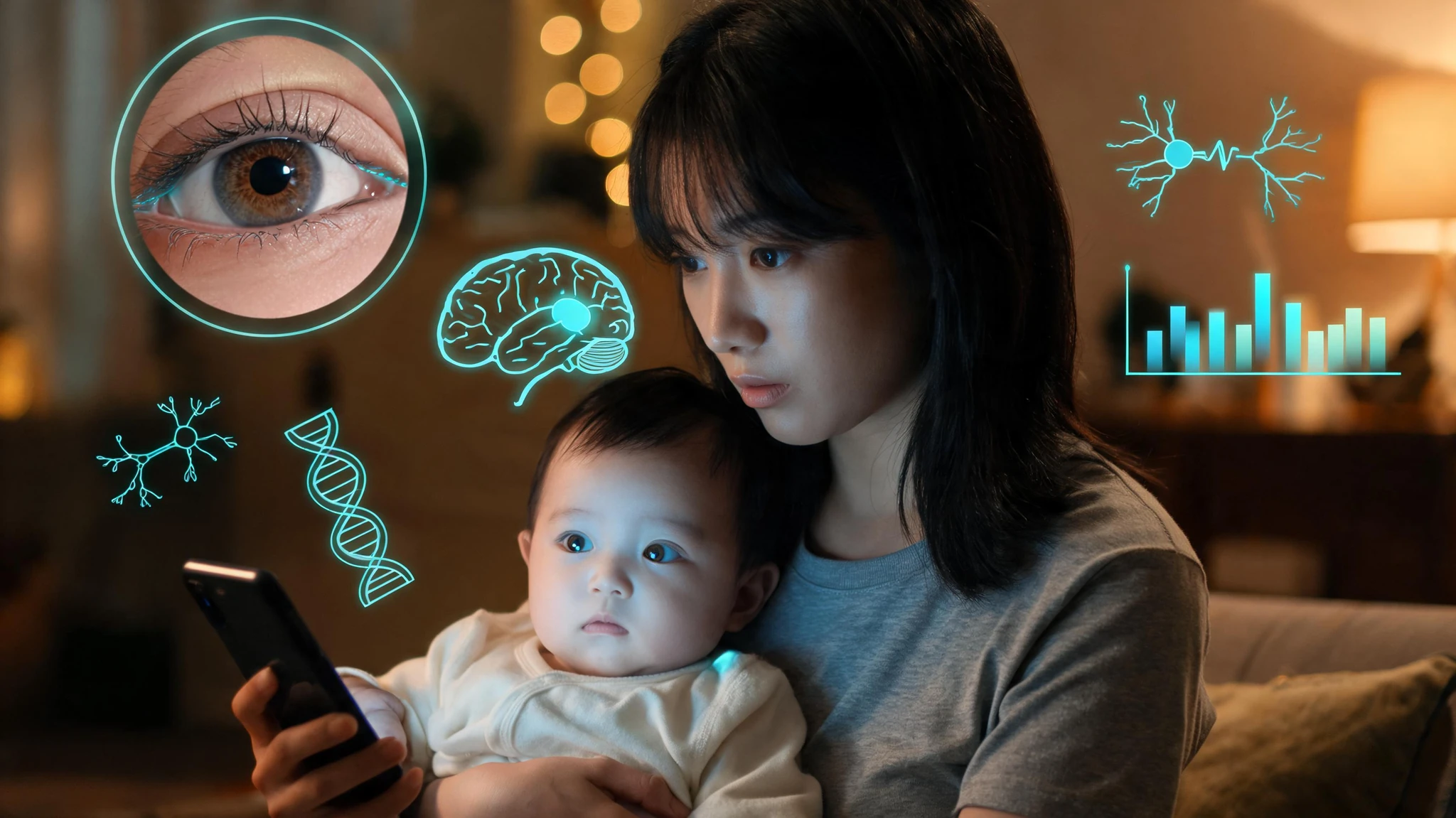
Babies who logged the most screen time in their first two years showed measurable differences in brain activity, slower decision-making by age eight, and higher anxiety symptoms by age thirteen, according to a long-running Singapore birth cohort tracked by Huang and colleagues at the Singapore Institute for Clinical Sciences and published in EBioMedicine in 2026.1 The same research group had already shown, in a 2023 JAMA Pediatrics paper led by Law, that infants with heavier screen exposure had altered EEG activity at 18 months and weaker performance on executive function tests at age nine.2
Those are unusually concrete findings in a field that has been long on alarm and short on data. They do not say screens cause permanent damage. They do say that what a baby looks at in the first 24 months appears to leave a footprint, and that the footprint is still detectable years later.
What did the new study actually find?
The Singapore researchers followed roughly 437 mother-and-infant pairs from the GUSTO cohort. Parents reported how many hours a day their babies spent in front of any screen, including phones held by adults nearby. The team then ran EEG scans at 18 months and circled back with cognitive testing at age 9 and anxiety questionnaires at age 13.1,2
Babies in the highest screen-time group, averaging more than two hours a day before age 2, showed reduced power in EEG frequency bands tied to attention and executive function. By age 9, they took longer to make decisions on tasks that required them to switch rules or hold information in mind. By the early teen years, the same children reported more anxiety symptoms than peers with lighter early exposure. The associations held after the team adjusted for household income, maternal education, and later screen use.1
One detail in the data is worth dwelling on. The relationship between infant screen time and adolescent anxiety was not direct. It ran through the EEG markers picked up at 18 months, which in turn predicted the cognitive scores at 9, which in turn predicted the anxiety symptoms at 13. In other words, the early brain signature appears to be the bridge.1,2
Why the first two years are different
The infant brain doubles in volume in the first year and reaches roughly 80 percent of adult size by age three. During that stretch, neurons are forming roughly a million new connections per second, and the connections that get used are the ones that survive. The ones that go quiet get pruned away.

That use-it-or-lose-it logic is why what an infant attends to genuinely matters. Hearing a parent narrate a snack, watching their face crinkle into a smile, reaching for a wooden block and missing, hearing a sibling laugh in the next room. Every one of those moments lights up overlapping circuits across the auditory cortex, the prefrontal cortex, and the social brain. A bright tablet screen lights up something narrower. The visual processing areas spike, but the auditory and social inputs that drive language and attention regulation are thinner or absent.
The 2020 Hutton study at Cincinnati Children’s Hospital used diffusion MRI to look at white matter in 47 preschoolers. Children who spent more time on screens, and whose parents read with them less, had lower fractional anisotropy in tracts that support language and emergent literacy. Those tracts include the inferior longitudinal fasciculus and the superior longitudinal fasciculus, which carry signals between the regions handling speech sounds and meaning.3 The study was small and cross-sectional, so it could not prove causation. It could show, vividly, that the brain wiring of heavy-screen kids looked physically different on a scan.
It is not just one study
The Singapore findings sit on top of a stack of earlier work pointing in the same direction. A Canadian team led by Sheri Madigan, working with the All Our Families cohort of around 2,400 children, reported in 2019 that more screen time at 24 months predicted poorer scores on a developmental screening test at 36 months, even after the team adjusted for the obvious confounders.4 The effect ran in one direction. Lower developmental scores did not predict higher screen time later. The arrow of time pointed from screens to development, not the other way around.
Madigan’s group followed up two years later in Pediatrics, this time looking at reading.5 Preschoolers who spent more time on screens read less for pleasure as they aged into kindergarten and first grade. The reading deficit was not large per child. Across an age cohort, it was the kind of shift that moves bell curves.
Each of these papers has caveats. Parents under-report or over-report their kids’ screen time. Households that use a lot of screens tend to differ from low-screen households in dozens of ways. The studies adjust statistically, but no statistical adjustment is perfect. Still, when four research teams on three continents reach a similar conclusion using different methods, the signal is hard to wave off.
What babies actually need during this window
The flip side of the screen-time literature is the developmental literature on what babies do thrive on. The list is short and unsurprising. Talking, narrated daily life, eye contact, back-and-forth babbling, being carried, floor time, pots and pans, water in a sink, the texture of a soft toy, the smell of dinner, music sung by a familiar voice. None of it requires a budget.

The mechanism is straightforward. Each of those experiences sends multimodal input to the brain. The baby hears a word, sees a face form the word, sees the object the word refers to, feels a hand on her back. That convergence trains the language and social circuits in a way no screen, however well-designed, has ever matched in the lab.
Reading aloud is the heaviest hitter in this list. Hutton’s earlier work has shown that children who are read to from infancy show stronger activation in left-hemisphere language regions during story listening. The Madigan team’s reading paper extends that pattern: kids who read more in early childhood read more, faster, and with more comprehension later.3,5 Even ten minutes a day of board books appears to shift the trajectory.
How big is the screen effect, really?
This is the question parents most want a number for, and it is the one researchers are most cautious about. Effect sizes in observational developmental studies tend to be small to moderate. In Madigan’s 2019 paper, the difference in developmental scores between high-screen and low-screen kids was about a third of a standard deviation.4 That is not a child failing kindergarten. It is a child landing slightly behind where they would otherwise have been on a screening test.
What the Singapore papers add is a hint that small effects compound. A 0.3 standard deviation gap in toddler executive function may sound modest. By age 9, with school demands stacking on, that gap widens. By 13, with adolescent anxiety pressures arriving, the same children are more likely to report worry, sleep trouble, and avoidance.1,2
The honest summary is that screen time is one input among many. Sleep, nutrition, language exposure, parental responsiveness, sibling interaction, and outdoor play all swamp it. But screens are the input parents have the most direct daily control over.
The buffer that keeps showing up: shared reading
The most actionable finding in the Singapore data is that parent-child reading at age 3 substantially weakened the link between infant screen exposure and altered brain development.1,2 Children who had been heavy screen users as babies, but whose families read with them regularly later, showed cognitive scores closer to the low-screen group than to their high-screen peers.

That is the kind of result researchers tend to call “encouraging” because it implies plasticity. The infant brain is shaped by what it gets, but it is not finished at age two. Enriched, interactive experiences in the toddler and preschool years can move the needle back. Hutton’s white matter findings, McArthur’s reading data, and the Singapore team’s mediation analysis all point at the same lever.3,5,1
What the major pediatric organizations actually recommend
The American Academy of Pediatrics suggests no screen media for children under 18 to 24 months, with one exception for live video chatting with relatives. Between ages 2 and 5, the AAP recommends limiting non-educational screen time to about an hour a day of high-quality programming, ideally co-viewed with a caregiver. The World Health Organization issues similar guidance, with even tighter limits for the under-2 group.
These guidelines were written before the Singapore mediation results were published, and they have not been loosened in light of newer evidence. If anything, the new data give them more support, not less.
Real-world adherence is another story. Surveys in the United States, the United Kingdom, and Singapore consistently find that the majority of children under 2 use screens daily, often for an hour or more. Parents are not ignoring the guidance because they do not care. They are tired, working from home, juggling other children, or trying to make dinner.
Practical moves that fit a real household
Three patterns show up across the research as meaningfully protective. None of them require a perfect parent.
The first is shifting passive viewing toward shared viewing. A baby watching a video alone gets one input. A baby watching the same video on a parent’s lap, with the parent narrating and pointing and pausing, gets language input layered on top. The screen becomes a backdrop rather than the lesson.
The second is establishing one or two reliably screen-free anchors in the day. A morning of floor play, a bath without a tablet, a meal without a phone propped up. Consistency seems to matter more than purity. Kids whose families had any predictable screen-free time did better than those whose screen exposure was uniformly high or chaotically variable.

The third is reading. Even five to ten minutes a day of board books with an infant changes the texture of the day, gives a parent a script when they are out of words, and stacks the kind of multimodal input the developing brain is wired to use. Hutton’s neuroimaging work and the Madigan reading paper both suggest that this single habit does heavy lifting.3,5
Common questions about screens and infant brain development
Does video chatting with grandparents count as harmful screen time?
No. Major pediatric guidelines specifically exempt live video chat. The reason is that real-time interaction with a familiar person provides social and language input that recorded content does not.
What about educational baby apps and shows?
Studies that have compared “educational” content with general entertainment in children under 2 have not found reliable cognitive benefits. Below age 2, the brain has trouble transferring information from a 2D screen to the 3D world, a phenomenon researchers call the video deficit.
Is a little background TV harmful?
Background screens compete with the auditory input babies need. Studies have shown that parents talk less when a TV is on, and the words spoken are shorter and less varied. Even if the baby is not watching, the room is changing.
My child watched a lot of screens as a baby. Is it too late?
Probably not. The Singapore data and Hutton’s work both suggest that the toddler and preschool brain remains responsive. Reading together, talking through the day, and protecting unhurried play time appear to soften earlier exposure.1,3
Are some kids more vulnerable than others?
Yes. Children with existing developmental concerns, premature infants, and kids in households where screens replace conversation rather than supplement it appear to be at higher risk in most studies. This is one reason the AAP frames its guidance as a household-wide pattern rather than a per-minute budget.
Where this leaves a tired parent at 6 p.m.
The science does not require guilt. It does suggest that the early years are a window where small inputs add up. Twenty minutes of screen time on a hard day will not undo a childhood. A consistent pattern of screens substituting for face-to-face interaction, sustained over hundreds of days, can.
The encouraging thread running through every paper cited here is the same one Huang and her colleagues wrote into their conclusion. Even when the early signature is there, the brain keeps changing. Reading together, talking, playing on the floor, and being present in ordinary, unremarkable ways are still the most reliable interventions on the table. They were before the screen era. They still are.
Sources
- Huang P, Chan SY, Zhou KX, et al. Neurobehavioural links from infant screen time to anxiety. EBioMedicine. 2026. PubMed: 41469287
- Law EC, Han MX, Lai Z, et al. Associations Between Infant Screen Use, Electroencephalography Markers, and Cognitive Outcomes. JAMA Pediatrics. 2023. PubMed: 36716016
- Hutton JS, Dudley J, Horowitz-Kraus T, DeWitt T, Holland SK. Associations Between Screen-Based Media Use and Brain White Matter Integrity in Preschool-Aged Children. JAMA Pediatrics. 2020. PubMed: 31682712
- Madigan S, Browne D, Racine N, Mori C, Tough S. Association Between Screen Time and Children’s Performance on a Developmental Screening Test. JAMA Pediatrics. 2019. PubMed: 30688984
- McArthur BA, Browne D, McDonald S, Tough S, Madigan S. Longitudinal Associations Between Screen Use and Reading in Preschool-Aged Children. Pediatrics. 2021. PubMed: 34031229