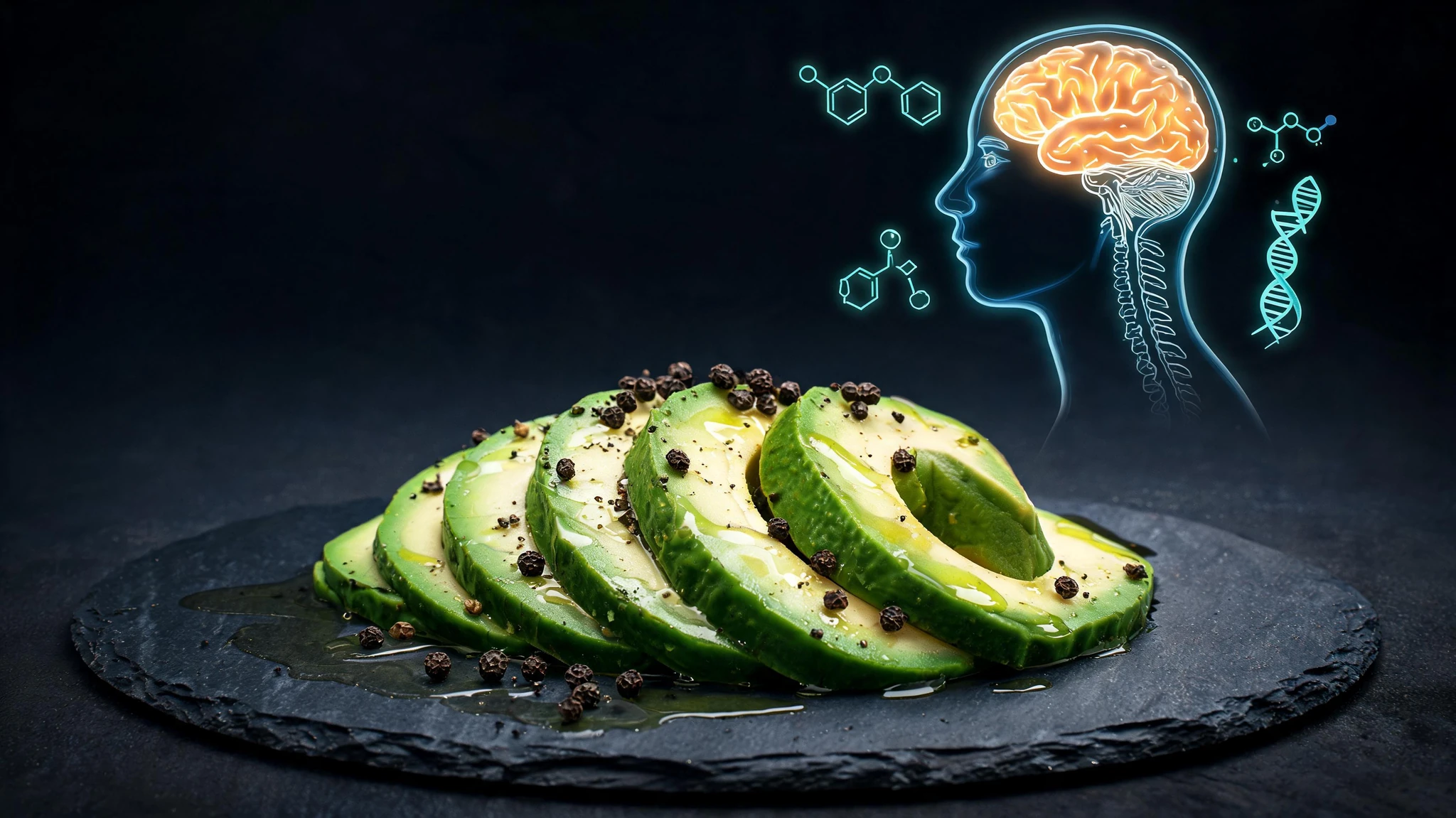
Adults over 50 who ate one Hass avocado every day for six months ended up with about 25% more of a brain-protective pigment called lutein in their blood, and they did measurably better on tests of working memory and sustained attention than people who skipped the fruit. That finding, from a randomized controlled trial led by Tammy M. Scott at the Jean Mayer USDA Human Nutrition Research Center on Aging at Tufts, was published in Nutrients in 2017.1
It is not a cure for cognitive decline, and the effect size is modest. But it is one of the cleaner pieces of evidence connecting a single, ordinary food to brain function in older adults, and the mechanism it points to is interesting enough that nutrition researchers have been chasing it ever since.
What the Tufts trial actually showed
The Tufts team recruited 40 healthy adults aged 50 and older and asked half of them to eat one fresh Hass avocado a day for six months. The other half ate either one cup of chickpeas or 30 grams of potato per day, matched roughly for calories but very different in fat and pigment content. Everyone had blood work, eye imaging, and a battery of cognitive tests at the start, the middle, and the end of the trial.1
Two things changed in the avocado group. Macular pigment optical density, a measurement of carotenoids deposited in the retina that also tracks lutein levels in brain tissue, went up significantly. And on tasks that probe sustained attention and the ability to hold information in mind for a few seconds at a time, the avocado eaters improved more than the controls. The chickpea and potato groups did not show the same shift, even though chickpeas brought their own modest nutritional benefits.
The trial was small. Forty people split across three arms is not the kind of sample size that moves clinical guidelines on its own. Scott and her colleagues were careful to frame it as preliminary, and the paper itself recommends larger replications. Still, the design was a randomized controlled trial with objective biomarkers, which puts it well above the standard FB-post claim of “superfood for your brain.”
Why lutein, of all things
Lutein is a yellow carotenoid pigment most people associate with eye health, because it concentrates in the macula and helps filter blue light. What is less widely known is that lutein also crosses the blood-brain barrier and accumulates in regions tied to memory and learning, particularly the frontal and occipital cortex.4 A 2019 review by Stringham, Johnson, and Hammond traced the pigment’s role from childhood cognition to the aging brain and made the case that the same antioxidant chemistry that protects the retina seems to protect neurons too.
That is not a fringe idea. A 2022 systematic review in Physiology & Behavior looked at studies linking macular pigment density to cognitive performance and concluded the evidence is consistent enough to take seriously, particularly for processing speed and memory in older adults.3 The reviewers stopped short of declaring causation, since most of the included studies were observational, but the convergence between retinal lutein, brain lutein, and test scores was hard to wave away.

Avocados happen to be one of the better dietary delivery vehicles for lutein. The pigment is fat-soluble, which means the body absorbs almost none of it from raw spinach or kale unless you eat the greens with oil or another fat. Avocado bundles the lutein with its own monounsaturated fat in the same bite, which is part of why the Tufts blood-lutein numbers moved as much as they did.
The fat matters as much as the pigment
About three-quarters of the calories in a Hass avocado come from fat, and most of that fat is oleic acid, the same monounsaturated fat that gives olive oil its reputation. Replacing saturated fat with monounsaturated fat tends to lower LDL cholesterol and improve markers of vascular health, and the brain is a vascular organ. Roughly 20% of the body’s blood flow goes to the brain at any moment. Anything that keeps the small vessels supple and the endothelium functioning has a fair chance of showing up in cognitive tests over time.
That is the theory, anyway. Edwards and colleagues tested a related version of it in 2020, in a 12-week trial of avocado consumption in 84 adults with overweight or obesity, published in the International Journal of Psychophysiology.2 The avocado group did not show a broad sweep of cognitive gains, but they did improve on a specific measure of attentional inhibition, the ability to suppress distracting information and stay locked onto a task. The authors linked the change tentatively to the combined effect of lutein and the fruit’s monounsaturated fat profile, while flagging that the trial ran for three months, not six, and used a younger sample.
So the picture across two trials is not “avocados make everyone smarter.” It is more like: in older adults, a daily Hass avocado modestly raises a pigment that brain tissue uses, and on certain attention-related tasks, that change shows up as better performance. Whether the same effect carries over to people in their thirties and forties, or whether it would compound over years of consumption, nobody has shown yet.

Where does black pepper come in
The original FB post that prompted this article suggested adding black pepper to the avocado, citing piperine, the compound that gives pepper its bite, as a “bioenhancer.” That phrasing is fair if you read it carefully, and overblown if you don’t.
Piperine has a real, measured effect on the absorption of certain compounds. The most cited demonstration is a 1998 study in Planta Medica by Shoba and colleagues, which found that 20 milligrams of piperine taken with two grams of curcumin (the active compound in turmeric) raised curcumin’s bioavailability in human volunteers by roughly 2,000% compared to curcumin alone.5 That is a striking number, and it has driven nearly every turmeric-with-pepper supplement on the market for the last 25 years.
The catch is that the same multiplier does not automatically apply to every other nutrient. Piperine appears to work mainly by inhibiting certain liver enzymes and slowing the gut’s clearance of specific molecules, which means its boost is selective. There is no published human trial showing that piperine meaningfully increases lutein absorption from avocado. Animal data on piperine and cognition is suggestive, but the leap from a rat hippocampus to a human meal plan is wider than wellness posts usually acknowledge.
None of which is a reason to skip the pepper. Cracked black pepper on avocado toast tastes good, costs nothing, and is unlikely to hurt. Just don’t expect it to multiply the brain effect of the avocado the way it does for turmeric. The honest framing is: the avocado is doing the work the trial measured, and the pepper is a flavor decision.
How much, how often, and is one really enough
The Tufts protocol used one whole medium Hass avocado per day, which is roughly 240 calories, 22 grams of fat, and about 370 micrograms of lutein.1 That dose was chosen partly because it is realistic, the kind of intake an ordinary person can stick to without feeling like they are on a diet plan. Half an avocado a day would presumably move the lutein needle less, although nobody has tested the dose-response curve cleanly in older adults.
The six-month duration matters too. Lutein accumulates in tissue gradually. Macular pigment density typically takes weeks to months to shift in response to dietary change, and brain levels likely follow a similar slow rhythm. A two-week avocado kick is unlikely to produce anything you can feel.

For people who can’t eat a whole avocado daily, two practical substitutes deliver some of the same building blocks. Cooked egg yolks are a concentrated source of bioavailable lutein because the pigment is bound to the yolk’s fat. Dark leafy greens like kale and spinach, eaten with olive oil or another fat, also contribute. None of these have been tested head-to-head against the Tufts avocado dose, so the comparison is mechanistic rather than evidence-based.
Things the headlines tend to leave out
Avocados are calorie-dense. One a day is fine for most people, but if you add it on top of an already energy-rich diet without removing anything, the math catches up with you over months. The Tufts and Edwards trials both controlled for this in their analysis, which is part of why their effects can be attributed to the avocado’s nutrients rather than to weight change.
The fruit is also not a substitute for medical care. People with mild cognitive impairment, a family history of Alzheimer’s disease, or worrying changes in memory should talk to a clinician, not reach for the produce aisle. The trials cited here studied adults who started out cognitively healthy, and the gains were measured at the population level, not in individuals with active disease.
It is also worth saying clearly: the source post mentioned a 25% increase in blood lutein, and that figure is consistent with the Tufts data. The cognitive improvements, however, were narrower than “sharpens memory instantly.” They showed up on specific tests of working memory and attention after months of daily consumption, not on a broad IQ-style measure, and not overnight. The honest version of the headline is closer to “a small but real edge on certain attention tasks, after about half a year.”
Common questions about avocado and brain health
Does eating avocado actually improve memory?
In one randomized controlled trial of adults aged 50 and older, daily consumption of a Hass avocado for six months was linked to better performance on tests of working memory and sustained attention compared with a control group.1 The effect was modest and limited to specific cognitive domains, not a sweeping IQ boost.
How long does it take to see any benefit?
The published trials ran for 12 weeks and 24 weeks. Lutein, the pigment thought to be doing most of the work, takes weeks to accumulate in retinal and brain tissue, so short trials and one-off meals are unlikely to produce measurable changes.
Is half an avocado enough?
The Scott study used one whole medium Hass avocado per day. Smaller doses have not been tested cleanly for cognitive effects in older adults, so the honest answer is that nobody knows the minimum effective amount.
Does black pepper really boost the effect?
Piperine in black pepper has been shown to increase the bioavailability of curcumin by about 2,000% in human volunteers,5 but that finding does not automatically transfer to lutein or to avocado. There is no human trial showing piperine meaningfully increases lutein absorption.
Can younger adults expect the same benefits?
The 12-week trial in younger adults with overweight or obesity found a narrower benefit, limited to attentional inhibition rather than memory.2 Whether avocados help cognition in healthy younger adults at all is still an open question.
The honest takeaway
If you already like avocados, the evidence supports keeping them in the rotation, especially after 50, and especially if your diet is otherwise low in lutein-bearing fats. The fruit is one of the few foods with a randomized controlled trial directly tying it to a measurable change in brain-relevant biomarkers, and the change went in the right direction. That is more than can be said for most things that get called brain food.
If you don’t like avocados, you are not missing a miracle. The cognitive gains in the Tufts data were real but small, and there are other ways to get lutein and monounsaturated fat into a diet. The bigger picture is the one the source post got right at the end: small, consistent choices over months and years are how diet appears to interact with cognitive aging. A daily avocado is one such choice, on a list that also includes sleep, exercise, social contact, and not smoking. Worth noting; not worth treating as a shortcut.
Sources
- Scott TM, Rasmussen HM, Chen O, Johnson EJ. Avocado Consumption Increases Macular Pigment Density in Older Adults: A Randomized, Controlled Trial. Nutrients. 2017;9(8):919. PubMed: 28832514
- Edwards CG, Walk AM, Thompson SV, Reeser GE, Erdman JW Jr, et al. Effects of 12-week avocado consumption on cognitive function among adults with overweight and obesity. Int J Psychophysiol. 2020;148:13–24. PubMed: 31846631
- García-Romera MC, Silva-Viguera MC, López-Izquierdo I, López-Muñoz A, Capote-Puente R. Effect of macular pigment carotenoids on cognitive functions: A systematic review. Physiol Behav. 2022;254:113888. PubMed: 35752349
- Stringham JM, Johnson EJ, Hammond BR. Lutein across the Lifespan: From Childhood Cognitive Performance to the Aging Eye and Brain. Curr Dev Nutr. 2019;3(7):nzz066. PubMed: 31321376
- Shoba G, Joy D, Joseph T, Majeed M, Rajendran R, Srinivas PS. Influence of piperine on the pharmacokinetics of curcumin in animals and human volunteers. Planta Med. 1998;64(4):353–356. PubMed: 9619120