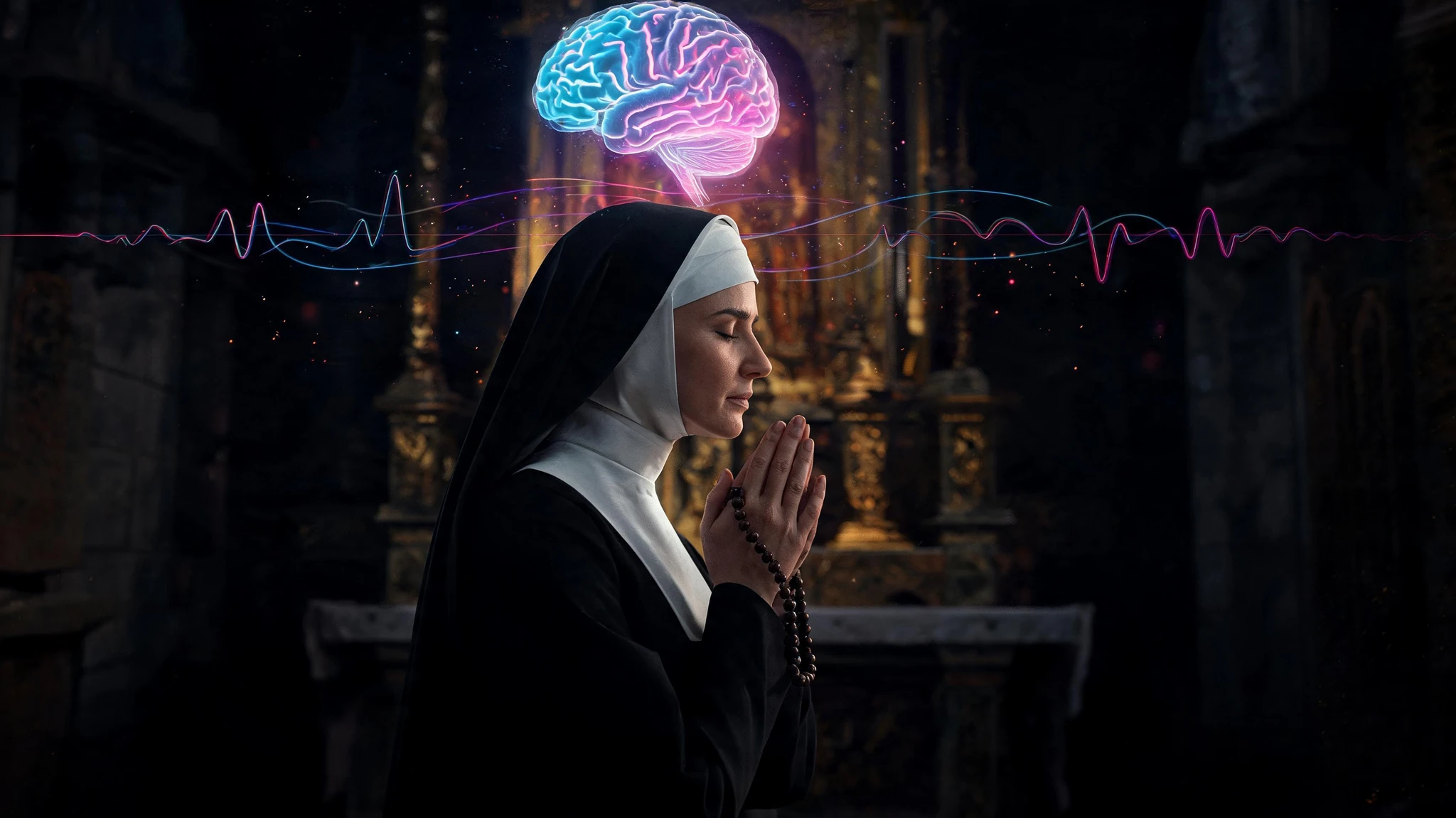
The phrase “your brain on prayer” sounds like a tagline, but it tracks something real. Across two decades of imaging studies, researchers watching the brains of nuns, monks, and longtime meditators have found that prayer and other contemplative practices light up specific networks tied to attention, self-reflection, and emotional regulation. One of the earliest of those studies, by Andrew Newberg and colleagues at the University of Pennsylvania in 2003, used SPECT scans during meditative prayer and reported increased blood flow in the prefrontal cortex1.
That finding has held up, with caveats. Newer work shows the picture is less about a single “prayer center” and more about how repeated practice nudges several networks at once. The headline is real. The pop version is too tidy.
What the scans actually see
When someone prays in a scanner, the machine isn’t reading their soul. It’s reading blood. Functional MRI tracks tiny shifts in oxygenated blood flow as a proxy for which neurons are working harder. SPECT, the technique Newberg used, tracks an injected radiotracer that lodges briefly in active tissue. Both methods give you a heat map. Neither tells you what the person is feeling.
What the heat maps consistently show, across different traditions, is increased activity in the prefrontal cortex during focused contemplative practice1. That’s the part of the brain just behind your forehead, the region that handles voluntary attention, planning, and emotional regulation. The same area lights up when you concentrate on a difficult problem, hold an emotion in check, or rehearse what you want to say in a hard conversation.
So one way to read the results is plain: prayer, when it involves sustained focus on a phrase, an image, or a felt presence, exercises the attention machinery. It is, at the level of brain mechanics, a workout for concentration. The original Facebook post that prompted this article put it that way, and the studies broadly agree.
Carmelite nuns and the mystical experience
One of the most cited single experiments in this field came out of the University of Montreal in 2006. Mario Beauregard and Vincent Paquette put fifteen Carmelite nuns into a 3-Tesla MRI and asked them to recall, as vividly as they could, the most intense mystical experience of their religious life2. The nuns, in the researchers’ words, said no one can summon a mystical state on demand, so a recall task was the closest honest design.
The scans showed activation across at least a dozen regions. The right medial orbitofrontal cortex, the right middle temporal cortex, the right inferior parietal lobule, the right caudate, and several others. No single “God spot.” Beauregard and Paquette argued that mystical experience is mediated by a distributed network covering self-awareness, emotion, body sensing, and visual imagery, all firing together. That conclusion has shaped how the field has talked about contemplative practice ever since.
It’s worth pausing on what the nuns reported afterward. Many cried. Several said the recall, even in a noisy magnet, brought back something close to the original feeling. The science of contemplation isn’t usually sentimental, but the people inside the scanners are.

Is prayer different from meditation?
Sometimes, yes. In 2009, Uffe Schjoedt and colleagues at Aarhus University scanned twenty devout Danish Christians while they prayed the Lord’s Prayer and again while they made up their own personal prayer to God3. The personal prayers, the spontaneous ones, recruited a set of regions the researchers called the brain’s social cognition network. The temporopolar regions, the medial prefrontal cortex, the temporoparietal junction, and the precuneus.
That’s the same circuitry people use when they think about another person’s mind. It’s how you guess what your partner is thinking, or read intent in a stranger’s face. Schjoedt’s interpretation: for the practitioners, talking to God in their own words activated the brain in roughly the same way as talking to a real, present person. Reciting a fixed prayer like the Lord’s Prayer did not produce the same pattern. The fixed prayer was, in brain terms, more like rehearsing a poem.
That distinction matters when people compare prayer to mindfulness. Open-monitoring meditation tends to quiet the brain’s self-referential chatter. Personal prayer, at least for committed believers, recruits the social brain. They are not the same exercise, even though both involve sitting still with eyes closed.
Default mode and the wandering mind
The default mode network is a set of midline brain regions that hum along whenever you’re not actively focused on a task. It’s where mind-wandering, rumination, and self-referential thinking live. Heavy activity in the default mode is associated with worry and depression in some studies, though the link is not clean.
In a 2011 PNAS paper, Judson Brewer and colleagues at Yale compared experienced meditators (more than 10,000 hours of practice) with novices during three styles of meditation5. The experienced group showed reduced activity in two main hubs of the default mode network, the medial prefrontal cortex and the posterior cingulate cortex. They also showed stronger coupling between those hubs and regions tied to cognitive control, even when the meditators were resting between tasks.
Translated: practiced contemplatives appear to have a quieter, better-supervised default mode. The mind still wanders, but it doesn’t seem to drift into the same loops. Brewer’s group went on to apply this in clinical work on smoking cessation and anxiety, where excessive default-mode activity is part of the problem.

Does the brain physically change?
Functional differences are one thing. Structural differences are another, and harder to dismiss as a quirk of one scan. In 2011, Britta Hölzel and colleagues at Massachusetts General Hospital ran an eight-week mindfulness-based stress reduction program with sixteen previously untrained participants and compared their brain scans before and after to a wait-list control group4.
The trained group showed increases in gray matter concentration in the left hippocampus, the posterior cingulate cortex, the temporoparietal junction, and the cerebellum. Eight weeks. Roughly thirty minutes of practice a day. The hippocampus is central to memory and emotional regulation. The temporoparietal junction supports perspective-taking. None of these regions is exotic.
That same year, Yi-Yuan Tang, Michael Posner, and colleagues took the structural question further with a different practice called integrative body-mind training6. After eleven hours of training spread over a month, participants showed measurable changes in white matter tracts connecting the anterior cingulate cortex to other regions. The anterior cingulate is one of the brain’s main conflict-detection and self-regulation hubs. Eleven hours is not a lot, which is part of why this study made noise.
Hölzel’s MBSR study and Tang’s integrative training study are closer to mindfulness than to Christian prayer, and that’s a fair caveat. The structural data on prayer specifically is thinner. What both studies do show, plainly, is that the adult brain remodels in response to repeated contemplative practice on a timescale of weeks, not years.
The reward system question
The original Facebook post claimed that some prayer activates the brain’s reward systems. The claim is reasonable but worth narrowing. Schjoedt’s broader work on intercessory prayer and charisma found that when believers expected to be prayed for by someone they considered a holy person, their frontal executive networks actually quieted down rather than ramping up3. That’s a compliance effect, not a reward effect.
True reward-system activation, the kind tied to dopamine release, has been reported in studies of expert meditators during loving-kindness or compassion practice. It has not been cleanly demonstrated for petitionary prayer in a believer who feels heard. The sustainability the post mentions, the reason people keep coming back to a daily practice, is more likely a mixture of attention reward, mood improvement, and social meaning. Not a single neurochemical hit.
What does “consistency over time” actually mean
The post argued that consistency matters more than the exact technique or session length. The studies broadly support this, with one important refinement. Across the meditation literature, dose appears to matter, but linearly rather than dramatically. Eight weeks of daily practice produces detectable change4. Eleven hours of training over a month produces detectable change6. Tens of thousands of hours produces a different brain in measurable ways5.
What the data does not support is the idea that any contemplative activity, done casually for a few minutes when you remember, will produce the same effect. The phrase “consistency over time” is doing real work. Twenty minutes a day, almost every day, for two months, looks like a reasonable lower bound for the kind of changes researchers can pick up with a scanner. Less than that, and the signal often does not show.

It is not just one study
The strongest evidence here is not any single experiment. It’s the convergence. Catholic nuns, Buddhist monks with thirty years of practice, Danish Christians praying the Lord’s Prayer, MBSR students with no religious background at all, and integrative body-mind trainees in China are all studied with different equipment, different paradigms, and different research questions. The findings rhyme. Repeated focused attention shows up in the prefrontal cortex. Self-referential practices show up along the medial wall of the brain. Practiced contemplatives show quieter default-mode chatter and stronger connections between attention and emotion-regulation regions.
That kind of convergence is what gives a finding staying power, more than any single fMRI image circulating online.
What this evidence does not say
It does not say prayer cures anything. It does not say one tradition’s practice is neurologically superior to another’s. It does not prove that God exists, or doesn’t. The brain regions involved are general-purpose. They light up when you’re concentrating on a chess problem, talking to a friend, or recalling a meaningful memory. The fact that they light up during prayer tells you prayer is a real cognitive activity, not that it has a metaphysical correlate.
It also does not replace medical or psychological care. A daily contemplative practice can be a useful adjunct for stress, attention, or mood, and a growing clinical literature supports that. It is not a treatment for major depression, an anxiety disorder, or trauma on its own. The Hölzel team is careful about this distinction, and so are most of the working researchers in the field.
Common questions about prayer and the brain
Does it matter which religion you pray in?
Probably not for the basic attention and emotion-regulation effects. Newberg’s group has scanned Franciscan nuns, Pentecostals speaking in tongues, and Tibetan Buddhists, and the convergent finding is increased prefrontal activity during focused practice1. Tradition shapes the experience and the meaning, not the underlying brain machinery.
Is silent prayer better than spoken prayer?
The Schjoedt work suggests they engage somewhat different networks. Personal, spontaneous prayer recruits social-cognition regions more strongly than recited prayer3. Neither is “better.” They do different things.
How long until you’d see a change in your own brain?
The minimum reliable timeline in the controlled studies is about four to eight weeks of daily practice46. Subjective changes (calmer reactions, less rumination) often show up sooner. Structural changes that a scanner can detect take longer.
Can secular meditation give the same benefits as prayer?
For attention and stress regulation, the evidence says largely yes. For the social-relational aspect that Schjoedt found in personal prayer, no. That part appears specific to the believer’s sense of addressing a real other.
Is this just a placebo effect?
Placebo effects are themselves real and brain-based. But the structural changes in MBSR participants and the white-matter changes after integrative training are not the kind of finding placebo usually produces46. Something is changing. The harder question is what it means in everyday life.
A reasonable read
If you pray, the scans suggest you are doing real cognitive work, not killing time. If you don’t pray and prefer secular meditation, you can get most of the attention and stress benefits the studies describe. If you do nothing contemplative at all, you are missing a small but well-documented set of effects on attention, emotional regulation, and possibly the structure of a few brain regions involved in memory and self-control.
None of this needs to settle anything bigger. A scanner in Philadelphia or Aarhus or Boston can show that something is happening when a person closes their eyes and turns inward with a particular intention. It cannot tell you what the experience is for. That part the practitioners have to work out themselves.
Sources
- Newberg A, Pourdehnad M, Alavi A, d’Aquili EG. Cerebral blood flow during meditative prayer: preliminary findings and methodological issues. Perceptual and Motor Skills. 2003. PubMed: 14620252
- Beauregard M, Paquette V. Neural correlates of a mystical experience in Carmelite nuns. Neuroscience Letters. 2006. PubMed: 16872743
- Schjoedt U, Stødkilde-Jørgensen H, Geertz AW, Roepstorff A. Highly religious participants recruit areas of social cognition in personal prayer. Social Cognitive and Affective Neuroscience. 2009. PubMed: 19246473
- Hölzel BK, Carmody J, Vangel M, Congleton C, Yerramsetti SM, Gard T, Lazar SW. Mindfulness practice leads to increases in regional brain gray matter density. Psychiatry Research. 2011. PubMed: 21071182
- Brewer JA, Worhunsky PD, Gray JR, Tang YY, Weber J, Kober H. Meditation experience is associated with differences in default mode network activity and connectivity. Proceedings of the National Academy of Sciences. 2011. PubMed: 22114193
- Tang YY, Lu Q, Geng X, Stein EA, Yang Y, Posner MI. Short-term meditation induces white matter changes in the anterior cingulate. Proceedings of the National Academy of Sciences. 2010. PubMed: 20713717