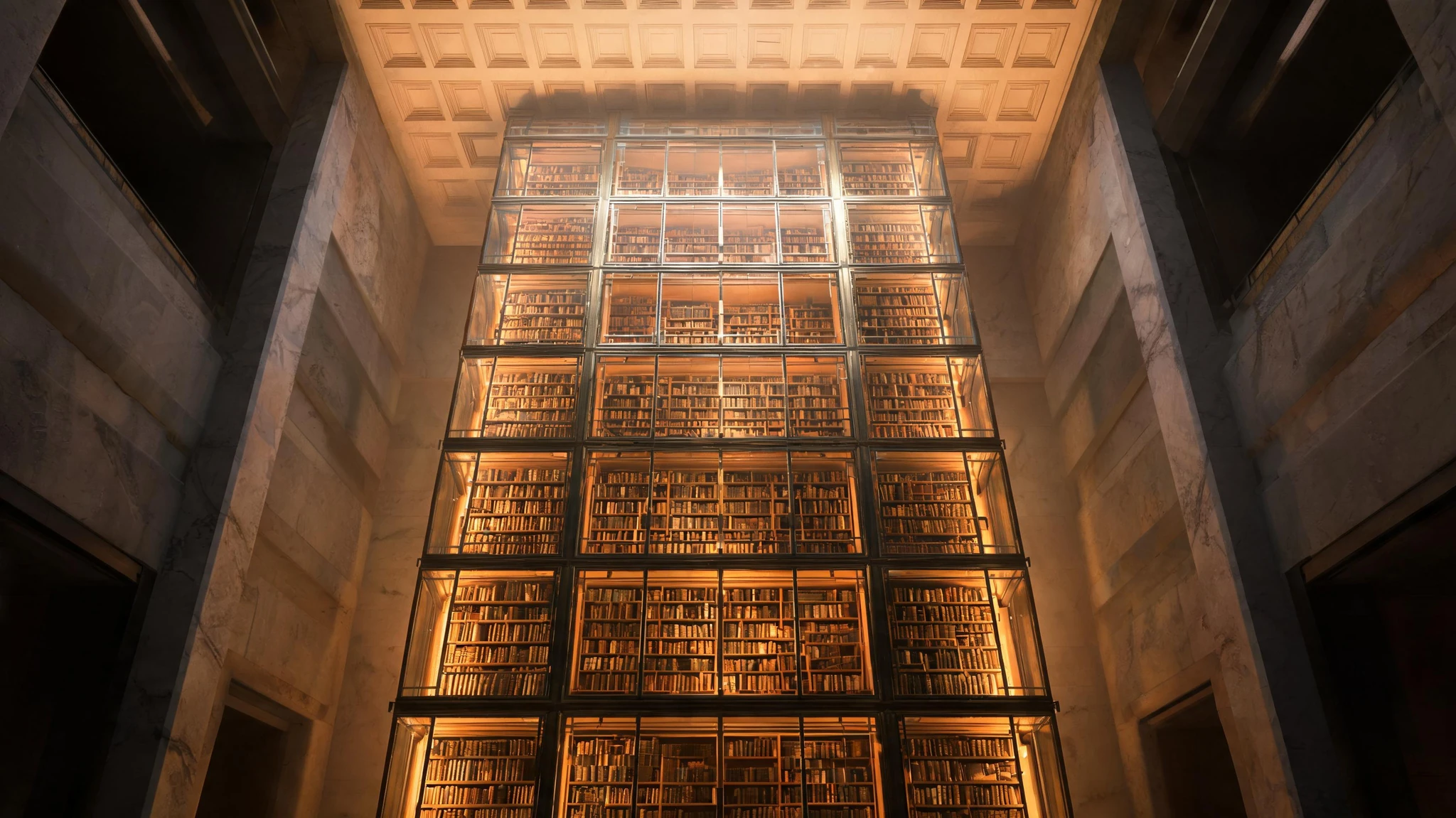
On a small block of Yale’s central campus in New Haven, behind a wall of veined Vermont marble that glows like a paper lantern when the sun hits it right, sits one of the strangest research libraries in the world. The Beinecke Rare Book and Manuscript Library opened in 1963 and now holds, by Yale’s own count, “one of the largest and most dynamic collections of rare books, manuscripts, and archives in the world.”2 Tucked inside that count is a quieter holding the internet keeps rediscovering: roughly three hundred medieval and Renaissance books on alchemy, astrology, magic, and the occult, formally known as the Mellon Collection of Alchemy and the Occult.4
The viral version of the story, currently bouncing around Instagram with the line “Yale has a secret,” frames the collection as forbidden and hidden. The truth is gentler. The books are not hidden. Most have been digitized, free to read on Yale’s public website.
What exactly is locked behind those marble walls?
The Beinecke is, physically, a six-story glass tower of books wrapped in a windowless marble box. The marble is thin enough that on bright days, light filters through, casting a warm honey color across the reading spaces. The point is climate control: to keep paper alive longer than the people who wrote on it.
Inside, the holdings span papyrus fragments to twentieth-century literary archives, medical herbals to early American newspapers.2 The Mellon Collection of Alchemy and the Occult is one named slice of that bigger whole, cataloged through Yale’s Digital Collections portal alongside hundreds of other named collections.4 Researchers can request the originals in the Beinecke reading room. Anyone with an internet connection can browse the scans.
Within the alchemy holdings, the texts are mostly Latin, with German, Italian, French, and English titles mixed in. They cover the practical recipes a medieval alchemist would have used (distilling spirits of wine, working with mercury, separating metals), the metaphysical theory behind why those recipes were supposed to matter (the four elements, the prima materia, the long search for the lapis philosophorum or Philosopher’s Stone), and the related arts: astrology, hermeticism, ritual magic, and Kabbalistic number symbolism. The dragons biting their tails and the green lions devouring suns that show up on Pinterest aesthetic boards come, originally, from books like these.
How did Yale end up with the dark arts?
The collection got there through a private obsession that turned into a memorial. In the 1940s, Mary Conover Mellon, the wife of philanthropist Paul Mellon, became fascinated with the work of Swiss psychiatrist Carl Jung. Jung had spent decades arguing that the imagery of alchemy was not a failed chemistry but an early map of the unconscious mind, with its furnaces and dragons standing in for psychological transformations a patient might undergo in analysis. Mary read his work, met him in Switzerland, and started quietly buying alchemical books to support that research.
She died in 1946, at 42, after an asthma attack. Paul Mellon kept buying for years and eventually gave the entire collection to Yale, named in her honor. The collection’s name on Yale’s digital platform still carries the dedication: the Mellon Collection of Alchemy and the Occult.4 The viral caption’s “60 years behind marble walls” framing oversells the secrecy. The Beinecke opened in 1963, so the collection has been at Yale for about that long, and most of that time it has been openly listed in the catalog, available to any reader with a research card.
The Voynich Manuscript and the polite refusal to be solved
The single most famous book in the Beinecke is not strictly part of the Mellon Collection, but it sits in the same building and gets folded into every viral story about Yale’s occult holdings. It is MS 408, the Voynich Manuscript.
Yale’s own catalog entry describes it carefully. The book is written in “an unidentified language, in cipher, apparently based on Roman minuscule characters.” Its 102 parchment folios are crowded with colored botanical drawings, astrological wheels, naked figures bathing in green pools connected by plumbing-like tubes, and pharmaceutical jars labeled in script no one has reliably read.1 The manuscript dates to roughly 1401–1599 and probably originated in Central Europe. It passed through the library of Holy Roman Emperor Rudolph II, then through the hands of a Prague physician, then to the Jesuit scholar Athanasius Kircher in 1666, then through three centuries of private collectors, before the rare-book dealer Wilfred Voynich bought it in 1912 and gave it the name it carries today. The bookseller H. P. Kraus donated it to Yale in 1969.1

The Voynich breaks the usual rules of how we read old books. Every few years, a paper or a press release claims to have decoded it, with theories ranging from a phonetic version of medieval Hebrew to a sixteenth-century hoax to encoded Nahuatl brought back from the New World. Yale’s posture is more honest: the catalog calls the text “an unsolved puzzle.”1 No one has cracked it. The book remains in the reading room, fully digitized, and most months it picks up another decoding attempt from somewhere on the internet.
Spells, Newton, and what the books actually say
Alchemical manuscripts do include recipes that sound, to a modern ear, like spells. Instructions for transmuting base metals into gold sit alongside diagrams of the philosopher’s egg and lists of correspondences between planets and metals. Some texts give procedures for “summoning” or “binding” spirits in the older sense of ritual magic. The Catholic Church’s relationship with these books was complicated: some titles were banned by the Index Librorum Prohibitorum at various points, others were owned and copied by clergy who saw alchemy as a continuation of natural philosophy.
The figure the viral post leans on, Isaac Newton, is a real anomaly. Newton wrote more than a million words on alchemical experiments and theology, often more than he wrote about gravity. Cambridge University, which holds the bulk of his personal papers, has digitized them through its Cambridge Digital Library.6 The claim that Newton “spent more of his life chasing magic than physics” is closer to true than the textbook version most of us got in school. Whether his alchemical notes sit at Yale specifically is harder to pin down. The Mellon Collection is best described as a corpus of medieval and Renaissance occult texts, not a Newton archive.
About that “the building will suffocate you” rumor
Every viral version of the Beinecke story repeats a single dramatic detail: that if a fire breaks out, the building floods with gas and the librarians inside are sacrificed to save the books. It makes a good line. It is also not quite right.
Like most rare-book libraries built in the second half of the twentieth century, the Beinecke uses an inert-gas fire suppression system in its stack tower, originally Halon and now a modern clean-agent equivalent. These systems lower the oxygen concentration enough to stop a fire, without water damage to paper. They are designed to be survivable, with alarms and time delays that let people evacuate. The visitor areas (the public exhibition hall on the ground floor and mezzanine) are climate-controlled but not part of the suppression zone, and the reading room is restricted to registered researchers, who are not standing inside the book tower itself.3 The dramatic version of the rumor is closer to an urban legend than a building code.

How to actually read this stuff for free
This is the practical part the viral post got right, and worth keeping. Yale University Library’s Digital Collections platform hosts millions of digitized works and images, and many of the Mellon alchemy holdings are part of it.4 You can search by collection name, by author, by subject heading like “alchemy” or “occult sciences,” and pull up high-resolution scans of the original pages. The Voynich is the most viewed of all, but the rest of the collection rewards a wander. Books on the medical uses of mercury that turn out to be poetry. Diagrams of furnaces designed for substances that do not exist. Margin notes from owners who copied passages they thought might be true.
The interface is plain, the download buttons work, the metadata is in English even when the manuscript is in Latin. A reader with no training can spend an evening turning the pages of a fifteenth-century book on the secrets of nature and come away with the unsettling sense that medieval scholars were not stupider than us, just working with a different map of what mattered. Yale’s library news section regularly highlights archives programming, including conversations with the Beinecke’s director,5 which suggests the institution is more interested in opening the collection than guarding it.
Why does any of this belong on a wellbeing site? Because the appeal of the Beinecke’s occult holdings is not really about magic. It is about the quiet pleasure of looking at how earlier people tried to understand bodies, minds, plants, metals, and time. Reading a sixteenth-century herbal is humbling in a way that doomscrolling rarely is. The books were copied by hand. The pigments were ground from rocks. Someone cared enough about a recipe for distilled wine, or for a balm to lift a sad mood, that they bound it between wooden boards and carried it across centuries.
What the source post got right and what to ignore
Worth keeping: Yale really does hold roughly three hundred medieval and Renaissance manuscripts on alchemy and the occult, gathered by Mary Mellon, donated by Paul Mellon, kept at the Beinecke, mostly digitized, free to read. The collection includes the Voynich Manuscript, which is genuinely undeciphered and one of the most reproduced objects in the digital humanities. Carl Jung’s influence on Mary Mellon is real and well-documented.

Worth softening: the “secret behind marble walls” framing, the “Catholic Church tried to burn these books” line (true for some titles, false for many others, since church scholars themselves owned and copied alchemical manuscripts), and the “building will suffocate everyone inside” rumor. The specific claim about Newton’s alchemy notes being at Yale is also shakier than the broader truth: Newton was an alchemist whose papers are scattered across multiple universities, most heavily at Cambridge.6
Common questions about Yale’s alchemy collection
Q. Is the collection actually open to the public?
A. The physical manuscripts are available to registered researchers in the Beinecke reading room. The public exhibition hall on the ground floor and mezzanine is open to all visitors with no reservation needed.3 Most of the digitized scans are free for anyone with an internet connection.
Q. How many books are in the Mellon Collection of Alchemy and the Occult?
A. Yale describes it as a named collection of roughly three hundred medieval and Renaissance manuscripts and printed books on alchemy, astrology, and related occult sciences.4 The exact count drifts a bit depending on what is included, since later acquisitions and adjacent named collections share themes.
Q. Has the Voynich Manuscript been decoded?
A. No. Yale’s own catalog calls the text “an unsolved puzzle” despite repeated public claims of a solution.1 The manuscript has been carbon-dated to roughly the early fifteenth century, but its language and purpose remain unknown.
Q. Did Isaac Newton really work on alchemy?
A. Yes. Newton wrote about a million words on alchemy and the search for the Philosopher’s Stone, much of it preserved in Cambridge University’s digitized Newton papers.6 Some of his alchemical material has surfaced at other libraries through later sales and donations.
Q. Can I download high-resolution images?
A. Yes, in most cases. Yale’s Digital Collections platform offers high-resolution viewing and downloads under access terms posted on each item’s page.4
A library is not a curse
The “Yale has a secret” framing flatters us. It suggests that, with one swipe, we have stumbled onto something the powerful tried to hide. The truth is calmer and more generous. The Beinecke is doing what good libraries do, which is to hold strange and difficult objects in trust, and let any curious person, undergraduate or insomniac on a couch in another country, come look. The medieval scribes who copied these books did not think they were doing magic in any dark sense. They thought they were preserving a record of how the world was supposed to work. Some of it turned out to be wrong. Some of it turned out to be the early scaffolding of chemistry and pharmacology. Some of it is still just beautiful.
The marble walls are not keeping you out.
Sources
- Yale University Library, Beinecke Rare Book and Manuscript Library. Cipher Manuscript (Voynich Manuscript), MS 408. Yale Digital Collections.
- Beinecke Rare Book and Manuscript Library. Collections overview. Yale University Library.
- Beinecke Rare Book and Manuscript Library. Visit: building access, reading room, and exhibition hall.
- Yale University Library. Digital Collections, including the Mellon Collection of Alchemy and the Occult.
- Yale University Library. Library news, including the Archives and Democracy Symposium with Beinecke director Michelle Light.
- University of Cambridge. Research news; see also the Cambridge Digital Library Newton Papers (Cambridge University Library).