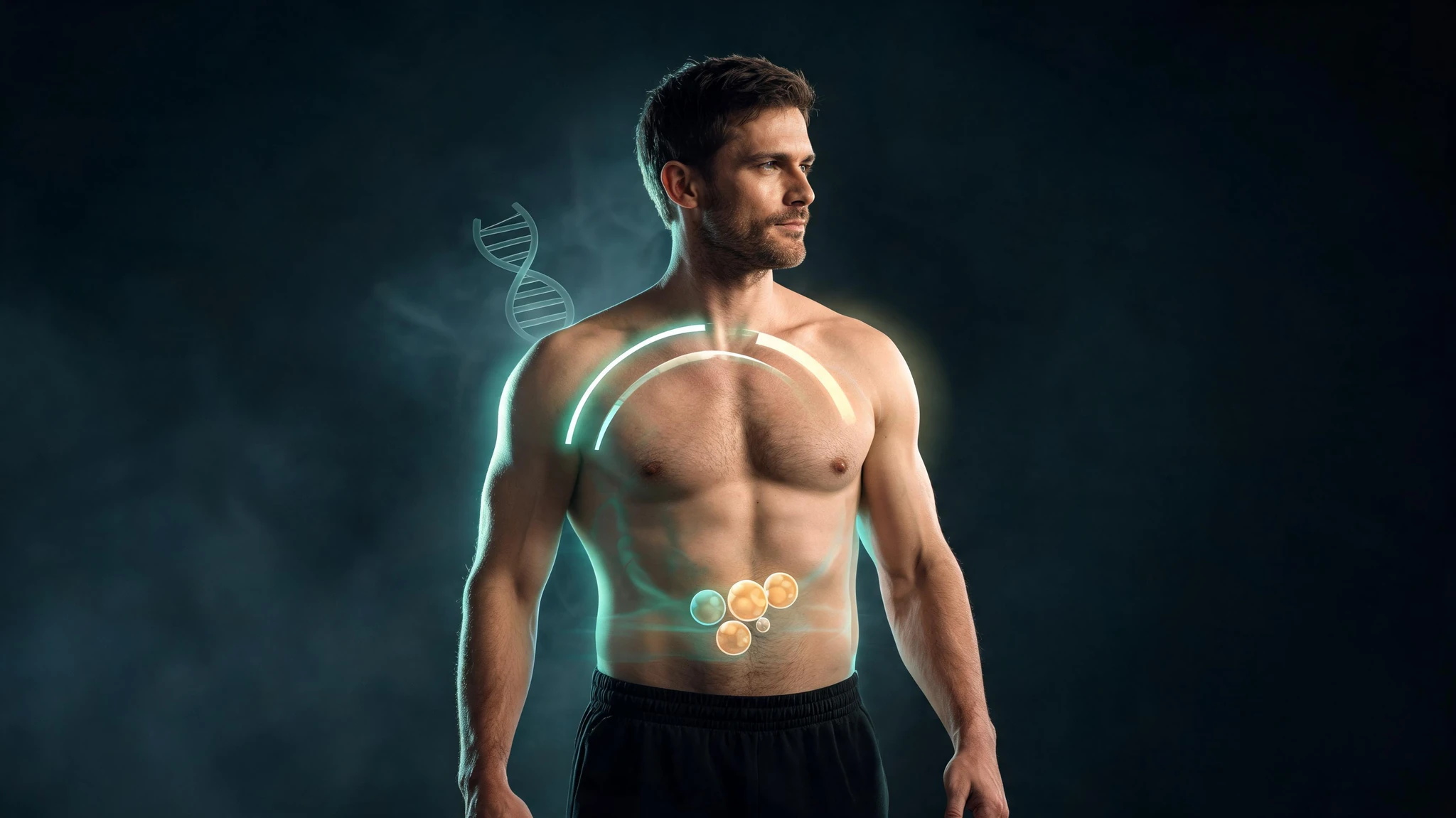
Women, on average, do not rate the leanest male bodies as the most attractive. In a 2016 study of 160 male torsos at varying levels of muscle and fat, female raters gave their highest scores to bodies sitting in the moderate range of body fat, and overall body composition predicted attractiveness more strongly than muscle or fat alone.1 Newer cross-cultural work points to a similar sweet spot. Men with a body mass index of roughly 23 to 27 and a body fat percentage somewhere around 12 to 15 percent tend to be rated highest by women raters from very different countries.
That is well above the look you see in fitness ads. A six-pack normally requires single-digit or low-teen body fat that is hard to hold for long. The data suggests most women are not asking for it, and that the body type they rate most attractive overlaps closely with the body type doctors call metabolically healthy.5
What the cross-cultural study actually found
The viral post that put this finding back into circulation in early 2026 referenced a paper by Kościński and colleagues in Body Image. The headline numbers are easy to repeat. Men in the BMI 23 to 27 band, with body fat around 12 to 15 percent, scored highest. Raters from China, Lithuania and the United Kingdom landed in nearly identical territory. Both male and female raters scored bodies in similar ways, which is itself interesting because it suggests the perception is not driven solely by women’s preferences.
Hedge in mind: that specific paper is hard to verify in the way the rest of the literature can be verified, so treat the exact numbers as one data point. The broader finding is older and well replicated. Brierley and colleagues, looking at over a hundred male torsos in 2016, reported that body fat percentage was the single biggest predictor of how attractive a male body was rated, beating both muscularity and BMI when each was considered on its own. The most attractive bodies in their sample were not the leanest, and they were not the most muscular. They sat in the middle.1
The 2016 study also separated judgments of attractiveness from judgments of health. Both peaked in similar zones, but they did not peak at exactly the same point. Health ratings stayed high a little further into the lean side. Attractiveness ratings dropped off sooner. In other words, the leanest men were judged healthy, but not the most attractive.
Why a moderate range, not a shredded one
If you ask a sports nutritionist what body fat percentage a male athlete can sustain year-round without performance issues, the honest answer is usually somewhere in the low to mid teens. Below that, sleep, mood, training output and immune function start to slide for a lot of people. The 12 to 15 percent zone aligns with what an active adult man can hold while still eating, training and sleeping like a person rather than a contestant.
The mortality data tells a related story. A large 2013 meta-analysis covering nearly three million adults found that all-cause mortality was actually lowest in the BMI band labelled “overweight,” roughly 25 to 30, and rose only modestly until BMI passed 35.5 The point of that paper is not that being heavy is healthy. It is that the leanest end of the normal range does not buy extra years of life on average, and that the BMI ranges associated with the longest lives sit slightly above what most magazine covers depict. The attractiveness window that women report and the survival curve epidemiologists describe end up roughly in the same neighbourhood.
Evolutionary explanations for this kind of overlap are speculative by nature, and the field is full of just-so stories. A more careful version goes like this. If, over many generations, observers who paid attention to cues of metabolic health when choosing partners had healthier offspring on average, those preferences would be selected for. Body fat percentage is one of those cues. So is shoulder-to-waist ratio, since it tracks testosterone exposure and upper-body strength. None of this proves causation, but it is consistent with what shows up in the rating studies.

The shoulder-to-waist ratio question
One of the oldest results in this corner of the literature is from a 1999 letter in The Lancet by Maisey and colleagues. They had women rate digital silhouettes of men and reported that the waist-to-chest ratio was the single biggest visual driver of male attractiveness, more so than BMI or waist-to-hip ratio.3 A V-shaped torso, with broader shoulders and a narrower waist, scored highest. That paper is now more than two decades old, but it has been replicated and extended often enough that the shoulder-to-waist effect is one of the more reliable findings in the field.
Body fat percentage and shoulder-to-waist ratio are not independent. As a man’s body fat creeps up, the waist usually grows faster than the chest, so the V softens. As body fat drops below a moderate level, you start to see ribs and a more angular look, which some raters read as gaunt rather than fit. The intermediate zone preserves the V without making the man look depleted.
That overlap helps explain why the visible waist matters more than the absolute number on the scale. A man at BMI 26 with broad shoulders and a softer but still defined midsection often outperforms a man at BMI 22 with narrow shoulders and a flat stomach. The composition of the body, and where the weight is carried, matters more than the weight itself.
How consistent is this across cultures?
The cross-cultural angle is where things get genuinely interesting, and where the recent Body Image paper sits in a long line. In a 2007 comparison of British and Greek raters, Swami and colleagues found that women in both countries preferred similar male body shapes, with broad shoulders and a slim waist, and that BMI preferences were close but not identical.4 The differences they did find tracked roughly with how Westernised the local media environment was. The more Western media exposure, the closer the local preferences sat to the lean, V-shaped ideal you see in international advertising.
That is the more honest framing of “cross-cultural consistency.” Preferences are not a free-floating universal. They sit on a spectrum that gets pulled toward whatever bodies the local media keeps showing. A 2022 study using computer-generated male and female bodies showed that women who had more strongly internalised the cultural ideal rated bodies closer to that ideal as more attractive, while women who had not internalised it rated a wider range of bodies as attractive.2 Internalisation, not biology alone, did much of the work.
So when the viral post says “consistency across cultures,” it is mostly right and slightly oversimplified. Across many populations, women converge on a moderate body fat range with a clear V-shape. The exact peak shifts a little with the local diet, the dominant body image in the media, and how strongly each rater has bought into it.

Why this matters for actual men, not models
The most useful takeaway is not a number to chase. It is a number to stop chasing. If a man at BMI 25 and 14 percent body fat is being rated, on average, more attractive than the same man at 22 and 8 percent, then the calorie deficit and the hours of cardio it takes to drop those last six points of body fat are not buying him attractiveness. They might buy him a different magazine cover, but the data does not support the idea that they buy more positive ratings from women. Some of those ratings actually go down.
There is a separate question, which the post raises and the studies do not answer well, of how much these averages apply to any one person’s love life. Rating studies use strangers looking at photos. Real attraction in real relationships involves voice, smell, conversation, the small movements of a face, status cues, and a long tail of personal preference that no scoring sheet captures. Maisey’s 1999 paper acknowledged this. So did most of the papers that came after it.3 Treat the rating studies as a description of average tendencies in a particular task, not as a prediction of what one specific person will find compelling in another.
What the rating studies do say, and say clearly, is that the body type women rate highest is not the body type fitness influencers sell. It is closer, in fact, to the body type a working adult can hold while sleeping seven hours, eating proper meals, training a few times a week, and not punishing himself.

Common questions about male body attractiveness ratings
Is BMI 23 to 27 actually “average”?
It is the upper part of the normal range and the lower part of the overweight range. For an adult man at 5 feet 10 inches, BMI 23 to 27 corresponds to roughly 73 to 86 kilograms, or about 160 to 190 pounds. Plenty of fit, healthy men sit there.
Is 12 to 15 percent body fat hard to maintain?
It is achievable for most men with consistent training, adequate protein and decent sleep. It is not so low that it disrupts hormones, sleep or mood for typical individuals, the way single-digit ranges often do. It does not require contest-prep dieting.
Did the study include only young women rating young men?
Most of the rating studies, including Brierley 2016 and the cross-cultural papers, used university-age raters, with some extensions into older samples. That is a real limitation. Preferences shift somewhat across the lifespan, and older raters often rate slightly heavier bodies as more attractive than younger raters do.1
Do men and women rate male bodies the same way?
Largely yes, in the studies that compared them. Male raters tended to rate slightly leaner, more muscular bodies as more attractive than women raters did, but the overall shape of the curve was similar.1
Does this mean a six-pack is unattractive?
No. Bodies with very low body fat were still rated as attractive, just not the most attractive on average. There is also large individual variation, and a man whose partner specifically prefers a leaner physique is not contradicted by an average.

The honest version of the takeaway
If a single line summed up the literature, it would be that moderate beats extreme. The body composition women rate as most attractive on average is also the body composition most men can hold while living a normal life, and it sits inside the BMI range associated with the longest survival in large mortality studies.5 That is a quietly encouraging finding. It says the body type that lets you sleep well, train sustainably and stay socially functional is roughly the same body type that scores highest in a controlled rating task.
None of this is permission to ignore body composition. Men carrying a lot of visceral fat are not in the moderate zone the studies describe, and the health risks of that pattern are well established. The point is the other side of the spectrum. Pushing past a healthy moderate range, into the territory of fitness covers and bulking-cut cycles, does not appear to add anything that women, on average, are looking at and rewarding. If a man finds himself in the BMI 24 to 26 band with a defined but not chiselled midsection, the studies suggest he is already inside the window most rating tasks identify as the most attractive.
It is also worth saying that any single rating study, however carefully designed, captures only a thin slice of attraction. People rate photos differently from how they react to a person across a table. Voice, eye contact, posture and the way someone holds attention all carry weight that a still image strips out. The numbers in this article describe the visual layer of a much bigger picture, and that visual layer is, on average, more forgiving than the gym-floor consensus suggests. The body composition women rate as most attractive in a lab is, by a long stretch, not the body composition most online fitness content treats as the entry ticket.
Sources
- Brierley ME, Brooks KR, Mond J. The Body and the Beautiful: Health, Attractiveness and Body Composition in Men’s and Women’s Bodies. PLoS One. 2016. PubMed: 27257677
- Ridley BJ, Cornelissen PL, Maalin N, et al. The degree to which the cultural ideal is internalized predicts judgments of male and female physical attractiveness. Frontiers in Psychology. 2022. PubMed: 36337567
- Maisey DS, Vale EL, Cornelissen PL, et al. Characteristics of male attractiveness for women. Lancet. 1999. PubMed: 10232328
- Swami V, Smith J, Tsiokris A, et al. Male physical attractiveness in Britain and Greece: a cross-cultural study. The Journal of Social Psychology. 2007. PubMed: 17345919
- Flegal KM, Kit BK, Orpana H, et al. Association of all-cause mortality with overweight and obesity using standard body mass index categories: a systematic review and meta-analysis. JAMA. 2013. PubMed: 23280227