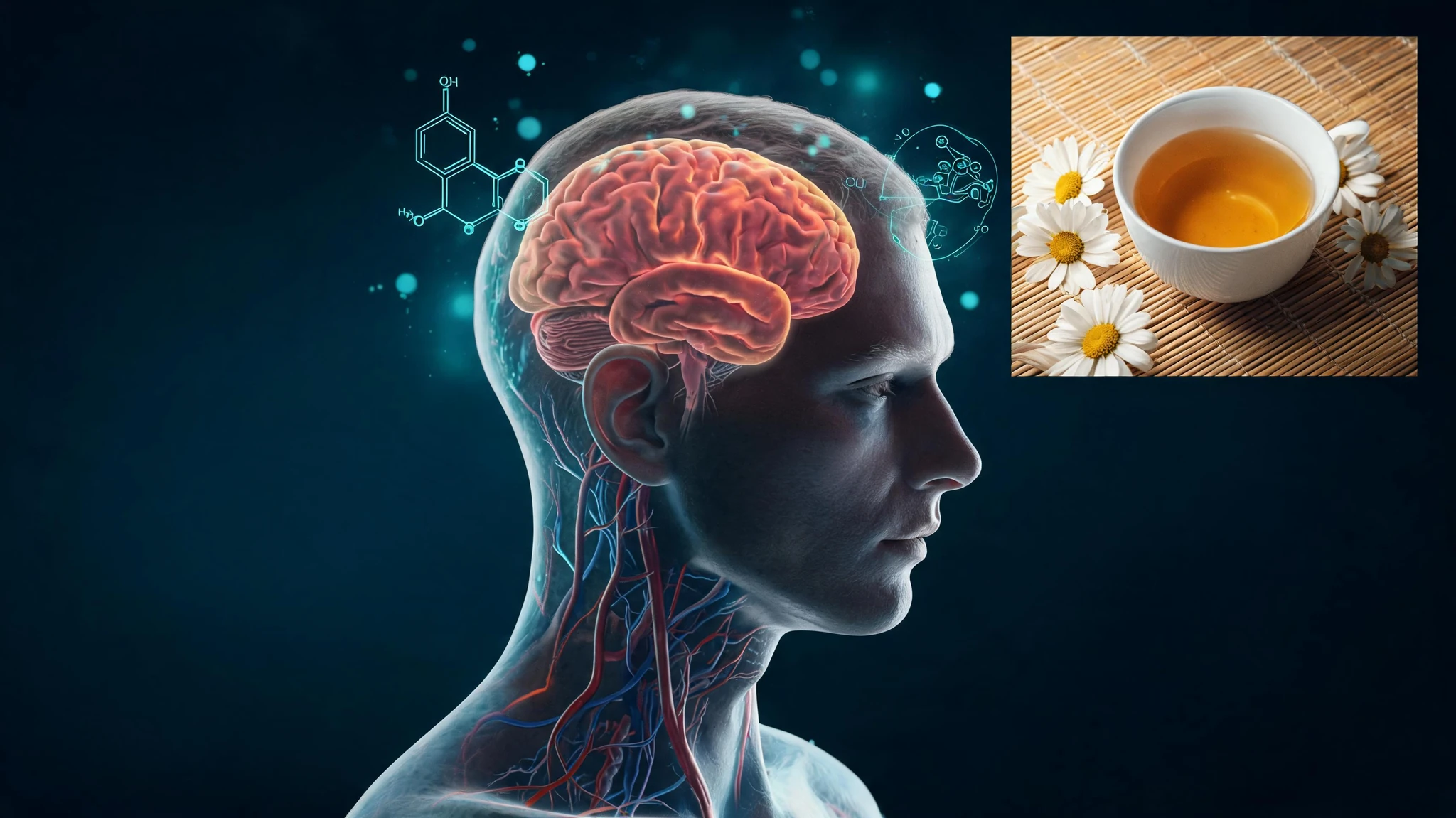
In a 2009 randomized controlled trial published in the Journal of Clinical Psychopharmacology, oral chamomile extract produced a clinically meaningful reduction in symptoms of mild to moderate generalized anxiety disorder compared with placebo1. The dose was specific. Pharmaceutical-grade German chamomile, 220 milligrams per capsule, standardized to 1.2 percent of a flavonoid called apigenin, taken one to five times daily. Not a sachet. Not a vague handful of dried flowers.
That trial, led by Amsterdam and colleagues at the University of Pennsylvania, is the study most commonly invoked when someone says chamomile “really works.” A 2024 systematic review in Clinical Nutrition Research by Saadatmand and colleagues looked across the published clinical trials and reached a careful conclusion: oral chamomile appears to have a modest anxiety-reducing effect, with the strongest signal in people who already have mild to moderate anxiety rather than the general population3. Modest is the right word. It is also not nothing.
What did the original chamomile trial actually find?
Amsterdam’s 2009 study enrolled 57 adults with a diagnosis of mild to moderate GAD. Half got the standardized chamomile capsule. Half got a matched placebo. After eight weeks the chamomile group showed a significantly larger drop on the Hamilton Anxiety Rating scale, the standard clinician-administered measure used in anxiety drug trials1. Side effects were uncommon and mild. No one in the chamomile arm had to quit because of how the capsule made them feel, which is more than you can say for many first-line anti-anxiety medications.
It was a small trial. Eight weeks is short. The participants were recruited from a single American academic center, so the sample skews narrow. None of that makes the result fake. It does mean the result needs replication before anyone calls it settled, and the careful systematic reviews in this space say exactly that3,4.
How might a tea flower nudge an anxious brain?
The honest answer is that researchers do not fully know. The leading hypothesis centers on apigenin, a flavonoid present at relatively high concentrations in Matricaria recutita (German chamomile) and to a lesser extent in Chamaemelum nobile (Roman chamomile). In animal studies and in vitro work, apigenin binds to benzodiazepine sites on the GABA-A receptor, the same receptor family that drugs like diazepam target, though apigenin’s effect is far weaker and its binding profile is different5. That weaker binding is part of why chamomile does not sedate most people the way a benzodiazepine does, and also why its effect is gentle rather than dramatic.

There is a second mechanism that gets less press but matters. Chronic anxiety is associated with a dysregulated hypothalamic-pituitary-adrenal axis, the body’s central stress-response system. Some preclinical evidence suggests apigenin and other chamomile constituents may dampen excessive HPA activity and lower circulating cortisol after stress5. A separate review of herbal anxiolytics by Sarris and colleagues at Swinburne University catalogued chamomile alongside kava, passionflower, and lavender as plants with at least preliminary clinical evidence and a plausible neurobiological story, while flagging that the evidence base for each is uneven4.
So the picture is not “chamomile does X.” It is closer to “chamomile contains compounds that, in the lab and in small clinical trials, behave the way a mild anxiolytic should behave.” The certainty stops there.
Does it keep working over months?
This is where the research got more interesting. In 2016, Mao and colleagues at Penn ran a longer follow-up trial, this time recruiting 179 adults with moderate to severe GAD. Everyone took standardized chamomile extract for 12 weeks of open-label treatment. The participants who responded were then randomized: half continued chamomile for another 26 weeks, half were switched to placebo2.

The relapse rates told a quieter story than a dramatic press release would suggest. Across the 26-week continuation, fewer people relapsed on chamomile than on placebo, but the difference did not reach statistical significance for the primary relapse endpoint. What did improve significantly were secondary outcomes: ongoing GAD symptoms, body weight, and blood pressure all looked better in the continuation group2. Long-term safety was good. No serious adverse events were attributed to the extract.
The takeaway, if you are a careful reader, is that long-term chamomile may help maintain gains in people who responded in the first place, but it is not a guaranteed shield against a return of symptoms. The plant is a supportive tool, not a cure.
Tea, tincture, or capsule: do they all work the same?
Almost every published chamomile anxiety trial used a standardized extract in capsule form, typically 220 milligrams of pharmaceutical-grade German chamomile per capsule, standardized to 1.2 percent apigenin1,2. The dosing in the trials ranged from one capsule daily up to five capsules daily based on individual response. That gives a maximum studied dose somewhere around 1,100 milligrams of standardized extract per day.
A cup of brewed chamomile tea is a different thing entirely. The exact apigenin content of a cup depends on the cultivar, how the flowers were dried, how long the tea steeps, and whether the water was actually hot enough to extract the flavonoids. Most home cups deliver a small fraction of the apigenin used in the trials. That does not make the tea worthless. There is a separate small literature on chamomile tea and self-reported sleep quality, and many people find a warm bedtime ritual genuinely settling regardless of the pharmacology5. But if you are hoping to replicate the anxiety-reduction findings, the tea is unlikely to deliver the studied dose.

Tinctures fall in between. A few are standardized, most are not. If a tincture lists “1.2 percent apigenin” or a milligram-equivalent dose on the label, the math is at least possible to do. If it does not, you are buying a hopeful brown bottle.
One useful frame for shoppers. The trials specified pharmaceutical-grade German chamomile. That phrase is not a marketing flourish. It refers to material grown, harvested, and extracted under conditions documented enough that an independent lab could verify the apigenin content. Most supermarket teas and many supplement brands cannot point to that paper trail. A handful of European pharmacy brands and clinical-research suppliers can. The cost difference is real, and the evidence base, such as it is, lives entirely on the standardized side of that line1,3.
Who should probably skip it?
Chamomile is a member of the Asteraceae family, the same plant family as ragweed, daisies, and chrysanthemums. People with established allergies to those plants can react to chamomile with skin rashes, eye irritation, or, rarely, anaphylaxis5. If you have ever had an allergic reaction to ragweed pollen, talk to a clinician before you start a daily extract.
Chamomile also has weak anticoagulant activity in laboratory work, and case reports describe an interaction with warfarin in which patients taking the blood thinner developed elevated bleeding risk after adding chamomile5. The clinical significance for someone taking a once-in-a-while cup of tea is probably negligible. The clinical significance for someone taking 1,100 milligrams of standardized extract daily while on warfarin is not negligible. Pregnancy is another situation where the safety data are thin, and most clinicians recommend caution rather than confidence.
If you are already taking a benzodiazepine, an SSRI, or another centrally active medication for anxiety, layering a chamomile extract on top is not automatically harmless. The interaction risk is small but real, and the responsible path is to mention it to whoever is managing the prescription.
Children are a separate question. The published anxiety trials enrolled adults, and pediatric dosing for any standardized chamomile preparation is not well established. A weak chamomile tea given to a fussy toddler is a long-running European tradition and broadly considered safe in moderation, but a 220 milligram apigenin-standardized capsule is a different intervention and not one a parent should improvise.
Where chamomile fits in a real life
The Saadatmand 2024 review reaches a verdict that is easy to miss because it sounds boring: the existing evidence supports oral chamomile as a possible adjunct for mild to moderate anxiety, with effects that are real but modest, and with a safety profile that compares favorably to most pharmaceutical alternatives3. Adjunct is the word that matters. Chamomile is not standing in for cognitive behavioral therapy. It is not replacing an SSRI for someone with severe GAD or panic disorder. It is the kind of intervention that can sit alongside sleep hygiene, regular movement, and an actual conversation with a clinician about what is driving the anxiety.

That framing may sound deflating after a Facebook post promising “the deepest sleep of your life.” It is also closer to what the science actually says. Plants that have been used for two thousand years tend to have real but limited effects, and chamomile fits that pattern. Srivastava and colleagues’ 2010 review in Molecular Medicine Reports traces the documented use of chamomile back through Egyptian, Greek, and Roman medicine, and argues the modern interest is essentially a return to a long-running observation: people who drink it tend to feel a little calmer5.
Common questions about chamomile and anxiety
How long does it take chamomile to work?
In the Amsterdam trial, the chamomile group separated from placebo on the Hamilton Anxiety scale across the eight-week treatment course, with gradual improvement rather than a sudden effect1. A single capsule is unlikely to feel like a sedative within an hour.
Is German chamomile different from Roman chamomile?
Yes. German chamomile (Matricaria recutita) is the species used in nearly every published anxiety trial. Roman chamomile (Chamaemelum nobile) shares some compounds but has been studied much less. If a label does not specify the species, assume you do not know what you are buying.
Can I take chamomile every day?
The Mao 2016 trial dosed standardized chamomile daily for up to 38 weeks total without serious adverse events2. That is not the same as saying it is safe forever for everyone, but it is reassuring evidence for medium-term use in adults without contraindications.
Will chamomile help me sleep?
The trials measuring chamomile against insomnia are smaller and less consistent than the anxiety trials. Some people find it modestly helpful for sleep onset, often as part of a wind-down ritual rather than as a true sedative4.
Should I tell my doctor I am taking it?
If you are on any prescription medication, especially blood thinners, sedatives, or antidepressants, yes. Even a herbal supplement counts as something a clinician should know about.
The honest bottom line
Chamomile is not a miracle. It is a mild, reasonably safe, mildly evidence-supported plant extract that may take a small edge off everyday anxiety in people who do not have severe symptoms. The effect size is real but modest, and most of the strong findings come from one research group using a specific 220 milligram standardized extract1,2. A casual cup of tea is unlikely to replicate that, though a casual cup of tea has its own quiet value.
If you live with anxiety that disrupts your work, your sleep, or your relationships, chamomile is the wrong starting point. Therapy and a real evaluation are. If you live with the lower-grade everyday version of anxiety that most adults will recognize, a standardized extract has a defensible evidence base, an unusually friendly side-effect profile, and a long history of people quietly reaching for it after dinner.
The Facebook caption that started this article promised “the deepest sleep of your life” and called chamomile “effective and less dangerous” than anxiety medications. The first claim oversells. The second claim is closer to true for some people in some situations, and unhelpful as a blanket statement. The cleaner version: chamomile is a small lever, not a large one, and small levers used consistently are sometimes exactly what a calmer week needs.
Sources
- Amsterdam JD et al. A randomized, double-blind, placebo-controlled trial of oral Matricaria recutita (chamomile) extract therapy for generalized anxiety disorder. Journal of Clinical Psychopharmacology, 2009. PubMed: 19593179
- Mao JJ et al. Long-term chamomile (Matricaria chamomilla L.) treatment for generalized anxiety disorder: A randomized clinical trial. Phytomedicine, 2016. PubMed: 27912875
- Saadatmand S et al. The Effect of Oral Chamomile on Anxiety: A Systematic Review of Clinical Trials. Clinical Nutrition Research, 2024. PubMed: 38784853
- Sarris J et al. Herbal medicine for depression, anxiety and insomnia: a review of psychopharmacology and clinical evidence. European Neuropsychopharmacology, 2011. PubMed: 21601431
- Srivastava JK et al. Chamomile: A herbal medicine of the past with bright future. Molecular Medicine Reports, 2010. PubMed: 21132119