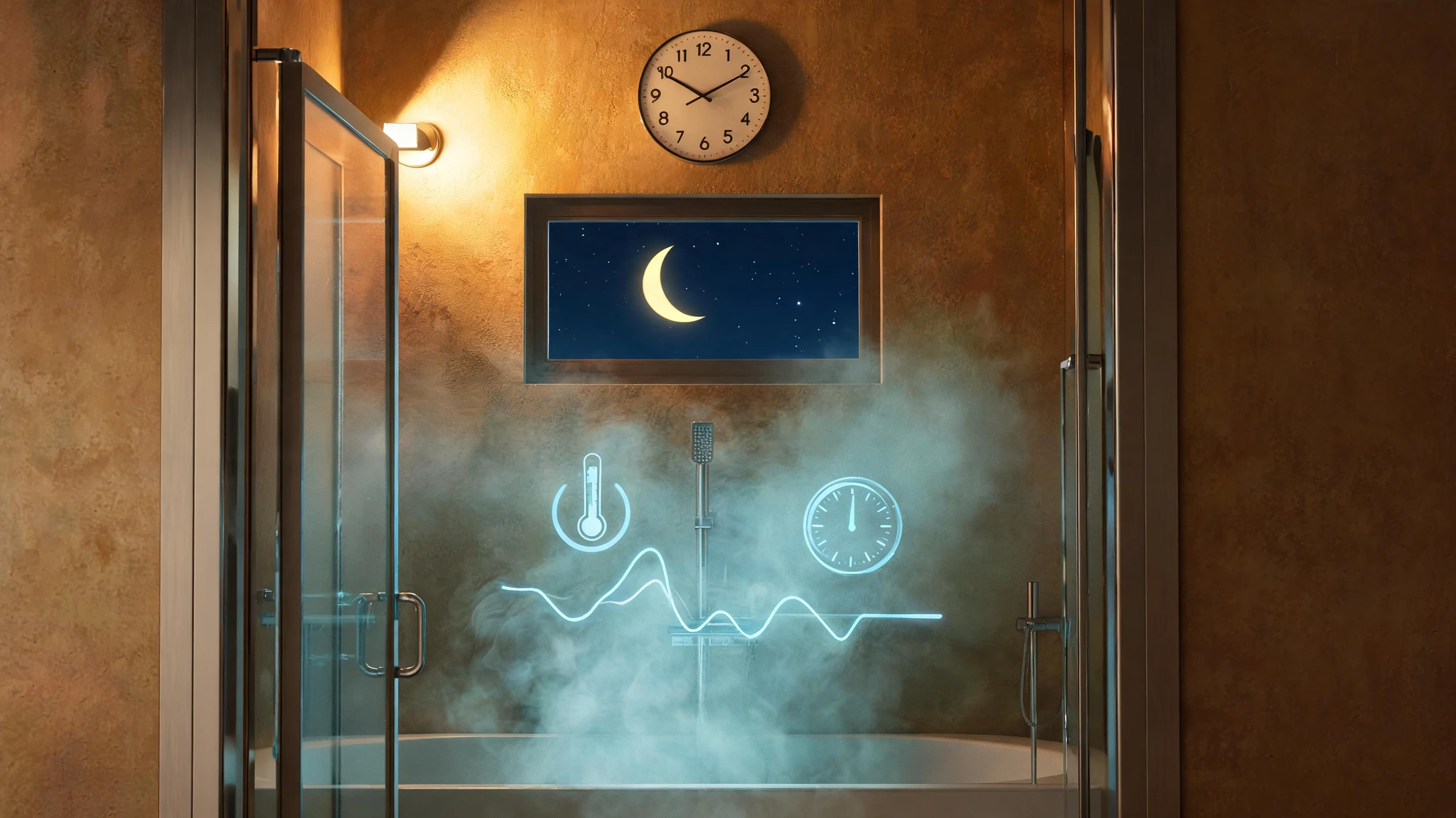
A warm shower roughly 90 minutes before lights-out shortened the time it took healthy adults to fall asleep by an average of about 10 minutes and improved self-rated sleep quality, according to a 2019 systematic review and meta-analysis in Sleep Medicine Reviews by Haghayegh and colleagues at the University of Texas at Austin.1 The pooled analysis covered 17 studies and 5,322 participants, and the effect held across young, middle-aged, and older adults.
The protocol that worked was specific. Water somewhere between 40 and 42.5 degrees Celsius (104 to 108.5 Fahrenheit), one to two hours before bed, with the strongest signal at the 90-minute mark. Not a cold plunge, not a brisk rinse right before climbing under the covers. Warm, deliberate, and timed.
What the 2019 meta-analysis actually measured
Haghayegh’s team pulled together studies that used what sleep researchers call passive body heating, meaning warm baths, warm showers, and in a few cases warm footbaths. They looked at four outcomes that come up over and over in sleep medicine: sleep onset latency (how long it takes to fall asleep), sleep efficiency (the percentage of time in bed actually spent asleep), total sleep time, and subjective sleep quality scores.1
Three of those four outcomes moved in the right direction. People fell asleep faster. Their efficiency improved. Their self-reported quality scores went up. Total sleep time was the one that did not consistently change, which makes sense if you think about it: most healthy adults already sleep close to the amount they want, so a bedtime habit is more likely to shift how that sleep starts and feels than to add an extra hour to the clock.
The 10-minute reduction in sleep onset is small in absolute terms. But anyone who has lain awake for half an hour staring at a ceiling knows that the first 10 minutes of failure to fall asleep are not psychologically equivalent to minutes 50 through 60. Cutting the front of that wedge has outsized weight.
Why does heating up help you cool down?
The mechanism sounds backwards at first. You take a hot shower to fall asleep faster, and the reason is that your body cools down afterward.
Core body temperature follows a daily rhythm. It peaks in the late afternoon or early evening and starts to drop in the hours before sleep, and that drop is one of the signals the brain uses to know that night has arrived.2 When you step into a warm shower, blood vessels near the surface of the skin dilate. Warm blood gets pushed out toward the hands and feet, where it is most efficient at radiating heat into the surrounding air.

Step out of the shower into a cooler bathroom, and that warmed peripheral blood now sheds heat fast. Core temperature drops a little more steeply than it would have on its own. The drop nudges the circadian system in the direction it was already heading. Reviews of thermoregulation and sleep have repeatedly tied the size of the evening core-temperature decline to how quickly people drift off, and how soundly they stay there.2
This is also why the timing matters more than most people assume. If you shower five minutes before bed, your skin is still flushed and your core has not yet finished its rebound dip. You climb into bed slightly too warm, which is the opposite of what you want. Pushing the shower back to about 90 minutes before lights-out gives the cooling cascade time to play out.
Does the trick still work if you are older?
One of the questions buried inside the sleep literature is whether passive body heating works the same way at 70 as it does at 25. Older adults tend to have a flatter circadian temperature rhythm, lighter sleep, and more frequent awakenings, so it would not be surprising if a habit that helps a college student fizzles out by retirement age.
The evidence suggests it does not fizzle. A 1999 study by Kanda and colleagues directly compared bathing before sleep in young people and in the elderly and found that warm bathing improved sleep parameters in both groups, with the elderly subjects showing meaningful gains in deep sleep stages.3 The pooled Haghayegh analysis was consistent with that, reporting benefits across age strata rather than only in the young.1
That matters because insomnia complaints rise with age. National-survey work from the late 1990s found that roughly one in three American adults reported some difficulty sleeping in the previous year, and the share climbed substantially among older respondents.5 A simple, low-cost evening habit that holds up across age groups is the kind of thing primary-care physicians like recommending, because it does not require a prescription pad.

How warm and how long?
The water-temperature window in the meta-analysis was tight: 40 to 42.5 degrees Celsius, which is comfortably warm for most people, hot enough to turn skin a little pink but well below scalding. In Fahrenheit, that is 104 to 108.5. Most home water heaters can reach that range without effort.
Duration in the included trials clustered between about 10 and 20 minutes. Long enough for skin vessels to dilate and for the body to register a clear thermal stimulus, short enough that you are not lingering in there for an hour. There is no evidence in the pooled data that more is better past that range. Comfort, not endurance, is the goal.
If you do not have a tub or you are short on time, a warm shower in that temperature window appears to do the same job as a soak. The 2019 analysis included both modalities and did not find that immersion in a bathtub was meaningfully superior. A 1996 study and follow-up work showed that even partial heating, like a warm footbath at bedtime, can shift core temperature enough to influence sleep onset, though the effect tends to be smaller than full-body warming.3
What about people with insomnia, not just light sleepers?
Most of the trials in the meta-analysis enrolled healthy adults or mild self-described poor sleepers, not people with diagnosed chronic insomnia disorder. That is a real limitation. The honest read is that warm-shower timing appears to help the kind of person who would benefit from sleep hygiene improvements in general, and it has not been shown to be a stand-alone treatment for clinical insomnia.
If you have been sleeping poorly for months, waking at 3 a.m. without a clear cause, or relying on alcohol or over-the-counter sedatives to get through the night, a shower habit is not where to stop. Cognitive behavioral therapy for insomnia is the first-line evidence-based treatment, and a clinician should be in the loop. The American College of Physicians has recommended CBT-I as the initial intervention for chronic insomnia in adults.
Comparing the size of the bedtime-shower effect to common pharmacological options is also useful for context. A meta-analysis of exogenous melatonin found that supplementation reduced sleep onset latency by roughly 7 minutes on average, with modest improvements in sleep quality.4 The shower effect in Haghayegh’s analysis was in the same neighborhood. That is not nothing, and it does not require buying anything.
The room temperature question nobody asks
The shower works partly because of contrast. You step out warm, into a cooler room, and your body sheds heat. If your bedroom is too warm, the second half of that mechanism stalls.
Reviews of thermal environment and sleep find that the bedroom range most consistent with good sleep is somewhere around 17 to 20 degrees Celsius, or roughly 63 to 68 Fahrenheit, with significant individual variation.2 Warmer than that and people wake more often, especially during the second half of the night when REM sleep is more vulnerable to thermal disruption. Cooler than that and people pull the covers tighter but generally sleep through.

So the practical pairing is to combine the bedtime shower with a bedroom that is cool enough to support the post-shower temperature drop. Cracking a window in winter, leaving a fan on in summer, or simply lowering the thermostat by a few degrees overnight all work. The shower starts the cascade. The bedroom finishes it.
What this is not
The viral version of this finding sometimes gets stretched into claims that bedtime showerers live longer. The Haghayegh meta-analysis did not measure mortality, did not follow participants for years, and was not designed to make life-expectancy claims. It measured how quickly people fell asleep and how they rated their sleep. Those are useful, modest outcomes, and they should be reported as such.
It is also not a fix for sleep apnea, restless legs, severe depression-linked early-morning waking, or sleep disrupted by chronic pain or shift work. Those are different problems with different evidence-based treatments. A warm shower is a nice habit on top of good sleep hygiene, not a substitute for diagnosis.
A reasonable way to test it on yourself
If you are curious whether the trick helps you specifically, a two-week self-experiment is a low-cost way to find out. Pick a consistent bedtime. For the first week, keep your evenings as usual and jot down a one-to-ten sleep-quality score the next morning, plus how long you think it took you to fall asleep. For the second week, take a 10-to-15-minute warm shower 90 minutes before that bedtime and keep the same notes.
You are not running a clinical trial, and your numbers will be noisy. But if you see a noticeable shift in either direction across seven nights, that is a useful signal. If you see nothing, the habit is still pleasant and harmless, and you can drop it without losing anything. The point of self-experiments is to lower the cost of trying.

Common questions about a warm shower before bed
Will a hot shower right before bed work just as well?
Probably not. The effect in the meta-analysis was strongest when the shower happened roughly 90 minutes before sleep, giving the body time to cool back down. Showering immediately before bed leaves you slightly too warm to slide easily into sleep.1
Is a bath better than a shower?
The pooled data did not find immersion in a bath to be meaningfully superior to a shower at the same temperature and duration. Use whichever is easier to do consistently.1
What temperature counts as warm enough?
Trials in the meta-analysis used water between 40 and 42.5 degrees Celsius, which is 104 to 108.5 Fahrenheit. Comfortably warm, not scalding, for about 10 to 20 minutes.1
Does a footbath count?
Older research on bathing in young and elderly subjects suggests partial heating can shift core temperature and improve sleep parameters, though the effect tends to be smaller than full-body warming.3
Should I try this if I have chronic insomnia?
It is fine to try, and it is harmless. But it is not a stand-alone treatment for clinical insomnia. Cognitive behavioral therapy for insomnia is the first-line evidence-based treatment, and a clinician should be involved if poor sleep has been going on for months.
The honest takeaway
A warm shower 90 minutes before bed is one of those rare health habits where the evidence is decent, the cost is zero, and the side effects are limited to slightly more laundry. It will not cure insomnia. It will not add years to your life. What it appears to do, fairly reliably, is shave a handful of minutes off the time it takes to fall asleep and nudge sleep quality up a notch. For most people that is worth a shot.
The mechanism is also a quiet reminder that the body still runs on signals older than any sleep tracker. Light, temperature, movement, and the absence of those signals at the right hour. Get the temperature curve right and the rest of the night tends to follow.
Sources
- Haghayegh S et al. Before-bedtime passive body heating by warm shower or bath to improve sleep: A systematic review and meta-analysis. Sleep Medicine Reviews, 2019. PubMed: 31102877
- Okamoto-Mizuno K et al. Effects of thermal environment on sleep and circadian rhythm. Journal of Physiological Anthropology, 2012. PubMed: 22738673
- Kanda K et al. Bathing before sleep in the young and in the elderly. European Journal of Applied Physiology and Occupational Physiology, 1999. PubMed: 10408315
- Brzezinski A et al. Effects of exogenous melatonin on sleep: a meta-analysis. Sleep Medicine Reviews, 2005. PubMed: 15649737
- Ancoli-Israel S et al. Characteristics of insomnia in the United States: results of the 1991 National Sleep Foundation Survey. I. Sleep, 1999. PubMed: 10394606