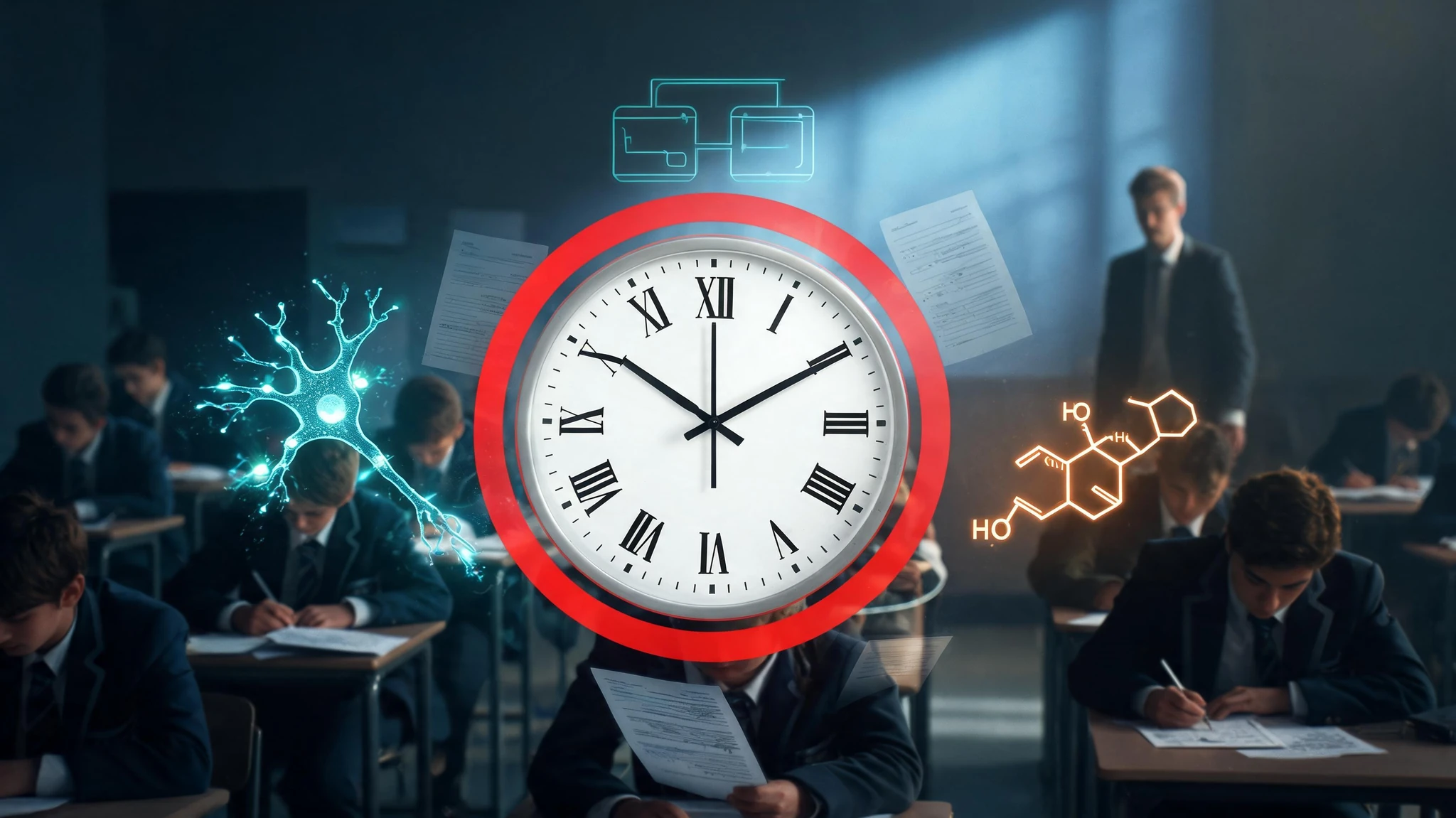
A round wall clock in a quiet exam hall used to be furniture, the kind of thing nobody noticed until they needed it. That has changed. Across England, head teachers are pulling the analogue clocks down before GCSEs and A-levels and replacing them with digital displays, after watching too many fifteen-year-olds glance up, squint, and lose their place. The reason teachers give is simple. A growing share of pupils cannot read the hands quickly enough to make the glance worth taking.
This is not, by itself, a failure of intelligence. It is a small mismatch between an old skill and a new generation, and it lands in the middle of one of the most stressful hours of a young person’s year. Under that kind of pressure, even tiny extra demands on working memory can drag scores down in measurable ways, a finding that has been replicated in lab after lab for two decades.1,2
What the schools actually changed
The shift began drifting into UK newspapers around 2018, when Malcolm Trobe, then deputy general secretary of the Association of School and College Leaders, told reporters that members were swapping analogue clocks for digital ones in exam halls because students “are not as good at reading the traditional clock face as older generations.” Since then the practice has quietly spread. In 2026, the same pattern has resurfaced on social feeds, with parents and teachers comparing notes from different counties about which schools made the switch and why.
Most heads frame it as a small kindness. Children who have grown up looking at phone lock screens, smart speakers, and oven panels rarely meet a clock face outside school. When they do, the dial is decorative more often than functional. Asking a tense sixteen-year-old to translate two slim hands into “twenty-three minutes left” is not a neutral request. It is a tiny extra computation in a brain that is already burning through fuel.
Why a small reading task matters during a timed exam
Working memory is the mental scratchpad. It holds the half-formed answer, the next step in the calculation, the phrasing of the sentence you are about to write. It is also the part of cognition that buckles first when a person feels watched, judged, or rushed. Sian Beilock and her collaborators at Michigan and Chicago spent the early 2000s showing that high-pressure conditions specifically damage performance on tasks that load up working memory, while leaving simpler, more automatic tasks intact.2,3
Their best-known demonstration asked students to solve modular arithmetic problems under low and high stakes. Heavy problems, the ones that ate up the most working memory, fell apart under pressure. Easier ones did not. Gimmig and colleagues, working independently in France, found the same pattern with fluid intelligence tests in 2006: people with the largest working memory capacity, the very people who normally lead the class, lost the most ground when stakes were high.1
That is the unglamorous reason a clock face matters. Reading “ten past two” off a dial is not hard in a quiet kitchen. Reading it off a dial three meters away while tracking a half-finished essay, a question you skipped, and a sense that the room has gone very still is a different problem. Each glance now costs something.

What anxiety actually does to attention
Michael Eysenck’s attentional control theory, published in Emotion in 2007, gives the cleanest account of why this happens. Anxiety, in his framing, does not simply drain processing power. It hijacks the attention system. Anxious students spend more of their working memory on threats, including internal ones such as “I’m running out of time,” and have less left over for the actual task.6 They can often still finish the test. They just take longer per item, miss small steps, and arrive at the end with thinner answers.
Acute stress also has a chemical fingerprint. Reviews in medical education have catalogued how a sharp rise in cortisol and adrenaline narrows attention, biases memory toward emotionally charged details, and degrades the kind of flexible thinking that exams demand.7 A trainee surgeon performing a familiar suture under stress can stay competent. The same trainee asked to make a novel decision while stressed gets noticeably worse. Schoolchildren are not surgeons, but the pattern is the same: pressure protects routine and erodes reasoning.
That is the lens through which to read the clock story. Pulling an analogue clock off a wall does not make children smarter. It removes a small, optional drag on attention at exactly the moment attention is already under siege.
Are teenagers really worse at reading clocks?
The honest answer is: probably yes for speed, almost certainly no for the underlying ability. There is no peer-reviewed national survey of British clock-reading. What does exist is a steady run of teacher reports and small classroom audits suggesting children today take longer to read a dial than children twenty years ago.
Two things probably explain the slowdown. First, the analogue clock is no longer the default surface for time. Phones, laptops, microwaves, and car dashboards all show numerals. A child can go a week without being asked to interpret a hand position. Second, primary-school maths curricula in the UK still teach analogue time, but the lessons compete with a long list of other topics, and pupils get less casual everyday practice at home than their parents did. Skills that are not used regularly do not become automatic, and skills that are not automatic always cost working memory.

What “automatic” really means in the brain
Cognitive scientists draw a sharp line between controlled processing, which is slow and deliberate, and automatic processing, which is fast and effortless. Reading a digital clock is, for almost everyone, automatic. The numbers go straight from the eye to “two thirty” without the mind having to pause. Reading an analogue clock can be automatic too, but only for someone who has done it thousands of times, mostly in childhood.
For pupils who got that practice, the clock still works as background furniture. For pupils who did not, the same clock turns into a small puzzle. The puzzle is solvable, but solving it pulls resources away from the algebra question on the page. Worse, the moment a student notices they are pausing, anxiety can spike, and the attentional control problem Eysenck described kicks in.6 A two-second glance becomes a six-second glance, then a thirty-second loop of “wait, what does that hand mean again, am I behind.”
Is removing analogue clocks dumbing things down?
This is the question that fuels the headlines. The phrase “schools have given up teaching kids to read a clock” is good for engagement and bad for the truth. Teaching analogue time is still in the curriculum at primary level. Schools are not banning analogue clocks from corridors, classrooms, or homework. They are removing them from one specific room: the exam hall, on the day of the test, when the goal is to measure subject knowledge rather than incidental reading speed.
That reframing matters. A standardized test is meant to be a controlled measurement. Anything that adds noise without adding signal makes the test worse. If half a class can read the wall clock at a glance and the other half cannot, the test is partly measuring clock literacy. Swap in a digital display and that variable goes away. The same logic is why exam boards allow extra time for pupils with dyslexia or visual impairment. The point is not lowering standards. It is keeping the measurement clean.
What the research says about reducing exam stress
There is also a quietly impressive evidence base on how to take pressure off students without changing the test itself. Gerardo Ramirez and Sian Beilock, writing in Science in 2011, asked ninth-grade biology pupils to spend ten minutes before a final exam writing freely about their worries. The expressive-writing group outperformed controls by roughly a full grade band, and the effect was largest for students who started off most anxious.4 A 2014 follow-up by Park and colleagues replicated the effect in a math context and traced part of the mechanism to working memory becoming available again once worry was offloaded onto paper.5
That is a strikingly cheap intervention: a pen, ten minutes, and a willingness to let a teenager write the sentence “I am scared I will forget everything.” It costs nothing, requires no new technology, and replicates one of the core findings about working memory and pressure: clear the scratchpad, and the rest of cognition functions better.

What parents can do without panicking
Most of the advice circulating online about analogue clocks reads like a culture-war reflex. The calmer version is short. If a child is heading toward GCSEs or A-levels and cannot read a dial in under three seconds, the fix is twenty minutes of practice scattered across a few weeks, not a public argument about phone screens. A wristwatch with hands, worn for a fortnight, sorts most of it out. The brain is built for this kind of skill consolidation. It just needs reps.
Parents who want to help with exam stress have stronger tools than clock drills. The Ramirez and Park studies point to expressive writing the night before or the morning of a test.45 Adequate sleep matters more than a final hour of revision. So does a familiar breakfast, a known route to the venue, and a parent who is calm about the outcome rather than openly anxious. Acute stress is contagious in families, and a worried adult in the kitchen at 7 a.m. tilts the day before the child has even left the house.7
What the original Facebook post got right and wrong
The viral version of this story leans heavily on a single line: pupils “can’t tell the time.” That overstates the case. Most teenagers can read an analogue clock at the breakfast table. They are slower at it in a silent hall, with a pen in their hand and a half-answered question in front of them. The Facebook caption hedged this honestly, noting the schools’ decision came from “observations from educators responding to real student needs, not a controlled scientific study.” That hedge is worth keeping.
What does have rigorous evidence behind it is the broader claim the schools are acting on without naming it. Small environmental changes that reduce extraneous load during a high-pressure task can preserve working memory for the work itself, and that benefits anxious students disproportionately.
Common questions about analogue clocks and exam stress
Is it true that British schools are banning analogue clocks?
No. Some secondary schools are removing them from exam halls during major tests like GCSEs and A-levels. Analogue clocks remain in classrooms, corridors, and the curriculum.
Should I worry if my teenager cannot read an analogue clock?
Probably not, if they can do it slowly. The skill comes back fast with a few weeks of casual practice, especially if they wear an analogue wristwatch.
Does exam stress really lower scores?
Yes, particularly on questions that demand working memory. Multiple studies have shown that high-pressure conditions selectively damage performance on demanding cognitive tasks while sparing simple, automatic ones.1,2,3
What is the simplest thing a student can do before a big exam?
Spend ten minutes writing freely about their worries on the morning of the test. The technique has been shown to raise grades, especially for the most anxious pupils.45
Are digital clocks better than analogue ones in everyday life?
Not really. They are just faster to read at a glance, which is why exam halls prefer them. Analogue clocks remain useful for spatial reasoning and for teaching children fractions of an hour.
The takeaway nobody wants to hear
The clock is a mirror, not a problem. It reflects how children today actually live, and how the schools they sit in have started to think about measurement. Pulling a dial off a wall during exam week is a tiny, almost invisible intervention. It will not raise a national grade average. It will not save a struggling student. What it will do, on the day, in that one room, is take a small, optional drag off attention at the moment attention is most precious.
Whether teenagers should relearn to read a dial is a fair separate conversation. They probably should, because the skill is cheap to acquire and useful for decades after school ends. But that conversation belongs in living rooms and primary classrooms, not in the silence of an exam hall with a stopwatch ticking.
Sources
- Gimmig D, Huguet P, Caverni JP, Cury F. Choking under pressure and working memory capacity: when performance pressure reduces fluid intelligence. Psychonomic Bulletin & Review, 2006. PubMed: 17484426
- Beilock SL, Carr TH. When high-powered people fail: working memory and “choking under pressure” in math. Psychological Science, 2005. PubMed: 15686575
- Beilock SL, Kulp CA, Holt LE, Carr TH. More on the fragility of performance: choking under pressure in mathematical problem solving. Journal of Experimental Psychology: General, 2004. PubMed: 15584808
- Ramirez G, Beilock SL. Writing about testing worries boosts exam performance in the classroom. Science, 2011. PubMed: 21233387
- Park D, Ramirez G, Beilock SL. The role of expressive writing in math anxiety. Journal of Experimental Psychology: Applied, 2014. PubMed: 24708352
- Eysenck MW, Derakshan N, Santos R, Calvo MG. Anxiety and cognitive performance: attentional control theory. Emotion, 2007. PubMed: 17516812
- LeBlanc VR. The effects of acute stress on performance: implications for health professions education. Academic Medicine, 2009. PubMed: 19907380