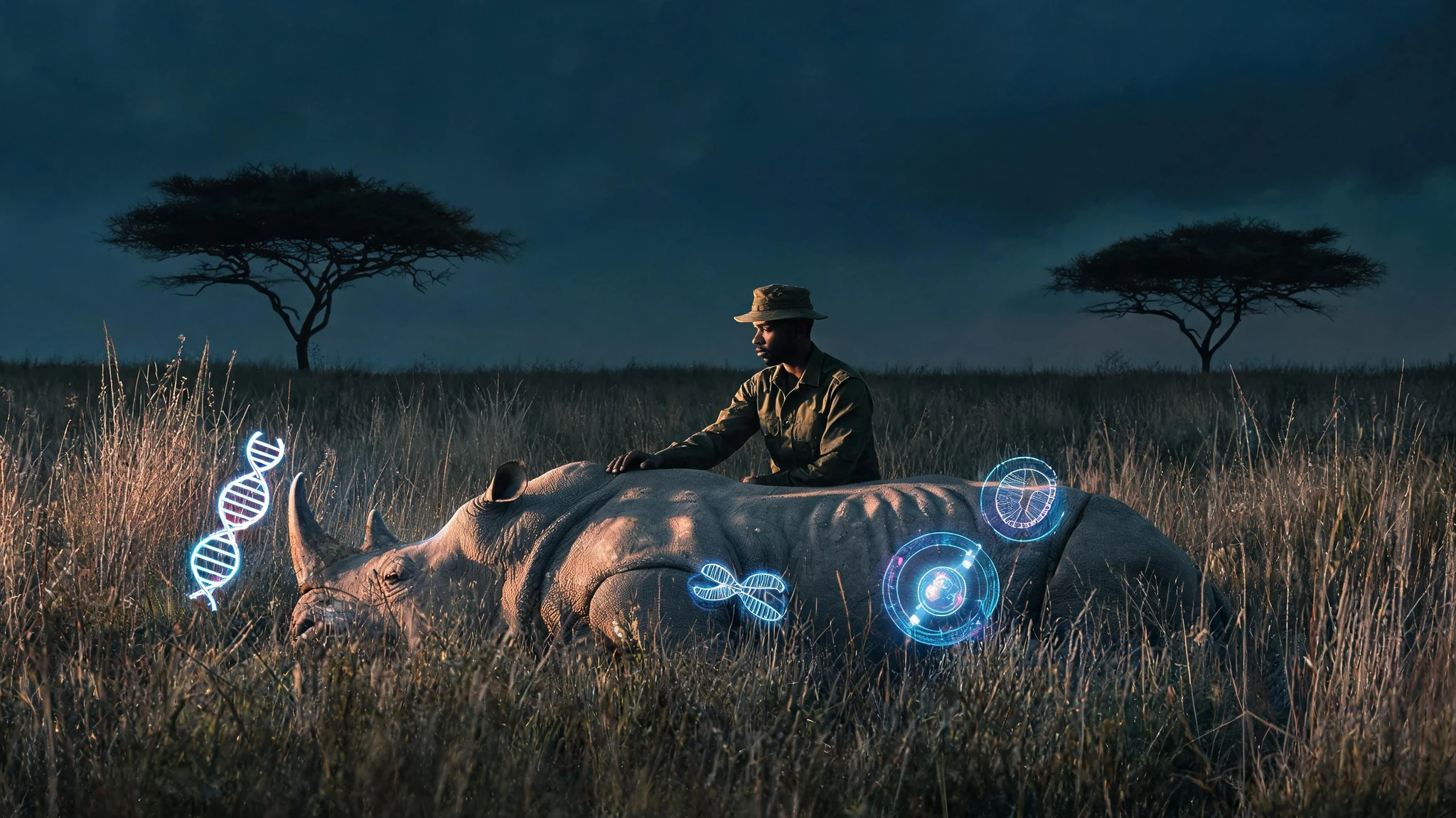
Two animals. That is the entire global population of the northern white rhinoceros, a creature that has lived in central Africa for hundreds of thousands of years. Najin and her daughter Fatu, both female, both kept under round-the-clock armed guard at the Ol Pejeta Conservancy in Kenya, are the only surviving members of the subspecies Ceratotherium simum cottoni. When the last male, a 45-year-old bull named Sudan, was put down on March 19, 2018, biologists declared the subspecies functionally extinct.
It does not have to end there. A consortium of researchers in Berlin, San Diego, Cremona, and Nairobi has spent the last decade working out how to rebuild a population from frozen cells, induced pluripotent stem cells, and the wombs of a different rhino subspecies. The science is real, the cells are real, and a 2025 review in Annual Review of Animal Biosciences calls it one of the most ambitious genetic rescue programs ever attempted2. Whether it works is another question.
How does a 55-million-year-old animal end up with a population of two?
The northern white rhino is not new. The genus Ceratotherium shows up in the fossil record millions of years before our own species split from the chimpanzee line, and a recent chromosome-level genome assembly published in PNAS in 2025 confirms it carries deep, distinct ancestry from its southern cousin1. In the early 1970s, conservation surveys still counted around 500 northern whites scattered across what is now South Sudan, Uganda, the Democratic Republic of Congo, and the Central African Republic.
Then came the horn rush. Civil wars armed everyone with cheap automatic rifles. Demand from East Asia for ground horn, sold as a fever cure and later as a status drug, sent the wholesale price climbing past $60,000 a kilo at the peak. By the early 1980s only about fifteen northern whites were left in the wild. The last known wild population, in Garamba National Park, was wiped out by 2008. Everything that has happened since then has happened in zoos and conservancies.
That collapse is not an outlier. A 2017 paper in PNAS by Gerardo Ceballos and Paul Ehrlich found that more than 30 percent of all vertebrate species with shrinking ranges have lost local populations they will not replace, and called the broader pattern a “biological annihilation”7. The northern white is one of the most visible victims, but it is not the strangest one.
Who are Najin and Fatu, exactly?
Najin was born in 1989 at the Dvur Kralove Zoo in the Czech Republic. Her daughter Fatu was born there in 2000. Both were moved to Ol Pejeta in 2009, in a long-shot bet that an African environment would coax them into breeding. It did not. Najin had a bad back leg and a cyst that made carrying a calf medically risky. Fatu has a uterine condition that prevents implantation. Neither can give birth.
Their daily life is unusual. They share a 700-acre enclosure with a small herd of southern white rhinos, eat grass and supplemental browse, and live within sight of a permanent armed-ranger team. Visitors who pay for the privilege can stand a few meters away while a keeper rubs Fatu behind the ear. The keepers know their personalities. Najin is the calmer one. Fatu is the one who pushes the gate first when feed buckets appear. Neither knows the species is gone.

What are scientists actually doing with their cells?
The plan, in plain language, is to build a rhino out of a freezer. There are two parallel tracks. The first is in vitro fertilization. Veterinarians from the Leibniz Institute for Zoo and Wildlife Research in Berlin sedate Fatu, insert an ovum-pickup probe through the rectum, and aspirate eggs from her ovaries. The eggs are flown to a lab in Cremona, Italy, where they are fertilized with reproductive cells preserved years ago from male northern whites including Sudan. As of late 2024 the team had created more than thirty pure northern-white rhino embryos, each frozen in liquid nitrogen and waiting for a surrogate2.
The surrogate would be a southern white rhino. The two subspecies are similar enough that a southern female should, in theory, be able to carry a northern white pregnancy to term. The team announced the first proof-of-concept pregnancy using IVF embryo transfer in a southern white surrogate in early 2024. The surrogate later died of a clostridial infection unrelated to the pregnancy, but the embryo had implanted and was developing normally, which the researchers took as evidence that the procedure can work2.
The second track is stranger. Jeanne Loring’s lab at Scripps Research, working with the San Diego Zoo Wildlife Alliance, took preserved skin cells from twelve different northern white rhinos collected over decades and reprogrammed them into induced pluripotent stem cells, the kind of stem cell that can in principle become any tissue in the body3. The lab has been coaxing those cells, step by step, toward primordial germ cells, which are the precursors of eggs and reproductive cells. If it works, the team could one day make eggs and reproductive cells from skin cells of rhinos that have been dead for years, and the resulting embryos would carry far more genetic diversity than the handful of recent animals can offer.
Has anyone done this before with a big mammal?
Not really. The first induced pluripotent stem cells from a highly endangered species were published in Nature Methods in 2011, when Inbar Friedrich Ben-Nun and colleagues reprogrammed cells from a drill and a northern white rhino8. That paper was the proof that the technology even applied to wildlife. The first true northern white rhino embryos created from preserved reproductive cells and southern white rhino eggs were reported in Nature Communications in 2018, the same year Sudan died4. The 2021 review “The ART of bringing extinction to a freeze” in Theriogenology laid out the full road map and was honest about how much could still go wrong5.
None of this has produced a calf yet. The gestation period of a white rhino is about 16 to 18 months. Even in a best-case scenario where a frozen embryo is implanted tomorrow and the southern white surrogate carries it to term, the first northern white calf would not arrive until late 2027 at the earliest. The team would need many more pregnancies, and many more years, before there was anything resembling a viable population.

Why a horn became worth more than the animal
Rhino horn is keratin. The same protein in fingernails, hooves, and hair. It has no documented medicinal effect for the conditions it is sold against, including fever, cancer, and hangovers. Forensic geneticists in South Africa have used microsatellite DNA panels to match seized horn fragments back to specific poached carcasses, the same way human DNA gets matched at a crime scene6. That work has put traffickers in prison. It has not stopped the trade.
One reason is that horn is rare and rarity is the product. A 2020 paper in Global Ecology and Conservation modeled what would happen if the international ban on rhino horn were partially lifted and farmed horn was sold legally. The authors concluded that legal supply could plausibly undercut poaching only if it were cheap, abundant, and trusted, and that the conditions in the actual market do not look like that8. In short, you cannot easily out-flood a black market that thrives on scarcity.
What has worked, in places, is boots and dogs. Ol Pejeta credits aerial patrols, tracker dogs, and a no-tolerance arrest policy for keeping its rhinos alive through the worst years of the 2010s. Across South Africa, where most of the world’s southern white rhinos live, poaching numbers have fallen from their 2014 peak of more than 1,200 animals a year to a few hundred, although the trend is shaky and the criminal networks behind it are intact.
It is not just the rhino
The deeper reason this story matters is that the northern white is a preview, not an exception. A 2020 follow-up paper, again from Ceballos and colleagues, found that more than 500 vertebrate species had populations of fewer than 1,000 individuals, the threshold below which extinction tends to accelerate, and that the same handful of human pressures (habitat conversion, hunting, climate, invasive species) explain almost all of them. Most of those animals are not famous. They will go quietly.
The northern white rhino is famous because it is huge, photogenic, and easy to anthropomorphize. The Sumatran rhino, of which fewer than 80 remain in the rainforests of Indonesia, gets a fraction of the attention and is in arguably worse shape. The vaquita porpoise of the Gulf of California is down to single digits. The kakapo, a flightless parrot in New Zealand, is genuinely starting to recover after 30 years of intensive management, and its case shows that the methods do work when they are funded for long enough.
What good does any of this do if you live in Ohio?
A reasonable question. The honest answer is that your individual contribution to a rhino’s fate is small, but it is not zero, and the small contributions are what fund the people who do the work. Ol Pejeta runs partly on tourism revenue and partly on direct donations. The BioRescue consortium, which is doing the IVF and stem-cell research, is funded by a mix of German and EU science grants, the Leibniz Institute, and a network of private donors. Both publish their finances. Both can be supported with as little as a single annual gift.
If you want to do something more concrete, the cleanest options are these. Give to a vetted on-the-ground program rather than a generic “save the rhinos” charity. Pay attention to who is selling carved-horn jewelry in your area, because trafficking does not stop at a port, and report anything that looks suspicious to local fish-and-wildlife authorities. Avoid traditional-medicine products with ambiguous animal ingredients when you travel. Vote, locally and nationally, for the people who fund customs enforcement and habitat protection.
Common questions about the northern white rhino
How many northern white rhinos are alive in 2026?
Two. Both are female. Najin is 36 and her daughter Fatu is 25. They live at Ol Pejeta Conservancy in Laikipia County, Kenya. There are no known wild northern whites and no others in any zoo.
Could the species be brought back?
Possibly, but slowly and not certainly. The BioRescue team has more than 30 frozen northern white rhino embryos and a stem-cell bank derived from a dozen individuals. A first northern white rhino calf, born from a southern white rhino surrogate, is the next milestone. Any real population recovery would take decades.
Is rhino horn medicine?
No. Horn is keratin, the same protein your fingernails are made of, and controlled studies have not found any pharmacological effect for the indications it is sold against. The trade is driven by status and tradition, not pharmacology.
Why can’t Najin and Fatu just have babies the normal way?
There is no male, for one. Beyond that, Najin’s hind legs and pelvic floor cannot safely carry a 100-kilogram calf, and Fatu has a chronic uterine condition that prevents implantation. Their eggs can still be harvested for IVF, which is the route the conservation team is now taking.
How is this different from cloning a mammoth?
Different in a useful way. The northern white rhino was alive in 2018, reproductive cells and tissue were preserved properly, and a closely related subspecies can serve as a surrogate. Mammoth de-extinction has none of those advantages and would have to invent the entire surrogate biology along the way.
Two left
The number on the page is small enough that it stops feeling like a statistic and starts feeling like a sentence. Two. The conservancy team in Kenya knows both their names. The Berlin lab knows the chromosome counts of every preserved cell line. The technology to undo this particular extinction may, with luck and money, exist in our lifetime. The technology to prevent the next one is mostly behavioral, and that is the harder part.
Najin and Fatu are not waiting for us. They graze, nap in the shade of acacia trees, and accept apple slices from a keeper they have known for years. The work that decides whether their lineage continues is happening in petri dishes thousands of miles away. The work that decides whether other species end up in the same place is happening in courtrooms, customs offices, and grocery aisles. Both kinds of work matter.
Sources
- Wang G, Korody ML, Brändl B, et al. Genomic map of the functionally extinct northern white rhinoceros (Ceratotherium simum cottoni). Proc Natl Acad Sci U S A. 2025;122(20):e2401207122. PubMed: 40359041
- Korody ML, Hildebrandt TB. Progress Toward Genetic Rescue of the Northern White Rhinoceros (Ceratotherium simum cottoni). Annu Rev Anim Biosci. 2025;13:483–505. PubMed: 39531386
- Korody ML, Ford SM, Nguyen TD, et al. Rewinding Extinction in the Northern White Rhinoceros: Genetically Diverse Induced Pluripotent Stem Cell Bank for Genetic Rescue. Stem Cells Dev. 2021;30(4):177–189. PubMed: 33406994
- Hildebrandt TB, Hermes R, Colleoni S, et al. Embryos and embryonic stem cells from the white rhinoceros. Nat Commun. 2018;9(1):2589. PubMed: 29973581
- Hildebrandt TB, Hermes R, Goeritz F, et al. The ART of bringing extinction to a freeze – History and future of species conservation, exemplified by rhinos. Theriogenology. 2021;169:76–88. PubMed: 33940218
- Harper C, Ludwig A, Clarke A, et al. Robust forensic matching of confiscated horns to individual poached African rhinoceros. Curr Biol. 2018;28(1):R13–R14. PubMed: 29316411
- Ceballos G, Ehrlich PR, Dirzo R. Biological annihilation via the ongoing sixth mass extinction signaled by vertebrate population losses and declines. Proc Natl Acad Sci U S A. 2017;114(30):E6089–E6096. PubMed: 28696295
- Eikelboom JAJ, Nuijten RJM, Wang YXG, et al. Will legal international rhino horn trade save wild rhino populations? Glob Ecol Conserv. 2020;23:e01145. PubMed: 32835033
- Ben-Nun IF, Montague SC, Houck ML, et al. Induced pluripotent stem cells from highly endangered species. Nat Methods. 2011;8(10):829–831. PubMed: 21892153