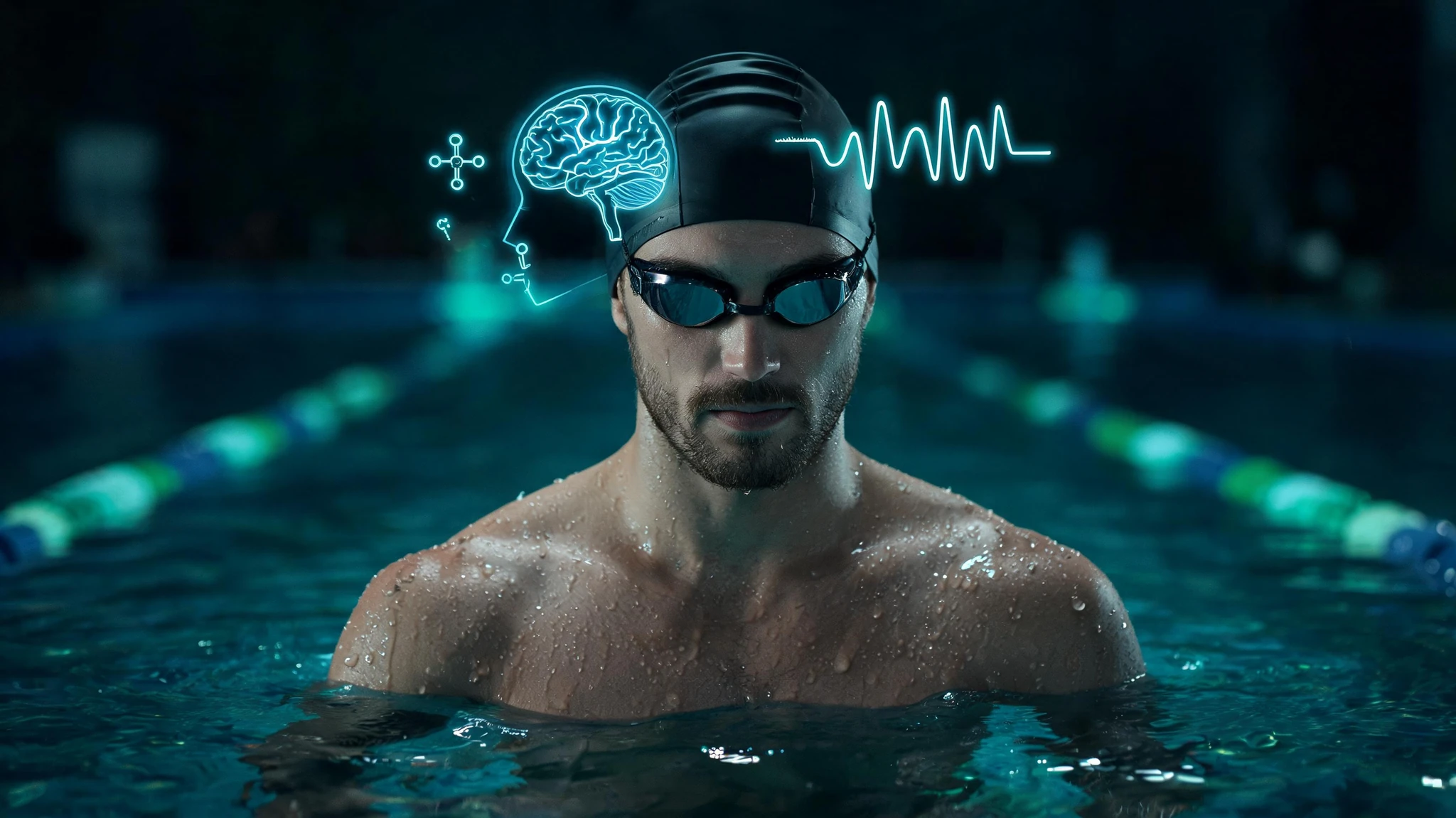
Swimmers have known the feeling for decades. You climb out of the water after twenty minutes of laps and your head feels rinsed, a little quieter, sharper at the edges. A pair of studies from a research group in Western Australia gives that feeling a number. When healthy adults are simply immersed in water up to the heart, blood flow through the main brain arteries rises by roughly 14 percent compared with sitting on the deck1. Add light exercise in the water and the effect grows.
That 14 percent figure travels well on Facebook, often in the form of a slogan: swimming gives you a “brain bath.” The slogan is a little loose. The research underneath it is real, and it is more interesting than the meme.
What the original study actually measured
In 2014, Howard Carter and colleagues at the University of Western Australia put nine healthy adults through a careful crossover protocol. Each volunteer was tested twice. On one day they sat in a chair on the pool deck, breathing normally. On the other they were lowered into 30 degree Celsius water up to the level of the right atrium and asked to do nothing in particular. The scientists used Doppler ultrasound to measure blood velocity in the internal carotid and middle cerebral arteries, the two highways that feed most of the cerebral cortex1.
The result that grabbed attention: head-out water immersion alone, no swimming required, raised flow through those arteries by about 9 to 14 percent. Heart rate dropped, stroke volume rose, and the redistribution of blood toward the chest seemed to free up a little extra perfusion for the head. Carter’s team was clear that this was a small physiology study, not a long-term trial, and that the people in it were young and healthy. Still, it was the first time anyone had cleanly shown that water by itself, without exercise, could push more blood toward the brain in awake humans.
Then they added exercise
The follow-up came a year later. Christopher Pugh and most of the same team ran a similar study, but this time the volunteers exercised. They did the same workload twice: once cycling on dry land at moderate intensity, once cycling in chest-deep water on a submerged ergometer2. Heart rate, oxygen consumption, and effort were matched. The only difference was the medium.
Cerebral blood flow rose during both sessions, which is what aerobic exercise normally does. But the in-water session produced a noticeably bigger rise. The difference was on the order of 10 to 14 percent extra flow during the water-based bout, with the effect most obvious in the internal carotid artery. Translation: at the same effort and the same heart rate, your brain appears to get more blood when you are working out in water than when you are working out on land.
That is the finding behind the meme. It is not a claim about lifetime brain health. It is a snapshot of what happens during the exercise itself, measured by ultrasound on a small group of fit volunteers.

Why might water do this?
Three plausible mechanisms keep showing up in the literature. None of them is a magic ingredient. Together they line up to make swimming a slightly different cardiovascular challenge than running or cycling on land.
The first is hydrostatic pressure. Standing in chest-deep water, you have several kilograms of water pushing inward on your legs and abdomen. That squeeze sends about 700 milliliters of blood from the venous reservoirs in the legs back toward the chest. The heart fills more completely with each beat, stroke volume goes up, and total cardiac output rises with very little extra work from the heart. Carter’s group flagged this redistribution as the most likely driver of the head-out immersion effect1. You are giving the brain a quietly enriched supply.
The second is breath control. Swimmers cannot inhale on every stroke the way runners can. They breathe to a rhythm. That tends to nudge arterial carbon dioxide upward, and CO2 is a powerful dilator of the small arteries that feed the brain. A modest rise in CO2 of just a few millimeters of mercury can lift cerebral blood flow by a similar 10 to 14 percent. The Western Australia group has explicitly pointed at this mechanism as a contributor to the effects they measured during in-water exercise2. It is the same physics that makes a slow nasal breath feel calming. You are gently rebreathing your own carbon dioxide and the brain is responding by opening its taps.
The third is blood pressure handling. On land, exercise drives blood pressure up sharply, and the brain protects itself with a process called cerebral autoregulation. In water, the pressure response is blunter and the autoregulatory squeeze is less aggressive, so a bit more flow is allowed through. That is the working hypothesis, anyway. It is the least well established of the three and deserves the heaviest hedge.
Does more blood flow mean a better brain?
This is the honest hinge of the article. A short term rise in cerebral perfusion is not the same as long term cognitive benefit. The physiology paper does not prove that swimmers get smarter. It measures plumbing, not thinking.
What the broader exercise literature suggests is that aerobic activity, sustained over weeks and months, does shift cognition in a measurable way. The largest meta-analysis on the topic to date pooled twenty-nine randomized trials of aerobic exercise in adults and found small to moderate improvements in attention, processing speed, executive function, and memory5. Effect sizes were modest, around 0.15 to 0.25 standard deviations, which is roughly what you would expect from a real but unspectacular intervention. Most of the trials in that analysis used walking, cycling, or treadmill running. Swimming was underrepresented, which is one reason the new water-based studies are so interesting. They suggest the same machinery, possibly turned up a little.
There is also direct evidence that the cognitive lift can be quick. In studies of acute exercise, a single bout of moderate aerobic activity often improves reaction time and selective attention for the next thirty to sixty minutes. Researchers have used event-related brain potentials to track that bump in young adults, and athletes with more aerobic background tend to show larger and faster attention-related brain responses than sedentary controls4. The signal is real, even if it is short-lived.

Swimming as therapy: a small but striking case
Most of the swimming research focuses on cardiovascular and metabolic outcomes. A scattering of clinical case work hints at something more specific. In 2023, a Greek team published a case report on a teenage boy with attention deficit hyperactivity disorder who had been struggling at school. After a structured swimming program of two to three sessions per week over several months, his teachers and parents reported clear improvements in concentration and impulsivity, with measurable changes on standard ADHD rating scales3.
A single case is not evidence that swimming treats ADHD. The authors are explicit about that. What the case adds is a plausible bridge between the physiology studies and real life. If water exercise reliably nudges cerebral blood flow upward, and if that helps engage attention networks, you would expect the people who already have trouble engaging those networks to feel the difference first. The next step is a properly randomized trial, and a few are now in progress.
How much, how often, how hard?
The protocols in the published studies are surprisingly modest. Carter’s immersion study used roughly 10 to 15 minutes in 30 degree water. Pugh’s exercise study used moderate intensity cycling at about 60 percent of peak oxygen uptake for around 30 minutes1,2. The newer cognition trials tend to use 20 to 30 minute sessions of swimming at a pace where you can still talk in short sentences. None of these are heroic workouts. They are something a reasonably fit adult can sustain in a public lap pool.
If you are starting from a sedentary baseline, the conservative version looks like this. Two or three sessions of 20 minutes per week, at a pace that leaves you mildly out of breath but not gasping, water at chest level, breathing every two or three strokes if you are doing freestyle. Skip the hard intervals for the first month. The blood flow effects show up at moderate intensity. The risk of overdoing it shows up at higher intensities, especially if your shoulder or lower back is unhappy.
Two practical notes. Cold water hits the cardiovascular system harder than warm water. The 30 degree pools used in the studies are warmer than most outdoor lake or sea swims. If you are heading to a cold lake, the rules change, and so does the safety profile. And anyone with poorly controlled blood pressure, recent cardiac events, or known cerebrovascular disease should clear an exercise plan with their doctor before adding water immersion to the mix. The hydrostatic shift is gentle for most people, but it is a shift.

The reaction-time finding, in context
The viral version of this story includes a specific number: 20 minutes of moderate swimming improved reaction time by around 4 percent in one study. That is a real published result, though the study sample was small and the effect was short-lived. It is the kind of finding that should be filed under “interesting, replicate it” rather than “swim before your driving test.” The same caution applies to similar acute-exercise studies on land. A short bout helps for an hour or two. Over months, the benefit comes from repeated exposure, not from any single swim.
It also helps to remember what 4 percent of reaction time means. On a typical task where reactions take around 350 milliseconds, a 4 percent improvement is about 14 milliseconds. That is not nothing. It is the difference between being a hair faster on a cognitive test, and it tracks with what acute aerobic exercise generally does. It is not the difference between cognitive impairment and brilliance.
Common questions about swimming and brain blood flow
Does the 14 percent figure mean swimming is better than running for the brain?
It means more blood flowed during the swim sessions in two small physiology studies, at matched effort. Whether that translates to better long-term cognition is unproven. Running has its own large body of evidence for brain health.
Do you need to swim laps to get the effect?
Probably not all of it. Carter’s immersion data suggest that simply standing or moving gently in chest-deep warm water raises cerebral perfusion. Walking in shallow water or gentle aquatic aerobics likely captures part of the benefit, particularly for older adults or those rehabbing an injury.
Is cold water swimming the same?
No. Cold water adds a major sympathetic nervous system response, which has its own pros and cons. It is not what these studies measured. Treat cold immersion as a separate practice with separate risks.
What about indoor pool chlorine?
Well-maintained indoor pools are generally safe for regular use. People with asthma should pay attention to chloramine exposure in poorly ventilated facilities and consider outdoor or saltwater pools when possible.
How long before I notice anything?
Acute effects on attention and reaction time can show up within a single session. Sustainable changes in cognition track with sustainable training, which usually means six to twelve weeks of consistent work.
Where this leaves a careful reader
The honest summary is that water exercise does something real and slightly distinctive to brain perfusion, and that the same broad principles that make any aerobic activity good for the brain probably apply, possibly with a small bonus from the water itself. The bonus is not magic. It is hydrostatic pressure, breath rhythm, and a softer blood pressure response, working together for as long as you stay in the pool.
If you already swim, you have one more reason to keep going, beyond the joints and the shoulders and the hour off your phone. If you are curious and the pool is nearby, two short sessions a week is a low-cost experiment. The research will keep arriving. So far it suggests that the people who like the way their head feels after a swim are not imagining it.
Sources
- Carter HH, Spence AL, Pugh CJ, Ainslie P, Naylor LH, Green DJ. Cardiovascular responses to water immersion in humans: impact on cerebral perfusion. American Journal of Physiology – Regulatory, Integrative and Comparative Physiology, 2014; 306(9):R636–40. PubMed: 24553298
- Pugh CJ, Sprung VS, Ono K, Spence AL, Thijssen DH, Carter HH, Green DJ. The effect of water immersion during exercise on cerebral blood flow. Medicine and Science in Sports and Exercise, 2015. PubMed: 24977699
- Skalidou S, Anestis A, Bakolas N, Tsoulfa G, Papadimitriou K. Swimming Activity Alleviates the Symptoms of Attention Deficit Hyperactivity Disorder (ADHD): a Case Report. Healthcare (Basel), 2023; 11(14). PubMed: 37510440
- Aly M, Ahmed MA, Hasan A, Kojima H, Abdelhakem AR. Sport Experience and Physical Activity: Event-Related Brain Potential and Task Performance Indices of Attention in Young Adults. Journal of Functional Morphology and Kinesiology, 2019; 4(2). PubMed: 33467348
- Smith PJ, Blumenthal JA, Hoffman BM, Cooper H, Strauman TA, Welsh-Bohmer K, Browndyke JN, Sherwood A. Aerobic exercise and neurocognitive performance: a meta-analytic review of randomized controlled trials. Psychosomatic Medicine, 2010; 72(3):239–52. PubMed: 20223924