Open the curtains in the morning and a chunk of the bacteria living in your house dust quietly stops being able to grow. That is the headline from a 2018 paper in the journal Microbiome, where Ashkaan Fahimipour and colleagues at the University of Oregon ran 11 climate-controlled mock rooms for 90 days and watched what daylight did to the tiny ecosystem on the floor.1
Rooms that received normal daylight through a regular glass window ended up with about 6.8 percent of their dust bacteria still viable, against roughly 12 percent in the dark rooms. Rooms exposed to UV alone landed near 6.1 percent. The dust did not get sterile. It got less alive, and the species shifted away from the kind of skin and gut microbes most associated with humans.1
What Fahimipour and his team actually did
The setup was deliberately ordinary. The researchers built small chambers, lit some with full-spectrum daylight passing through standard window glass, lit others with only the UV portion of that light, and kept a third group completely dark. They then seeded each chamber with the same starter dust collected from real homes and let it sit for three months. Temperature and humidity were held steady so the only meaningful variable was light.1
At the end they counted not just total DNA, which captures dead and alive cells together, but viable cells specifically. That distinction matters. Plenty of papers have shown that dust everywhere is loaded with bacterial DNA. The Oregon team wanted to know whether the bugs were still able to do anything.1
The answer was no, not as many of them, in rooms the sun reached. The community structure in the daylit dust looked closer to outdoor soil and air communities, while dark dust held on to its human-derived microbes longer. The authors framed it carefully. This is one experiment, in artificial rooms, with a specific dust starter. They did not claim sunlight cleans your house.1
Why does light kill bacteria at all?
The mechanism is not mysterious. Ultraviolet wavelengths damage microbial DNA directly, forming covalent links between adjacent bases that block replication. Cells that cannot replicate cannot make a colony. Visible blue and violet light, around 405 to 470 nanometers, also produce reactive oxygen species inside bacterial cells through endogenous porphyrins, with similar end results at higher doses and longer exposures.
Most window glass blocks the shortest, hardest-hitting UVC almost entirely and lets through some UVA and a little UVB. That is far weaker than a hospital germicidal lamp. It is also continuous for hours every day, and that adds up. The Fahimipour study suggests that the cumulative dose drifting through a residential window over weeks is enough to bend the dust microbiome.1
What about dust mites?
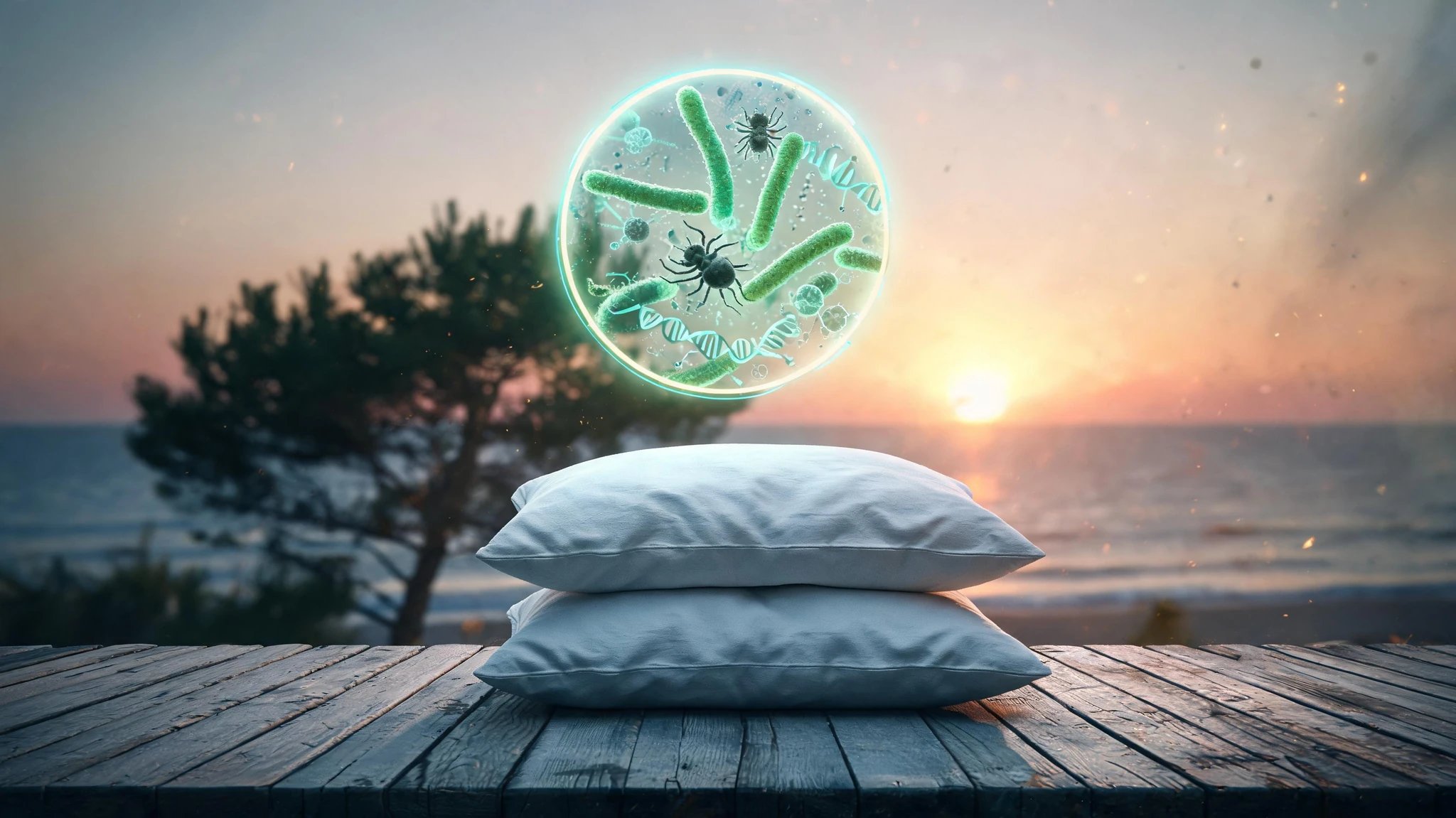
Dust mites are not bacteria. They are microscopic arachnids, mainly Dermatophagoides pteronyssinus and D. farinae, and their droppings are the main allergen source for millions of asthma and rhinitis sufferers. The 2018 paper did not study mites. People who pin their mattresses and pillows under a midday sun on the balcony are usually working from a different body of evidence, mostly about heat, dryness, and direct UV at intensities glass does not allow.
What the mite literature does show is that humidity, not light, is the master switch. Larry Arlian’s group at Wright State University demonstrated decades ago that dropping indoor relative humidity below about 50 percent for several hours a day kills mites by dehydration in laboratory conditions and steadily lowers the population in real bedrooms.3 Bedding interventions that combined hot washing, encasements, and humidity control have repeatedly cut measurable Der p 1 and Der f 1 allergen loads in pillows and mattresses, with modest but real symptom benefits in sensitized people.4,5

So the pillow on a sun-warmed deck is doing two things at once. The fabric is heating and drying, which is hostile to mites. The bacteria on its surface are taking a separate hit from the UV. Both effects exist. Neither is a substitute for laundry.
It is not just one study
The Oregon paper has been cited a few hundred times since publication, and a 2021 review in the Journal of Basic Microbiology by Rai and colleagues pulled the wider field together. They concluded that the indoor microbiome is shaped by occupancy, ventilation, humidity, and light, and that buildings designed with more natural daylight tend to host microbial communities that look less like a continuous skin shedding event.2
That is a soft finding. It is not the kind of result you stake a public health policy on. But it lines up with older architectural research on tuberculosis wards, with hospital studies on ward orientation, and with the simple folk knowledge that damp dark basements smell different from sunny rooms because the things growing in them are different.
Florence Nightingale, working at Scutari in 1855, wrote that a patient in a sunless room recovered more slowly than one whose bed faced a window. She was guessing at a mechanism. The Oregon team supplied one piece of the answer 163 years later. The dust on the floor was different.1
There is also indirect support from the air-handling literature. Hospitals that retrofit ultraviolet germicidal lamps in upper-room ventilation see drops in airborne tuberculosis transmission that have been documented in field trials going back decades. Those lamps run at intensities a window cannot match, but the underlying physics is the same. Photons damage nucleic acids. Cells die.
How much sunlight is enough?
The honest answer is that nobody has run the dose-response trial in real homes yet. The Fahimipour chambers received roughly the equivalent of a south-facing window in a temperate climate, with the sun tracking across the room for a few hours a day. The effect was clear at 90 days. Whether two weeks would be enough, or whether a north-facing window in winter does anything, has not been measured.1
For a rough mental model, treat sunlight the way you would treat a slow background process. It is not going to disinfect a kitchen counter you just cut raw chicken on. It can plausibly nudge the persistent low-level community in floor dust, on shelf surfaces, on the underside of a couch cushion, over weeks and months.
The geometry matters too. A window that gets two hours of direct sun a day will do more than a window in perpetual shade, and a beam that lands on a rug is bleaching the dust right where it accumulates, not on a wall. People who keep heavy drapes drawn until evening get less of this background effect than people who open up at breakfast and forget about the curtains until bedtime. None of that is a prescription. It is just where the small effect lives.
Which bacteria actually drop?
The Oregon team did not just count bodies. They sequenced the 16S ribosomal RNA gene in living cells and watched community structure shift. In the dark rooms, dust held a heavier load of skin- and gut-associated genera, the kind shed continuously by the people who live in a house. In the daylit rooms, those genera lost ground and outdoor-derived bacteria, the sort blown in on shoes and air, took up a larger relative share. The total community was less human and more ambient.1
That distinction is what makes the result interesting beyond the headline number. A house full of dust microbes that mostly came from people is also a house where any pathogen one of those people sheds, including the seasonal respiratory ones, has a slightly more hospitable place to wait around. Tilting the community toward outdoor bugs is not a guarantee of anything clinical, but it is the direction most building scientists would call healthier.2
What this does not mean
Three things the study does not say.
It does not say that sunlit homes have fewer infections. There is no clinical endpoint here, only a microbiome shift. People in dim apartments are not somehow more likely to catch colds because of dust composition.
It does not say that all the bacteria in dust are bad. Plenty of evidence, much of it from the farm-versus-city allergy literature, points the other way. Children raised around diverse microbial environments often have lower rates of asthma and allergy. The goal is not a sterile house. The goal, if there is one, is a less stagnant one.2
And it does not say that pulling the curtains will fix mold. Mold is mostly a humidity and ventilation problem. Sunlight discourages some surface fungal growth on already-damp materials, but the fix for a mold patch is finding the leak, not opening a blind.

Practical things you can do this week
Open the curtains in the morning, every morning, and leave them open. The dust in the strip of light along the floor has been studied. The dust in the dark corner of the bedroom closet has not. Behave accordingly.
Crack a window for ten minutes when you wake up. Air exchange does more for indoor air quality than light alone, and the two together do more than either. The 2021 Rai review treated ventilation as a peer of daylight in shaping indoor microbial communities, not a competitor.2
If you have asthma or a confirmed dust mite allergy, the bigger-impact interventions are still the unsexy ones. Wash bedding weekly at 60 degrees Celsius, use allergen-impermeable encasements on pillows and mattresses, and try to keep household humidity in the 40 to 50 percent range. Those are the moves with the most evidence behind them.3,4,5
Take the cushions and pillows out into direct sun on a dry afternoon every few weeks. The fabric heats well past what mites tolerate, the moisture wicks out, and the surface microbes get a UV dose glass would have blocked. It is a slow trick, not a fast one.
Common questions about sunlight and house dust
Does sunlight through a window kill all bacteria in dust?
No. In the Fahimipour study, daylight reduced the share of viable bacteria from about 12 percent in dark rooms to roughly 7 percent in lit rooms. Most cells were already non-viable in either condition. The bigger story is which species survive, not how many.1
Is UV from a window strong enough to disinfect surfaces?
Not by hospital standards. Most window glass blocks UVC, the wavelength used in clinical germicidal lamps. The effect on household dust accumulates over weeks, not minutes.
Does putting a pillow in the sun kill dust mites?
It can reduce them, mostly through heat and dryness rather than UV. Mites die when relative humidity inside the fabric drops below about 50 percent for long enough, which a sunny outdoor afternoon achieves.3
Should I open the curtains for health reasons?
The evidence points to yes, but as a small daily habit alongside ventilation, regular cleaning, and humidity control. Not as a standalone fix.
Are blackout curtains bad for me?
No. Sleep-quality benefits from a dark bedroom at night are well established. The relevant question is whether the room sees daylight at some point, not whether it is dark when you sleep.
The thing to take away
The Fahimipour paper is one careful experiment, in mock rooms, on a single dust pool, over 90 days. It does not transform anything about how a healthy home works. What it does is put a number behind something people have noticed for as long as they have lived in houses with windows. Rooms the sun reaches feel cleaner because they are, in a measurable, microbial sense, a little less alive in the wrong ways.1
Pull the blind tomorrow morning. Open a window for a few minutes while the kettle boils. Wash the pillowcases on Saturday. None of those moves are dramatic. Stacked, they are how a house gets quietly easier to breathe in.
Sources
- Fahimipour AK, Hartmann EM, Siemens A, et al. Daylight exposure modulates bacterial communities associated with household dust. Microbiome. 2018. PubMed: 30333051
- Rai S, Singh DK, Kumar A. Microbial, environmental and anthropogenic factors influencing the indoor microbiome of the built environment. Journal of Basic Microbiology. 2021. PubMed: 33522603
- Arlian LG, Neal JS, Vyszenski-Moher DL. Reducing relative humidity to control the house dust mite Dermatophagoides farinae. Journal of Allergy and Clinical Immunology. 1999. PubMed: 10518832
- Lee IS. Effect of bedding control on amount of house dust mite allergens, asthma symptoms, and peak expiratory flow rate. Yonsei Medical Journal. 2003. PubMed: 12728474
- Tsurikisawa N, Saito A, Oshikata C, et al. Effective allergen avoidance for reducing exposure to house dust mite allergens and improving disease management in adult atopic asthmatics. Journal of Asthma. 2016. PubMed: 27049597