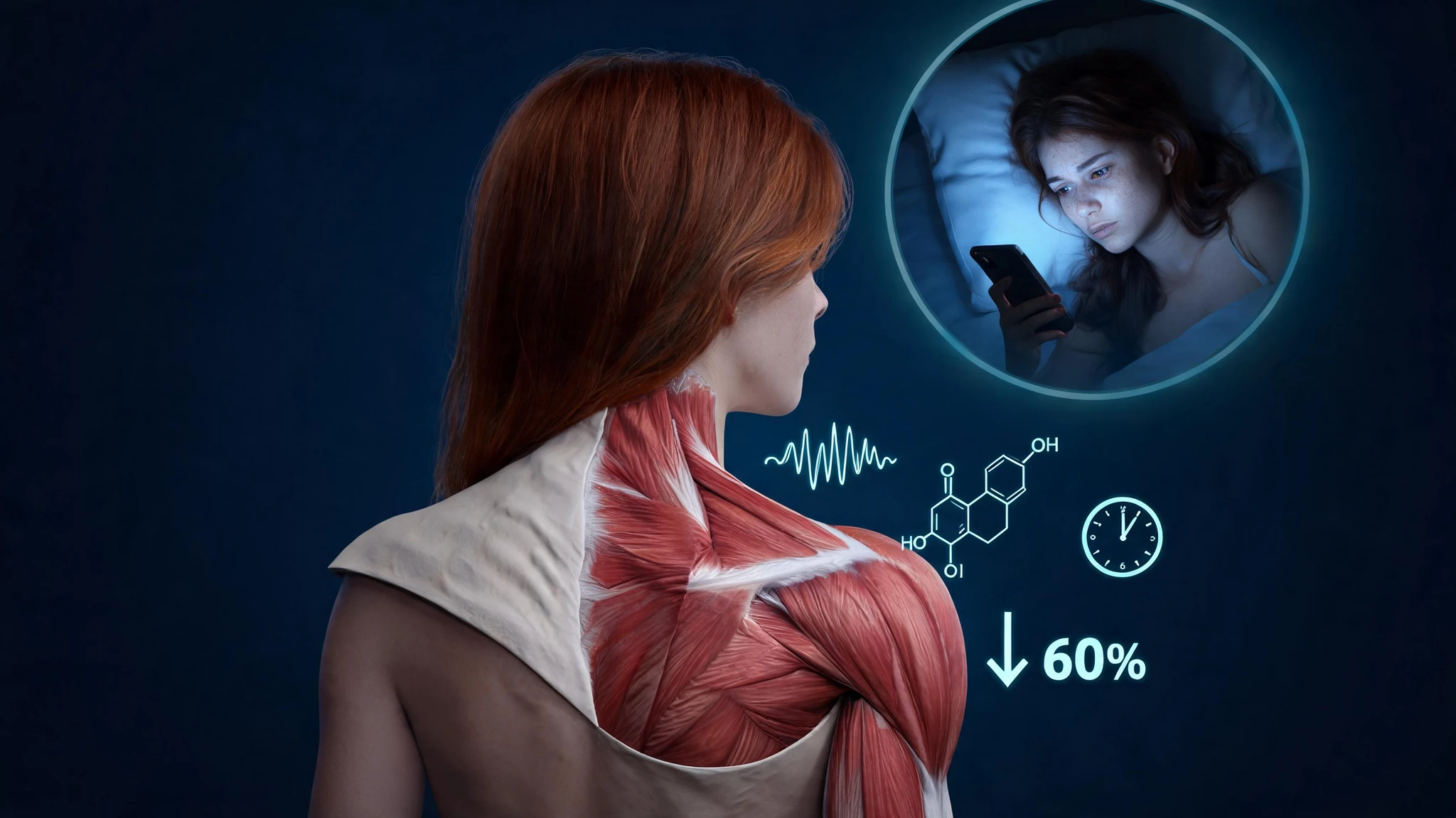
If you are working hard on a calorie deficit and sleeping five and a half hours a night, the scale might still drop, but a controlled trial run at the University of Chicago suggests the weight you are losing is the wrong kind. Researchers led by Arlet V. Nedeltcheva and published in Annals of Internal Medicine in 2010 found that adults on the same diet lost about 55% less body fat and roughly 60% more lean tissue when their nights were cut to 5.5 hours, compared with 8.5 hours.1
The calories were identical. The food was identical. The only thing that changed was sleep, and the result was a slower, less flattering kind of weight loss. That is the headline finding, and it has held up well enough that endocrinologists now treat sleep as part of a fat-loss prescription, not a bonus.1
What the Chicago crossover study actually measured
The trial enrolled ten overweight, otherwise healthy adults and ran them through two two-week stays in a sleep laboratory, in random order. During each stay they ate the same moderate-deficit diet, with calories pre-portioned and intake supervised. In one block they were allowed 8.5 hours in bed. In the other they were restricted to 5.5 hours.1
Total weight lost was almost the same in both blocks, around three kilograms. The composition of that loss was not. Under the 8.5-hour condition, just over half of what came off was fat. Under the 5.5-hour condition, fat made up only about a quarter of the loss, and the rest was lean body mass. In plainer terms: the dieters who slept less ended the two weeks lighter, but smaller in muscle, with more of their body fat still attached. The participants also reported feeling hungrier and rated themselves as having less energy when they were sleep restricted.1
It was a small trial, ten people, not hundreds. The strength came from the design. Each person served as their own control across the two conditions, which removes a lot of the noise that ruins bigger nutrition studies. The signal was unusually clean for a field where signals are usually muddy.
Why does short sleep change what your body burns?
The mechanism is not one switch. It is a handful of hormonal and behavioral shifts that all push in the same direction.
The first is appetite. In a 2004 study in the same journal, Karine Spiegel and colleagues restricted healthy young men to four hours in bed for two nights and saw leptin, the hormone that signals fullness, fall by about 18%, while ghrelin, which drives hunger, rose by 28%. The men reported a 24% jump in hunger and a particular pull toward calorie-dense, starchy foods.3 A larger population study by Shahrad Taheri and coauthors, also published in 2004, found that habitual short sleepers had lower leptin, higher ghrelin, and a higher body mass index than people who slept seven to eight hours.2
The second shift is in cortisol. Rachel Leproult and colleagues showed in a 1997 paper in Sleep that even one night of sleep loss raised evening cortisol the following day.4 Chronically elevated cortisol nudges the body toward breaking down protein, including muscle protein, for fuel. It also encourages fat storage, particularly around the abdomen. So you get a metabolism that is more catabolic for muscle and more conservative with fat. Exactly the opposite of what someone in a deficit wants.

The third is growth hormone and recovery. Most of the body’s pulse of growth hormone happens during deep slow-wave sleep, which is the first casualty when nights are short. Less deep sleep means less of the signal that helps muscle repair and grow. Combine that with rising cortisol and you have a textbook recipe for losing lean tissue when you would rather be losing fat.
The fourth is behavior. Tired people move less. They take fewer steps, fidget less, skip workouts, and choose drive-throughs over cooking. None of this is moral failure. It is what brains do when they are short on rest.
Activity researchers have a name for the small unconscious movements that burn calories all day, from pacing on a phone call to bouncing a leg under a desk. It is called non-exercise activity thermogenesis, and it can swing daily energy expenditure by several hundred calories between two people of identical weight. Sleep loss appears to dial it down. The fitness tracker on your wrist will quietly report fewer steps and lower heart-rate variability for a week of bad nights, even if your scheduled workouts stay the same.
Is the 55% number the whole story?
Not quite. That number comes from one trial in ten people, and the absolute amount of fat lost in two weeks was modest in either condition. Replicate it in a thousand people across six months and the headline number will probably soften. But the direction of effect, less fat loss and more muscle loss when sleep is short, has shown up in independent studies of appetite, hormones, and body composition in dieters.2,3,5
It is also worth knowing the limits. Nedeltcheva’s volunteers were adults with overweight, not athletes. Their deficit was moderate. The intervention was two weeks, which is long enough to see hormonal and body-composition shifts but not long enough to capture what happens to a person dieting for six months. Real life is messier, and the numbers in your own mirror will be too.
What sleep extension does in the other direction
If short sleep undoes a diet, does longer sleep help one? In 2022, Esra Tasali and her team at the University of Chicago published a randomized trial in JAMA Internal Medicine testing exactly that. Eighty adults with overweight who habitually slept under 6.5 hours were randomized to either keep their usual schedule or get a one-session counseling intervention designed to lengthen their sleep. The extended-sleep group added an average of 1.2 hours per night. Over two weeks, with no instructions to change their diet, they ate roughly 270 fewer calories per day on average compared with controls.6
That is a startling number for a non-pharmacological intervention. Two hundred and seventy calories a day, sustained, is the kind of deficit that produces meaningful fat loss over months. The mechanism is not magic; it tracks with the appetite hormones above. Better-rested people simply do not feel as driven to eat.6

How much sleep is enough for body composition?
The current consensus is seven hours or more for most adults. The American Academy of Sleep Medicine and the Sleep Research Society jointly recommend at least seven hours per night on a regular basis to promote optimal health, and they note that habitual sleep below six hours is associated with adverse outcomes.7 The National Sleep Foundation’s expert panel recommends seven to nine hours for adults aged 26 to 64, with seven to eight hours considered appropriate for older adults.8
Those numbers are population guidance, not personal prescription. Some people genuinely thrive on a little less. Most who think they thrive on six hours are running a low-grade deficit they have learned to ignore. A practical test: if you wake without an alarm on weekends and sleep ten or eleven hours, your weekday number is too low.
What changes if you actually fix this
People who add an hour of sleep tend to notice the appetite shift first. Cravings for sugar and refined starch in the late afternoon, a hallmark of short-sleep biology, soften within a week or two. Workouts feel less like punishment. Recovery between sessions improves, which means the same training stimulus produces more muscle and less injury.
The scale, perversely, may move slowly at first. A well-rested body holds onto a little more glycogen and water in muscle, both of which weigh something. After three or four weeks the trend usually catches up. The mirror is a better judge than the scale during this period, and so is the waist of your jeans.
Strength numbers in the gym are another fair test. If your bench press, your squat, or whatever you measure starts creeping up two or three weeks into a sleep upgrade, you are almost certainly holding more muscle than you would have on six-hour nights. That is not a vanity statistic. Lean tissue is the engine that keeps a diet sustainable, because every pound of muscle quietly raises the calories you burn at rest.
Resistance training while dieting, paired with adequate protein and adequate sleep, is the closest thing to an evidence-based protocol for losing fat without losing muscle. Subtract any one of those three and the math gets worse. Subtract sleep, on the data above, and it gets worse fastest.1
It is not just one study
The Nedeltcheva trial is the cleanest single demonstration, but the body-composition pattern fits with a decade of related work on appetite, cortisol, and metabolic rate. Spiegel’s 2004 work tied short sleep to leptin suppression and cortisol shifts.5 Taheri’s epidemiology found the same pattern at the population level.2 Leproult’s earlier cortisol work explained part of the mechanism.4 Tasali’s 2022 sleep-extension trial closed the loop in the other direction.6 Different teams, different methods, same answer.

Common questions about sleep and fat loss
Does napping count toward the seven-hour minimum?
A short nap can recover daytime alertness, but the hormonal and metabolic benefits of sleep are tied to consolidated nighttime sleep, including deep slow-wave and REM stages. Naps help; they do not replace a short main sleep period.
How long does it take to see body-composition changes from better sleep?
Appetite changes are often noticed in one to two weeks. Visible body-composition shifts typically need four to twelve weeks of consistent sleep paired with training and adequate protein intake.
Is one bad night enough to slow fat loss?
One bad night nudges hunger and cortisol the next day, but it will not derail a diet on its own. Chronic short sleep, several nights a week for weeks at a time, is what bends the curve.3,4
Will sleeping more make you lose weight without dieting?
Tasali’s 2022 trial suggests it can reduce daily intake by about 270 calories on average in habitually short sleepers, which over time produces fat loss. It is not a guaranteed shortcut, and it works best alongside the basic levers of food and movement.6
What if I cannot get to bed earlier because of my schedule?
Then the realistic intervention is protecting the sleep you do get. A consistent bedtime even on weekends, a dark cool room around 18 degrees Celsius, no caffeine after early afternoon, and limited alcohol within three hours of bed will all raise the share of deep sleep inside a shorter window. Quality is not a full substitute for quantity, but the gap it closes is real.
The honest takeaway
Sleep is not the magic ingredient that replaces a sensible diet and resistance training. It is the unglamorous third leg of the stool, and the data suggest the stool falls over without it. If you are running a deficit and stuck, the cheapest experiment available is to add an hour in bed for two weeks and see what your hunger, your training, and your waistband do.
The Nedeltcheva trial is small. The biology behind it is not. Across a dozen studies in different populations, short sleep keeps producing the same pattern: more hunger, higher cortisol, less growth hormone, more muscle loss, less fat loss. None of this argues for sleeping the day away. It argues for treating seven to eight hours as part of the plan, not the part you cut when life gets busy.
Sources
- Nedeltcheva AV, Kilkus JM, Imperial J, Schoeller DA, Penev PD. Insufficient sleep undermines dietary efforts to reduce adiposity. Ann Intern Med. 2010;153(7):435–441. PubMed: 20921542
- Taheri S, Lin L, Austin D, Young T, Mignot E. Short sleep duration is associated with reduced leptin, elevated ghrelin, and increased body mass index. PLoS Med. 2004;1(3):e62. PubMed: 15602591
- Spiegel K, Tasali E, Penev P, Van Cauter E. Brief communication: Sleep curtailment in healthy young men is associated with decreased leptin levels, elevated ghrelin levels, and increased hunger and appetite. Ann Intern Med. 2004;141(11):846–850. PubMed: 15583226
- Leproult R, Copinschi G, Buxton O, Van Cauter E. Sleep loss results in an elevation of cortisol levels the next evening. Sleep. 1997;20(10):865–870. PubMed: 9415946
- Spiegel K, Leproult R, L’hermite-Balériaux M, Copinschi G, Penev PD, Van Cauter E. Leptin levels are dependent on sleep duration: relationships with sympathovagal balance, carbohydrate regulation, cortisol, and thyrotropin. J Clin Endocrinol Metab. 2004;89(11):5762–5771. PubMed: 15531540
- Tasali E, Wroblewski K, Kahn E, Kilkus J, Schoeller DA. Effect of sleep extension on objectively assessed energy intake among adults with overweight in real-life settings: a randomized clinical trial. JAMA Intern Med. 2022;182(4):365–374. PubMed: 35129580
- Watson NF, Badr MS, Belenky G, et al. Joint Consensus Statement of the American Academy of Sleep Medicine and Sleep Research Society on the Recommended Amount of Sleep for a Healthy Adult. Sleep. 2015;38(8):1161–1183. PubMed: 26194576
- Hirshkowitz M, Whiton K, Albert SM, et al. National Sleep Foundation’s sleep time duration recommendations: methodology and results summary. Sleep Health. 2015;1(1):40–43. PubMed: 29073412