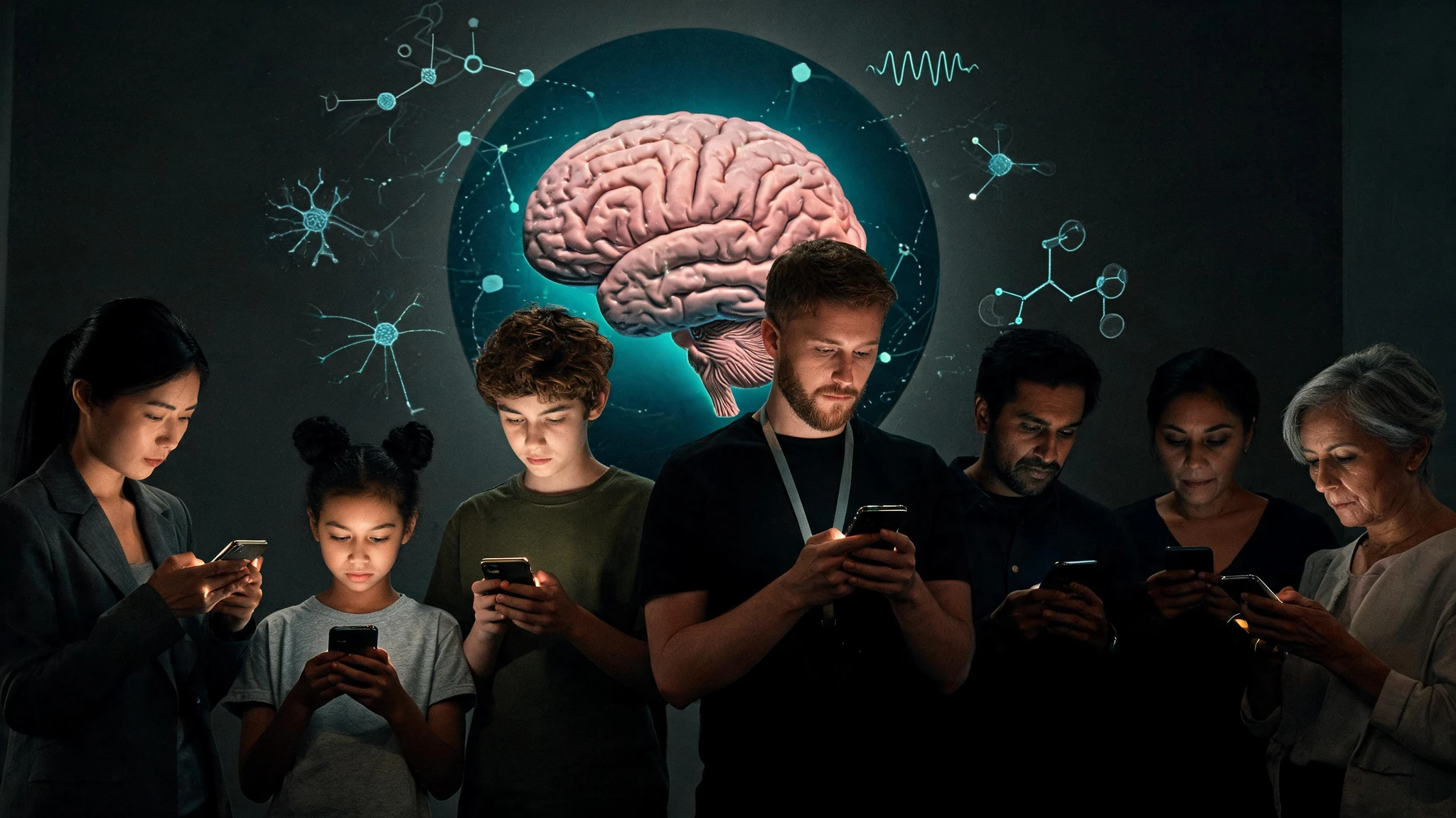
A 2024 EEG study out of China reported that frequent short-form video users showed weaker attentional control on a standard cognitive task than people who used those apps lightly, with the differences visible in their brainwaves before they had even pressed a button.1 The authors, led by Tao Yan at Tianjin Normal University, framed it as a small but real signal that the format itself, not just the time spent, may be doing something to focus.
That single paper would not be worth a long article. The reason it is worth one is that it now sits inside a much larger pile of work, including MRI scans of nearly 4,000 adults, that points in roughly the same direction.2 The picture is messier than the viral version. It is also harder to dismiss.
What the Facebook post got mostly right
The original viral post making the rounds put it bluntly. “Is your scrolling habit reshaping your brain?” it asked, before listing reduced attention, weaker impulse control, and lower memory performance among heavy users. It is the kind of claim that is half hyperbole, half real science, and it is worth pulling apart.
The “reshaping your brain” framing sounds dramatic. Brains, though, are always being reshaped. Reading a book reshapes your brain. Learning to drive reshapes your brain. The interesting question is not whether short videos change anything inside your skull, but whether the changes look like the ones we already worry about in other contexts, like substance use disorders or pathological gambling. On that narrower question, recent imaging studies are quietly answering yes.2,3
A 2025 paper in NeuroImage by Yongqiang Gao and colleagues used structural and functional MRI on 3,956 young adults and reported that people who scored higher on a short-video addiction scale showed smaller gray-matter volume in the cerebellum and altered connectivity between the cerebellum and reward-processing regions.2 A separate 2025 study in the same journal, by Chang Liu and colleagues, found that heavy short-video users took longer to weigh potential losses during a decision-making task, and that this delay tracked with activity in the medial prefrontal cortex.3 Neither paper proves that the apps caused the differences. Both are consistent with what neuroscientists usually see when a behavior is starting to act like a habit you cannot easily quit.
Why short videos are stickier than long ones
The format is doing something specific. A typical TikTok or Reels session is not one long story. It is dozens of micro-stories, each with its own setup and payoff, stitched together by a swipe. Every swipe is a small lottery. Most clips are forgettable, a few are funny, one is unexpectedly moving. That intermittent reward pattern is the exact pattern that, in animal studies going back decades, produces the most stubborn habits.
Yan’s 2024 EEG paper found that heavy short-video users had a smaller P3 wave when asked to ignore distracting stimuli, a brainwave component that researchers use as a proxy for top-down attention.1 In plain English, their brains were spending less effort on filtering out noise. The participants were also slower on incongruent trials of a flanker task, the same task that lights up when someone is sleep-deprived or mildly intoxicated. The effect was modest. It was statistically real.
A 2025 study using functional near-infrared spectroscopy on Chinese college students reported that students with higher short-video addiction scores showed less activation in the dorsolateral prefrontal cortex during a risk-taking task, a region that does a lot of the work when you stop yourself from clicking the obvious bad option.4 They also took riskier choices on the task. The combination matters. Lower activity in a self-control region while making more impulsive choices is the same fingerprint researchers describe in problem gamblers and people with stimulant use disorder.

What “addiction” actually means here
Almost every paper above uses the phrase “short video addiction,” and that wording deserves a flag. None of these researchers are saying TikTok is chemically equivalent to cocaine. They are using a validated questionnaire that asks whether a behavior has become hard to control, whether it is interfering with sleep, study, or relationships, and whether stopping causes irritability. Score high enough and you meet the threshold for what behavioral scientists call a “compulsive use” pattern.
By that measure, a 2023 study in Psychiatry Research by Miao Chao and colleagues split more than 3,000 Chinese adolescents into non-users, moderate users, and addictive users, and found that the addictive group reported significantly higher loneliness, anxiety, and depression scores than the other two.5 Moderate users looked roughly fine. The risk was concentrated at the heavy end of the curve, which is also how alcohol research tends to play out.
This is the part the viral post glossed over. Most people who scroll a lot are not heading toward a clinical problem. The minority who are tend to be the ones who scroll for hours when they are anxious, who keep going past the point of enjoyment, and who feel worse after, not better. If that does not describe you, the studies above are probably not about you. If it does, they probably are.
Memory, focus, and the deep-work problem
Memory is the messiest of the claims. Several recent papers report worse performance on working-memory tasks in heavy short-video users, but the effect sizes are small and the studies are correlational. People with attention difficulties may be drawn to short videos in the first place because the format does not punish a wandering mind. Causality cuts both ways.
What seems clearer is the engagement gap. The Yan EEG study and the Liu decision-making study both point at the same idea, which is that activities offering slow rewards start to feel oddly flat in someone whose baseline has been recalibrated by hours of fast ones.1,3 A book that opens with a quiet description of a winter morning has to compete, in your brain, with the memory of a thousand seven-second jokes. It often loses. Not because the book is bad, but because the threshold for “interesting enough to keep going” has been quietly raised.

Who is most at risk
Two recent studies point at vulnerability factors that get less attention than they deserve. A 2025 paper in Scientific Reports by Qing Yao and colleagues reported that adults with histories of childhood trauma had higher short-video addiction scores and showed corresponding morphological differences in the prefrontal cortex.6 A separate 2025 paper in Addiction Biology by the same group found that adolescents who had been bullied were more likely to develop compulsive short-video use, and that emotional distress mediated the link.7
The throughline is that the apps are not equally risky for everyone. They are riskiest for people whose nervous systems are already running a little hot, who are already using something to numb out, and who do not have many other tools for that job. That is a different conversation than “phones are rotting your brain,” and it is the one most worth having with a teenager who never seems to put their phone down.
Is any of this reversible?
The honest answer is that we do not yet have a clean longitudinal trial showing what happens when a heavy user puts the apps down for a month. We do have a lot of indirect evidence from the broader literature on behavioral habits, which is reassuring on the whole. The brains studied in those imaging papers are not damaged. They are tuned, in the way a guitar is tuned. Re-tuning is possible.
The interventions that show up most often in the discussion sections of these papers are unsexy. Time limits at the operating-system level. Replacing the morning scroll with a slower input, even a low-stakes one like a podcast or a paper newspaper. Putting the phone in another room while reading, because willpower is unreliable when the device is six inches from your hand. None of these are heroic. They work, in the small studies that have tried them, by reducing the number of swipes per day rather than by demanding total abstinence.
One detail worth keeping. Several of the imaging studies above also found that lighter users looked, on the relevant measures, indistinguishable from non-users.2,5 The dose seems to matter more than the substance. Twenty minutes a day of Reels on the train probably is not the thing that is going to reshape your prefrontal cortex. Three hours a night, every night, in bed, might be.

What a sensible amount looks like
There is no official number. The closest thing to a guideline comes from the addiction-scale cutoffs used in the studies, which roughly correspond to “more than two hours a day, with at least some loss of control.” Below that, the data is mostly quiet. Above it, the patterns described in this article become more likely.
For most adults, a workable rule is to notice the difference between active and passive use. Watching a specific creator, learning something, sending a clip to a friend, all of that uses the apps the way a magazine subscription gets used. Opening the app with no plan and surfacing thirty minutes later having absorbed nothing is the pattern that the brain-imaging papers care about. The first kind is fine. The second kind, repeated daily, is the kind that the data gently warns against.
Common questions about short videos and the brain
Does watching short videos shrink your brain?
No study has shown that short videos cause brain shrinkage in healthy users. Imaging studies have linked heavy use to smaller gray-matter volume in specific regions like the cerebellum, but these are correlations, not proof of cause, and the differences are subtle.2
How much short-video use is too much?
Most of the recent studies use a cutoff of about two hours per day combined with signs of loss of control to identify problematic use. People well below that threshold tend to look like non-users on the cognitive measures.
Are kids more vulnerable than adults?
Adolescents appear to be more vulnerable, especially those with histories of trauma or bullying, where short-video use can become a way to manage emotional distress.6,7 The developing prefrontal cortex is still building its self-control circuitry.
Will quitting cold turkey reverse the changes?
We do not have strong trial data on full abstinence. The pattern in related habit-reversal research is that gradual reduction, paired with substituting other activities, works better than dramatic resets that tend not to last.
Is long-form content actually better?
Long-form video, books, and podcasts give the brain more practice with sustained attention, but they are not magically virtuous. A four-hour Netflix binge has its own problems. The relevant axis is whether your attention spans match the demands of your real life.
The unsatisfying takeaway
Articles like this one usually end with a clean sentence about taking back your time. The science does not actually support a clean sentence. What it supports is something more boring, which is that the format is mildly worse for your focus than its absence, that the people most hurt by it are the ones with the least slack to lose, and that small reductions in dose seem to matter more than grand abstinences.
That is a less viral message than “your phone is quietly destroying your young mind.” It is also, given what the studies actually say, the closer one to the truth. The brain on short videos is not broken. It is simply being trained, in small daily doses, to expect a kind of stimulation that not much else in adult life can deliver. Whether that trade is worth it is a question the data cannot answer for you.
Sources
- Yan T, Su C, Xue W, Hu Y, Zhou H. Mobile phone short video use negatively impacts attention functions: an EEG study. Frontiers in Human Neuroscience. 2024. PubMed: 38993329
- Gao Y, et al. Neuroanatomical and functional substrates of the short video addiction and its association with brain transcriptomic and cellular architecture. NeuroImage. 2025. PubMed: 39826772
- Liu C, et al. Loss aversion and evidence accumulation in short-video addiction: A behavioral and neuroimaging investigation. NeuroImage. 2025. PubMed: 40324736
- Zhang S, Li S. How short video addiction affects risk decision-making behavior in college students based on fNIRS technology. Frontiers in Human Neuroscience. 2025. PubMed: 40270566
- Chao M, Lei J, He R, Jiang Y, et al. TikTok use and psychosocial factors among adolescents: Comparisons of non-users, moderate users, and addictive users. Psychiatry Research. 2023. PubMed: 37167877
- Yao Q, et al. The impact of childhood trauma on short video addiction: psychological and morphological correlates. Scientific Reports. 2025. PubMed: 40447763
- Yao Q, et al. The Impact of Bullying Victimization on Short Video Addiction in Adolescents: The Role of Emotional Distress and Neural Mechanisms. Addiction Biology. 2025. PubMed: 40255102