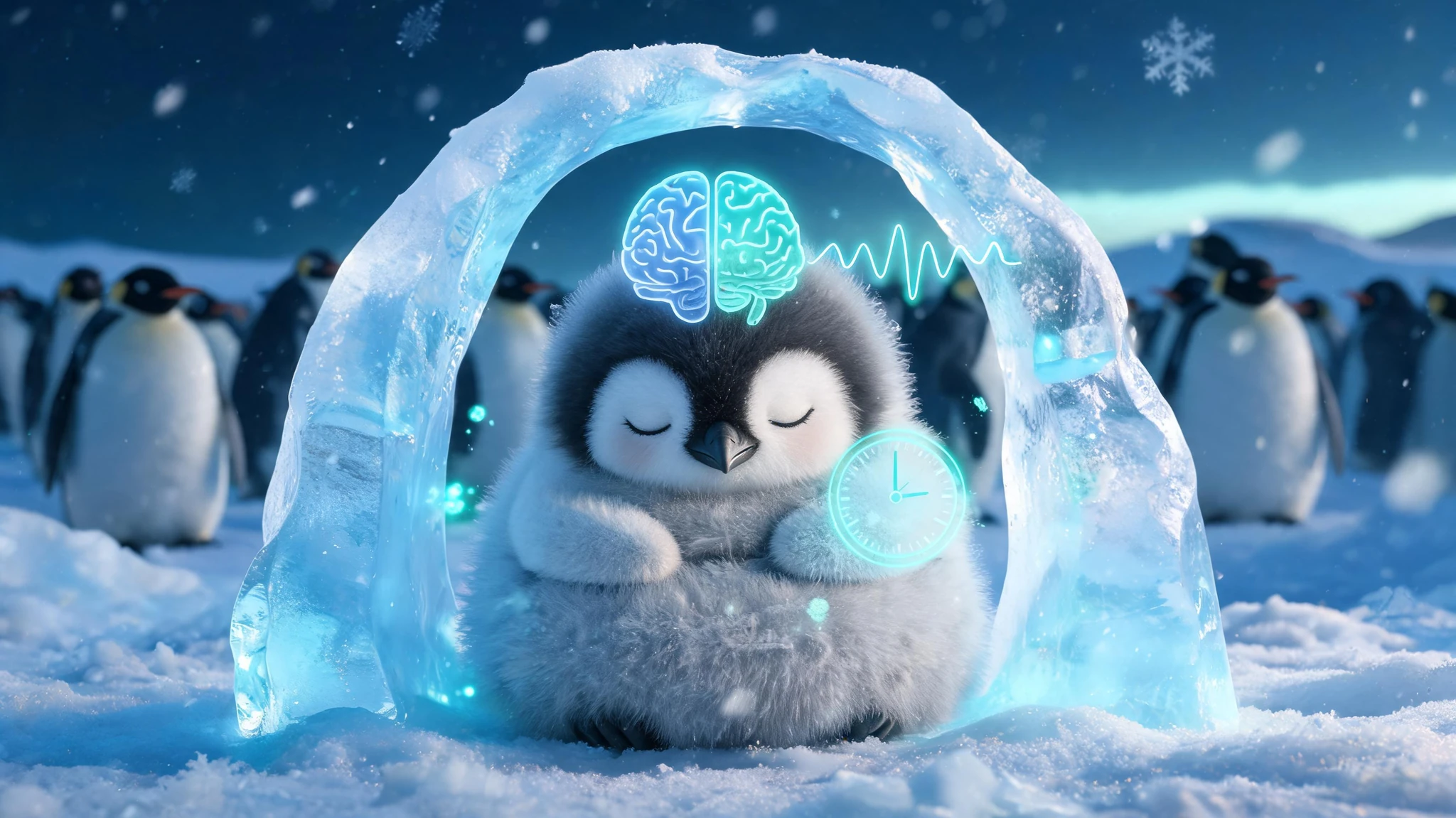
Nesting chinstrap penguins on a windblown island off Antarctica fall asleep more than 10,000 times a day, in episodes that last roughly four seconds each, and somehow add up to over eleven hours of total rest. That is the headline finding of a 2023 study by Paul-Antoine Libourel and colleagues, published in Science, which monitored brain activity in 14 wild birds for about eleven days using surgically implanted electrodes.1
The work matters beyond the cuteness of a sleeping penguin. It is one of the strongest pieces of evidence that the restorative benefits of sleep can accumulate in tiny, scattered installments rather than one long block, at least in a species that has good evolutionary reasons to never fully switch off.
What the researchers actually measured
The study took place at King George Island, a chunk of rock and ice in the South Shetlands where chinstrap penguins gather in dense colonies during breeding season. Libourel’s team, working with co-authors from France, South Korea and Germany, captured 14 incubating birds, fitted them with EEG electrodes and accelerometers, then released them back to their nests. Brain activity, body movement, GPS position and video were recorded continuously for around eleven days per bird.1
What they saw, once they parsed the data, was strange. The penguins were not sleeping in long stretches. They were nodding off, again and again and again, hundreds of times an hour. The average bout of slow-wave sleep lasted about four seconds. Across a 24-hour day, the cumulative total reached more than 11 hours. The team logged over 10,000 of these microsleep bouts per bird per day.
Slow-wave sleep is the deeper, restorative phase associated with the big slow oscillations on an EEG. In humans it shows up mostly in the first half of the night and is linked to memory consolidation and physical recovery. In a chinstrap penguin, the same brainwave pattern was happening in four-second flashes between flickers of vigilance.
Why these birds cannot afford to truly sleep
To understand why, it helps to picture the colony. Chinstraps nest on bare ground in tight clusters. Eggs and chicks face two main threats. The first is the brown skua, a gull-like seabird that patrols the colony watching for unguarded nests and will snatch an egg in seconds. The second is the neighbours. Penguins steal pebbles from each other’s nests constantly, and a parent who lapses for too long can come back to a half-dismantled scrape.
So the parent on duty has to stay alert. But it also has to recover. The bird that ends up doing the sitting has often just returned from a long foraging trip at sea, and a few days later it will have to do another. Total sleep deprivation across that schedule would not be sustainable. The penguin needs both vigilance and rest, and in a continuous shift that can last days at a time.
Microsleeps are how this trade-off resolves. By dipping into slow-wave sleep for four seconds at a time, hundreds of times an hour, the bird gets what looks like a workable amount of sleep without ever leaving the post for long enough to lose an egg.1

One brain, two sleep states
The Libourel team also confirmed something earlier work had hinted at in birds. Penguins can sleep one hemisphere at a time. Sometimes both halves of the brain showed slow waves together, the kind of bilateral pattern familiar from mammals. Other times only one side dropped into slow-wave sleep while the other side stayed in a wake-like state. This is called unihemispheric slow-wave sleep, and it is one of the more exotic things vertebrate brains can do.1
Mallard ducks at the edge of a flock will preferentially open the eye facing outward and let only the brain hemisphere connected to that eye stay awake, a finding from a 1999 paper by Niels Rattenborg and colleagues that established unihemispheric sleep as a real, predator-pressure-driven phenomenon in birds.2 Cetaceans, meaning dolphins and whales, take it further. They essentially never have both hemispheres asleep at once, because surfacing to breathe is a voluntary act for them and a fully sleeping brain would drown the animal. A long review by Oleg Lyamin and colleagues documented this pattern across several species and proposed it as the default sleep architecture of the marine mammal lineage.3
What the chinstrap penguin shows is a third variation. The bird does not pick one hemisphere or the other for the whole bout. It mixes. In a single hour you can get bilateral microsleeps, left-only microsleeps, and right-only microsleeps, scattered through a sea of vigilance. The flexibility is the point.
Is four seconds really long enough to count as sleep?
This is the question that keeps the study honest, and it is the one the authors take seriously. From a strict behavioral definition, sleep usually requires a sustained drop in responsiveness and a characteristic posture. A four-second nap does not look like that.
From a brain-activity definition, though, slow-wave sleep is slow-wave sleep. The EEG signature was there. The penguins showed the kind of cortical oscillation a human or a dog shows during deep non-REM sleep, just chopped into very small pieces. And the cumulative dose, over 11 hours per day, is in the same general range as what an awake-mostly-during-the-day bird would log in a more conventional pattern.1
The most important piece of evidence is functional. The penguins bred. They incubated successfully, the chicks hatched at expected rates, and the colony carried on. Whatever benefits sleep is supposed to confer, fragmentation into seconds-long bouts did not appear to wreck them.
That is a striking result. Most laboratory work on sleep deprivation, in mammals at least, suggests that interrupting sleep degrades its benefits. Wake an animal up every few minutes and you get cognitive deficits, immune trouble, metabolic problems. Penguins seem to have evolved their way past that constraint, or at least to have found a regime where the constraint behaves differently.

How does this fit with what birds do elsewhere?
Birds, as a group, are unusually creative about sleep. Migrating songbirds chip away at sleep during the day and shift their night activity. Frigatebirds, who spend weeks at a time in flight over the open ocean, were shown by Rattenborg’s team in 2016 to log small amounts of slow-wave and REM sleep while airborne, sometimes one hemisphere at a time, sometimes both, with most of it happening during slow-rising thermal soars at dusk.4 Total airborne sleep was less than an hour a day, far below what the same birds get on land, and the birds did not appear visibly impaired by the deficit.
Put the frigatebird and the penguin side by side and a pattern emerges. Bird sleep is plastic. Different species, under different ecological pressures, have arrived at sharply different scheduling solutions. The chinstrap’s answer is hyper-fragmentation. The frigatebird’s answer is short bouts on the wing, banked alongside long sleeps on land. Both work.
That plasticity is part of why this paper is more than a curiosity. If sleep can be reorganized this aggressively in one lineage and still serve its function, the question of which features of sleep are essential becomes sharper. Is duration what matters, or total slow-wave power, or something about the spacing? The penguin data say total power and total duration can both come in tiny installments. They do not yet say what would happen if a mammal tried the same trick.
Does any of this apply to humans?
The honest answer is: not directly, and probably not in a way you would want.
Human microsleeps do happen. Drivers who are severely sleep-deprived have them at the wheel, and they cause crashes. The shorthand here is that an unintended four-second microsleep in a human under sleep pressure is a sign the system is failing, not a sign it has found a clever workaround. Our sleep architecture is built around long, consolidated bouts, with REM sleep in particular requiring a sustained progression through earlier stages.
What the penguin study does, for human sleep science, is mark the boundaries of what is biologically possible and force researchers to be more precise about what they think sleep is doing. The work of Matthew Walker and Robert Stickgold on sleep-dependent memory consolidation, for example, has shown across many studies that motor and procedural learning improvements appear after a night of sleep but not after the same hours spent awake.5 That literature treats consolidated nocturnal sleep as the relevant unit. The penguin result does not overturn it. It does suggest that the relationship between consolidation and sleep architecture may be more lineage-specific than once assumed.
Practically, the takeaway for a tired human is unromantic. You cannot replicate eleven hours of penguin microsleeps by napping for four seconds at your desk all day. The bird’s brain is not built like yours. But the study is a useful reminder that the universal-need-for-sleep finding is real precisely because it shows up in such unlike forms across the animal kingdom.

What the researchers still do not know
Several questions are open. The biggest is whether microsleep in chinstraps is good sleep or merely good-enough sleep. The birds bred, but no one yet has data on long-term cognitive function, immune markers, or post-breeding recovery. It is possible the birds are running a deficit that they pay back later in the year, when the colony breaks up and the adults return to the open ocean.
Another open question is REM. The Libourel paper documents slow-wave microsleeps in detail. REM sleep, the dreaming phase associated in birds with a brief loss of muscle tone, is harder to detect in four-second bouts. Whether penguins are getting normal amounts of REM, no REM at all, or something in between is something future fieldwork will have to settle.1
A third question is how this changes once the chicks fledge. The microsleep regime was measured during incubation, when vigilance is at its peak. Birds at sea, off duty, almost certainly sleep differently. Tracking the same individuals across the full annual cycle would close that loop.
Common questions about penguin microsleeps
How many microsleeps a day do chinstrap penguins actually take?
The 2023 Libourel study counted more than 10,000 bouts per bird per day, with each bout averaging about four seconds, totalling over 11 hours of cumulative slow-wave sleep.
Why don’t they sleep in one block like most birds?
Predators, mainly skuas, and pebble-stealing neighbours give a parent on the nest no safe window long enough for consolidated sleep, so the birds spread their rest across thousands of micro-bouts.
Can they really sleep one half of the brain at a time?
Yes. The EEG recordings showed bouts of unilateral slow-wave activity as well as bilateral bouts, mirroring patterns previously documented in ducks and dolphins.
Did the penguins seem tired or impaired?
The breeding outcomes were normal, which the authors take as evidence that the fragmented schedule was functional under the conditions studied. Long-term effects beyond the breeding season have not been measured.
Should humans try this?
No. Microsleeps in humans are a sign of dangerous sleep deprivation, and our sleep architecture depends on long, consolidated bouts. The penguin’s brain is wired for a different game.
The takeaway
Sleep is older than mammals, older than birds, probably older than vertebrates. Whatever it does for a brain, it has been doing for hundreds of millions of years across wildly different bodies. The chinstrap penguin’s solution to the eternal predator-versus-rest trade-off is not a tidy one. It is thousands of four-second flickers, one after another, all day and all night, while a parent stands over an egg.
It works for them. It is, on its own terms, beautiful. And it is one more reminder that the textbook picture of sleep, the eight consolidated hours in a dark quiet room, is the textbook picture of human sleep. The animal kingdom has been running other experiments for a long time.
Sources
- Libourel PA et al. Nesting chinstrap penguins accrue large quantities of sleep through seconds-long microsleeps. Science, 2023. PubMed: 38033080
- Rattenborg NC et al. Facultative control of avian unihemispheric sleep under the risk of predation. Behavioural Brain Research, 1999. PubMed: 10563490
- Lyamin OI et al. Cetacean sleep: an unusual form of mammalian sleep. Neuroscience and Biobehavioral Reviews, 2008. PubMed: 18602158
- Rattenborg NC et al. Evidence that birds sleep in mid-flight. Nature Communications, 2016. PubMed: 27485308
- Walker MP et al. Sleep-dependent motor memory plasticity in the human brain. Neuroscience, 2005. PubMed: 15964485