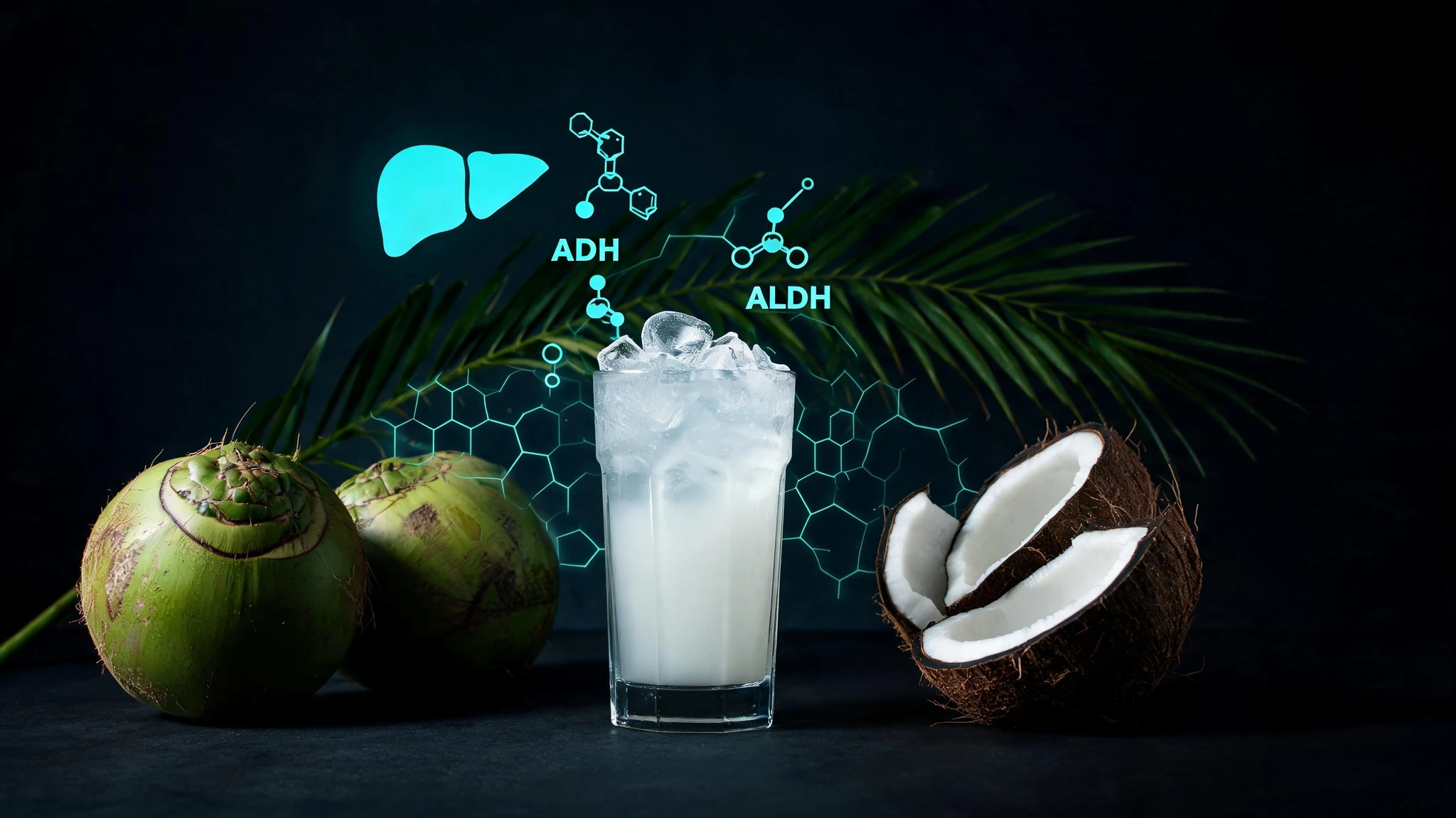
A specific blend of pear juice, sweet lime juice, and coconut water raised the activity of the two liver enzymes that break alcohol down, according to a 2019 laboratory study from researchers at the Institute of Chemical Technology in Mumbai, published in Current Research in Food Science.1 The mix used was 65 percent pear, 25 percent sweet lime, and 10 percent coconut water. In their assays, alcohol dehydrogenase activity rose by roughly 23 percent and acetaldehyde dehydrogenase activity rose by about 70 percent compared with controls.
That is a real finding, but it is a narrow one. The work was done in vitro, not in people drinking on a Friday night. Knowing what it does and does not show is the difference between a useful pre-party habit and a viral claim that quietly outruns the data.
What the Mumbai team actually tested
The study screened a list of common foods and beverages for their effect on the two enzymes the liver uses to handle alcohol, ADH and ALDH.1 Pear came out on top among fruits. Sweet lime, cucumber, tomato, and a few cheeses also showed measurable increases in enzyme activity. Coconut water added rehydration value through its potassium and natural sugars. The headline blend, often summarized as “pear, sweet lime, coconut water,” was the combination that produced the largest combined effect on ADH and ALDH in the lab.
A few things to keep straight. The increases were measured in cell-free or cellular assays, not by giving the juice to volunteers and then measuring blood acetaldehyde over time. The 70 percent ALDH rise is striking, and it is also exactly the kind of number that shrinks once you move from a controlled assay into a living body that is also digesting food, redistributing fluid, and metabolizing other compounds. Treat the numbers as a signal, not a dose response.
Why ADH and ALDH matter so much
When you drink, ethanol gets oxidized in two steps. ADH turns ethanol into acetaldehyde, a toxic intermediate. ALDH then turns acetaldehyde into acetate, which is harmless and goes on to be used as fuel. Acetaldehyde is the villain in this chain. It is what flushes the face red, makes the heart race, and contributes to the headache, nausea, and general wreckage of a hangover.5
People with the common East Asian variant of ALDH2 know this physiology in their bodies. Their enzyme is slow, acetaldehyde piles up, and even a small drink turns the cheeks crimson. For everyone else, the same chemistry is happening; it is just less visible. Anything that nudges ALDH activity up should, in theory, clear acetaldehyde a little faster, which is the mechanistic story behind the pear and sweet lime finding.
The two enzymes also have a finite working speed. A healthy adult clears roughly one standard drink of alcohol per hour, give or take. Nothing in the food world meaningfully changes that ceiling. What pear and sweet lime appear to do, in the assays, is help the system run closer to its natural ceiling rather than shift the ceiling itself. That is a small, useful thing. It is not a force multiplier.

Pear and the dihydromyricetin question
Pear has a reputation in alcohol research that goes back further than the Mumbai paper. A 2013 study in Food and Chemical Toxicology tested Korean pear juice (Pyrus pyrifolia cv. Shingo) in human volunteers before they drank, and reported lower hangover severity scores and lower blood acetaldehyde the next morning compared with placebo.3 That was a small trial, but it pointed the same way as the in vitro work: pear consumed before alcohol, not after.
Pears, along with grape skins and Hovenia dulcis, contain dihydromyricetin, often called DHM. A 2012 paper in The Journal of Neuroscience isolated DHM and showed in rats that it blunted ethanol intoxication, sped up the return to sobriety, and reduced anxiety-like withdrawal behavior, apparently by acting on GABA-A receptors in the brain.2 That paper became the foundation for a small industry of “DHM hangover pills.”
It is easy to overstate this. The Shen study used purified DHM at doses that are hard to match by drinking pear juice. A glass of pear juice contains a much smaller amount of DHM, plus other antioxidants, sugars, and fiber. So if you are buying pear juice expecting Shen’s effect, you will be disappointed. If you are buying it because the food matrix as a whole appears to support enzyme activity and provides hydration and a little fructose to support liver metabolism, you are on more honest ground.
What sweet lime adds
Sweet lime, called mosambi in much of South Asia, is closer in flavor to a mild orange than a regular lime. It carries a useful payload of vitamin C, potassium, and a small amount of natural sugars. In the Mumbai screen it independently increased ADH activity, which is part of why it earned a spot in the final blend.1
Vitamin C is not a hangover cure on its own. The systematic review in Human Psychopharmacology of hangover interventions, which looked at randomized trials of everything from prickly pear to clove extract, found very few interventions with strong evidence and noted that most studies were small, short, and inconsistent in how they measured hangover.5 But the supportive role of micronutrients and electrolytes is plausible. Heavy drinking depletes potassium, magnesium, and B vitamins. Replacing some of them with food and juice the next morning is sensible regardless of whether it changes a hangover score.

Coconut water and the rehydration piece
Alcohol is a diuretic. It suppresses vasopressin, your kidneys keep more water in the urine, and you end the night several hundred milliliters down on fluids. Coconut water is a culturally familiar way to put some of that back. It contains roughly the same potassium concentration as a sports drink, less sodium, and a moderate amount of natural sugars.6
A small randomized trial published in the Journal of the International Society of Sports Nutrition compared coconut water against a standard sports drink and plain water for rehydration after exercise.6 All three rehydrated participants similarly. There were no large differences. That is fine. It does not need to beat Gatorade to be useful. It just needs to be something you will actually drink, with potassium, a little sugar, and no caffeine.
For a hangover, the coconut water at 10 percent of the blend is doing two things. It thins the pear juice into something easier to drink first thing in the morning, and it adds potassium that alcohol stripped out overnight. Neither of those is glamorous, but both are real.
Mixed-juice trials in people
Beyond the Mumbai paper, a 2018 study in Preventive Nutrition and Food Science gave healthy adults a mixed fruit and vegetable juice before drinking and reported lower self-rated hangover symptoms compared with placebo, with shifts in markers of antioxidant status the next morning.4 The juice was different from the Mumbai blend, but the pattern is the same. Pre-drinking a fruit-forward juice with antioxidants and electrolytes consistently nudges hangover scores in the right direction in small trials. None of these trials are large, none are blinded the way a drug trial would be, and none let you skip basic prevention.
Timing is the part most people get wrong
The Mumbai team specifically flagged that the effect appeared when pear juice was consumed before drinking, not after.1 The Korean pear trial said the same thing.3 Once acetaldehyde has built up at 3 a.m., chugging a glass of pear and coconut at 9 a.m. is doing very little for the chemistry. The window where this kind of intervention can plausibly help is the hour before the first drink, while ADH and ALDH are getting set to do their work.
What about the morning after? That is where coconut water, food, sleep, and time take over. None of the studies above support pear juice as a recovery drink in any strong sense. They support it as a pre-load.

The food side dish: cheese, cucumber, tomato
The viral version of this tip usually adds cheese, cucumber, and tomato as accompaniments. That is also from the Mumbai screen.1 A few cheeses, along with cucumber and tomato, showed independent enzyme activity increases. The mechanism is less clean than for pear. Cheese delivers fat and protein, both of which slow gastric emptying and modestly slow alcohol absorption, which may matter as much as any direct enzyme effect. Cucumber and tomato deliver water, electrolytes, and antioxidants like lycopene and vitamin C.
Eaten together with the juice an hour before drinking, the practical version is a small plate of food and a tall glass. That is closer to a Mediterranean apéro than a magic potion, and it is probably why people who already eat that way tend to suffer less the next day.
What this is not
It is worth being blunt. The juice blend is not a license to drink more, and it is not a treatment for alcohol use disorder. The systematic review of hangover interventions concluded that the only consistently effective intervention is moderation, and that no over-the-counter remedy currently has strong evidence for clinical effectiveness.5 Anyone marketing this as a cure is overselling it.
The right framing is smaller and more useful. If you are going to a wedding, a long dinner, or a New Year’s Eve party where you know you will drink, a pre-party glass of pear juice cut with coconut water and a slice of sweet lime, eaten with cheese and a few slices of tomato and cucumber, is a low-risk thing to try. It will not make four cocktails feel like one. It might make two cocktails feel cleaner the next morning.
Common questions about the pear, lime, and coconut water blend
Does this work after I have already started drinking?
The published studies pointed at a pre-drinking effect. Once acetaldehyde is already accumulating, the window for ADH and ALDH support has largely closed. Drink water, eat something, and stop drinking earlier than you planned.
Can I just take a dihydromyricetin supplement instead?
DHM supplements exist and the rat data are interesting, but no large human trials have replicated the Shen findings at supplement doses, and quality varies widely between brands.2 Food sources are gentler and come with the rest of the matrix that the studies actually tested.
Is coconut water better than a sports drink for a hangover?
For straight rehydration after exercise the two perform similarly in small trials.6 For a hangover the differences are minor. Choose what you will actually drink at 8 a.m.
How much should I drink, and when?
The Mumbai blend was pear 65, sweet lime 25, coconut water 10. A glass of about 250 ml roughly an hour before the first drink is a reasonable starting point. Larger amounts do not seem to add much, and pear juice is high in fructose.
Does it help with anxiety the next morning?
The DHM rat work suggested an anti-anxiety effect through GABA-A receptors, but that has not been confirmed in human trials at food-level doses.2 Sleep, food, and time still do most of that work.
The honest summary
A blend of pear, sweet lime, and coconut water is not a hangover cure. It is a small, mostly food-based way to support the body’s own alcohol-clearing machinery before a night out, with modest evidence behind it from in vitro work and a couple of small human trials. The biggest gains come from drinking less and drinking slower. The juice is a useful bit of theater on top of that, with real biochemistry under the theater.
If you try it, try it on a night you were going to drink anyway, and notice what you feel the next morning. That is the only experiment that matters to you. Keep it simple, keep portions modest, and pair it with water through the evening rather than relying on the juice to do work it cannot do.
Sources
- Srinivasan S, et al. Influence of food commodities on hangover based on alcohol dehydrogenase and aldehyde dehydrogenase activities. Current Research in Food Science, 2019. PubMed: 32914100
- Shen Y, et al. Dihydromyricetin as a novel anti-alcohol intoxication medication. The Journal of Neuroscience, 2012. PubMed: 22219299
- Lee HS, et al. Effect of Korean pear (Pyrus pyrifolia cv. Shingo) juice on hangover severity following alcohol consumption. Food and Chemical Toxicology, 2013. PubMed: 23587660
- Kim MJ, et al. Effect of Mixed Fruit and Vegetable Juice on Alcohol Hangovers in Healthy Adults. Preventive Nutrition and Food Science, 2018. PubMed: 29662841
- Jayawardena R, et al. Interventions for treatment and/or prevention of alcohol hangover: Systematic review. Human Psychopharmacology, 2017. PubMed: 28568743
- Kalman DS, et al. Comparison of coconut water and a carbohydrate-electrolyte sport drink on measures of hydration and physical performance in exercise-trained men. Journal of the International Society of Sports Nutrition, 2012. PubMed: 22257640