A randomized trial published in PNAS in 2011 reported something most people assume is impossible after sixty: a part of the brain that normally shrinks with age actually got bigger. Older adults who walked briskly three times a week for a year grew their hippocampus by about 2 percent on average, and on memory tests they did measurably better than a stretching-and-toning control group.1 The lead author was Kirk Erickson, then at the University of Pittsburgh, working with Art Kramer’s group at Illinois.
The trial was small, 120 sedentary adults between 55 and 80, but its results have held up. Later studies replicated the effect in different populations, and other work has filled in the biology.7 The caveats are real, the practical implication is hard to ignore.
What the 2011 PNAS study actually found
Erickson and colleagues recruited sedentary older adults and randomly assigned them to one of two groups. The aerobic group walked at moderate intensity, slowly working up to 40 minutes per session, three times a week, for a full year. The comparison group did stretching, toning, and balance exercises on the same schedule but without the cardiovascular load. Everyone got an MRI at baseline, six months, and twelve months, plus a battery of memory tests.1
By the end of the year, the walkers had increased their left and right hippocampal volume by about 2.12 percent and 1.97 percent respectively. The stretching group had lost roughly 1.4 percent on each side, which is what aging usually does to that structure in this age range. So the gap between the two groups, after twelve months, was closer to 3 to 4 percent of total volume. That is not a dramatic number in absolute terms. But the hippocampus is small, dense, and tightly tied to memory, so a few percentage points show up on tests.
Spatial memory scores improved in the walkers and tracked the size change. People whose hippocampus grew more tended to do better on memory tasks. Levels of brain-derived neurotrophic factor, or BDNF, in the blood also rose alongside the volume changes, which fits with the animal work suggesting BDNF is one of the messengers exercise uses to talk to neurons.1
Why is the hippocampus the structure that grew?
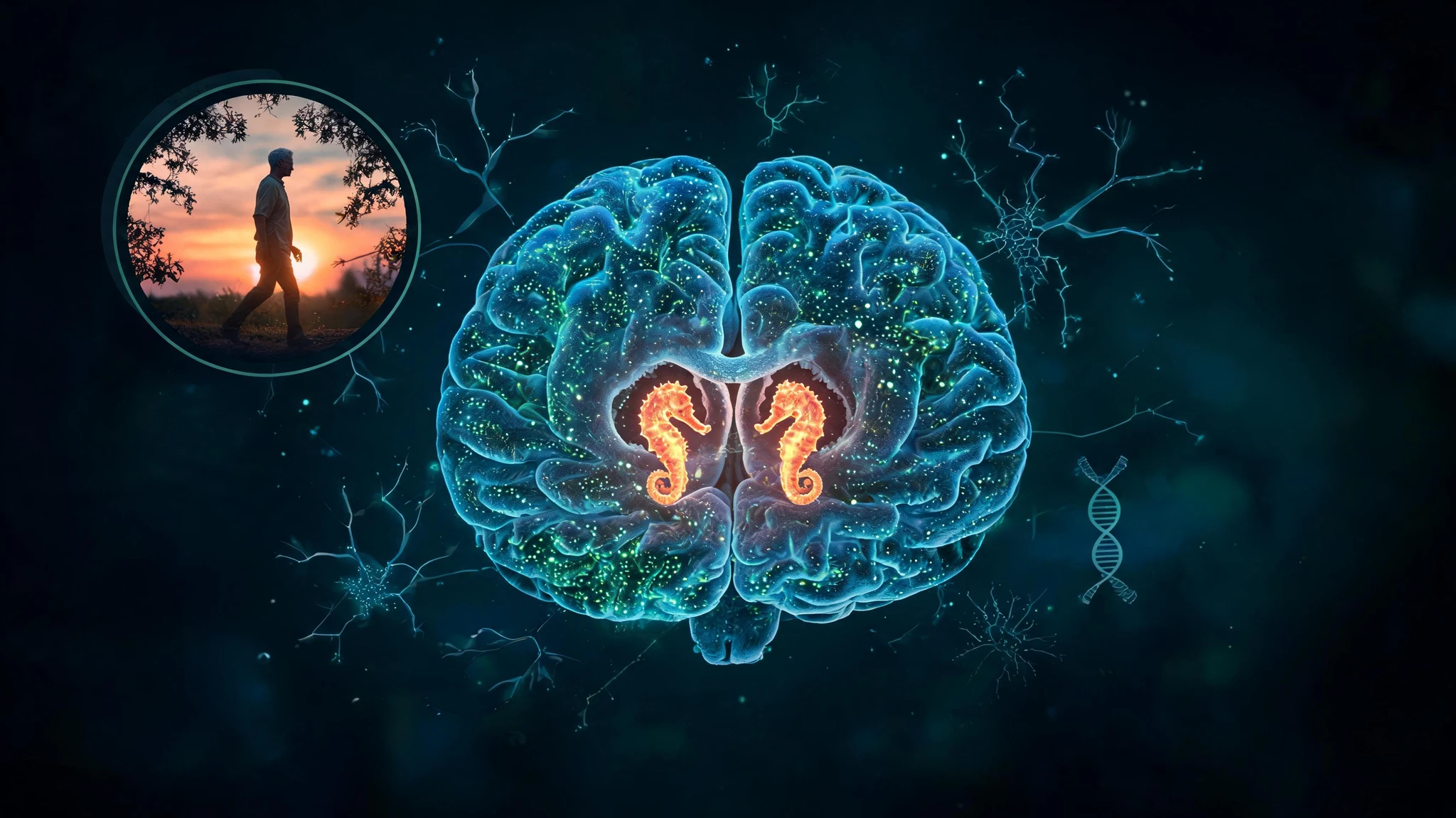
The hippocampus is a curled, seahorse-shaped strip of tissue tucked deep in the temporal lobe, one on each side. It is the part of the brain that turns experience into memory you can later recall on purpose. It also handles spatial navigation, which is why London taxi drivers, famously, have a slightly larger one than the rest of us.
It is also one of the structures that shrinks earliest and most reliably as we age. Healthy adults lose somewhere between 1 and 2 percent of hippocampal volume per year after about age 55, and people who go on to develop Alzheimer’s disease lose it faster.1 Anything that slows or reverses that shrinkage is biologically interesting, because the hippocampus is also one of the very few regions of the human brain where new neurons are still being made in adulthood.
The 2011 trial was the first randomized human study to show, with structural MRI, that a year of walking could move the dial in the right direction in older adults. Earlier work by Stan Colcombe and colleagues had hinted at it. A 2006 trial showed that six months of aerobic exercise increased gray and white matter volume in several regions of the aging brain, and an earlier cross-sectional study found that fitter older adults simply had more brain tissue than less fit peers of the same age.2,3
How walking talks to neurons
The plumbing answer is blood flow. Aerobic exercise raises cardiac output, opens capillaries in the brain, and over time encourages new ones to form. More capillaries means more oxygen and more glucose delivered to working neurons. That alone would help.
The signaling answer is more interesting. When muscle contracts repeatedly during sustained moderate effort, it releases small molecules into the bloodstream that cross into the brain and switch on growth pathways. BDNF is the most famous of these. It acts like a fertilizer for neurons, encouraging them to form new connections, strengthen existing ones, and, in the dentate gyrus of the hippocampus, support the survival of newly born cells. Exercise also bumps up insulin-like growth factor 1 and vascular endothelial growth factor, which support brain blood vessels and tissue health more broadly.
You do not need to memorize the alphabet soup. The point is that the body has its own internal nutrient and signaling system that turns on when you move at moderate intensity for long enough. Sitting still does not turn it on. Going for a brisk walk does.

Has the finding been replicated?
This is the question worth asking about any single study, no matter how widely it gets shared. The honest answer is: partially, and with nuance.
In 2010, a German group led by Frank-Gerald Pajonk ran a similar protocol in young adults with schizophrenia, a population whose hippocampus tends to be smaller than average. After three months of aerobic cycling, volume in the affected region rose by about 12 percent, much more than in the older walkers, and improvements showed up on cognitive tests too.6 A 2015 trial by Lindsay ten Brinke and colleagues in older women with probable mild cognitive impairment found that six months of moderate-intensity aerobic exercise increased hippocampal volume relative to balance and tone controls, although the effect was concentrated on the left side.7
Other replications have been less clean. Some studies in healthy older adults find regional, rather than global, hippocampal growth. A few find no significant volume change at all over six months, especially when the dose of exercise is low. The pattern across the literature, taken together, is that aerobic exercise reliably affects brain structure and function in older adults, but the size and location of the effect depend on age, baseline fitness, dose, and how long the intervention runs.5
What about memory and thinking, not just brain size?
Volume on a scan is interesting. What people actually want to know is whether a year of walking helps them remember names, find their keys, and stay sharp.
A 2010 meta-analysis by Patrick Smith and colleagues pulled together 29 randomized controlled trials of aerobic exercise in adults and looked at performance across attention, processing speed, executive function, and memory. They found small to moderate improvements across all four domains, with the strongest effects on attention and processing speed.4 A larger 2018 meta-analysis in the British Journal of Sports Medicine, by Joseph Northey and colleagues, looked specifically at adults over 50 and found that exercise of at least moderate intensity, done for 45 to 60 minutes per session, improved cognition regardless of starting cognitive status.5
A 2008 randomized trial by Nicola Lautenschlager and colleagues, published in JAMA, took 170 older adults with subjective memory complaints and assigned half of them to a 24-week home-based physical activity program. The active group improved their cognition modestly compared with the control group, and the benefit was still detectable 18 months after the intervention ended.8 The effect was small. It was also durable, which is unusual.

How much walking, and how fast?
The 2011 trial used a specific dose. Three sessions per week, working up to 40 minutes each, at a moderate intensity defined as 60 to 75 percent of maximum heart rate.1 That is a brisk walk for most people. You can hold a conversation, but you would prefer not to. You are warm. You are not gasping.
Most replication and meta-analytic work converges on a similar dose. Roughly 150 minutes a week of moderate aerobic activity, which is also what the World Health Organization and the American Heart Association recommend for general cardiovascular health, looks like a reasonable floor for cognitive benefit. Northey’s 2018 meta-analysis suggested that going a bit longer per session, 45 to 60 minutes, may matter more than going harder, at least for cognition.5
What this does not mean: that more is always better. The trials that worked used moderate effort over a long timeline. They did not push older sedentary participants into anything resembling a hard workout. The dose that grew the hippocampus is the dose your knees can probably tolerate.
It is not just one study, and it is not a cure
The Erickson trial gets shared because it is concrete and visual. People can picture a walk. They can picture a brain. The pairing makes a clean headline. But the underlying claim, that aerobic activity supports brain health in older adults, sits on top of a much larger evidence base than one paper. Cross-sectional studies, prospective cohorts, randomized trials, and animal mechanistic work all point in the same direction.3,4,5
That said, walking is not a cure for dementia. The effect sizes in cognitive trials are real and worth having, but they are modest. Nobody in the 2011 study reversed Alzheimer’s disease. What walking does, on the available evidence, is probably nudge the timeline. It buys some years of better function. For a behavior with no copay, no side effects, and a short list of contraindications, that is a remarkable trade.
If you have a diagnosed cognitive condition, or risk factors for one, talk to a clinician before changing your routine. If you have joint problems or a heart history, ease in. The trials that produced the brightest results used graded onset, with the first weeks deliberately slow.
What if you cannot walk that much?
Plenty of people have knees, backs, or schedules that rule out three 40-minute sessions a week. The literature suggests two consolations.
The first is that some movement appears to be much better than none. Cohort studies tracking older adults’ activity levels find that even light activity, and consistent low-volume walking, is associated with slower cognitive decline than sedentary behavior. The second is that the type of exercise matters less than the consistency. Stationary cycling, water aerobics, dancing, and even coordinated movement programs that emphasize balance and rhythm have all shown structural or cognitive benefits in different trials.5 If walking is the easiest thing you can stick with, walk. If something else is the easiest thing you can stick with, do that.
Common questions about walking and brain health
Does the hippocampus really grow new cells in adults?
Yes, a small population of new neurons is generated in the dentate gyrus of the hippocampus throughout adult life, although the rate slows with age. Exercise, in animal studies, reliably increases that rate. Whether the human volume changes seen on MRI come specifically from new neurons, from existing cells getting larger, from new blood vessels, or from glial cell support is still debated.
How quickly does walking start to help cognition?
A single moderate walk improves attention and mood within minutes to hours, but those are short-term effects. Structural changes in the brain take longer. The PNAS trial saw measurable hippocampal volume changes by six months and clearer ones by twelve.1
Is walking better than running for the brain?
Probably not better, but not worse either. The trials that produced the cleanest brain results used moderate intensity, which most people reach by walking briskly. Higher-intensity work has its own benefits, but for cognition specifically, longer and steadier seems to beat shorter and harder.5
Will walking help if I am already showing signs of memory loss?
The trial in older women with mild cognitive impairment by ten Brinke and colleagues showed measurable hippocampal benefit from six months of brisk walking, and the JAMA trial by Lautenschlager and colleagues showed cognitive benefit in adults with memory complaints that lasted well past the intervention.7,8 If you are concerned about memory, work with a clinician on this alongside any other care.
Do I need a treadmill, a tracker, or a coach?
None of those are required. Two pairs of comfortable shoes, a watch, and a reliable route are enough. The protocol that worked in 2011 was almost embarrassingly simple. The hard part is showing up three times a week for a year.
The boring intervention that keeps winning
What is striking about this whole literature is how unsexy the working dose is. There is no supplement, no app, no specialized class. Just regular brisk walking, done at a sustainable pace, on a schedule a sedentary person can keep. The brain rewards consistency more than effort.
The 2011 study has been cited thousands of times because it answered a question people have been asking for decades. The hippocampus does not have to keep shrinking on a fixed schedule. In healthy older adults, structured walking pushed the curve in the other direction for a year. That is not a magic result. It is a useful one. The shoes are by the door.
Sources
- Erickson KI et al. Exercise training increases size of hippocampus and improves memory. Proceedings of the National Academy of Sciences, 2011. PubMed: 21282661
- Colcombe SJ et al. Aerobic exercise training increases brain volume in aging humans. The Journals of Gerontology Series A, 2006. PubMed: 17167157
- Colcombe SJ et al. Aerobic fitness reduces brain tissue loss in aging humans. The Journals of Gerontology Series A, 2003. PubMed: 12586857
- Smith PJ et al. Aerobic exercise and neurocognitive performance: a meta-analytic review of randomized controlled trials. Psychosomatic Medicine, 2010. PubMed: 20223924
- Northey JM et al. Exercise interventions for cognitive function in adults older than 50: a systematic review with meta-analysis. British Journal of Sports Medicine, 2018. PubMed: 28438770
- Pajonk FG et al. Hippocampal plasticity in response to exercise in schizophrenia. Archives of General Psychiatry, 2010. PubMed: 20124113
- ten Brinke LF et al. Aerobic exercise increases hippocampal volume in older women with probable mild cognitive impairment: a 6-month randomised controlled trial. British Journal of Sports Medicine, 2015. PubMed: 24711660
- Lautenschlager NT et al. Effect of physical activity on cognitive function in older adults at risk for Alzheimer disease: a randomized trial. JAMA, 2008. PubMed: 18768414