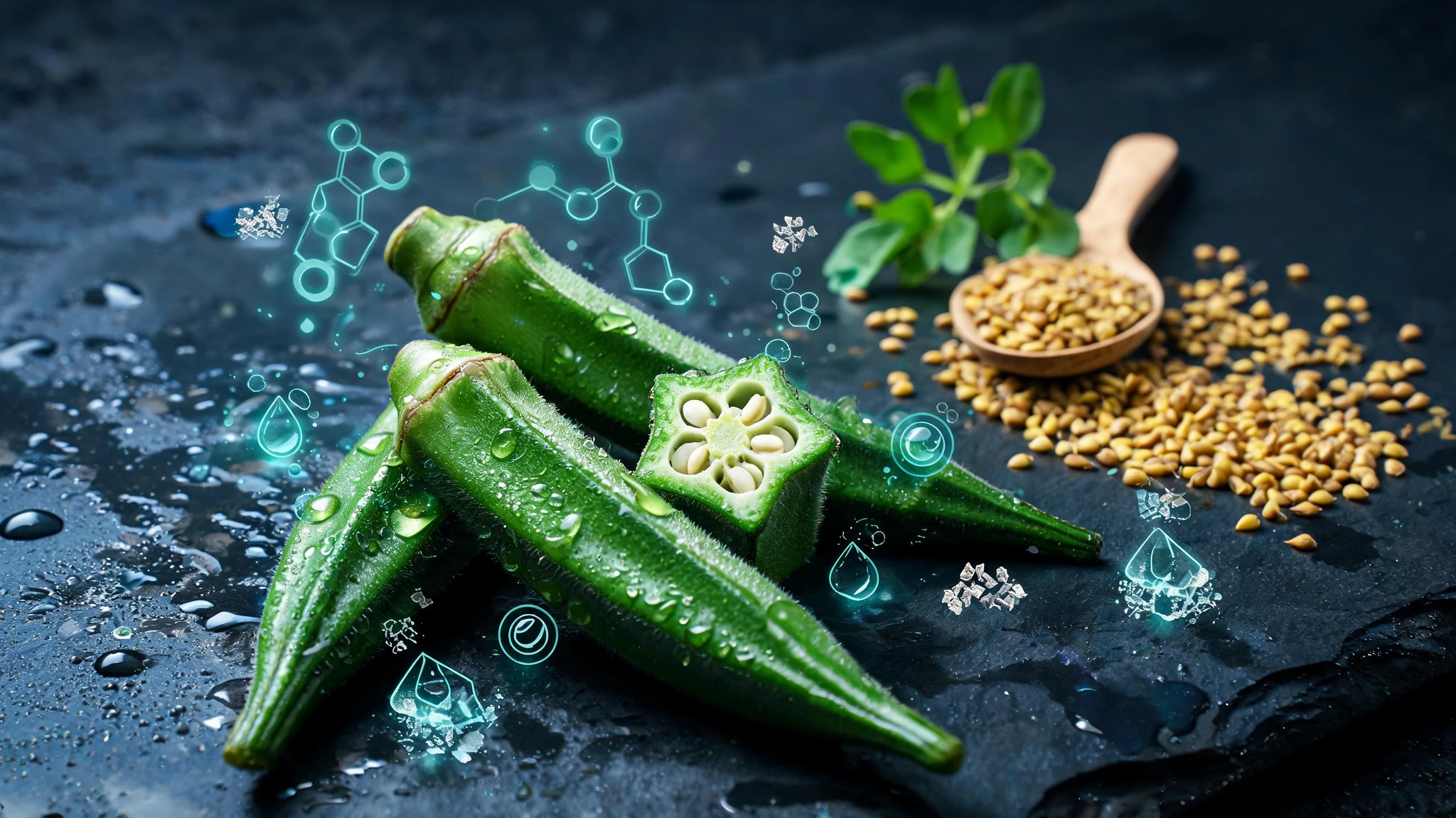
Two ordinary kitchen ingredients pulled most of the microplastics out of contaminated water in a recent laboratory test. Polysaccharide extracts from fenugreek seeds removed up to 89% of microplastic particles from groundwater samples, and okra extracts removed up to 80% from seawater, according to a 2025 paper by Srinivasan and colleagues in the journal ACS Omega.1
The work is preliminary. It was done on the bench, not at a city waterworks. But it points at a quietly hopeful idea: that two cheap, edible plants might one day replace some of the synthetic chemicals currently used to clean drinking water.
Why microplastics in water matter
Microplastics are tiny fragments of plastic, generally smaller than 5 millimeters and often invisible to the naked eye. They come from broken-down bottles, food wrappers, fishing gear, synthetic clothing fibers shed in the wash, and the slow weathering of larger plastic objects. They drift down rivers, settle in soils, ride on the wind, and turn up in the strangest places.
One of those places is your tap. A 2018 study led by Mary Kosuth tested 159 tap water samples from 14 countries and found microplastic fibers in 81% of them.2 The same paper documented contamination in commercial sea salt and bottled beer, suggesting that plastic particles have worked their way into food and drink at a population scale.
What happens after we drink them is less clear. Researchers in Amsterdam reported in 2022 that they had detected plastic particles in the blood of healthy adult donors, the first published evidence that microplastics can move from the gut and lungs into the human circulation.3 A team in Rome reported the year before that microplastics were present in human placenta tissue.4 And in 2024, a group led by Raffaele Marfella found that patients whose carotid plaque contained microplastics and nanoplastics had a substantially higher rate of heart attack, stroke, or death over the following 34 months than patients whose plaque did not.5 The Marfella study was observational, so it cannot prove the plastic caused the events. It is enough, though, to take the question seriously.
That is the backdrop against which the okra-and-fenugreek paper lands. Anything that can pull plastic particles out of water before we drink it is worth a look.
What the researchers actually did
The team, led by Rajani Srinivasan at Tarleton State University in Texas, started with a deceptively simple question: can the slimy, viscous substance you get from soaking okra pods or fenugreek seeds grab microplastic fragments out of contaminated water? Both plants are known to be rich in long-chain polysaccharides, the kind of large sugar molecules that form a thick mucilage when mixed with water. Industrial water treatment already uses polymer flocculants for the same job, but most of those are synthetic, and some leave behind residues that people would rather not drink.1
The researchers prepared dried, powdered extracts from okra pods and fenugreek seeds. They then dosed laboratory water samples with known concentrations of microplastic particles and added the plant powders at various amounts. After mixing, they let the water sit and watched what settled out, then measured how many particles remained in the supernatant.
The optimal dose, the paper reports, was about 1 gram of powdered extract per liter of water. At that level, fenugreek extract removed up to 89% of microplastics from groundwater. Okra extract removed up to 80% from a seawater sample. A combined fenugreek-and-okra preparation removed up to 77% from a freshwater sample. Effectiveness varied with the type of water and the type of plastic tested, which is exactly what you would expect for a process that depends on how molecules fit together.1

How does plant slime catch a piece of plastic?
The mechanism is called bridging flocculation. Picture each microplastic fragment as a small, lonely speck floating in water, too light to settle on its own. Now drop in long, ribbon-like polysaccharide molecules. Each ribbon is sticky in many places along its length, so a single chain can latch onto two, three, or more separate plastic specks at once. Multiply that across millions of polymer chains, and the specks get knitted together into clumps. Once the clumps grow big and heavy enough, gravity does the rest. They sink, and clear water is left above.
It is the same trick aluminum sulfate (alum) and synthetic polyacrylamide pull in conventional water plants. The novelty here is the source. Fenugreek seeds and okra pods are food-grade, grown on every inhabited continent, and have been thickening soups and stews for centuries. The polysaccharides involved (galactomannan in fenugreek, a rhamnogalacturonan-rich pectin in okra) are not new to chemists. What is new is using them, well-characterized and dosed, to chase microplastic particles in particular.
Why the result is encouraging without being a solution
The numbers are good for a first pass. They are not, however, a permission slip to start tossing okra into your kitchen filter. A few caveats matter.
First, the experiments were done in clean, controlled water with known concentrations of well-characterized microplastic particles. Real drinking-water sources carry a chaotic mix of dissolved organic matter, mineral salts, biological contaminants, and microplastics of many different polymer types and shapes. All of that can change how flocculants behave. The paper itself notes that effectiveness already varied between groundwater, seawater, and freshwater samples in the lab.1
Second, removing 89% sounds like a lot, and it is. But for a city water utility serving hundreds of thousands of people, the difference between 89% and 99% is the difference between a treatment plant that meets a future microplastic standard and one that does not. Industrial deployment will probably mean optimizing extraction, dosing, and recovery in ways the bench study did not need to address.
Third, what happens to the clump after it settles? In a treatment plant, the sludge is pumped off and disposed of. The plastic is still plastic; it has just been moved out of the drinking-water stream. That is a real benefit, but the broader plastic problem does not vanish.

Should I start filtering my tap water through okra?
No. The honest answer is that the study was a laboratory experiment using purified extracts at carefully controlled doses. There is no published evidence that throwing chopped okra into a pitcher of water will do anything useful, and there is real risk that home preparations could introduce contaminants of their own. The researchers explicitly frame their work as a step toward better large-scale treatment, not a recipe.
If you are concerned about microplastics in your drinking water today, the more practical move is the boring one: a certified home filter. Activated-carbon block filters and reverse-osmosis systems can reduce microplastic counts in tap water, depending on pore size and maintenance. Pick one tested by an independent lab, follow the cartridge replacement schedule, and you will probably do more for your daily exposure than any plant-based remedy on the horizon.
Reducing the microplastics that end up in water in the first place is the bigger lever, and most of it lives outside the kitchen. Choosing fewer single-use plastic items, washing synthetic clothing in a microfiber-catching bag, and supporting waste-collection infrastructure in your community all chip away at the source.
What this kind of research signals
The Srinivasan paper is one of a steadily growing list of studies asking whether biological materials can do jobs we currently hand to industrial chemicals. There are research lines on chitosan from shrimp shells, alginate from brown seaweed, tannins from tree bark, and starch from potatoes, each tested as a possible flocculant or sorbent for water treatment. None of them is a finished product. Together they sketch a picture of where municipal water treatment could go in the next decade or two: less reliant on petroleum-derived polymers, more reliant on what grows on a farm.
For the specific microplastic problem, the policy timeline is also moving. The European Union restricted intentionally added microplastics in consumer products in 2023. The World Health Organization has called for more research into microplastic exposure in drinking water, and several national agencies are drafting monitoring programs. A treatment chemistry that is cheap, food-safe, and biodegradable would slot neatly into that emerging regulatory environment.

What the science still has to figure out
A short list, in plain language. Can the okra-and-fenugreek approach handle the smallest microplastic fractions, the ones approaching nanoplastic size, where bridging flocculation gets harder? How do you separate the polysaccharide-plastic clumps cleanly from the treated water at scale? What is the cost per liter compared with synthetic flocculants, once you account for growing, harvesting, drying, and shipping the plant material? Does the chemistry hold up across seasonal variation in the plants themselves, or do you need standardized cultivars? And is there any downside to having residual plant polysaccharide in the treated water, even if it is food-grade?
The Tarleton State team has signaled interest in following these threads. Other groups will probably try to replicate the result with their own water samples and their own plant sources, including ones grown under different climate conditions. That kind of unglamorous, slow follow-up work is how a promising lab study becomes a real water treatment option, or quietly fails to. Funders who care about clean drinking water in regions where okra and fenugreek already grow as staple crops have an obvious reason to pay attention.

Common questions about microplastics and plant-based water filters
Are microplastics in tap water actually harmful?
The honest answer is that scientists do not yet know the full picture. Microplastics have been detected in human blood, placenta, and arterial plaque, and one observational study has linked plaque microplastics to higher rates of cardiovascular events.3,4,5 Causation in humans is not yet established. Reducing exposure is reasonable; panic is not.
What is bridging flocculation?
It is a water treatment process where long polymer molecules stick to many small suspended particles at once, knitting them into clumps that are heavy enough to settle out of the water.
Is fenugreek extract safe to drink?
Fenugreek seeds are widely consumed as a spice and a traditional remedy. The Srinivasan paper used purified polysaccharide preparations at low doses. There is no specific safety profile yet for using these extracts at municipal-scale drinking water plants, which is one of the questions future work would have to settle.
Could I make my own okra water filter at home?
It is not advisable based on this study. The experiments used dried, powdered extracts under lab conditions, not raw okra in a pitcher. Home preparations risk introducing other contaminants, and there is no published guidance on dose or contact time for kitchen use.
Do reverse-osmosis filters remove microplastics?
Most reverse-osmosis systems and well-maintained activated-carbon block filters reduce microplastic counts in tap water meaningfully. Look for independent third-party certification rather than marketing claims.

Where this leaves us
A team in Texas showed that two pantry staples, prepared as polysaccharide extracts, can grab a large fraction of microplastic particles out of contaminated water in a beaker. That is a real result, even if the road from beaker to faucet is long and full of unanswered questions. It belongs on the same shelf as a dozen other quietly promising studies that probe whether the next generation of water treatment can lean on what grows in a field rather than what comes out of a chemical plant.
The work also lands in an honest emotional register. Microplastic news has been relentlessly bleak for several years; finding a chemistry where okra and fenugreek do something genuinely useful is a small piece of cheerful counterprogramming. It does not let any of us off the hook for the larger plastic problem, and it does not change what you should do at home this week. But it is a reminder that there are still simple, inexpensive ideas worth testing, and sometimes one of them works.
Sources
- Srinivasan R et al. Fenugreek and Okra Polymers as Treatment Agents for the Removal of Microplastics from Water Sources. ACS Omega, 2025. PubMed: 40290963
- Kosuth M, Mason SA, Wattenberg EV. Anthropogenic contamination of tap water, beer, and sea salt. PLoS One, 2018. PubMed: 29641556
- Leslie HA et al. Discovery and quantification of plastic particle pollution in human blood. Environment International, 2022. PubMed: 35367073
- Ragusa A et al. Plasticenta: First evidence of microplastics in human placenta. Environment International, 2021. PubMed: 33395930
- Marfella R et al. Microplastics and Nanoplastics in Atheromas and Cardiovascular Events. New England Journal of Medicine, 2024. PubMed: 38446676