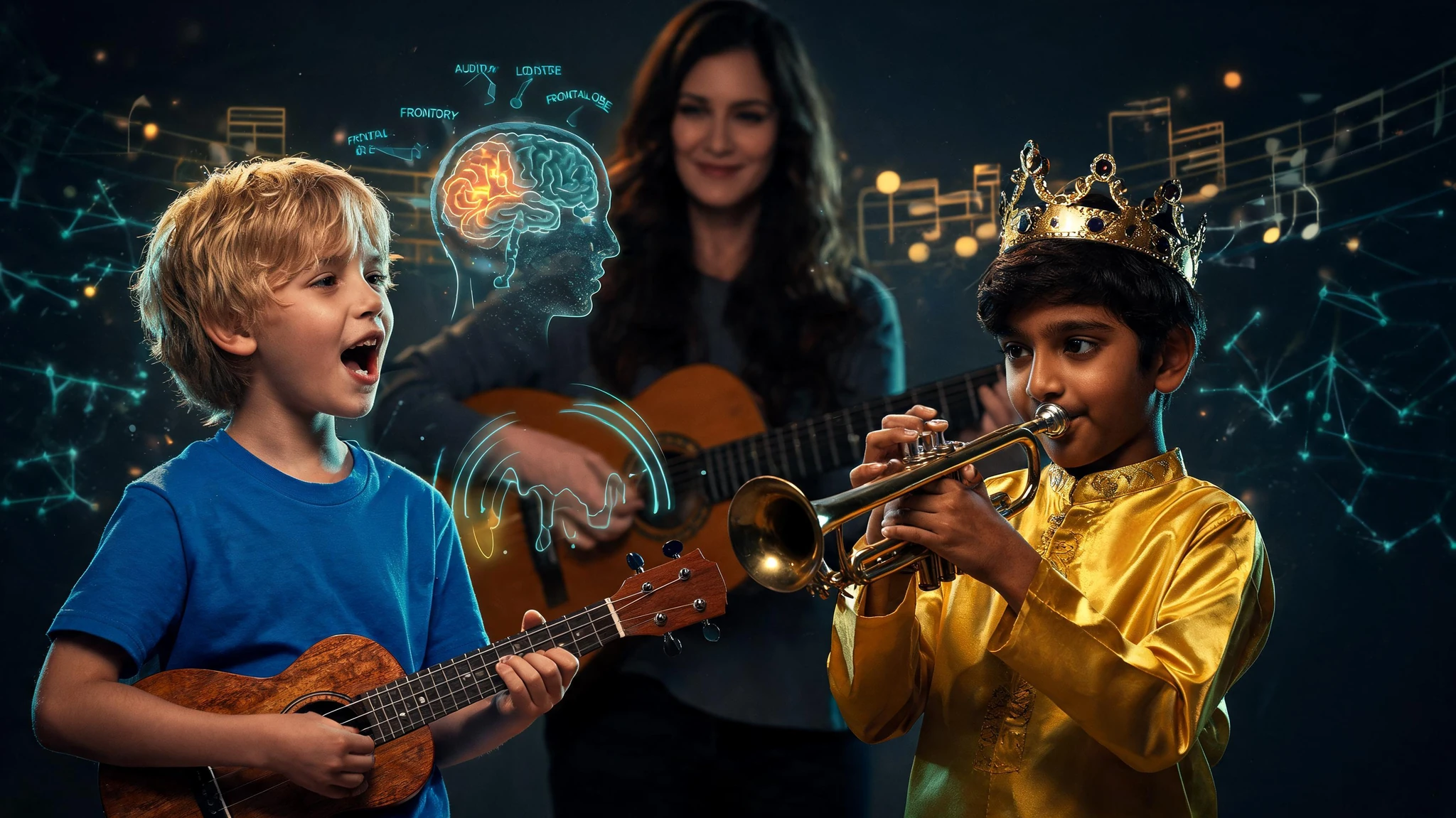
A few hours a week at the piano bench, the trumpet, or the second-hand violin can leave a measurable trace inside a child’s skull. In a 15-month brain-imaging study, Krista Hyde and Gottfried Schlaug found that children who took weekly keyboard lessons showed structural changes in motor and auditory regions that non-musical peers did not, and those changes tracked with gains on motor and auditory tests2. The kids were six years old at the start. The differences were visible by age seven and a half.
That is the headline finding behind a swelling body of research connecting early music training to brain development, language, and cognition. The picture is not magical. It is concrete, mechanical, and hopeful in a quiet way.
What actually changes inside the brain
When a child learns an instrument, the brain doesn’t light up in one tidy spot. It activates in a network. Functional MRI work by Stefan Koelsch, Gottfried Schlaug, and colleagues showed that adults and children processing music recruit overlapping regions across the auditory cortex, frontal lobe, and motor planning areas, with children leaning more heavily on right-hemisphere structures while adults engage a more bilateral pattern5. In other words, the same task pulls different machinery online depending on age, and a young brain practices using a wiring diagram that is still being drawn.
Add a year of weekly keyboard lessons on top of that, and the diagram itself starts to shift. Hyde’s team measured deformation-based changes in the corpus callosum, the right precentral gyrus (a motor region), and the right primary auditory area in the children who took lessons2. The children who didn’t take lessons showed no equivalent changes during the same window. These are subtle effects, not personality transplants. But they are reliable, and they are exactly where you would expect them given what playing an instrument actually demands: bimanual coordination, fine motor control, and pitch processing all running in parallel.

How long do the effects stick around?
Short-term studies are easy to dismiss. A child gets better at the thing they practice. The harder question is whether anything generalizes, and whether the gains last past the lessons themselves. Two longer projects suggest the answer is yes, with caveats.
The first is Assal Habibi’s longitudinal study at the University of Southern California, which followed children from low-income Los Angeles neighborhoods over several years. Some joined an El Sistema-inspired orchestra program. Others joined a sports program or no extracurricular at all. After two years, the music-training group showed accelerated maturation of auditory pathways and changes in cortical thickness compared with controls3. The brain wasn’t just bigger or smaller. It was developing on a different timetable, particularly in regions linked to sound processing and executive control.
The second is Sylvain Moreno’s randomized study in Toronto, where 4 to 6 year olds were assigned to either a 20-day computerized music training program or a comparable visual arts program. The music group’s verbal IQ rose, with about 90% of the trained children showing measurable gains, while the visual arts group did not show the same effect4. Twenty days. That is striking, and it is also a small short-term study, so the appropriate response is interest, not certainty.
What about decades later? Folk wisdom holds that childhood violinists turn into sharper grandparents. The research community has explored this with mixed results. Some observational studies suggest that lifetime musical engagement is associated with better cognitive performance in older adults, but the studies cannot rule out the possibility that the kind of person who sticks with music for sixty years is also the kind of person who eats vegetables and reads books. The 70-versus-11 comparison sometimes quoted on social media should be taken as suggestive rather than settled.
Why music in particular?
Plenty of activities build skills. Soccer builds coordination. Chess builds working memory. What makes music distinctive, according to researchers like Schlaug, is the unusual combination of demands packed into a single practice session1. A child reading sheet music has to translate visual symbols into motor commands while monitoring auditory feedback, holding rhythm in working memory, and adjusting in real time when something goes off. Speech, math, and reading all share pieces of that machinery, which is the hypothesized reason music seems to nudge other domains.
The phonological angle is the cleanest example. Phonological awareness, the ability to hear and manipulate the small sound units of a language, is a strong predictor of early reading ability. Music training drills exactly the auditory discrimination skills that phonological awareness depends on. Children who practice telling apart subtle pitch and timing differences get better at telling apart subtle speech differences, and the reading benefit follows from there in many studies.

It is not just one study
One reason this area is more credible than a typical “X makes kids smarter” claim is that the evidence comes from multiple labs, multiple countries, and multiple methods. Schlaug’s group in Boston has used structural MRI. Habibi’s group in Los Angeles has used longitudinal designs comparing music, sports, and no-treatment controls3. Moreno’s group in Toronto has used randomized assignment with active control groups4. Koelsch’s work has used functional imaging across age groups5. The findings don’t agree on every detail. They do agree on a basic shape: music training, when it actually happens consistently, leaves measurable marks on the developing brain and on related cognitive tests.
That said, two honest caveats. First, effect sizes in this literature are often modest. The differences are real, but they don’t turn average kids into prodigies. Second, the people who keep their kids in music lessons tend to differ from people who don’t, in ways that go beyond the lessons. Income, parental education, household stability, all of these things correlate with music participation and with cognitive outcomes. The strongest studies, like Hyde’s and Moreno’s, try to handle this by using control groups and randomization. They still find effects. But the effects are smaller than the headlines suggest.
What about academic performance and SAT scores?
Population-level data from groups like the College Board has long shown that students reporting more music coursework also report higher SAT scores. The same data shows that students taking more of almost any elective tend to score higher, which is a problem for any clean causal story. Inside controlled studies, the effects on math and reading are smaller and more inconsistent than the effects on auditory and language tasks. So the honest version of “music boosts academic performance” is closer to “music training appears to improve specific auditory and verbal skills that feed into academic performance, with less consistent effects on other domains.”
For a parent, that distinction is less interesting than the practical question. If you put your kid in piano lessons, are they likely to come out a stronger reader and a more focused listener two years later? The aggregate evidence says probably yes, on average, with a modest but real benefit, especially if the lessons are consistent and the child engages. That is a defensible bet.

What kind of music training, and how much?
The studies cluster around a few practical patterns. Most use weekly individual or small-group lessons, often paired with daily practice of 20 to 45 minutes. Programs range from formal Suzuki-style instruction to community orchestra setups like El Sistema in Habibi’s work3. The instrument seems to matter less than the consistency. Piano, violin, guitar, and brass have all produced positive findings.
Three patterns recur across this work. Lessons that combine listening, reading notation, and producing sound seem to do more than lessons that drill only one of those. Instruction that starts before age seven appears to take advantage of a more plastic developmental window, though older starters still benefit1. And quitting after a few months tends to undo the cognitive gains, while sustained practice over a year or more is when the brain-structure changes show up most clearly2.
None of this is a script. Some children will love the violin and quit the piano. Some will discover percussion at age twelve and ride it through adulthood. The shape of the engagement matters more than the brand of instrument.
What if your child can’t take formal lessons?
Most of the research is on structured lessons, but the underlying mechanisms, exposure to musical sound, active singing, rhythm games, are not locked behind a private teacher. Singing together at home, learning simple percussion patterns, even regular structured listening with a parent talking through what they hear, all engage overlapping auditory and motor circuits. Free or low-cost options exist in most cities through community music programs, public schools, and church or temple choirs.
That said, prose-honesty: the evidence on informal exposure is thinner than the evidence on consistent structured practice. The brain changes Hyde and others document came from kids who actually played an instrument every week2. The point isn’t that lessons are the only way. The point is that the dose, regular, active, sustained, seems to matter as much as the format.

Common questions about music training and child development
At what age should a child start lessons?
Most studies showing structural brain changes begin instruction between ages five and seven. Younger children can benefit from informal music play, group singing, and rhythm activities. Formal one-on-one lessons typically work best once a child can sit and focus for 20 minutes.
Is one instrument better than another?
The research base is broad. Piano, string instruments, and brass have all produced positive findings on auditory and motor development. Choose what your child is curious about and what your household can support, since long-term consistency is what drives the brain effects.
How much practice is enough?
Studies that detect cognitive and structural change usually involve at least one weekly lesson plus regular practice, often 20 to 45 minutes a day. Less than this can still build skill but is less likely to show measurable cognitive transfer.
Will music lessons raise my child’s IQ?
Short-term studies have shown gains on verbal intelligence subscales after structured music training4. The effects are real but modest, and IQ is influenced by many things. A more accurate way to think about it: music lessons are one of several enrichment activities with documented small positive effects on cognition.
What if my child wants to quit?
This is one of the harder parenting questions in the literature. Brief stints of music training do leave temporary changes, but the most robust effects come from sustained practice. A reasonable middle path is to negotiate a minimum commitment, often a year, before letting a child fully drop an instrument, while staying alert to whether the resistance is to music itself or to a particular teacher or method.
The shape of an evidence-aware bet
Music lessons are not a smart-pill. They are not a fix for a struggling reader on their own, and they are not a substitute for sleep, nutrition, sustained reading at home, or a stable adult. What the research does support is something quieter and more useful: regular, active musical practice in childhood appears to leave measurable marks on the brain’s auditory and motor systems, and those marks line up with small but real gains in language and cognitive skills that matter for school and life1,2,3.
If you can give a child consistent access to an instrument they enjoy, with a teacher or program that takes the work seriously, the bet is worth making. Some of the children in the photo at the top of this article will keep playing into their twenties. Some will quit at twelve and pick up a guitar at thirty. Either way, the brain that learned to listen carefully, coordinate two hands, and read a second symbolic system in childhood does not fully forget how.
Sources
- Schlaug G, Norton A, Overy K, Winner E. Effects of music training on the child’s brain and cognitive development. Annals of the New York Academy of Sciences, 2005. PubMed: 16597769
- Hyde KL, Lerch J, Norton A, Forgeard M, Winner E, Evans AC, Schlaug G. Musical training shapes structural brain development. The Journal of Neuroscience, 2009. PubMed: 19279238
- Habibi A, Damasio A, Ilari B, Veiga R, Joshi AA, Leahy RM, Haldar JP, Varadarajan D, Bhushan C, Damasio H. Childhood Music Training Induces Change in Micro and Macroscopic Brain Structure: Results from a Longitudinal Study. Cerebral Cortex, 2018. PubMed: 29126181
- Moreno S, Bialystok E, Barac R, Schellenberg EG, Cepeda NJ, Chau T. Short-term music training enhances verbal intelligence and executive function. Psychological Science, 2011. PubMed: 21969312
- Koelsch S, Fritz T, Schulze K, Alsop D, Schlaug G. Adults and children processing music: an fMRI study. NeuroImage, 2005. PubMed: 15850725