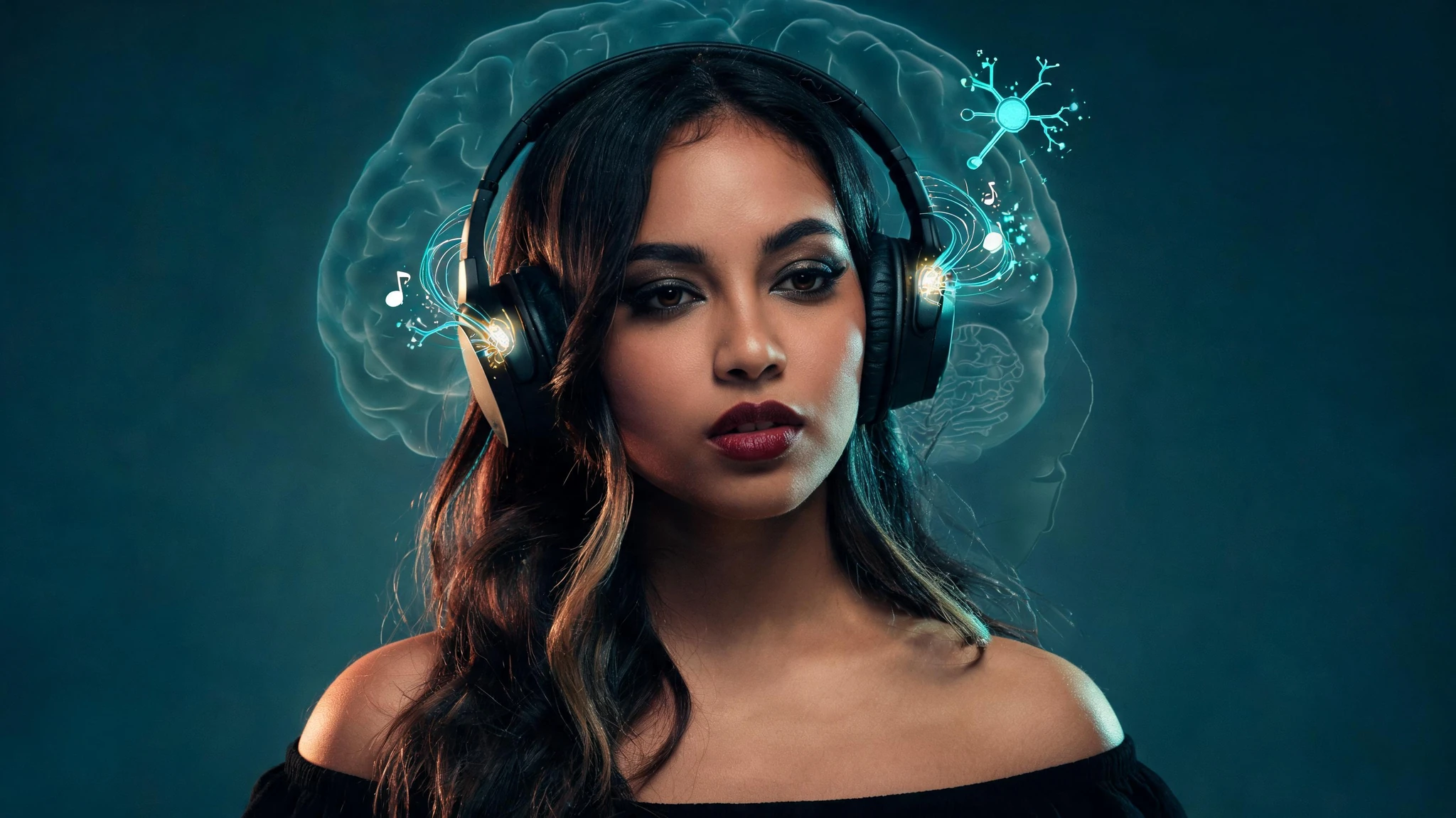
If a particular song has ever raised the hair on your arms, tightened your throat, or sent a shiver down your back, a small 2016 study at Wesleyan University and Harvard suggests your brain may be wired with a denser bundle of fibers between the part that hears sound and the parts that process feeling.1 Matthew Sachs and his coauthors scanned twenty young adults, half of whom regularly got chills from music, and found measurably stronger white-matter connectivity in the chill-prone group.
That is the headline finding behind the now-popular claim that “music chills” mean a uniquely wired brain. It is a real result. It is also a small study, and the science around the experience scientists call frisson is bigger, older, and more interesting than a single MRI scan.3
What is frisson, exactly?
Frisson is the shorthand researchers use for the brief, full-body shiver that hits when a piece of music, or sometimes a film scene or a poem, lands at exactly the right moment. The word is borrowed from French and just means a thrill or a chill. People describe it as goosebumps, a tingling that runs from the scalp down the spine, a flushed feeling in the chest, sometimes tears that arrive before they understand why.
Surveys put the share of adults who report regular music chills somewhere between half and two thirds, with a smaller fraction (roughly one in ten) saying they almost never feel anything like it. The trait is fairly stable across a person’s life. Someone who got chills from a film score at fifteen is likely to still get them at forty-five, sometimes from the same piece.
What sets it apart from related sensations matters. Autonomous sensory meridian response, the soft-spoken whispering tingles popularised on YouTube, sits in a different category. A 2020 paper by Roberts and colleagues compared the two directly and concluded ASMR and frisson are physiologically and emotionally distinct, even though they can feel cousinly.5 Frisson tends to peak quickly and fade. ASMR, when it arrives, often lingers and calms.
The 2016 study, in plain terms
Sachs and his team recruited twenty volunteers, ten who reliably got chills from their favorite songs and ten who said they did not. Each person picked the music. Inside the scanner, the researchers used a technique called diffusion tensor imaging, which traces how water molecules move along the brain’s nerve fibers. Where water flows in a clean directional line, you have a tightly bundled white-matter tract. Where it diffuses every which way, the tract is thinner or less organised.1
The chill-prone group showed higher fiber density in tracts connecting the auditory cortex (where sound becomes recognisable as sound) to the insula and medial prefrontal cortex (which handle interoceptive feelings and social-emotional meaning). The popular framing calls these “extra neural pathways.” The careful framing is that the highways are wider and better-paved, not that there are more of them.
The study is genuinely informative, and it is also genuinely small. Twenty people is a tiny sample for any neuroimaging claim. The authors said as much. They called for replication in larger groups and across more diverse populations, which has been slow to arrive in the form of a true direct replication, though related work on music-driven reward has continued to grow.

Why does music move us in the first place?
Long before the 2016 wiring paper, Anne Blood and Robert Zatorre at McGill scanned ten musicians as they listened to the pieces that gave them chills. Activity climbed in the ventral striatum, midbrain, and orbitofrontal cortex, the same circuit that lights up for food, sex, and addictive drugs.3 That 2001 paper is the foundation stone. It said, with imaging evidence, that intense musical pleasure is not metaphorically rewarding. It uses the brain’s literal reward system.
A decade later, Valorie Salimpoor and her colleagues took the next step. Using PET scans with a tracer that binds to dopamine receptors, they showed that listening to chill-inducing music caused real-time dopamine release, with one peak during the build-up to a favorite passage and a second, anatomically distinct peak when that passage actually arrived.2 Anticipation and consummation each had their own neural signature. The brain was rewarding the listener twice: once for predicting what was coming, once for hearing it land.
By 2013, the same group had pushed further. In a clever experiment, they had volunteers listen to unfamiliar songs and bid real money on whether they wanted to buy them. The amount someone was willing to pay tracked with how strongly the nucleus accumbens (a hub of the reward system) talked to the auditory cortex.4 The reward did not live in the music. It lived in the conversation between the part of the brain that recognised patterns in sound and the part that decided those patterns mattered.
So when the 2016 paper found denser wiring between auditory and emotion regions in chill-prone listeners, it dropped into a story that already made sense. Wider conversational bandwidth between sound and feeling could plausibly produce stronger, more frequent peak responses. Plausibly. The data do not yet prove that the wiring causes the chills, only that the two things travel together.
Is the goosebump itself a clue?
The shiver is not just a feeling. It is a measurable autonomic event. Heart rate jumps a few beats. Skin conductance rises. Body hairs stand up briefly, the same piloerection reflex other mammals use to look bigger when threatened or to trap warm air against cold skin. In humans, the practical use of that reflex has mostly faded, but the wiring is still there, ready to fire when something cuts through.
Anthropologists and music theorists have long argued that frisson is what happens when the brain’s prediction machinery gets surprised in a satisfying way. A familiar progression breaks. A held note resolves a half-beat later than expected. A choir crashes in where a solo voice was. The brain registers a tiny error, decides it is a welcome one, and rewards itself for the update. Goosebumps are the body’s footnote to that decision.
That theory fits the dopamine timing Salimpoor found. The anticipatory peak is the prediction tightening. The consummatory peak is the prediction confirmed or pleasantly broken. The chill is the cleanup signal.

Does this mean some brains are “better” at music?
No, and the original authors were careful about this. The chill-prone listeners in the 2016 study did not have higher musical training, higher IQ, or a better ear in any tested sense.1 They had a particular flavor of connectivity. People who do not get chills are not missing out on music in any moral or cognitive way. They tend to enjoy music as much, just without the autonomic fireworks.
It is also worth saying that musical anhedonia, the rare profile of someone who hears music perfectly well but feels almost nothing from it, is its own studied trait, with its own pattern of reduced connectivity between auditory and reward regions. That work, led in part by Ernest Mas-Herrero and Josep Marco-Pallares in Barcelona, suggests the chill axis is a spectrum, not a binary, and the frisson-prone end is one tail of a distribution that has another tail at the opposite extreme.
The honest summary: brains differ, and the frisson trait sits inside a wider human range of musical reward.
Can you train yourself to feel it?
Probably not in the sense of building new white-matter tracts on demand. Adult brain wiring changes slowly and modestly. But the conditions that make frisson more likely are very much under your control, and people who pay attention to those conditions report more chills, even if their wiring stays the same.
Listen to music you love, not music you tolerate. Frisson is a peak response, and peaks need a high baseline of attachment to a piece. Listen with attention, ideally on headphones or in a quiet room, where the dynamic range can do its work. Pieces with sharp contrast (a quiet build into a loud release, an unexpected key change, a single voice giving way to an ensemble) are common chill triggers. Familiar music and unfamiliar music both work, but for different reasons. The familiar version surfs on prediction and memory; the unfamiliar version on surprise.
One more practical note: frisson is more likely when you are emotionally available. People who are exhausted, distracted, or numbed out report fewer chills. The same listeners report more chills after sleep, after a meal, or after a small ritual that puts the day down for a moment. None of this is mysterious. The reward system runs better when the rest of the body is not fighting fires.

What about other arts?
The same circuitry seems to fire for poems read aloud, certain film scenes, and (in some people) sports moments and religious ritual. The triggers vary; the body’s response is recognisable across them. That suggests frisson is not really about sound. It is about the brain registering a moment of meaningful surprise and rewarding the registration. Music is just unusually good at producing those moments because it is built out of patterns and breaks of patterns by design.
If you are the kind of person who tears up at a particular line in a poem, or at the resolution of a long film, your wiring is likely doing the same trick the 2016 study described, with a different input.
It is not just one study
It would be tidy to wrap this around the 2016 paper alone, but the trustworthy version of the story stretches across two decades of work. Blood and Zatorre showed in 2001 that musical pleasure used the reward circuit.3 Salimpoor and her group showed in 2011 that the reward involved real dopamine release, in two distinct phases.2 The same group showed in 2013 that individual differences in how much someone valued a new song could be predicted from how strongly the reward system and the auditory cortex talked to each other.4 Sachs and colleagues then showed in 2016 that the structural wiring between those regions varied with whether a person regularly got chills.1 Roberts and colleagues showed in 2020 that frisson, while related to other tingle responses, has its own emotional fingerprint.5
Read together, the literature describes a clear picture: music can hit the reward system, the response is partly chemical and partly structural, and people vary in how reliably it happens to them. The 2016 wiring finding is one piece of that picture, not the whole of it.

Common questions about music chills
Is frisson rare?
No. Surveys suggest most adults experience it at least occasionally, with a smaller fraction reporting it often and another small fraction reporting it almost never.
Does not feeling chills mean my brain is “less musical”?
No. People who do not get chills usually report enjoying music just as much. Frisson is a particular autonomic response, not a measure of musical ability or appreciation.
Can medication change it?
In some cases, yes. Drugs that block opioid receptors have been shown in small studies to reduce music-induced pleasure and chills, which fits the reward-system explanation. Some antidepressants and some recreational drugs also dampen or amplify the response. Talk to a clinician before reading too much into any single change.
Is it the same as ASMR?
No. A 2020 comparison study found that ASMR and frisson share the word “tingle” but differ in their emotional profile and physiology, with ASMR feeling calming and frisson feeling activating.5
Will my chills go away as I age?
For most people, no, although which songs trigger them tends to shift. Music encountered in adolescence and young adulthood often retains its frisson power for life, while new triggers are added more slowly.
What to take home
If music regularly gives you chills, that response is a real, measurable thing, with a plausible neural substrate that has been mapped piece by piece since 2001. A small 2016 study suggests one part of why some people feel it more than others lies in the density of fibers connecting sound to feeling.1 That is worth knowing, and it is also worth holding loosely. Twenty brains are not a verdict.
The kinder reading of the science is that bodies talk to music in different dialects. Some get the full goosebump version, some a quieter one, some mostly the cognitive pleasure without the physical signal. None of those is wrong. If you have cried at a chord change, you have company, and a small but real biology underwriting the experience.
Sources
- Sachs ME, Ellis RJ, Schlaug G, Loui P. Brain connectivity reflects human aesthetic responses to music. Social Cognitive and Affective Neuroscience, 2016. PubMed: 26966157
- Salimpoor VN, Benovoy M, Larcher K, Dagher A, Zatorre RJ. Anatomically distinct dopamine release during anticipation and experience of peak emotion to music. Nature Neuroscience, 2011. PubMed: 21217764
- Blood AJ, Zatorre RJ. Intensely pleasurable responses to music correlate with activity in brain regions implicated in reward and emotion. Proceedings of the National Academy of Sciences, 2001. PubMed: 11573015
- Salimpoor VN, van den Bosch I, Kovacevic N, McIntosh AR, Dagher A, Zatorre RJ. Interactions between the nucleus accumbens and auditory cortices predict music reward value. Science, 2013. PubMed: 23580531
- Roberts N, Beath A, Boag S. A mixed-methods examination of autonomous sensory meridian response: Comparison to frisson. Consciousness and Cognition, 2020. PubMed: 33242764