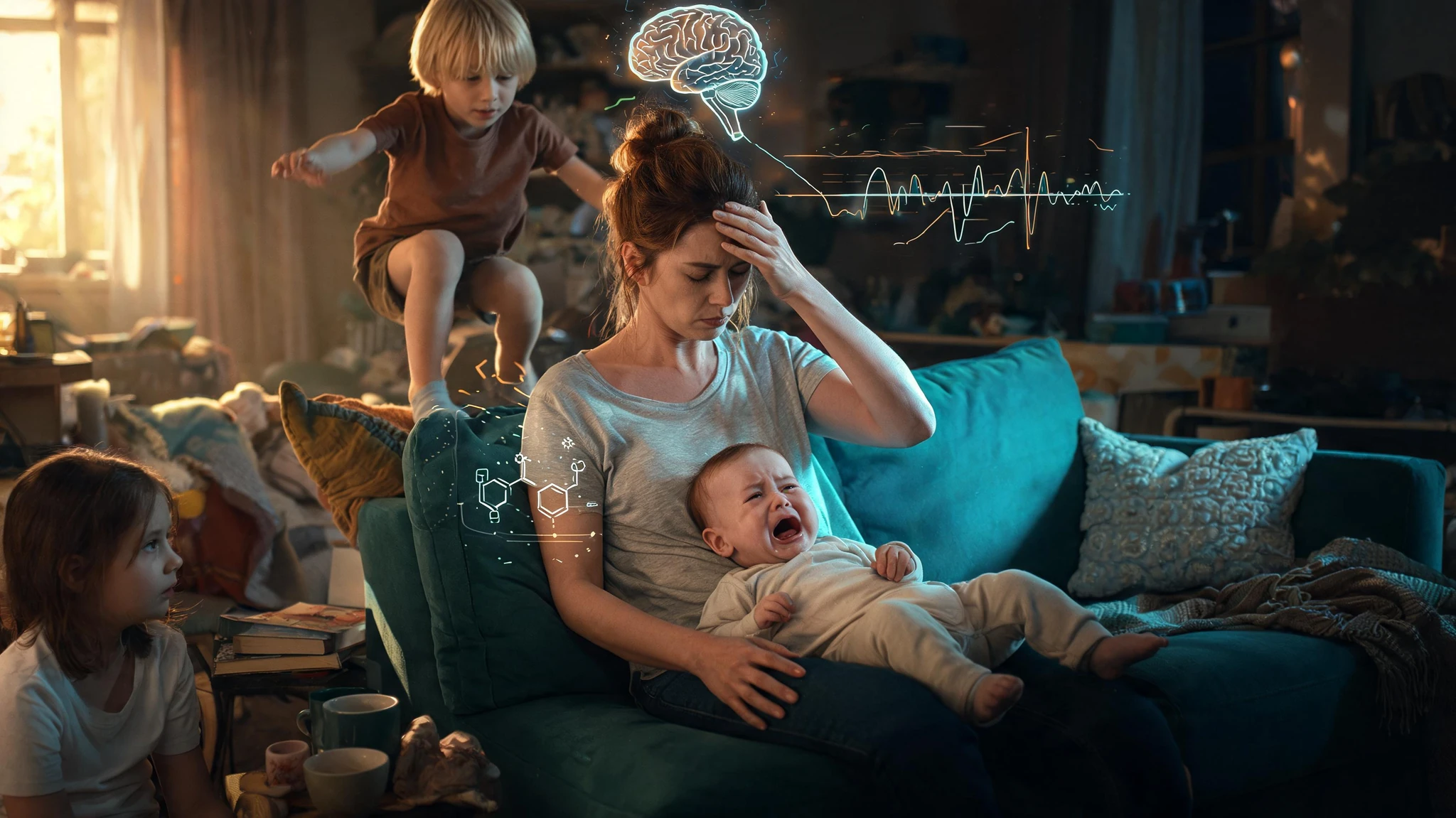
A national survey of more than 7,000 American mothers, run by TODAY Parents in 2019, landed on a finding that surprised almost everyone who looked at it: moms of three reported higher stress than moms of one, two, four, or even five-plus kids. The number that supposedly tips you into chaos is not the one most people picture.
The pattern is consistent with what sociologists have been documenting for years. Research led by Melissa Milkie at the University of Toronto found that parents who report large “time deficits” with their children, the gap between the time they want to give and the time they actually have, score worse on measures of mental and physical health than parents who do not.1 Three kids is where that deficit tends to bite hardest.
What the TODAY Parents survey actually found
The 2019 survey collected responses from over 7,000 U.S. mothers about the daily emotional weather of parenting. When researchers sliced the data by family size, the curve was not linear. Stress climbed from one child to two, climbed again from two to three, then dropped slightly for moms of four or more. The peak sat squarely on the three-kid household.
Sixty percent of mothers in the survey said lack of time was their single biggest source of tension. Seventy-two percent said they felt stressed about feeling stressed, a layered worry that anxiety researchers call meta-worry, or worry about worry. The classic instrument for measuring that loop, Cartwright-Hatton and Wells’s Meta-Cognitions Questionnaire, has shown for decades that beliefs about your own worry can be as exhausting as the original worries themselves.4
One mother quoted in the original write-up, a psychiatrist herself, summed it up plainly. “Everything was turned upside down. I did not feel like I had it together.” She was the third-time parent. She had two hands and three kids who needed to cross a street.
Why three is the breakpoint
Two adults can man-mark two kids. One per parent, eyes on, hands free if needed. Add a third child and a household with two adults is suddenly playing zone defense. If only one parent is on duty, which is the norm during weekday afternoons in most U.S. families, the math gets uglier. Two hands, three small humans. You cannot physically hold every hand at the curb.
The shift is not just logistical. Sociologists Kei Nomaguchi and Melissa Milkie, in their decade-in-review of the parenthood-and-well-being literature, point out that parental well-being depends heavily on the fit between cultural expectations and actual conditions.2 American culture has, over the last forty years, raised the bar for what counts as good parenting. Children are now expected to be cognitively stimulated, emotionally attuned to, scheduled, fed organic, and screened off from harm at almost all hours. The ideology has a name in the academic literature: intensive mothering.
Intensive mothering is doable, more or less, with one child. It is hard with two. With three, the gap between the cultural script and the physics of the day becomes punishing. A 2022 qualitative study of mothers during the first COVID wave found that women who internalized the intensive-mothering ideal reported significantly more guilt, exhaustion, and self-criticism when they could not meet it.5 Three kids tends to be where the ideal stops being meetable.

So why do moms of four or more cope better?
This is the part of the data that surprises people most. If three is hard, four should be harder. The survey says it is not.
The leading explanation among researchers is something like adaptive surrender. By the fourth child, most mothers have already given up on the version of motherhood that requires homemade bento boxes and a Pinterest-worthy birthday for every kid. The expectations come down. The reliance on older siblings goes up. The house is louder, but the standard against which the mother is measuring her own day is lower, and that standard is what produces a lot of the stress in the first place.
It is also a selection effect. People who choose a fourth child often do so because the first three did not break them, or because they grew up in a large family and find the noise normal. The four-or-more group is, in part, a self-selected sample of people who handle high-load households well. The three-kid group includes everyone who got there.
Nomaguchi and Milkie’s review notes that bigger families also tend to develop something closer to a household economy, where chores, babysitting, and emotional support get distributed across siblings rather than living entirely on the mother’s shoulders.2 A six-year-old who can pour cereal for a four-year-old saves the mother a small but real number of cognitive moves per morning. Multiply that across a year and it adds up.
The time-scarcity engine
Sixty percent of mothers in the survey named time as their biggest stressor. That number lines up almost exactly with the time-deficit findings in Milkie, Nomaguchi, and Schieman’s 2019 study, which used the National Survey of the Changing Workforce to show that parents who feel they have “too little time” with their children report worse self-rated health and more depressive symptoms than parents who feel their time is adequate, even after controlling for income, hours worked, and the actual number of hours spent with kids.1
That last detail matters. The damage is in the felt deficit, not the clock. A mother who works 30 hours a week and feels she has enough time with her kids tends to do better on health measures than a mother who works the same 30 hours and feels she does not. Three kids inflates the felt deficit because each child has a separate inner life, a separate set of needs, and a separate window of attention they want from you. With one child, attention is a one-to-one channel. With three, it is a triage queue, and somebody is always last.

The 72% who said they felt stressed about being stressed are caught in the meta-worry loop the cognitive literature has been mapping since the 1990s.4 The first-order worry is “I do not have time.” The second-order worry is “the fact that I am this anxious means I am failing my kids.” The second one is often heavier than the first, because it pulls in identity. You are not just behind. You are the wrong kind of mother.
Is this a U.S. problem or a global one?
Mostly a U.S. problem, in its sharpest form. A 42-country study of parental burnout led by Isabelle Roskam at UCLouvain found that parental burnout is not evenly distributed across cultures.3 Western, individualistic, high-expectation countries, with the United States near the top, have noticeably higher rates than collectivist countries with extended-family caregiving and lower expectations of individual parental performance. Same biology of children. Different cultural pressure.
That fits with what the TODAY Parents data captured. The survey did not measure ambient cultural pressure directly, but the very high rate of meta-worry, 72%, is the fingerprint of a culture that scores its mothers continuously and tells them their kids’ outcomes are mostly their fault.
What the research suggests actually helps
Nothing in the literature points to a single trick. The findings cluster around four levers, in rough order of effect size.
The first is real, sustained social support. A scoping study of women diagnosed with perinatal depression found that isolation and loneliness, more than the workload itself, were the consistent thread in their narratives.6 “Mums alone” was the title the researchers gave their analysis, and it captures the texture of three-kid stress better than any number does. A nearby grandparent, a friend who actually shows up on Tuesdays, a babysitter for two predictable hours a week: these are not luxuries. In the data, they are protective.
The second is dropping the intensive-mothering script where you can. The 2022 COVID-era interview study found that mothers who explicitly named and rejected the ideal-mother standard reported lower distress than mothers who kept trying to meet it.5 “Good enough” is a research-backed parenting goal, not a cop-out.
The third is sleep. Most three-kid households are sleep-debted in some combination of infant, toddler, and bad-dream wakings. Sleep loss amplifies almost every other stressor it touches. It is not always fixable, but where there is any slack, that is where the slack should go.
The fourth is naming the meta-worry for what it is. The Cartwright-Hatton and Wells line of research suggests that simply recognizing “I am now worrying about my worrying” can interrupt the loop, because metacognitive awareness reduces the second-order belief that the worry itself is dangerous.4 It does not make the first-order worry go away. It makes it a single layer instead of two.

What this is not saying
It is not saying don’t have a third child. The survey captures average stress, not regret. Parents of three are, on the whole, glad to have three. The Nomaguchi and Milkie review is careful to point out that parental well-being is multi-dimensional: stress, meaning, joy, and exhaustion can all run high in the same week.2 A mother of three can be the most stressed in the dataset and also report deeper meaning than the average non-parent. Both are real.
It is also not saying every mother of three feels this way. Individual circumstances, partner involvement, financial slack, the kids’ temperaments, and the presence of nearby family swing the experience hard. The survey describes a population pattern, not a personal verdict.
Common questions about three-kid stress
Q. Is the TODAY Parents survey peer-reviewed?
A. No. It is a media-run national survey, not a journal study, so the headline finding should be read as a strong descriptive signal rather than a clinical result. The reason researchers find it credible is that it lines up with peer-reviewed work on parental time deficits and burnout.1,3
Q. Does the third child cause the stress, or is it the conditions around the third child?
A. The conditions, mostly. Time scarcity, lack of nearby help, and the cultural pressure of intensive mothering are the variables that move the dial. The same family in a culture with built-in extended care tends to look different in the data.3
Q. Do dads of three show the same pattern?
A. The TODAY Parents survey was of mothers, so it cannot say. The broader literature suggests fathers also feel time deficits, but the meta-worry rate, the 72% stressed-about-being-stressed figure, tends to be higher in mothers, who absorb more of the cultural blame for child outcomes.2
Q. Will it get easier?
A. Usually. The hardest stretch is when all three kids are below age seven and at least one is below age three. Once the youngest hits school age, the time-deficit math eases noticeably, and so does the meta-worry. The peak is a phase, not a verdict.
Q. What is the single most useful thing a mom of three can do tonight?
A. Probably text one person who could give her two real hours next week. Social support is the lever with the most research behind it.6
The honest bottom line
The three-kid finding is not a curse. It is a description of where a particular cultural script collides with a particular logistical load. If you are in that exact spot right now, looking at one infant in your lap and two louder kids on the couch and wondering why everything feels harder than the parenting books promised, the data is on your side. You are not weaker than the mom of one or the mom of four. You are running a harder version of the same race, with shoes that fit nobody.
The kindest thing the research has to offer is that the curve drops on the other side. The kids get older. The worst hands-at-the-curb year is one year. The meta-worry loosens once you stop scoring yourself against an ideal that was never reachable in the first place. None of that arrives by tomorrow. It does arrive.
Sources
- Milkie MA, Nomaguchi K, Schieman S. Time Deficits with Children: The Link to Parents’ Mental and Physical Health. Soc Ment Health. 2019. PubMed: 31763056
- Nomaguchi K, Milkie MA. Parenthood and Well-Being: A Decade in Review. J Marriage Fam. 2020. PubMed: 32606480
- Roskam I, Aguiar J, Akgun E, et al. Parental Burnout Around the Globe: a 42-Country Study. Affect Sci. 2021. PubMed: 33758826
- Cartwright-Hatton S, Wells A. Beliefs about worry and intrusions: the Meta-Cognitions Questionnaire and its correlates. J Anxiety Disord. 1997. PubMed: 9220301
- Batram-Zantvoort S, Wandschneider L, Niehues V, et al. Maternal self-conception and mental wellbeing during the first wave of the COVID-19 pandemic: A qualitative interview study through the lens of “intensive mothering” and “ideal worker” ideology. Front Glob Womens Health. 2022. PubMed: 36132187
- Taylor BL, Howard LM, Jackson K. Mums Alone: Exploring the Role of Isolation and Loneliness in the Narratives of Women Diagnosed with Perinatal Depression. J Clin Med. 2021. PubMed: 34073903