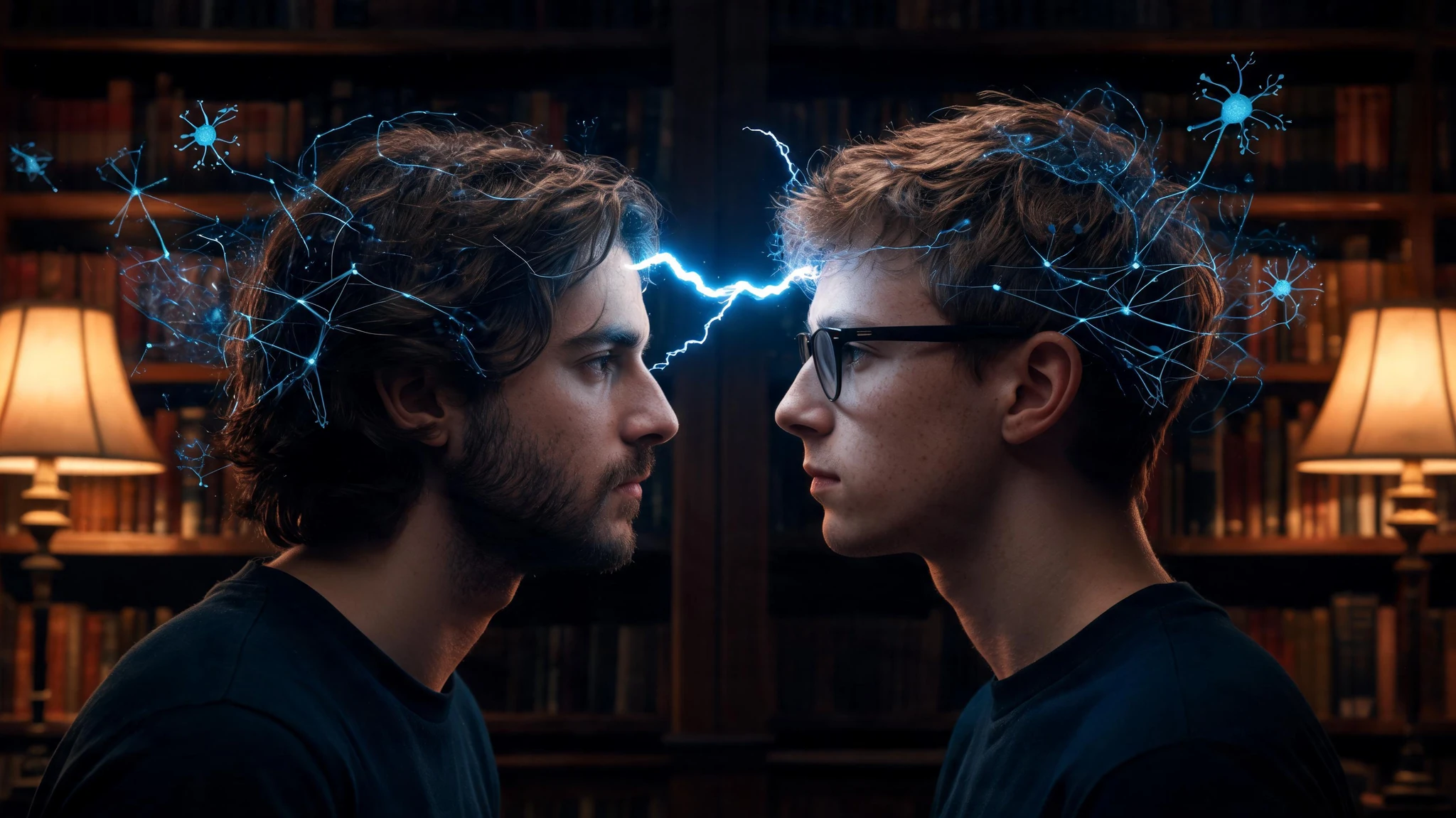
When two people who love each other sit down to talk, their brains may quietly fall into step. A 2024 meta-analysis pooling 17 hyperscanning studies and more than 1,100 pairs of participants found that close partners, friends, parents and children, romantic couples, show measurably synchronized activity across the frontal, temporal, and parietal cortex during real social interaction.1 The effect was small to moderate, but it was consistent enough to survive pooling across very different labs, tasks, and cultures.
The finding, published by Zhao and colleagues in Neuroscience and Biobehavioral Reviews, is not a claim that minds merge or that closeness can be measured with a brain scanner.1 It is something quieter and, in a way, more interesting. It says that the felt sense of being on the same wavelength as someone you love appears to track an actual biological wavelength, picked up from outside the skull, while the conversation is still happening.
What is interpersonal neural synchronization?
Interpersonal neural synchronization, sometimes shortened to INS, is a fairly literal term. Two people are wired up at the same time with overlapping brain-activity recorders, usually functional near-infrared spectroscopy (fNIRS) caps that read blood-oxygen changes through the scalp, sometimes EEG. They do something together. Talk. Solve a puzzle. Build a tower. Sing. The researchers then look at whether the time courses of activity in matched regions of the two brains track each other more closely than chance would predict.
When the two brains do track each other, that’s synchronization. The technique that makes this possible is called hyperscanning, and it’s only about two decades old. fNIRS hyperscanning in particular is what made studies of natural conversation feasible, because the caps are light, tolerate movement, and don’t require lying motionless in an MRI bore. You can put them on a parent and a toddler, or on two friends across a table, and let them just be.
Synchrony, in this literature, is not the same as identical activity. It means that when one person’s prefrontal cortex ramps up, the other person’s matched region tends to ramp up shortly after, or in step, or in a predictable inverse pattern. The relationship is statistical, not magical, and researchers spend a lot of effort ruling out artifacts like both brains simply responding to the same external cue.
What the 2024 meta-analysis actually found
Zhao and colleagues screened the published fNIRS hyperscanning literature on close relationships and pooled results across 17 studies covering parent-child dyads, romantic couples, friends, and other close pairs.1 The headline number, more than 1,100 pairs, refers to the combined sample, which is large for a hyperscanning meta-analysis given how labor-intensive the method is.
Three regions stood out. The prefrontal cortex, particularly the medial and lateral prefrontal areas often linked to mentalizing, showed reliable synchrony. The temporo-parietal junction, a region associated with taking another person’s perspective, also synced up. So did parts of the inferior frontal cortex involved in language and gesture coordination. Effects were stronger when the interaction was face-to-face and free-flowing, weaker when partners were separated or asked to do strictly parallel tasks.1
The authors are careful in how they frame this. They do not claim INS measures the depth of love. They argue that emotionally close pairs show a reliable biological signature of mutual attunement during interaction, and that this signature is plausibly part of how human bonding works at the level of the brain.

Why do brains do this in the first place?
The leading explanation comes from predictive-processing theories of social cognition. Brains are forecasters. Yours spends a lot of energy guessing what’s about to happen next, including what the person in front of you is about to say, do, or feel. When two people know each other well, those forecasts are unusually accurate and run in both directions at once. You predict her, she predicts you, and the predictions feed back into your behavior in real time.
That mutual-prediction loop is one candidate mechanism for synchrony. If both brains are running similar models of the same unfolding interaction, their activity in social-cognition regions should look alike, because both are computing similar things at similar moments. Researchers like Nozawa and colleagues argued early on that fNIRS hyperscanning of natural group conversation captures exactly this kind of frontopolar coordination, with synchronization rising and falling with the conversational turn-taking itself.2
A second piece is sensorimotor coupling. Couples who have been together a long time often move alike. They mirror posture, match breathing, walk in step. Hyperscanning studies of joint motor tasks suggest that synchronized action is accompanied by synchronized brain activity in motor and parietal regions, and that the two go up and down together rather than one driving the other.4 Whether this is the body pulling the brain along or the brains pulling the bodies into rhythm is still being argued.
It is not just close relationships
One useful sanity check on the close-relationship finding is that brain synchrony also shows up, in different patterns, in other kinds of meaningful interaction. A 2022 meta-analysis of teacher-student hyperscanning studies found a reliable INS effect, with stronger synchrony predicting better learning outcomes.3 The mechanism there is not romantic attachment. It’s joint attention, shared goals, and the ordinary work of one mind helping another mind catch up.
The pattern goes the other way too. In a 2022 NeuroImage study of small groups asked to work together on creative tasks, synchrony actually decreased in some regions during the most generative moments and increased in others, suggesting that creative collaboration is not a simple “more sync, more good” story.5 Sometimes coordination helps. Sometimes the group needs each brain to wander off and come back with something the others didn’t expect.
Put together, these strands suggest INS is best understood as a marker of coordinated cognitive engagement, not as a love meter. In a close relationship, that engagement happens to look warm. In a classroom, it looks like learning. In a brainstorming session, it can even look like friction.

What it might feel like from the inside
Most people don’t need a fNIRS cap to notice the experience the science is pointing at. There’s the conversation that runs almost without effort, the friend who finishes your sentence and gets the joke before the punchline, the kid who reaches for your hand at the exact moment you reach for theirs. There’s also the opposite, the dinner where every exchange feels half a beat off, where you both keep apologizing for talking over each other.
If you’ve felt that contrast, you’ve felt the thing INS researchers are trying to measure. The science doesn’t promise that strong synchrony equals a good relationship, and weak synchrony equals a bad one. Plenty of close pairs argue, miss each other’s cues, and come back together. But it does suggest that the felt difference between flowing and stuck conversations isn’t only psychological. There’s a neural rhythm under it, and that rhythm is shared.
One useful caution. The studies are correlational. Researchers can show that pairs who report feeling close synchronize more, on average, during certain tasks. They cannot yet show that nudging up your synchrony tonight will make your marriage warmer next year. The arrow of cause is still being worked out, and honest researchers say so.
How researchers actually measure it
The dominant tool in this corner of neuroscience is fNIRS, which uses harmless near-infrared light shone through the scalp to track changes in oxygenated and deoxygenated hemoglobin. Where blood flow rises, neural activity probably rose a few seconds earlier. The caps look like soft swim caps studded with small sensors. Two people wear them simultaneously, and the recorders are time-locked so the signals can be compared moment by moment.
To turn raw signals into a synchrony number, researchers typically use wavelet coherence or correlation across matched channels, then test whether the observed coupling is stronger than what you’d see in shuffled “pseudo-pair” data, where each participant is paired with a stranger from another session. The pseudo-pair comparison is what separates real interpersonal coupling from coincidence, and it’s the step that makes the field’s claims defensible. The Zhao meta-analysis required this control, or an equivalent one, in every study it pooled.1
fNIRS has limits. It only reads cortex, not deeper structures like the amygdala or hippocampus. Spatial resolution is modest. The signal is slower than EEG. Within those limits it is, at the moment, the best practical tool for studying two interacting brains in something close to a normal social setting.

What it doesn’t mean
It is worth saying plainly what this research is not. It’s not telepathy. It’s not evidence that thoughts pass directly between people. It’s not a quantifiable score for how much you love your partner, and any product that claims to read your relationship through a headband is overselling.
It also doesn’t say that low-synchrony couples are doomed or that high-synchrony couples are saints. Effect sizes in the meta-analysis were modest, individual variation was substantial, and many factors that affect a relationship, kindness, conflict-repair skill, shared values, financial stress, never show up on a brain scan at all.1
The honest takeaway is narrower and, to my mind, lovelier. When you and someone you love are deeply engaged in the same moment, your brains are doing something measurably together. You’re not just imagining the connection. There’s a faint physical fingerprint of it on the cortex, and a small, careful international literature is slowly learning to read it.
Common questions about brain synchrony in close relationships
Can I increase synchrony with my partner on purpose?
Probably, indirectly. Activities that promote joint attention and turn-taking, real conversation without phones, shared tasks with eye contact, music or movement done together, reliably produce stronger INS in lab studies. Whether deliberately chasing synchrony improves a relationship is unproven. Doing things that happen to produce it tends to be good for couples for other, well-established reasons.
Does brain sync show up in long-distance relationships?
The strongest effects in the meta-analysis required face-to-face interaction.1 A handful of studies have looked at remote video calls and found weaker but detectable synchronization. Distance dampens the signal, but it does not erase it.
Do parents and infants synchronize too?
Yes, this is one of the most-studied subgroups. Parent-child INS appears early, shifts with the child’s age, and is sensitive to caregiver attunement. The Zhao meta-analysis treats parent-child pairs as one of the core close-relationship categories.1
Is synchrony always a good thing?
No. Some studies show synchrony rising during conflict as well as connection, and creative collaboration sometimes works better with desynchronized phases.5 The healthier read is that synchrony is a sign of engagement, and engagement can be loving, tense, or productive.
Is this finding replicated?
The 17-study meta-analysis is itself a replication exercise across labs, samples, and cultures, and the cross-task signal it surfaces is part of what makes the result trustworthy.1 The field is still young, individual studies vary, and more pre-registered work is needed.
A small thing to sit with
Most of the science of love runs on questionnaires, behavior, and self-report. That’s fine, and it has produced a lot of what we know. The hyperscanning literature is something different. It says that when two people who matter to each other talk, the matter of their brains briefly behaves as a coupled system. Not fused. Not identical. Coupled, the way two pendulums on the same shelf will, given enough time, start to swing in step.
Whatever else closeness is, it appears to have this quiet physical signature, hidden under skin and bone, audible only with a few thousand dollars of optical equipment and a patient research assistant. The next time a conversation with someone you love feels effortless, it might be worth knowing that some part of what you’re feeling has, for a moment, been seen.
Sources
- Zhao Q, Zhao W, Lu C, Du H, Chi P. Interpersonal neural synchronization during social interactions in close relationships: A systematic review and meta-analysis of fNIRS hyperscanning studies. Neuroscience and Biobehavioral Reviews, 2024. PubMed: 38295965
- Nozawa T et al. Interpersonal frontopolar neural synchronization in group communication: An exploration toward fNIRS hyperscanning of natural interactions. NeuroImage, 2016. PubMed: 27039144
- Zhang L et al. Interpersonal Neural Synchronization Predicting Learning Outcomes From Teaching-Learning Interaction: A Meta-Analysis. Frontiers in Psychology, 2022. PubMed: 35295390
- Dai R et al. Holistic cognitive and neural processes: a fNIRS-hyperscanning study on interpersonal sensorimotor synchronization. Social Cognitive and Affective Neuroscience, 2018. PubMed: 30321411
- Liang Z et al. Increased or decreased? Interpersonal neural synchronization in group creation. NeuroImage, 2022. PubMed: 35843516