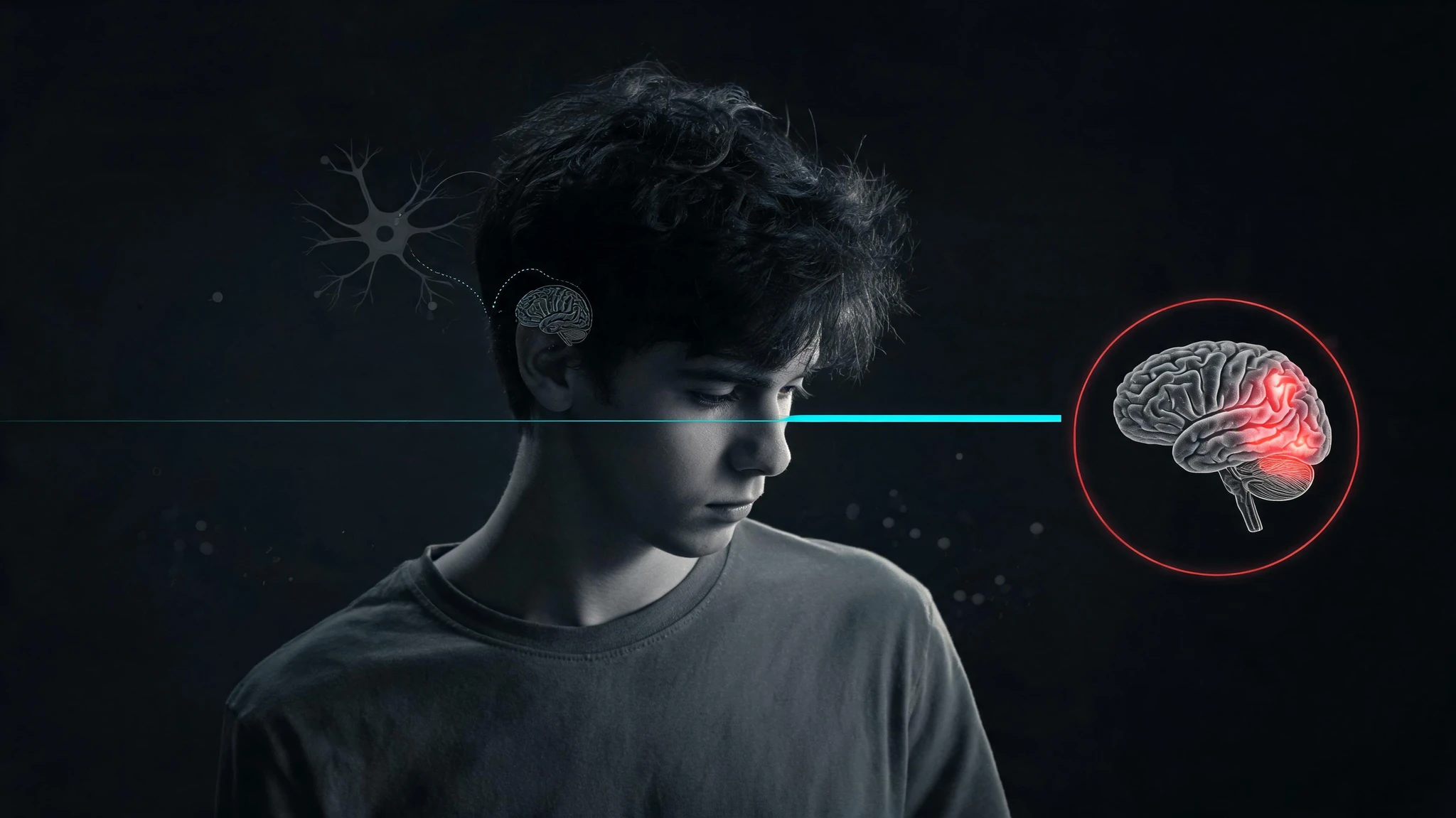
People who became socially isolated in adulthood had brains that scanned about 1.73 years older than peers who stayed connected, according to a 2023 longitudinal study by Lay-Yee and colleagues in Psychological Medicine.1 The study tracked a large birth cohort over decades, then estimated each participant’s “brain age” from MRI scans in midlife.
That figure is small compared to the four-year claim circulating on social media, and the difference matters. The science here is solid in outline but easily mangled in transit. The viral version makes loneliness sound like a sudden cliff. The actual data describe a slow drift, statistically detectable, biologically plausible, and almost certainly reversible at the margin.1
What the 2023 study actually found
Lay-Yee and colleagues used the Dunedin Study, one of the longest-running birth cohorts in the world, which has followed a group of New Zealanders born in the early 1970s from childhood into their forties.1 Participants were assessed at multiple points for social isolation, including how often they saw friends and family, whether they lived alone, and whether they reported close confidants.
At age 45, the cohort underwent structural MRI. Researchers fed those scans through a brain-age estimation model trained on thousands of healthy adults, which predicts a person’s age from features like cortical thickness, grey-matter volume, and white-matter integrity. The gap between predicted age and actual age is what scientists call brain-age gap, and it is the field’s best current shorthand for “older-than-expected biological brain.”
People who had become socially isolated as adults, defined by accumulated patterns over the cohort’s twenties, thirties, and forties, scored an average of 1.73 years older than peers who stayed connected.1 Childhood-only isolation showed no clear association with adult brain age once researchers controlled for later-life factors. The strongest signal sat with isolation that persisted into adulthood, especially when it overlapped with other stressors.
That is not nothing. A 1.73-year structural difference, observed across hundreds of people from the same birthplace and similar early environments, is the kind of effect that emerges only when something real is going on. It is also not a sentence. It is a nudge in one direction across a population, with wide individual variation hiding behind the average.
Where did the “four years” headline come from?
The four-year figure, which has been pasted across reels and listicles for the last two years, traces back to preliminary, unadjusted readouts of similar datasets. In some early models, before researchers controlled for socioeconomic status, depression, physical health, and cardiovascular risk, the gap between isolated and connected groups looked closer to three or four years.
Once the controls were applied, much of that gap absorbed into the other variables. Loneliness clusters with poor sleep, less exercise, more smoking, untreated depression, and chronic illness, all of which independently age the brain. Strip those out, and the residual signal attributable to isolation itself was smaller. The 1.73-year figure is what survived adjustment in the published version. It is the more honest number.1
The Framingham Heart Study group, working in a different cohort, found broadly similar patterns. Tao and colleagues reported in EClinicalMedicine that different types of loneliness, including emotional and social loneliness, were linked to specific differences in cognitive scores and grey-matter volume in midlife participants.2 The effect sizes were modest. The direction was consistent.
Why might isolation change the brain at all?
Two mechanisms keep coming up in the literature, and neither is exotic.
The first is the stress-cortisol-hippocampus pathway. Chronic loneliness functions as a low-grade, long-duration stressor. Cortisol, the body’s main glucocorticoid, gets released in pulses throughout the day under normal conditions and surges when we feel threatened. The hippocampus, a curved structure in each temporal lobe central to memory and spatial navigation, is densely packed with cortisol receptors. In animal models, prolonged exposure to high cortisol shrinks dendritic branches, reduces neurogenesis in the dentate gyrus, and impairs the kind of memory tasks the hippocampus runs.4,5
Holmes and colleagues, working with aged female mice after stroke, showed that social isolation specifically reduced cell proliferation in the dentate gyrus and shifted microRNA expression patterns in ways that mirror accelerated aging.5 Rivera’s group, in a separate model using long-lived rodents, found that long-term isolation altered behavioral performance and changed the levels of social-affective proteins in brain tissue, and that re-socializing the animals partially reversed those changes.4 Animal models are not human models, but they show the mechanism is real and that the brain is, to some extent, listening to who you spend time with.

The second mechanism is cognitive disuse. A conversation is not a calm activity for the brain. Reading a face, predicting what someone is about to say, recalling shared history, holding two threads of meaning at once, and adjusting tone in real time light up the prefrontal cortex, the temporal lobes, the cingulate, and parts of the cerebellum. Strip out those interactions for years, and the circuitry that runs them gets less practice. Like any underused tissue, it slowly thins.
Imaging studies in lonely older adults have shown reduced volume in regions tied to social cognition, including parts of the prefrontal cortex and the temporal pole.2 Whether the volume difference comes first and predisposes someone to isolation, or whether isolation drives the difference, is a chicken-and-egg question the field has not fully answered. Probably both.
There is a third, quieter mechanism worth naming: sleep. Lonely adults sleep worse on average. They wake more often, spend less time in slow-wave stages, and report poorer subjective quality. Sleep is when the brain runs its glymphatic clearance, flushing out metabolic byproducts including beta-amyloid. Years of fragmented sleep look, on imaging, a lot like years of low-grade isolation. The two probably feed each other. A person who feels unsafe, in the social-evolutionary sense, sleeps as if a predator might come through the door. The brain pays a small bill for that vigilance every night.
How serious is this for memory and dementia risk?
This is where careful reading matters. A 2023 systematic review and meta-analysis by Harrington and colleagues in the Journal of Alzheimer’s Disease pooled data from dozens of studies of older adults without dementia and found that loneliness was associated with worse global cognition and faster cognitive decline, particularly in memory and executive function.3 The associations were small to moderate.
What that meta-analysis cannot do is prove causation. People who are lonely tend to also be widowed, depressed, in worse physical health, more likely to live alone in unsafe neighborhoods, and less likely to attend regular medical appointments. Each of those conditions has its own relationship with cognitive decline. Picking apart the unique contribution of loneliness from the bundle is genuinely hard.
What the evidence does support, fairly cleanly, is this: chronic, persistent loneliness in adulthood is a modest but real risk factor for accelerated brain aging, and a modest contributor to cognitive decline. It is not a death sentence. It is closer in size to the risk you take on by sleeping six hours instead of seven, or by skipping moderate exercise.1,3

Solitude is not the same as isolation
The data describe people whose lives lacked meaningful contact with others, not people who like quiet evenings. Introversion, in particular, is a temperament. It is not a clinical risk factor. Many introverts have one or two close friends, an active text thread, and a satisfying inner life, and the studies do not flag them.
The signal that matters is closer to what gerontologists call structural isolation stacked on top of perceived loneliness. The first is whether you actually see people. The second is whether you feel connected to anyone. Both contribute, and the combination appears to be the most damaging.2
One of the more interesting findings in the Framingham work is that emotional loneliness, the absence of a confidant, and social loneliness, the absence of a wider network, lit up partly different brain patterns.2 A retiree with a strong marriage but no friends, and a single person with many acquaintances but no one who knows them well, may both be lonely. They are not the same kind of lonely.
What appears to help
The honest answer is that randomized trials of “more friends” are scarce, for obvious logistical reasons. But several adjacent literatures point in a hopeful direction.
Re-socialization, in the rodent studies, partially reversed brain protein changes after long isolation.4 In humans, joining group activities, taking up a class, volunteering, and rebuilding contact with one or two specific people are the interventions most studied as buffers against late-life cognitive decline. They are also the interventions most likely to be funded, because they are cheap. The active ingredient appears to be regular, real interaction with people who recognize you, not the number of contacts in a phone.

It is also worth taking the small wins seriously. A weekly phone call with a sibling. A standing coffee with a neighbor. A book club that meets eight times a year. None of these will look impressive on a fitness tracker, and none of them have been shrink-wrapped into a wellness product, which is partly why they work. They impose just enough structure that the brain has something to chew on.
Researchers who study late-life cognition have started talking about “third places,” the term sociologist Ray Oldenburg used in the 1980s for the spots that are neither home nor work: the diner, the library, the church basement, the chess corner of the park. The data on third places and brain health are observational, not randomized, but the pattern is consistent. People who have one or two of these spots tend to age better cognitively than people who do not. The location matters less than the regularity. Showing up at the same place at the same time each week appears to do something for the brain that a calendar full of one-off events does not.
Therapy and treatment for underlying depression also belong on the list, even though they are rarely framed as brain-aging interventions. Untreated depression and chronic loneliness overlap heavily, and treating the depression appears to lift some of the cognitive penalty independently. If loneliness has tipped into something heavier, the social-prescription approach is not enough on its own.
Common questions about loneliness and brain aging
Does loneliness cause Alzheimer’s disease?
No single study shows loneliness causes Alzheimer’s. It is one of several modifiable factors associated with higher risk, alongside hearing loss, untreated depression, and low physical activity. Treating it likely lowers risk by a small to moderate amount.3
How quickly can the effect reverse?
That is not well established in humans. Animal data show partial recovery within weeks of re-socialization. In people, the working assumption is that consistent, meaningful contact over months helps, and that gains in cognitive performance can show up within a year of joining a group activity.4
Is living alone the same as being isolated?
No. Many people who live alone are densely connected. The risk shows up when living alone overlaps with rare contact, no close confidants, and self-reported loneliness lasting years.
Does video calling count?
The studies suggest some benefit, less than in-person contact, more than texting. The brain regions that handle social cognition seem to engage more fully with a real face and voice than with text alone.
What if I genuinely prefer being alone?
Preferring solitude is fine. The risk pattern shows up when isolation is unwanted and persistent. If you feel content, the data do not say you should change.
The realistic takeaway
The headline number is 1.73 years, not four. The mechanism is real and biological, not metaphorical. The size of the effect is modest, comparable to other lifestyle exposures we already accept. And the most useful response is not panic, it is small habits. A standing call. A weekly walk with someone. A class you keep showing up to.
Loneliness changes the brain, slowly, and not always permanently. The same neighborhoods of cortex that go quiet in isolation are the ones that respond when someone you know walks through the door. That is worth a phone call this week.
Sources
- Lay-Yee R, Hariri AR, Knodt AR, Barrett-Young A, Matthews T, Milne BJ. Social isolation from childhood to mid-adulthood: is there an association with older brain age? Psychological Medicine (2023). PubMed: 37485695
- Tao Q, Akhter-Khan SC, Ang TFA, DeCarli C, Alosco ML, Mez J, et al. Different loneliness types, cognitive function, and brain structure in midlife: Findings from the Framingham Heart Study. EClinicalMedicine (2022). PubMed: 36105871
- Harrington KD, Vasan S, Kang JE, Sliwinski MJ, Lim MH. Loneliness and Cognitive Function in Older Adults Without Dementia: A Systematic Review and Meta-Analysis. Journal of Alzheimer’s Disease (2023). PubMed: 36617781
- Rivera DS, Lindsay CB, Oliva CA, Bozinovic F, Inestrosa NC. “Live together, die alone”: The effect of re-socialization on behavioural performance and social-affective brain-related proteins after a long-term chronic social isolation stress. Neurobiology of Stress (2021). PubMed: 33426200
- Holmes A, Xu Y, Lee J, Maniskas ME, Zhu L, McCullough LD, Venna VR. Post-Stroke Social Isolation Reduces Cell Proliferation in the Dentate Gyrus and Alters miRNA Profiles in the Aged Female Mice Brain. International Journal of Molecular Sciences (2020). PubMed: 33374156