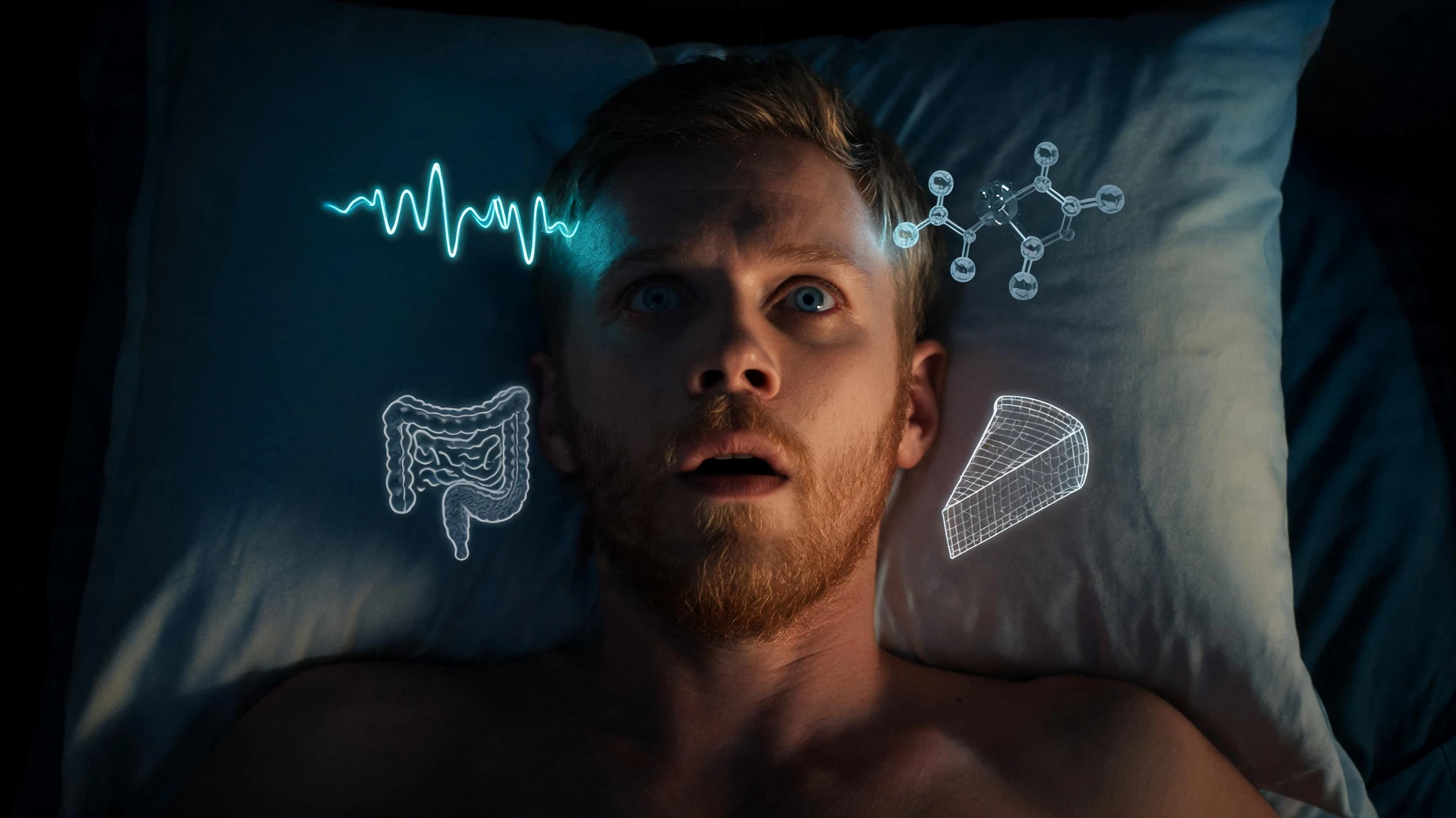
A new survey of more than 1,000 adults found that people who eat dairy or sweets close to bedtime report stranger, more disturbing dreams, and the effect was strongest in those with food sensitivities like lactose intolerance.1 The work comes from Tore Nielsen and colleagues at the University of Montreal, published in Frontiers in Psychology in 2025, and it gives a careful update to a folk belief that goes back more than a century.
Sweets were blamed by 31 percent of respondents for changes in their dreams. Dairy came second at 22 percent.1 The headline is not that cheese causes nightmares for everyone. It is that for a meaningful slice of people, the gut and the dreaming brain seem to be talking to each other after lights out.
What did the study actually measure?
Nielsen’s team surveyed 1,082 university students about their sleep, their diets, their food intolerances, and their dream lives. They asked which foods, if any, the participants believed had given them nightmares or particularly vivid dreams. They also collected scores for food allergies, lactose intolerance, and other gastrointestinal complaints.1
Two patterns stood out. First, people with worse food sensitivities reported worse sleep and more disturbing dreams. Second, the foods most often named as dream-altering were the same ones that tend to produce gut symptoms in sensitive people, with dairy at the top of the list. The authors call the paper “More dreams of the rarebit fiend” as a nod to Dream of the Rarebit Fiend, an early 1900s comic strip in which a character ate cheese-on-toast at night and was plagued by surreal nightmares. The folk wisdom turns out to be partly right, just for a more boring reason than the comic suggested.
One important caveat sits in the methods. This was a survey. Participants self-reported what they ate, what they dreamed, and how their guts behaved. No one was woken in a sleep lab and asked for a dream report after a controlled cheese plate. Self-reported data is useful for spotting patterns at scale, but it cannot tell you whether the cheese caused the nightmare or whether someone who already sleeps badly is more likely to remember a bad dream and blame the snack.
The gut-to-dream pipeline, in plain English
The mechanism the authors propose is not mystical. If a food does not agree with you, your gut reacts. That reaction does not stop just because you fell asleep. Bloating, cramping, reflux, gas, and small temperature shifts can all push the brain toward lighter, more fragmented sleep. Lighter sleep means more time in REM, the stage where most vivid dreaming happens, and more frequent micro-awakenings, which are when you are most likely to remember a dream.
A 2016 randomized study by Marie-Pierre St-Onge and colleagues at Columbia University showed how sensitive sleep is to what you eat. People who ate more saturated fat and less fiber had less slow-wave sleep, the deep restorative kind, and woke up more often during the night.2 That study did not look at dreams, but it did establish that diet shifts the architecture of a single night of sleep, not just long-term averages.

So when a lactose-intolerant person eats a bowl of ice cream at 10 p.m., a chain of small events follows. Undigested lactose ferments in the colon. Gas builds. Mild discomfort triggers brief arousals. The brain, sitting in REM, weaves whatever signal reaches it into the story it is already telling itself. Sometimes that signal becomes a chase scene. Sometimes it becomes a dream about being trapped, or about teeth falling out, or about a building tilting sideways. The narrative is invented. The discomfort is real.
Sleep researchers call this kind of bodily signal “somatic incorporation.” A bladder that needs emptying becomes a dream about waterfalls. A cold foot becomes a dream about walking through snow. The Nielsen paper extends that idea down into the gut, which is the largest sensory surface most people never think about and a nightly broadcaster of low-grade signal even on quiet nights.1
Why dairy and sweets, specifically?
Dairy is an obvious suspect because lactose intolerance is genuinely common. Roughly two-thirds of the world’s adults lose the ability to fully digest lactose after early childhood, with rates much higher in East Asian, West African, and Indigenous American populations and lower in those of Northern European descent. For these people, a glass of milk or a slice of pizza late in the evening is a near-guaranteed way to start producing gas in the small hours.
Sweets are a different story. Sugar itself usually digests fine. The issue with a sugar-heavy snack at night is the blood-sugar curve that follows. A spike in glucose is followed, ninety minutes later, by an insulin-driven dip. That dip can wake you up, or pull you out of deep sleep into REM. People who track their continuous glucose monitors often see this pattern: dessert at 10 p.m., a 3 a.m. wake-up, a fragmented second half of the night.
The Nielsen survey could not separate “this food made me dream” from “this food made me sleep badly and remember more dreams as a result.”1 Both routes lead to the same headline. Both routes also point to the same advice: if your dreams have gotten weirder, look at what you are eating in the three hours before bed.
How meal timing rewires your night
The bigger picture here belongs to a field called chrono-nutrition, which studies how the timing of meals interacts with the body’s internal clock. A 2018 review by Gerda Pot in Proceedings of the Nutrition Society pulled together the evidence and reached a fairly direct conclusion: eating late, eating heavy, and eating irregularly are each associated with poorer sleep quality, even in people without diagnosed sleep disorders.3
Part of this is mechanical. Lying flat with a full stomach pushes acid back up into the esophagus and slows gastric emptying. Part of it is hormonal. The stress hormone cortisol, which normally drops to its lowest point in the first half of the night, can be pushed back up by a big meal. A 2016 review in Advances in Nutrition by Pistollato and colleagues mapped out how diet, cortisol, and sleep feed back into one another.4 Heavy late meals nudge cortisol higher, higher cortisol fragments sleep, and fragmented sleep makes the next day’s food choices worse.

None of this means a 9 p.m. snack is dangerous. It means the body would prefer that the snack be small, mostly plain, and finished at least two hours before you lie down. That is a much softer rule than “never eat after 7 p.m.,” which most people cannot keep anyway.
Is it a nightmare or just a vivid dream?
The two are easy to confuse. A nightmare is a dream so frightening or unsettling that it wakes you up and leaves a mark for several minutes afterward. A vivid dream is just one you can remember in detail. Both seem to cluster around lighter REM sleep in the second half of the night, which is exactly where late-night digestion likes to interfere.
People with irritable bowel syndrome, who have one of the most documented overlaps between gut symptoms and disturbed sleep, give a useful natural experiment. A 1998 study in Nursing Research by Margaret Heitkemper and colleagues used polysomnography, the gold-standard sleep recording, and found that women with IBS showed more REM sleep and reported worse sleep quality than healthy controls.5 More REM means more chances for memorable, emotional, sometimes disturbing dream content. The pattern fits.
It also fits with what Nielsen’s 2025 paper found at the population level. The people most likely to blame food for their nightmares were the people whose guts were most likely to talk back at night.1,5
What you can actually do this week
Start by treating it as detective work, not a diet overhaul. For seven nights, keep a small note in your phone. Write down what you ate after 7 p.m., when you went to bed, how many times you woke up, and one sentence about whatever you remember dreaming. Patterns usually surface within a week.
If dairy keeps showing up before disturbed nights, try a two-week experiment. Move dairy to earlier in the day. Keep everything else the same. If the dreams calm down, you have your answer, and you can decide whether to test lactose-free alternatives or simply move your yogurt to breakfast. The point is not to swear off cheese forever. The point is to find the version of your routine that lets you wake up rested.

Sweets deserve a similar test. Move dessert to lunch or the early afternoon, when an insulin response will not collide with your sleep architecture. If you crave something at night, try a small portion of plain protein and a piece of fruit instead of cake or ice cream. Many people find this single swap quiets both the late-night cravings and the strange dreams within a week or two.
For everyone, two practical rules cover most of the benefit. Finish your last real meal at least two to three hours before bed. Drink water rather than sugary or alcoholic drinks in the final hour. The Pot review and the St-Onge trial both support these as low-cost, high-yield habits.2,3
Common questions about food and dreams
Does cheese specifically cause nightmares?
Cheese has a reputation older than the science. The new Nielsen survey suggests dairy is associated with disturbing dreams, especially in lactose-intolerant people, but cheese is not uniquely guilty. Any food that gives your gut a hard time at night can do the same thing.1
Why do my dreams feel more intense after a heavy meal?
Heavy meals before bed shift cortisol, slow gastric emptying, and increase the number of micro-awakenings during REM, which is where most vivid dreaming happens. You are not dreaming more. You are remembering more of what you dream because you are sleeping more lightly.3,4
Are nightmares a sign of a serious health problem?
Occasional nightmares are normal and not a red flag. Chronic, frequent nightmares that disrupt your daytime functioning are worth a conversation with a clinician, particularly if they started after a stressful event or alongside other sleep symptoms.
What about alcohol?
Alcohol fragments REM sleep and produces a known rebound in the second half of the night, which is exactly when nightmares are most likely. A nightcap is one of the more reliable ways to wake up at 4 a.m. with a strange story in your head.
Will switching to a “sleep-friendly” snack actually work?
For some people, yes. A small bowl of oats, a banana, or a glass of warm water with a few almonds tends to be gentle on digestion and gentle on glucose. The Nielsen survey did not test specific swaps, but the broader chrono-nutrition literature supports lighter, earlier evening eating.3

Listening to a quieter signal
Sleep research is full of stories where the body has been trying to say something obvious and people have been politely ignoring it. The Nielsen team’s contribution is to take a folk observation about cheese and bad dreams and show, in modern survey form, that there is something to it. Not magic. Not curse. Just a sensitive gut talking to a sleeping brain through the only channel still open at 3 a.m.
If your dreams have gotten louder lately, the kindest first move is to look at the plate, not the pillow. A small change in what you eat in the last three hours of the day will tell you, within a week, whether your nights have been responding to your dinner all along. The cheese plate is not the villain. Your sleeping body is just being honest about what it can handle.
Sources
- Nielsen T, Radke J, Picard-Deland C, Powell RA. More dreams of the rarebit fiend: food sensitivity and dietary correlates of sleep and dreaming. Frontiers in Psychology. 2025;16:1544475. PubMed: 40667395
- St-Onge MP, Roberts A, Shechter A, Choudhury AR. Fiber and Saturated Fat Are Associated with Sleep Arousals and Slow Wave Sleep. Journal of Clinical Sleep Medicine. 2016;12(1):19–24. PubMed: 26156950
- Pot GK. Sleep and dietary habits in the urban environment: the role of chrono-nutrition. Proceedings of the Nutrition Society. 2018;77(3):189–198. PubMed: 29065932
- Pistollato F, Sumalla Cano S, Elio I, Masias Vergara M, Giampieri F, Battino M. Associations between Sleep, Cortisol Regulation, and Diet: Possible Implications for the Risk of Alzheimer Disease. Advances in Nutrition. 2016;7(4):679–689. PubMed: 27422503
- Heitkemper M, Charman AB, Shaver J, Lentz MJ, Jarrett ME. Self-report and polysomnographic measures of sleep in women with irritable bowel syndrome. Nursing Research. 1998;47(5):270–277. PubMed: 9766455