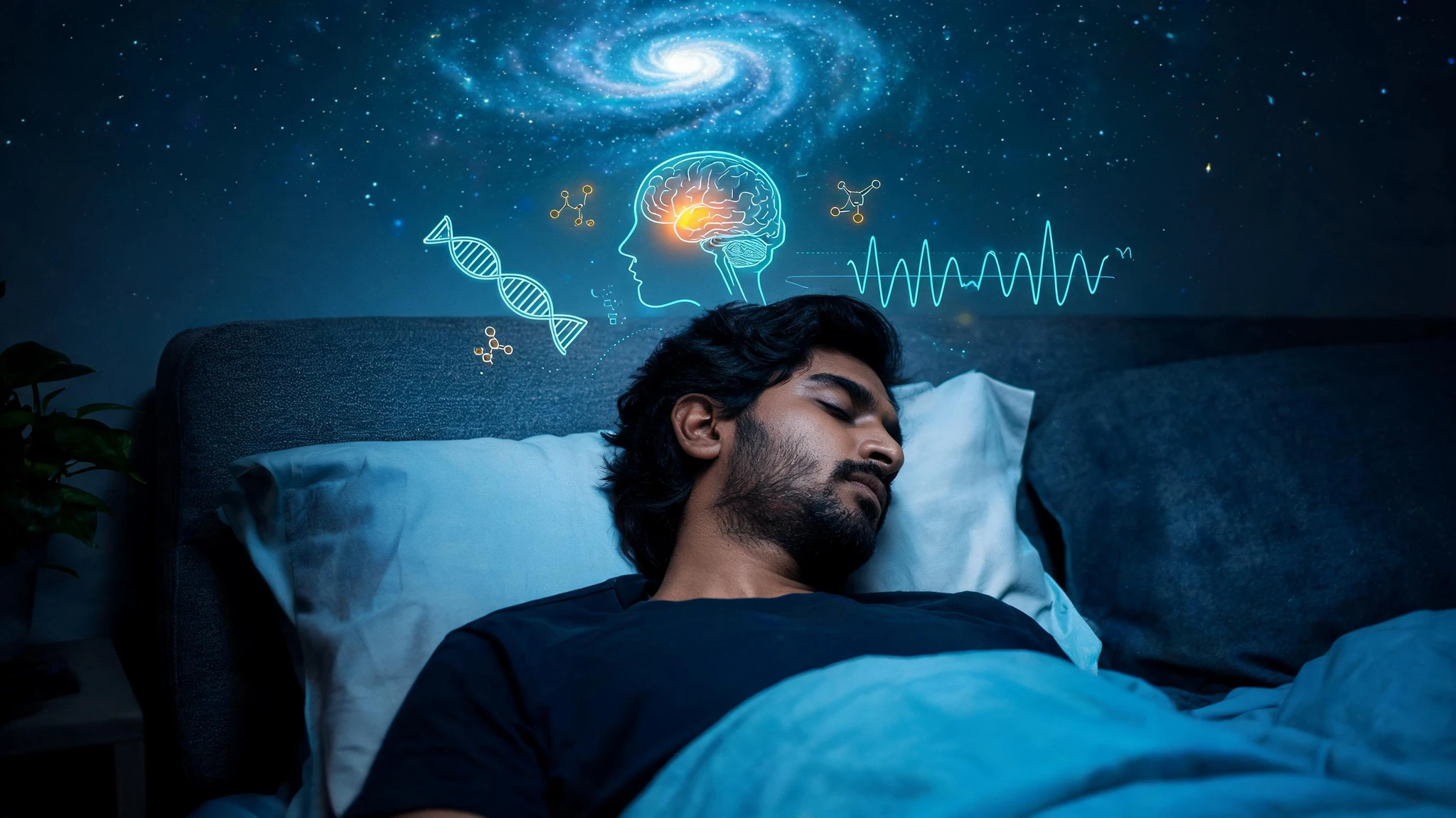
People who struggle to fall or stay asleep carry roughly double the odds of developing depression later, according to a 2011 meta-analysis of 21 longitudinal studies by Baglioni and colleagues at the University of Freiburg, published in the Journal of Affective Disorders.1 The pooled odds ratio across more than 76,000 participants came in at about 2.10. Put plainly, insomnia is not just a symptom that tags along with low mood. It often arrives first.
The good news landed a decade later. In 2021, a team led by Alexander Scott at the University of Sheffield pooled 65 randomized controlled trials of sleep interventions and reported that fixing sleep produced a moderate, statistically significant lift in mental health, with the largest gains in depression scores.2 The effect was dose-responsive: bigger sleep improvements tracked bigger mood improvements.
What does the evidence actually say about sleep and depression?
The Baglioni meta-analysis is the cleanest answer we have to the chicken-and-egg question. Cross-sectional studies have known for decades that depressed people sleep badly. Harder to know is which way the arrow points. Baglioni’s team only included prospective studies in which participants had insomnia at the start and were tracked for new-onset depression years later. Across that filter, insomniacs were about twice as likely to become depressed as good sleepers.1
The two-fold figure is a population average. Some subgroups in newer cohort work, particularly people with chronic, severe insomnia plus other risk factors, show steeper gradients. The viral claim that poor sleepers can be “up to ten times more likely” to experience depression refers to those high-risk subgroups in selected samples, not to the average insomniac, and it is worth holding loosely. The two-fold finding is what replicates.
What Scott’s 2021 review adds is a treatment-side answer. Across trials of cognitive behavioral therapy for insomnia, sleep hygiene programs, and sleep-focused digital tools, participants who slept better also reported less depression, less anxiety, less rumination, and fewer symptoms of psychosis-like thinking.2 The standardized mean difference for depression was around g = 0.63, which is in the moderate-to-large range for a behavioral intervention. That is comparable to a lot of antidepressant trial effects, with no pharmaceutical side-effect profile to manage.
Why does sleep have so much leverage on mood?
Three biological stories help explain why sleep changes mental health rather than just reflecting it. None is the whole picture. Together they hold up.
The first story is emotional regulation. In a 2007 study published in Current Biology, Seung-Schik Yoo, Matthew Walker, and colleagues kept healthy young adults awake for 35 hours and then put them in an fMRI scanner while they viewed escalating emotional images. The sleep-deprived brains showed a 60 percent increase in amygdala reactivity to negative stimuli compared to a rested control group, and the connection between the amygdala and the medial prefrontal cortex (the region that normally puts the brakes on emotional responses) was significantly weaker.4 The amygdala was also coupling more strongly with brainstem regions tied to fight-or-flight. A tired brain, in short, runs hotter and downshifts more slowly.

The second story is housekeeping. In 2013, Lulu Xie and Maiken Nedergaard’s lab at the University of Rochester published a striking Science paper showing that during sleep, the spaces between brain cells widen by about 60 percent, allowing cerebrospinal fluid to flush through and carry away metabolic waste, including beta-amyloid.3 They called this the glymphatic system. Clearance of injected radiolabeled beta-amyloid was roughly twice as fast in sleeping mice as in awake ones. Whether the same exact rates hold in humans is still being worked out, but the principle (sleep is when the brain takes out its trash) has held up across follow-up studies. If clearance lags night after night, the molecular environment of mood-regulating circuits drifts.
The third story is inflammation. A 2016 systematic review by Michael Irwin and colleagues at UCLA pooled 72 studies and found that sleep disturbance and very short sleep are associated with elevated levels of C-reactive protein and interleukin-6, two key markers of systemic inflammation.5 Long sleep was, oddly, also associated with higher inflammation, suggesting a U-shaped relationship rather than a simple “more is better” curve. Independent of that, experimental sleep deprivation in humans reliably bumps these markers within days. Inflammatory cytokines, in turn, are known to alter serotonin and dopamine signaling and to produce sickness behaviors that overlap heavily with depressive symptoms: low energy, social withdrawal, anhedonia, blunted appetite. The biology of “I feel rough” and “I feel depressed” runs through some of the same wires.
A reasonable summary across all three mechanisms: a tired brain processes negative input more sharply, clears its biochemical leftovers more slowly, and bathes itself in a slightly more inflammatory soup. Repeat that pattern for weeks or months and the conditions for a depressive episode become more fertile. None of these mechanisms are deterministic. They are tilts.
It is not just one study
It would be easy to dismiss any single finding above. The evidence base is bigger than that.
The UK Biobank cohort, which has tracked roughly half a million British adults since 2006, has produced a steady drip of analyses linking short or fragmented sleep to higher rates of depressive episodes, anxiety, and self-reported low mood. Genetic-based analyses inside Biobank have used Mendelian randomization, a method that exploits naturally randomized genetic variants influencing sleep traits, to argue that the insomnia-to-depression direction is at least partly causal rather than purely correlational. That work is consistent with the Baglioni picture and with Scott’s interventional one. Three different methods, pointing the same way, is harder to wave off than any one of them alone.

None of this proves sleep is the only lever. Genetics, early-life stress, social isolation, chronic pain, and substance use all matter, often more. But sleep sits in a useful spot: it is modifiable, it is measurable, and the trial evidence says interventions move the dial.2
One nuance that often gets lost. The Baglioni meta-analysis and the Scott meta-analysis are answering different questions, and both answers are important. Baglioni is asking, “If your sleep is broken, what happens to your future mental health?” Scott is asking, “If we fix the sleep, does mood respond?” The first is observational and tells you about risk. The second is experimental and tells you about treatment. When two methods designed to catch different errors agree on the direction of the effect, the underlying claim gets stronger. That is roughly where this field sits in 2026.
How much sleep, and what kind?
Most adults function best on seven to nine hours, with a fairly stable schedule. The viral image accompanying the source post for this article cited a 22 percent reduction in overall sadness for people in that range. Treat the exact number as directional rather than precise. The wider literature does support the shape of the claim: people sleeping in the seven-to-nine band consistently report better mood than chronic short sleepers (under six hours) and chronic long sleepers (over nine hours).5
Quality matters as much as duration. Two seven-hour nights are not equal if one was fragmented by anxiety, alcohol, or a noisy street. The cleanest behavioral lever, by a wide margin, is keeping consistent bed and wake times across weekdays and weekends. The second cleanest is protecting the last hour before bed: dim light, cooler room, no doomscrolling. Cognitive behavioral therapy for insomnia (CBT-I), now available through several validated apps and many therapists, is the first-line treatment for chronic insomnia in most international guidelines and accounted for a meaningful share of the trial evidence Scott’s team analyzed.2

Caffeine deserves a quick honest mention. Half of the caffeine in a 3 p.m. cup is still circulating at 9 p.m. for many people, and slow metabolizers (a sizable minority of the population, determined largely by a single liver enzyme variant) feel that residue much more strongly. If sleep is fragile, that single habit is often the highest-leverage one to test changing. A two-week experiment of cutting off all caffeine after noon costs nothing and tells you something useful. Alcohol is the other classic trap: it gets you to sleep faster and wrecks the second half of the night by suppressing REM and triggering middle-of-the-night cortisol rebounds. Many people who feel chronically unrested are not sleeping too little. They are sleeping while mildly intoxicated.
Light is the third lever, and the one most people underuse. Bright outdoor light in the first hour after waking helps anchor your circadian rhythm and makes it easier to feel sleepy at night. Even on a grey day, outdoor light is roughly ten to fifty times brighter than typical indoor lighting. A short morning walk, taken consistently, often outperforms supplements people try first.
What about people who are already depressed?
Here is where the framing matters. Sleep is not a substitute for treatment. Anyone with persistent low mood, loss of interest, or thoughts of self-harm should be talking to a clinician, full stop. What the evidence does suggest is that sleep is a useful adjunct, and sometimes a surprisingly powerful one.
Several randomized trials in Scott’s review tested sleep interventions in people who already had depression at baseline. They tended to show roughly the same direction of benefit as in healthy populations, sometimes slightly larger, with patients reporting fewer depressive symptoms by the end of treatment.2 A separate line of work suggests that residual insomnia after antidepressant treatment is one of the strongest predictors of relapse, which makes treating the sleep, even after the mood lifts, a sensible precaution.
The clinical posture, then, is “and” not “or”. Therapy and medication where indicated, and sleep treatment alongside, not instead. For mild or subclinical low mood, fixing sleep first is often a reasonable starting move, with the caveat that if it does not help within a few weeks, more help is warranted.
Common questions about sleep and depression
Does insomnia always lead to depression?
No. The doubled-risk figure means insomniacs are about twice as likely to develop depression as people without sleep difficulties, not that they will. Most people with insomnia do not develop a depressive episode, but the relative risk is high enough to take seriously.1
If I sleep more on weekends, does that fix weekday sleep loss?
Partially, and not as well as steady sleep. Catch-up sleep recovers some cognitive performance, but the irregularity itself shifts your circadian rhythm and tends to make Monday harder. A consistent schedule beats a binge-and-recover one.
How quickly do mood improvements show up after sleep gets better?
In trials, meaningful changes in depression and anxiety scores typically appear within two to eight weeks of consistent sleep improvement, with the dose-response pattern Scott’s group identified.2
Is sleeping ten or eleven hours actually fine?
Routinely sleeping more than nine hours, especially with grogginess on waking, is associated in epidemiological data with higher inflammation and worse mood, not better.5 If you genuinely need that much sleep most nights, it is worth discussing with a doctor.
Are sleep apps and trackers useful?
For motivation and pattern-spotting, yes. For diagnosis, no. Wearables overestimate deep sleep and miss apnea events. Treat the trends as informative and the absolute numbers as rough.

Where this leaves you
The point of the research is not that sleep is a magic cure. The studies are too varied and human nervous systems too different for any single lever to fix everything. The point is more modest, and more useful: sleep is one of the most powerful, most accessible, and most understudied levers in everyday mental health.
If your sleep has been fraying for months, that is worth treating in its own right, regardless of whether you also feel low. If you are already in the dip, sleep work is a reasonable second front to open while you address the rest. The body, as the old line goes, keeps the score. Some of the score is kept overnight.
Sources
- Baglioni C, Battagliese G, Feige B, Spiegelhalder K, Nissen C, Voderholzer U, Lombardo C, Riemann D. Insomnia as a predictor of depression: a meta-analytic evaluation of longitudinal epidemiological studies. Journal of Affective Disorders. 2011;135(1–3):10–19. PubMed: 21300408
- Scott AJ, Webb TL, Martyn-St James M, Rowse G, Weich S. Improving sleep quality leads to better mental health: A meta-analysis of randomised controlled trials. Sleep Medicine Reviews. 2021;60:101556. PubMed: 34607184
- Xie L, Kang H, Xu Q, Chen MJ, Liao Y, Thiyagarajan M, O’Donnell J, Christensen DJ, Nicholson C, Iliff JJ, Takano T, Deane R, Nedergaard M. Sleep drives metabolite clearance from the adult brain. Science. 2013;342(6156):373–377. PubMed: 24136970
- Yoo SS, Gujar N, Hu P, Jolesz FA, Walker MP. The human emotional brain without sleep: a prefrontal amygdala disconnect. Current Biology. 2007;17(20):R877–R878. PubMed: 17956744
- Irwin MR, Olmstead R, Carroll JE. Sleep Disturbance, Sleep Duration, and Inflammation: A Systematic Review and Meta-Analysis of Cohort Studies and Experimental Sleep Deprivation. Biological Psychiatry. 2016;80(1):40–52. PubMed: 26140821