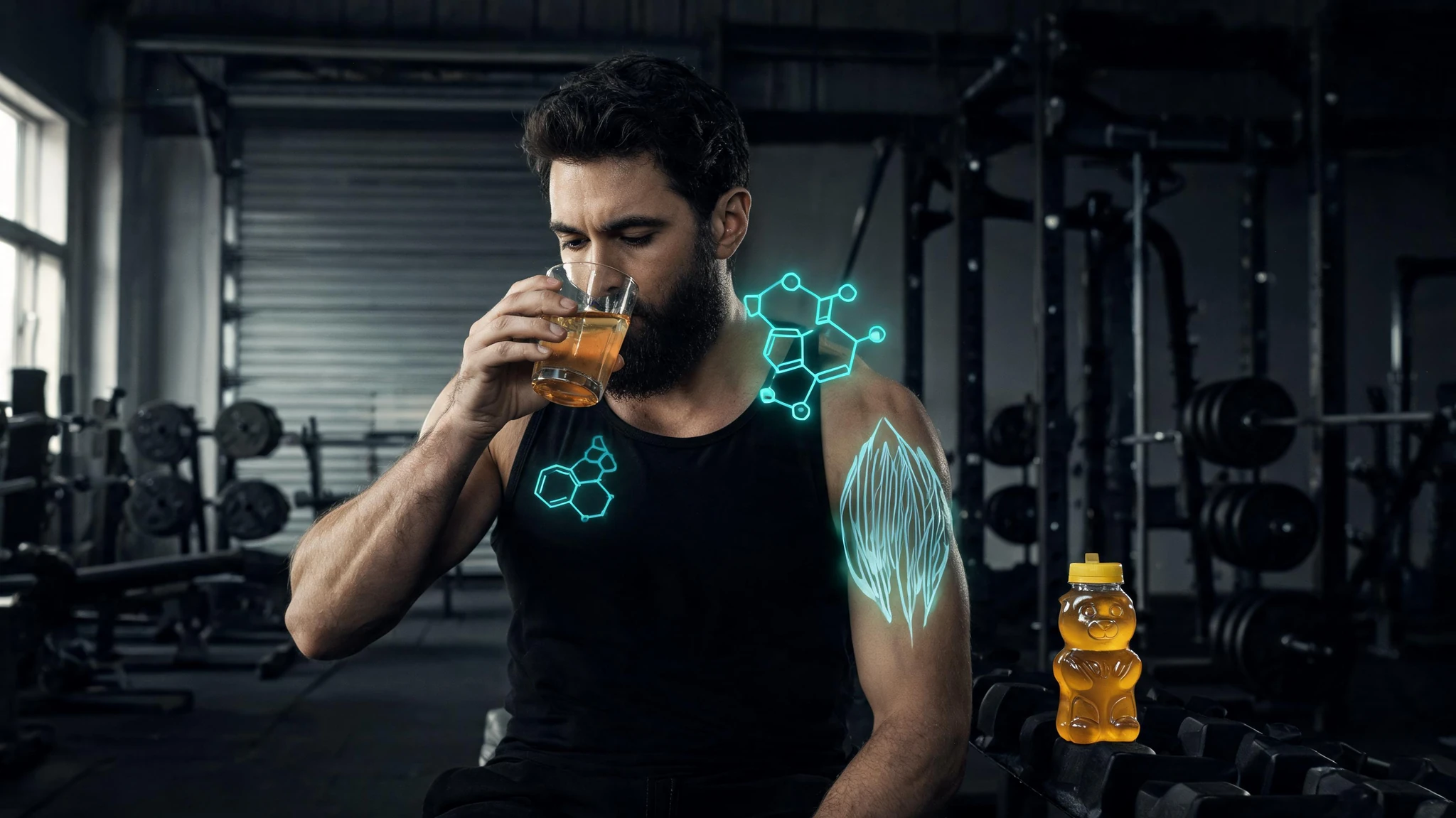
In a 2024 randomized controlled trial published in Frontiers in Physiology, strength-trained women who drank a beverage of 70 grams of honey stirred into 250 milliliters of water about 90 minutes before a hard lower-body session reported less muscle soreness in the 48 hours that followed, and their lower-body strength and endurance held up better than on the placebo day.1 The study was small, sixteen participants, but the design was tight and the protocol is the kind any lifter could copy on a Tuesday morning.
Honey is not a wonder drug. It is a sugar with trace antioxidants and a long folk-medicine resume. What is interesting is that a cheap pantry staple held its own in a trial against a flavor-matched placebo, in trained women, on the kind of leg day that leaves you walking down stairs sideways the next morning.1
What the 2024 trial actually did
The Hemmati group recruited sixteen women who had been strength-training for at least a year. Each came in twice, in a crossover design, so every woman served as her own control. Ninety minutes before a session built around heavy back squats and other compound lower-body work, they drank either the honey beverage (70 grams of honey in 250 milliliters of water) or a flavor-matched placebo. The session was specifically designed to provoke exercise-induced muscle damage, the kind of damage that shows up the next morning as stiffness, tenderness, and a quietly resentful pair of quadriceps.1
The researchers tracked perceived soreness on a visual analog scale at 24 and 48 hours, jump height, and lower-body endurance over several time points. On the honey days, soreness scores were lower and the recovery of performance was faster. The effect sizes were modest but consistent across measures, which is what you want to see in a small trial. A single small study does not settle a question. It does, however, point in the same direction as the broader honey-and-exercise literature.1,2
Why might a spoonful of honey do anything at all?
Two mechanisms are usually proposed, and they are not exotic.
The first is fuel. Honey is mostly fructose and glucose, roughly in even parts, with a small slice of more complex sugars. That blend is interesting because fructose and glucose use different intestinal transporters, so a mixed sugar load can deliver carbohydrate to the bloodstream a little faster and at a higher total rate than glucose alone. For a heavy resistance session, where glycogen in the working muscles is one of the limiting factors, having a steady trickle of available sugar is helpful. A 2023 narrative review in Nutrients on carbohydrates and endurance exercise made the same general point about food-first carbohydrate sources: real foods can serve as a perfectly reasonable fuel, and the timing window before exercise is when they tend to matter most.5
The second is the trace stuff. Raw and minimally processed honey contains a small but real amount of polyphenols and flavonoids, plus enzymes and a smattering of organic acids. Some of those compounds have measured antioxidant and anti-inflammatory activity in lab and animal work. Whether the dose you get from 70 grams of honey is enough to materially blunt the inflammatory cascade after a hard set of squats is genuinely unknown. The honest answer is that it might contribute and probably is not the main event.2
There is also a third, less-discussed angle. Honey has a moderate glycemic index, somewhere in the 50s for most varietals, depending on the floral source and the ratio of fructose to glucose. That is lower than pure glucose and lower than maltodextrin, the carbohydrate that powers most commercial pre-workouts. A more gradual rise in blood sugar before training tends to feel more stable in the body, with less of the spike-and-crash pattern that some lifters report from sugary energy drinks taken too close to a session. Whether that smoother curve translates into better lifts is hard to say in any single trial, but it shows up in the bloodwork and it lines up with how lifters describe their experience.4

It is not just one study
Honey has been turning up in sports-nutrition trials for two decades. A 2009 study in the International Journal of Sport Nutrition and Exercise Metabolism tested a honey-sweetened sports drink against standard sports drinks in soccer players going through a fatiguing protocol. Performance markers and the cytokine response (the chemical signaling that tracks inflammation) were broadly comparable, with no penalty for the honey version. In other words, a less-processed sugar source kept up with the gel-and-powder pack.3
A 2007 study by Kreider and colleagues in the Journal of the International Society of Sports Nutrition compared protein paired with honey, sucrose, or maltodextrin after resistance training. The honey condition produced a more stable post-workout blood-sugar profile than the maltodextrin condition, while the markers of muscle protein turnover and recovery looked similar across the three carbohydrate sources. That is a small finding, but it lands in a useful place: if you are using a carbohydrate source after lifting, honey behaves about how you would expect from a slow-release sugar, not worse.4
Pull all of this together and you see the shape that honey has in the literature. It is not a magic recovery elixir. It is a respectable, food-first carbohydrate source whose trace compounds may add a small bonus on top of the fuel itself. A 2019 systematic review in Nutrients by Hills and colleagues looked across the available trials and concluded much the same: honey appears to be at least as effective as other carbohydrate sources for fueling exercise, with some signals around glycemic stability and antioxidant content that warrant more research.2

How big is the effect, really?
This is where you should slow down. The 2024 trial had sixteen participants. That is enough for a crossover design to detect an effect, but it is not enough to nail down how large the effect would be in, say, a thousand women across a range of training ages and menstrual-cycle phases. The reductions in soreness reported in the paper were meaningful on the visual analog scale, and the performance differences were measurable, but small studies tend to overstate effect sizes. Replication will tell you whether the real-world honey benefit is closer to “noticeable” or closer to “your training partner could not pick the honey day from the placebo day.”1
It is also worth saying what the trial did not measure. It did not test honey against a high-quality maltodextrin pre-workout in trained women on the same lifting protocol. It did not separate raw honey from filtered supermarket honey, which can vary in polyphenol content by a wide margin depending on the floral source. It did not look at men, and it did not look at endurance athletes. Generalizing past those guardrails is not science. It is wishful thinking with footnotes.1,2
How to try this without overthinking it
If you want to copy the 2024 protocol on your own leg day, the recipe is not complicated. About 70 grams of honey, which is a heaped two and a half tablespoons, stirred into roughly a cup of water, drunk about 90 minutes before a hard lower-body session. That timing matters because it gives the sugar a window to clear from the gut and stabilize in the bloodstream by the time you start your warm-up.1
A few practical notes worth keeping in mind:
- Calories count. Seventy grams of honey is around 210 calories of nearly pure carbohydrate. If you are training hard, that fuel is doing work. If you are eating in a calorie deficit and not training particularly hard, you are essentially adding a sugary drink to your day.
- Honey is sugar. If you have diabetes, prediabetes, or a history of reactive hypoglycemia, a 70-gram bolus of honey on an empty stomach is a meaningful blood-sugar event. Talk to your clinician before you copy a protocol you read about online. The 2024 paper is upfront about this caveat too.1
For most healthy lifters, though, this is one of the lower-risk experiments you can run on yourself. The downside is mostly the calories and a sticky spoon. The upside, if the trial replicates, is a slightly easier 48 hours after a brutal session.
One more practical point. The 2024 protocol used water as the carrier, but if you find 70 grams of honey on its own a little much, you can stir it into unsweetened tea, lemon water, or your usual electrolyte drink. The carbohydrate dose is what is doing the work. Pair it with something that lives in your routine and you are more likely to actually run the experiment for a few weeks rather than abandon it after one sticky morning.1

Where this fits in the bigger picture of recovery
Reach for honey water if you like. Do not let it crowd out the things that move the needle more.
Sleep is the cheapest and most powerful recovery tool you have. Adequate protein across the day, generally somewhere around 1.6 to 2.2 grams per kilogram of bodyweight if you train hard, does more for soreness and adaptation than any pre-workout drink. Showing up consistently to your sessions, week after week, beats every clever supplement strategy in existence. None of this is news, and none of it is exciting, which is probably why people keep looking for the cup of honey water that will fix everything.
That said, food-first nutrition has a quiet appeal that the supplement aisle does not. You can buy a jar of honey at any grocery store. It does not need a coupon code or a subscription. It does not separate out the active compounds from everything else in the food matrix, which sometimes matters in ways nutrition science is still working out. The 2023 Nutrients review on carbohydrates and endurance exercise made a similar argument: pulling carbohydrate from real foods, with their cofactors and fiber and trace nutrients, is not just acceptable, it is often preferable.5

Common questions about honey before workouts
Will honey water help me build muscle faster?
No direct evidence supports that. The 2024 trial measured soreness and short-term recovery of performance, not hypertrophy. Muscle growth is driven by progressive overload, total protein intake, and sleep, not pre-workout carbohydrate choice.1
Is raw honey better than supermarket honey for this?
Possibly, because raw and minimally filtered honey tends to retain more polyphenols, but the trial used a standard honey beverage, not a specific raw varietal. The carbohydrate effect should be similar across honey types. The trace-compound effect, if it matters at all, may favor less-processed honey.2
Can I use honey instead of a sports drink during a workout?
For many sessions, yes. The 2009 soccer-performance study found a honey-sweetened beverage performed comparably to standard sports drinks. For very long endurance events, mixed-sugar formulations engineered for high-rate intake may still have an edge.3
Does honey work better in women than men?
The 2024 trial only tested women, so the question is open. The general carbohydrate-and-exercise literature does not show large sex-based differences in the response to pre-workout fueling, but specific honey trials in men have used different protocols, so direct comparison is hard.1,2
Are there people who should avoid this?
Anyone with diabetes, prediabetes, certain digestive conditions, or a history of reactive hypoglycemia should talk to a clinician first. Children under one should never have honey, for unrelated infant-botulism reasons.
The honest bottom line
One small but well-designed 2024 trial found that drinking 70 grams of honey in water 90 minutes before a hard leg day reduced soreness and supported lower-body performance in trained women. The mechanism is plausible, the broader literature is consistent, and the cost of trying it is roughly nothing. None of this means honey will rescue a poorly designed program or compensate for short sleep. It means a cheap pantry ingredient earned its keep in a controlled setting, and that is a result worth a small experiment of your own.1,2
The next study will tell us more. Until then, the worst-case outcome of trying it is that you drank a cup of honey water before training. The best case is a measurably easier walk down the stairs on Wednesday morning.
Sources
- Hemmati H, Alkasasbeh WJ, Hemmatinafar M, Salesi M, Pirmohammadi S, Imanian B, Rezaei R. Effect of a honey-sweetened beverage on muscle soreness and recovery of performance after exercise-induced muscle damage in strength-trained females. Frontiers in Physiology. 2024. PubMed: 39355153
- Hills SP, Mitchell P, Wells C, Russell M. Honey Supplementation and Exercise: A Systematic Review. Nutrients. 2019. PubMed: 31336992
- Abbey EL, Rankin JW. Effect of ingesting a honey-sweetened beverage on soccer performance and exercise-induced cytokine response. International Journal of Sport Nutrition and Exercise Metabolism. 2009. PubMed: 20175433
- Kreider RB, Earnest CP, Lundberg J, Rasmussen C, Greenwood M, Cowan P, Almada AL. Effects of ingesting protein with various forms of carbohydrate following resistance-exercise on substrate availability and markers of anabolism, catabolism, and immunity. Journal of the International Society of Sports Nutrition. 2007. PubMed: 17997840
- Naderi A, Gobbi N, Ali A, Berjisian E, Hamidvand A, Forbes SC, Koozehchian MS, Karayigit R, Saunders B. Carbohydrates and Endurance Exercise: A Narrative Review of a Food First Approach. Nutrients. 2023. PubMed: 36986096