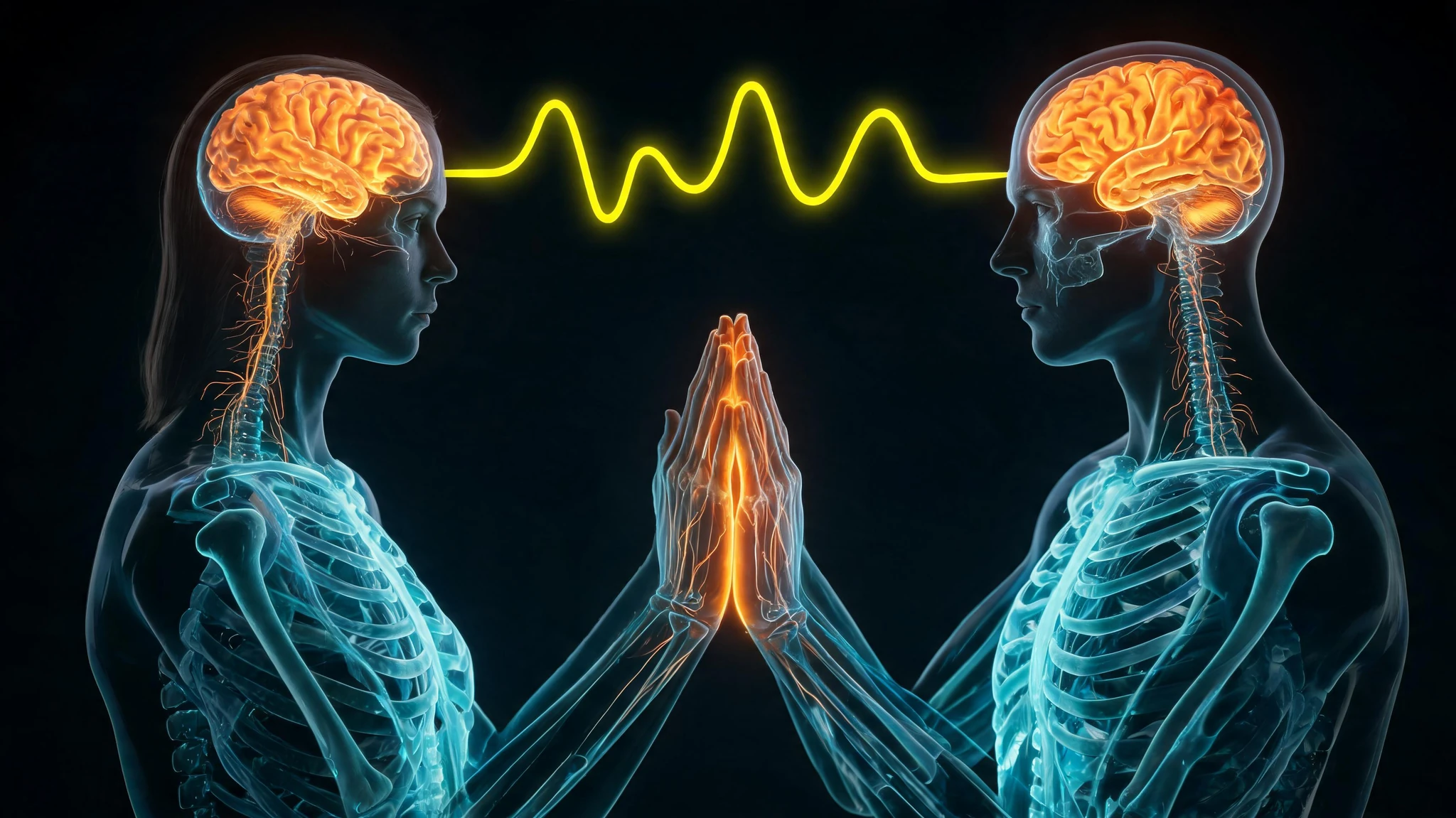
When 22 romantic couples sat together in a University of Haifa lab in 2017 and one partner was given a low-grade heat burn on the forearm, something quietly strange showed up on the EEG monitors. The moment the unhurt partner reached over and held the other’s hand, both of their brains started to oscillate at the same rhythm in the alpha-mu band, roughly 8 to 12 cycles per second, and the partner in pain rated the burn as less painful. The lead author was Pavel Goldstein, and the paper landed in Proceedings of the National Academy of Sciences in early 2018.1
It was a small study and a controlled lab setting. But it gave a tidy mechanistic picture for something most of us already do without thinking: when somebody we love is hurting, we reach for their hand.
What the 2018 handholding study actually found
Goldstein and his colleagues recruited 22 heterosexual couples who had been together for at least a year. Each couple cycled through several conditions while wearing EEG caps. Sometimes the partners sat in separate rooms. Sometimes they sat together but did not touch. Sometimes they sat together and held hands. The researchers then applied a mildly painful heat stimulus to the woman’s forearm, calibrated below the level of tissue damage, and asked her to rate it.1
Two findings stood out. First, when the couple was in the same room and holding hands, the EEG signals from the woman’s right central region (above the somatosensory cortex) and the man’s right frontal region became more correlated in the alpha-mu range than in any other condition. The technical term is brain-to-brain coupling, and it is not a poetic flourish; the team measured it with cross-spectrum analysis on time-aligned EEG.
Second, the bigger that handholding-driven coupling was, the lower the pain ratings tended to be. The two effects moved together. Goldstein has noted in interviews that pain seemed to disrupt the natural coupling that exists between close partners, and physical touch appeared to put it back.
One more nuance worth keeping. The amount of empathy the unhurt partner showed beforehand, measured with standard self-report scales, predicted how much the brain coupling went up during handholding. More empathic partners produced more synchrony, which tracked with more pain relief. That is a finding worth saying out loud, because it suggests touch by itself is not the whole story; the inner state of the person doing the touching matters.
The control conditions in the study are part of why the result is taken seriously. Coupling did not jump simply because two people were in the same room. It did not jump when they sat near each other and refrained from touch. It rose specifically in the handholding-with-pain condition, and the size of that rise mapped onto the size of the pain reduction. Goldstein has framed this as a kind of analgesic dialogue between two nervous systems, with touch as the channel that carries the signal.

Why brain waves syncing might dial down pain
Pain perception is not a one-way signal from a hot pan to your brain. The brain decides, in real time, how loud to make the alarm. A wide review of chronic pain mechanisms describes pain as a fundamentally biopsychosocial event, modulated by attention, expectation, mood, and social context.5 The dial is real. Distraction, reassurance, and a calm autonomic nervous system can all turn it down. Stress and isolation can turn it up.
The alpha-mu rhythm Goldstein’s team flagged is interesting because it is the EEG signature of the somatosensory cortex when it is at rest. When you pay attention to a sensation in your body, that rhythm tends to suppress, like a screen lighting up. When two brains hover around the same alpha-mu state at the same time, the simplest reading is that the partners’ attentional and bodily systems are tuned to each other rather than fragmenting under the threat.
That fits with an older and very influential 2006 study by James Coan, Hillary Schaefer and Richard Davidson at Wisconsin, in which 16 married women lay in an fMRI scanner expecting an unpredictable mild electric shock to the ankle.2 When they held their husband’s hand during the threat, several brain regions linked to threat response (the right anterior insula, the superior frontal gyrus, the hypothalamus) showed less activation than when they held a stranger’s hand or no hand at all. The size of that calming effect tracked with how high the women rated their marriage. Better marriage, more brain-level damping. The two studies look at different signals, fMRI versus EEG, but they are pointing in the same direction.
The chemistry on the other side of the skin
Touch from a trusted person also nudges hormones. Karen Grewen and Kathleen Light’s group at the University of North Carolina has published a series of studies on warm partner contact. In a 2005 paper in Biological Psychology, women who reported more frequent hugs from their partner had higher resting oxytocin levels and lower resting blood pressure and heart rate.3 The correlation does not prove causation by itself, but it lines up with a much larger literature on oxytocin as a touch- and bonding-linked peptide.
Kerstin Uvnäs-Moberg, who spent decades on this question in Stockholm, has summarized oxytocin as a mediator of what she calls a “calm and connection” response, the rough mirror image of the better-known fight-or-flight pattern.4 In her synthesis, oxytocin release linked to non-noxious skin contact tilts the autonomic nervous system toward parasympathetic dominance, lowers cortisol, and slightly raises pain thresholds. None of those effects are huge in any one person on any one day. They are small, additive, and chronic, more like the way good sleep adds up than the way an aspirin works.

How big is the effect, really?
It is fair to ask. Goldstein’s couples were not having root canals. The heat pain in the lab was tuned to be uncomfortable but not damaging. Pain ratings during handholding came down by a meaningful but not dramatic amount, roughly the size you would expect from a moderate distraction or a placebo with mild expectations.
That is not a knock on the study. It is a reminder that “your partner’s hand” is not a substitute for an analgesic in serious pain. People have asked Goldstein this directly in press interviews, and his answer has been consistent: the finding is about a real but modest mechanism, and it complements medical care rather than replacing it.
The bigger picture is that small effects in a lab can still matter a lot in life, because life is mostly small moments. A frightened toddler whose mother holds their hand during a vaccination may rate the jab the same on a faces scale, but they will calm down faster afterward. A spouse waiting for biopsy results does not stop being scared because someone is sitting next to them, but the heart rate creeps down, and the night is more bearable.
Who actually gets the benefit?
This is where the empathy finding from the 2018 paper earns its keep. The brain-to-brain coupling effect was strongest when the partner offering touch scored higher on empathic concern. Coan’s older fMRI work pointed the same way; the threat-buffering effect of handholding scaled with reported marital quality.2 A reluctant or distracted hand seems to do less.
That has a practical edge. If you are with someone in pain, the most useful thing you can do is show up emotionally first and physically second. Look at them. Slow your own breathing. Then take their hand. The order is doing real work.
It also means the effect is not magical, and it does not transfer. A stranger’s hand, in both Coan’s data and Goldstein’s, does less. Trust is part of the active ingredient.
None of this is a license to grade your partner’s empathy in real time. The cleaner reading is that small steady habits matter. Couples who routinely make eye contact, ask after each other, and are physically gentle in ordinary moments are the same couples whose nervous systems will already be partly tuned in when one of them gets hurt. The handholding scene in the lab is just a snapshot of that longer co-regulation.

What about same-sex couples, friends, parents and children?
Goldstein’s 2018 sample was 22 heterosexual couples, which is a real limit on how broadly to read the result. Coan’s 2006 fMRI study used married women and their husbands. Neither paper claims the effect is exclusive to a particular configuration of bodies.
Looking across the touch-and-stress literature more broadly, including Light and Grewen’s hugging work and Uvnäs-Moberg’s oxytocin reviews, the active ingredients seem to be felt safety, warm and willing skin contact, and emotional attunement.3,4 Those ingredients are not gendered, and they are not specific to romantic partners. A close friend, an adult child holding a parent’s hand in a hospital, a parent holding a child’s hand at the dentist all plausibly work through similar pathways. The strength of evidence is best for romantic partners simply because that is who researchers most often recruit.
A note on what this is not
It is worth being plain about the limits, because the internet version of this finding tends to overshoot.
This research does not show that holding hands cures chronic pain. It does not replace pharmacological pain management for surgery, cancer treatment, labor, or serious injury. It does not mean that someone whose partner cannot hold their hand right now is doing anything wrong, or that being single is bad for your nerves. Single people, friendships, pets, and self-soothing all engage overlapping calming pathways.
It does say something modest and reassuring: the old human gesture of reaching for somebody’s hand when they are hurting is not just sentimental. There is a measurable signal under it, in two different imaging methods, in independent labs, with consistent direction.

Common questions about handholding and pain
How long does the brain-syncing effect last after you let go?
Goldstein’s protocol measured coupling during contact, not after. Coan’s fMRI threat-buffering also faded once the hand was withdrawn. Treat the benefit as something that works while it is happening, not a stored reserve.
Does it matter which hand you hold, dominant or non-dominant?
The 2018 study did not isolate hand dominance as a variable. In practical terms, hold whichever hand the person in pain offers. The neural effects were measured bilaterally and did not depend on a specific side.
What if my partner is not very physically affectionate?
Empathic concern, not raw skin time, did most of the work in the brain-coupling result. A partner who is calmly and attentively present and willing to hold a hand for a few minutes appears to deliver most of the effect, even if grand gestures are not their style.
Can holding the hand of a friend or relative do the same thing?
Probably partially yes, with weaker evidence. The literature most directly studies romantic partners, but the underlying ingredients (felt safety, oxytocin release with warm contact, attentional co-regulation) are not unique to romance.
Is there a downside?
Not a known physiological one in healthy people. The relevant caution is social. Forcing touch on someone who does not want it, or holding the hand of someone in an unsafe relationship, could amplify stress rather than dampen it. Consent and felt safety are part of the mechanism, not a polite footnote.
The smaller and truer takeaway
Reach for the hand. Slow your own breathing first. Stay a little longer than feels necessary. None of that will replace medicine, and none of it is a moral instruction. It is just that, in a small lab in Haifa and a smaller one in Wisconsin, with very different machines, two teams independently watched the brains of people in pain quiet down a notch when somebody who actually cared about them held their hand.
The instinct, it turns out, was right.
Sources
- Goldstein P, Weissman-Fogel I, Dumas G, Shamay-Tsoory SG. Brain-to-brain coupling during handholding is associated with pain reduction. Proceedings of the National Academy of Sciences of the United States of America. 2018. PubMed: 29483250
- Coan JA, Schaefer HS, Davidson RJ. Lending a hand: social regulation of the neural response to threat. Psychological Science. 2006. PubMed: 17201784
- Light KC, Grewen KM, Amico JA. More frequent partner hugs and higher oxytocin levels are linked to lower blood pressure and heart rate in premenopausal women. Biological Psychology. 2005. PubMed: 15740822
- Uvnäs-Moberg K, Petersson M. Oxytocin, a mediator of anti-stress, well-being, social interaction, growth and healing. Zeitschrift für Psychosomatische Medizin und Psychotherapie. 2005. PubMed: 15834840
- Gatchel RJ, Peng YB, Peters ML, Fuchs PN, Turk DC. The biopsychosocial approach to chronic pain: scientific advances and future directions. Psychological Bulletin. 2007. PubMed: 17592957