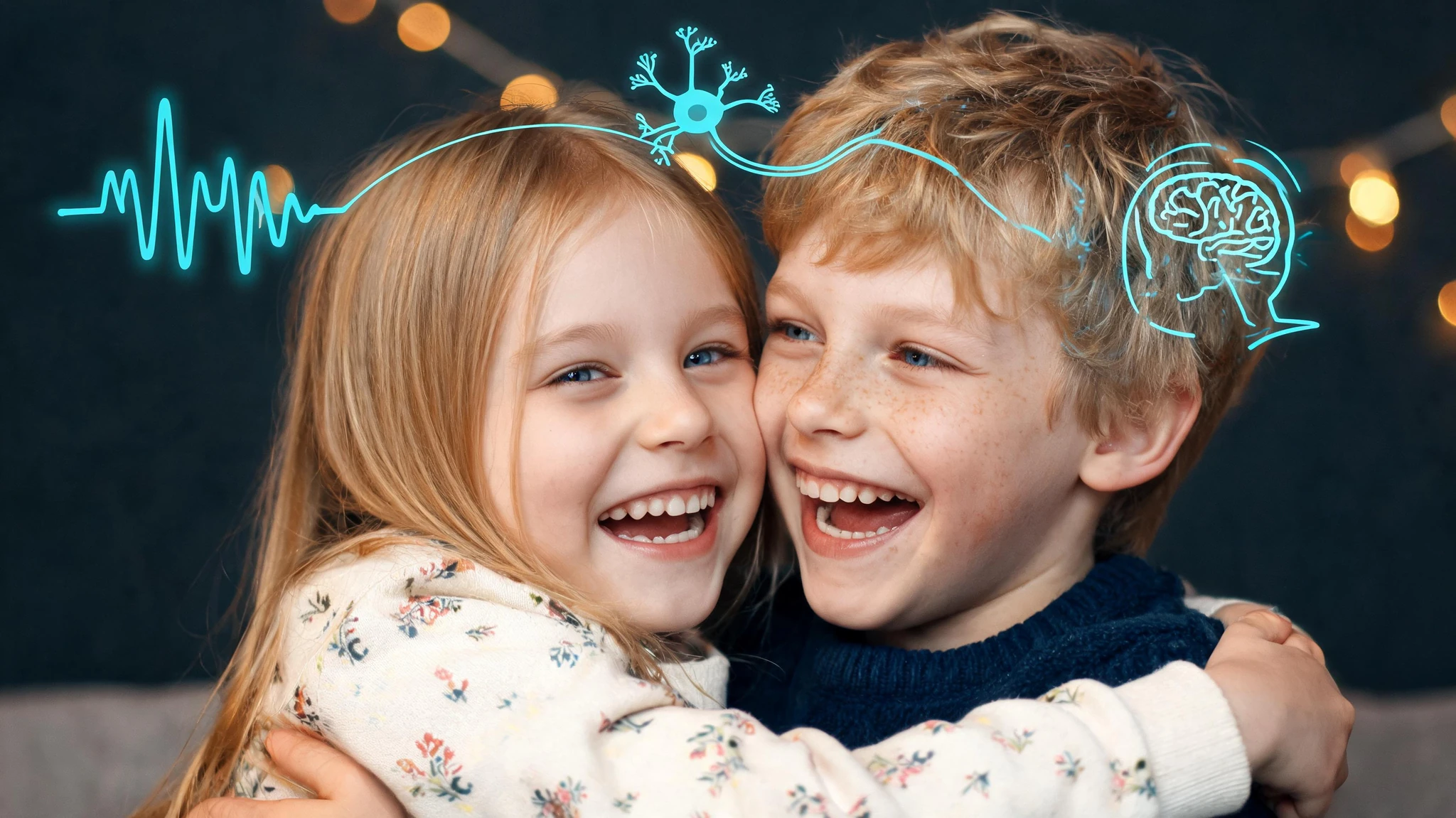
Researchers at Brigham Young University followed 395 families for a year and found that adolescents who had a sister, older or younger, reported feeling less lonely, less unloved, less guilty, less self-conscious, and less afraid than peers without one. The study, by Laura Padilla-Walker and colleagues, was published in 2010 in the Journal of Family Psychology1. It is a small finding with a large reach, and it has been quietly cited ever since.
The same study turned up something almost stranger. Sibling affection predicted kindness and good deeds in teenagers more than twice as strongly as parental affection did1. That single comparison is the part of the paper that keeps getting passed around, and it is also the part most worth slowing down on, because it does not say what most people think it says.
What the BYU study actually measured
The Flourishing Families Project at BYU recruited 395 two-parent and single-parent families across the western United States, with a target adolescent in each, mostly aged 11 to 14. Researchers visited each family twice, a year apart, and had every member fill out questionnaires about warmth, conflict, prosocial behavior, depression, anxiety, and self-worth. They also recorded the families talking through a disagreement, then coded the videos1.
Padilla-Walker and her colleagues were not asking, “are sisters magic.” They were asking a more boring question: how much of an adolescent’s emotional health, after you account for parenting style, do you still need to explain by sibling closeness? The answer was: more than you would expect. Sibling warmth predicted lower depression, lower delinquency, and higher self-worth, even after the parenting variables had already done their work1. And the size of the link between sibling affection and prosocial behavior was about double the link between parenting and prosocial behavior in the same model.
That doubling is real, and it is a within-study comparison rather than a thunderous claim about life. It does not mean siblings replace parents. It means that, for this specific outcome, in this specific sample, kindness traveled along the sibling channel a little more efficiently than along the parental one. Researchers themselves have repeated this caveat in follow-up papers from the same lab5.
Why a sister, specifically?
The 2010 paper ran a separate analysis on whether having a sister of any age, versus only brothers, mattered for the adolescent’s own mental health. It did. Teens in families that included at least one sister scored lower on depression, anxiety, loneliness, fear, guilt and self-consciousness than teens in all-brother sibling groups1. The effect was small, but it survived statistical controls.
The authors offered a tentative interpretation, and they were honest that it was tentative: sisters may engage in more emotionally explicit conversation, ask more personal questions, share more disclosures, and offer more verbal comfort. The study did not directly observe any of that. The behavioral content of sister-versus-brother interactions was not coded. Anyone telling you BYU “proved” sisters talk feelings more is reading the press release, not the paper.
What the data did show was a directional pattern. Loving sibling relationships, regardless of birth order, predicted better mental health, and the presence of at least one sister nudged the average a little further in the protective direction. That is the entire claim. The folk version, “girls just talk about feelings more,” may turn out to be right, but it is not what was tested.

What sibling closeness does to a teenage brain
Other labs have asked a related question with brain scans. A 2019 study in Neuroscience looked at adolescents in Hong Kong and used diffusion imaging to map the structural efficiency of brain networks. The researchers, led by Wong and colleagues, found that teens who reported high levels of negative emotion within their sibling relationships also showed lower structural connectivity in networks that have been linked to social processing, and these teens reported more loneliness2.
That is a single cross-sectional study with a small sample, and it does not establish that bad sibling moods cause brain changes. The authors are careful to say so. What it does suggest is that the quality of the sibling tie shows up in measurements taken miles below the level of self-report. If you treat your brother like an enemy at thirteen, your brain at thirteen is not pretending the relationship is fine.
The flip implication, which the same authors sketch out, is that sibling warmth might be one of the everyday social inputs that adolescent brains use to calibrate themselves. Teens who feel emotionally safe with a sibling have one more channel of low-stakes intimacy on call. Loneliness is an absence of that, not a presence of bad weather.
It is not just one study
A 2024 paper in the Journal of Research on Adolescence by Masarik and Rogers followed adolescents into their twenties and tracked how teenage sibling relationships predicted later romantic-partner behavior3. Warmer, more cooperative sibling ties in adolescence were associated with warmer, less hostile partner behavior in young adulthood. Hostile sibling dynamics in adolescence predicted more hostile interaction patterns later. The link held after controlling for parents’ relationship quality.
This kind of longitudinal evidence does not prove causation either. People who are good at relationships in general may be good at both kinds. But the reading that comes naturally to developmental researchers is that siblings are practice partners. They are the first peers most of us argue with, repair with, lose to, win against, share a room with, and forgive. That practice, especially the repair part, looks like it leaves a residue.

Holt-Lunstad and her co-authors, in a much larger meta-analysis published in 2010, pooled 148 studies on social relationships and mortality and found that people with stronger social ties had a 50 percent higher likelihood of survival over the follow-up periods than people with weaker ties4. That is not a sibling-specific paper. It is the longest possible lens on why warm relationships matter at all. The size of the effect was comparable, in their analysis, to quitting smoking. Whatever channel the warmth comes through, social or familial or romantic or sibling, the body counts it.
Why fights with a sister might also help
The same 2010 BYU paper, and several others since, have argued that sibling conflict, in moderation, does some of the developmental heavy lifting1. Disagreements between siblings give kids early, low-cost reps at noticing another person’s anger, regulating their own, finding a workaround, and not bringing it back up at dinner. These are skills you can study in a lab, but you can only really practice them on someone you cannot escape.
The qualifier matters. Padilla-Walker’s team, and Jensen and Pond writing later, both flagged a difference between ordinary squabbles and sustained hostility1,5. Conflict that was high in frequency but low in cruelty looked harmless and possibly useful. Conflict that included contempt, mockery, and sustained social comparison looked harmful, and it tracked with worse mental health outcomes for the targeted child. If a sibling makes a younger child feel like a permanent runner-up, that is not character building.
The everyday version of this distinction is recognizable. There is the argument over who left the dishes, and there is the long campaign of “you are the dumb one.” The first is friction. The second is corrosion.
How big a deal is “twice as strong as parenting”?
Big enough to be interesting, small enough to not be a parenting verdict. The path coefficient comparison in the BYU paper was about kindness and helpful behavior, not about depression or anxiety1. Parents still mattered enormously for almost every other outcome the team measured, including self-worth and depression scores. What the result suggests is that kids may copy the texture of how a sibling treats them and turn around and offer that same texture to a stranger more readily than they copy what a parent has told them about kindness.
That is consistent with a much older finding from peer-influence research: in adolescence, demonstrated peer behavior often beats stated parental advice, especially in social and prosocial domains. A sibling sits in a strange middle category. They are family, but they live in the peer modality. They are practice for being a friend, with none of the friend’s option to leave.

What this does and does not mean for your family
If you have a sister, the research is one more reason to keep that line open. Texts that ask how she is. The phone call you keep meaning to make. The decision to fly out for her birthday rather than send a card. None of that is a guaranteed mental-health intervention. It is, if the literature is roughly right, a medium-quality input into a system that responds well to medium-quality inputs over time.
If you do not have a sister, you are not condemned. The same Padilla-Walker paper, and the broader literature, both make the same point: the strongest predictor in every model was warmth itself, not the sex of the sibling delivering it1. A loving brother counted. A close cousin in the same household counted. The teen’s own friendships counted. The Holt-Lunstad meta-analysis suggests that the channel is plural, and that what matters is having any of them4.
If you are a parent watching your kids treat each other badly, the research offers neither relief nor blame. The kindest thing the literature says is that some of this is friction in service of skill, and the kids will probably figure it out. The honest thing it also says is that hostility past a certain threshold is not benign, and that an adult intervening in mockery, comparison, or contempt is doing protective work whether or not anyone thanks them at the time1,5.

Common questions about sisters and mental health
Does the BYU study prove sisters cause better mental health?
No. It is correlational. Adolescents with at least one sister, on average, reported lower loneliness, fear, and self-consciousness, but the design cannot rule out that families with sisters differ in other ways too.
Was the difference between sisters and brothers large?
No. The effect was statistically reliable but small. Most of the variance in adolescent mental health was explained by overall sibling warmth, not by sibling sex.
Is sibling rivalry actually good for you?
In moderate amounts and without contempt, sibling conflict appears to give kids practice at conflict resolution and emotional regulation. Sustained hostility, mockery, or social comparison is associated with worse outcomes.
Do these benefits last into adulthood?
A 2024 longitudinal study suggests that adolescents with warmer sibling relationships had warmer, less hostile romantic partnerships in young adulthood, even after parental effects were accounted for.
What about only children?
The same literature consistently finds that the active ingredient is close, warm relationships in general, including with friends, parents, and other relatives. A meta-analysis of 148 studies found social ties of any kind were strongly associated with better long-term health.
The boring, durable version
The viral version of this finding is “having a sister makes you a better person.” The boring version, which is the one that matches the paper, is more useful. Adolescents who feel loved by a sibling tend to internalize that and pass some of it on. Sisters seem to deliver this slightly more reliably than brothers in this sample, possibly because of how they talk, possibly because of effects the study did not measure.
None of this is destiny. Plenty of people without sisters end up exceptionally kind. Plenty of people with sisters do not. What the research keeps quietly suggesting is that the warm sibling tie is one of the few free, repeatable, low-stakes training environments a child has for becoming the kind of adult who picks up the phone. If you have access to one, the science is on the side of using it.
Sources
- Padilla-Walker LM, Harper JM, Jensen AC. Self-regulation as a mediator between sibling relationship quality and early adolescents’ positive and negative outcomes. Journal of Family Psychology. 2010;24(4):419–428. PubMed: 20731488
- Wong NML, Shao R, Yeung PPS, Khong PL, Hui ES, Schooling CM, Leung GM, Lee TMC. Negative Affect Shared with Siblings is Associated with Structural Brain Network Efficiency and Loneliness in Adolescents. Neuroscience. 2019;421:39–47. PubMed: 31678342
- Masarik AS, Rogers CR. Behavioral pathways from sibling relationships in adolescence to romantic partnerships in adulthood. Journal of Research on Adolescence. 2024. PubMed: 38783833
- Holt-Lunstad J, Smith TB, Layton JB. Social relationships and mortality risk: a meta-analytic review. PLoS Medicine. 2010;7(7):e1000316. PubMed: 20668659
- Jensen AC, Pond AM, Padilla-Walker LM. Why Can’t I Be More Like My Brother? The Role and Correlates of Sibling Social Comparison Orientation. Journal of Youth and Adolescence. 2015;44(11):2067–2078. PubMed: 26208830