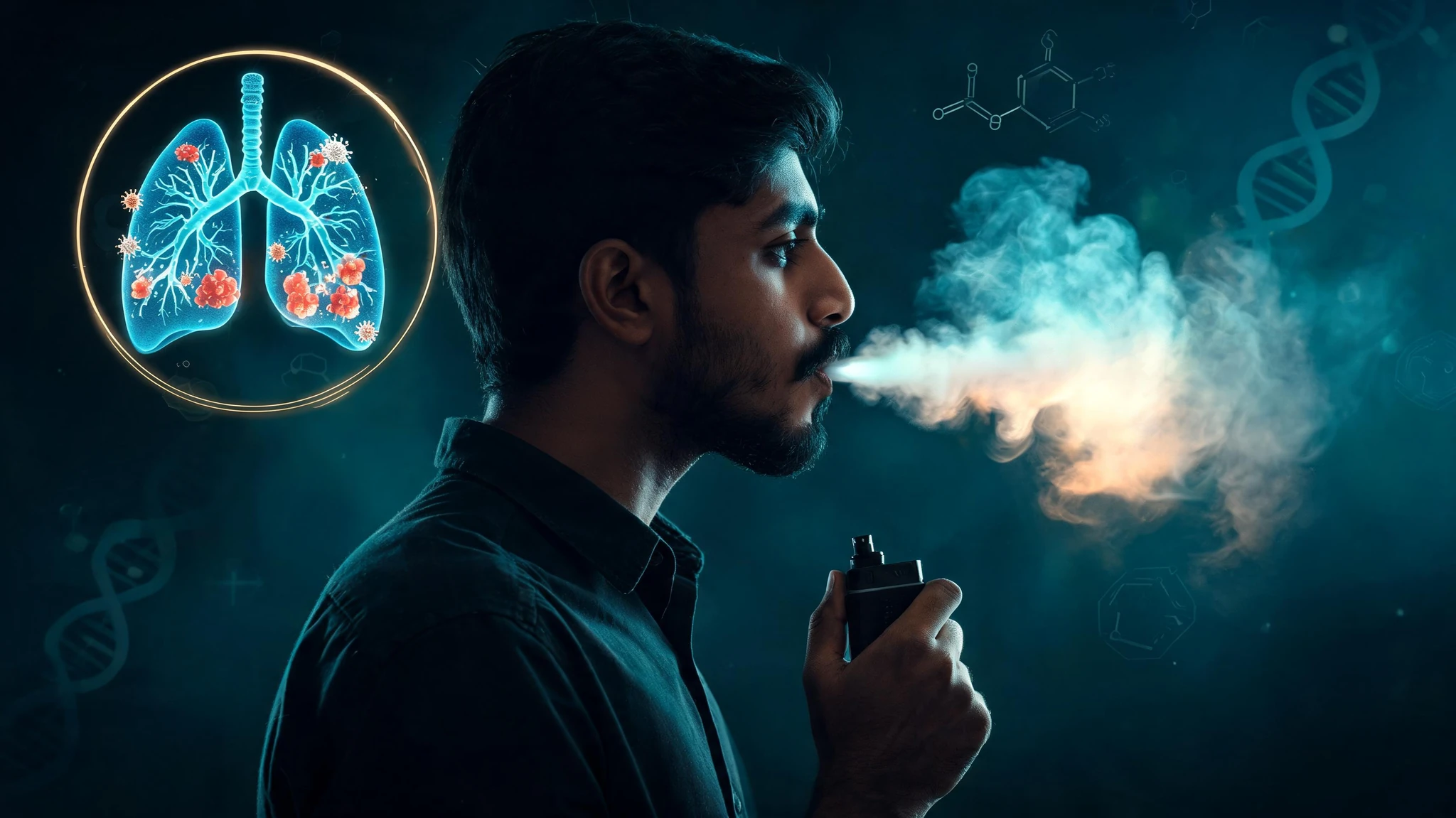
When researchers at Harvard’s T.H. Chan School of Public Health bought 51 flavored e-cigarettes off the shelf and ran them through a gas chromatograph, they found diacetyl, the buttery flavoring chemical that scarred the lungs of microwave-popcorn factory workers, in 39 of them. At least one of three known harmful flavoring chemicals showed up in 47 of the 51 products tested.1
That study, led by Joseph Allen and published in Environmental Health Perspectives, didn’t prove that any individual vaper would develop popcorn lung. It proved something narrower and harder to argue with. The chemical that gave bronchiolitis obliterans its nickname is sitting inside many of the cartridges people are inhaling, often in the sweetest flavors marketed to the youngest users.1
What is popcorn lung, really?
Bronchiolitis obliterans is the formal name. It’s a disease of the bronchioles, the smallest airways in the lung, the ones thinner than a strand of spaghetti where air finally branches out toward the alveoli to deliver oxygen into the blood. In bronchiolitis obliterans, those tubes get inflamed and then scar shut from the inside. The scarring is fibrotic, which means the body’s repair system has laid down stiff connective tissue where soft, flexible airway used to be. Once that tissue forms, it does not soften back down.2
The “popcorn” part is occupational history. In the early 2000s, NIOSH investigators identified a cluster of severe lung disease in workers at a microwave-popcorn factory in Missouri. The workers were inhaling vapor from heated artificial-butter flavoring. The strongest signal, both in those workers and in animal models that followed, came from diacetyl, the volatile diketone that gives butter its smell. Kathleen Kreiss, who led much of that NIOSH work, summarized the findings under the matter-of-fact label “flavoring-related bronchiolitis obliterans.”3
Akpinar-Elci and colleagues followed up by characterizing the radiographic and clinical pattern in popcorn-plant workers, confirming a syndrome that looked nothing like ordinary smoker’s bronchitis and everything like a small-airway disease driven by inhaled flavoring vapor.2 The damage they saw was patchy, progressive, and resistant to corticosteroids. Several of the affected workers ended up on lung-transplant lists.
How the chemistry got from a popcorn plant into a strawberry vape
Diacetyl is cheap, stable, and tastes uncannily like real butter at parts-per-million concentrations. It’s also a generically useful flavor molecule for anything you want to read as creamy, custardy, or rich. Strawberry shortcake. Vanilla cupcake. Caramel macchiato. Cotton candy. Many of those notes share a buttery undertone that diacetyl supplies almost effortlessly.
Allen’s team chose 51 flavored cartridges across fruit, candy, and cocktail categories on purpose, because those were the categories most aggressively marketed to teenagers in 2014 and 2015. They detected diacetyl above the laboratory limit of detection in 39 cartridges and at least one of the three diketones (diacetyl, 2,3-pentanedione, or acetoin) in 47 of 51. Concentrations varied. Some cartridges produced what the authors called “well above the laboratory limit of detection” levels in a single puff’s worth of vapor.1
Two things matter about that finding. The first is that diacetyl exposure inside a popcorn factory was an industrial-scale problem the FDA and OSHA spent a decade trying to control with engineering, ventilation, and respirators. The second is that vaping delivers the same molecule directly into the lung, by design, with no engineering controls between the heating coil and the small airways.

What inhaled diacetyl does inside the airways
The bronchioles are lined with a thin layer of epithelial cells. When diacetyl vapor reaches them, animal studies and the occupational human data agree on a rough sequence. The cells get inflamed. Some die. The body recruits fibroblasts to the injury site, which start laying down scar tissue. In a healthy bronchiole, that repair tightens up but the airway stays open. In flavoring-related bronchiolitis, the scarring keeps going until the lumen, the open part of the tube, narrows or closes.2,3
Once an airway closes, the alveoli downstream of it lose their connection to fresh air. They can still receive blood, but they can’t exchange oxygen efficiently. That mismatch is why the early symptom of bronchiolitis obliterans is exertional shortness of breath that does not respond to inhalers the way asthma does. Vital capacity drops. The chest CT shows a mosaic pattern of trapped air in some lobules and normal tissue in others. The disease tends to progress, and the scarring does not reverse with steroids the way ordinary inflammation might.3
That irreversibility is the part of the science worth taking seriously. Asthma flares. COPD progresses but responds to bronchodilators and pulmonary rehab. Bronchiolitis obliterans, once established, is largely a one-way door.
Pulmonologists sometimes describe the lung as forgiving in the upper airways and unforgiving in the lower ones. The trachea and large bronchi can take a beating from infection or smoke and still recover most of their function. The bronchioles cannot. They are too thin, the tissue is too fine, and the local repair machinery is more likely to scar than to remodel cleanly. That asymmetry is why a chemical that causes mostly cosmetic damage to the throat can cause structural damage to the small airways with a fraction of the dose.2,3
Is it really happening in vapers?
Here’s where honest hedging matters. Confirmed cases of classic, biopsy-proven popcorn lung in vapers are rare in the published literature. That is the truth, and a few outlets have used that rarity to argue the whole popcorn-lung-and-vaping story is overblown. The longer answer is more useful.
What is documented is a broader category of vaping-associated lung injury that emerged forcefully in 2019. Maddock and colleagues, writing in the New England Journal of Medicine, described pulmonary lipid-laden macrophages in patients with vaping-related respiratory illness, suggesting a distinct pattern of small-airway and alveolar damage in young, otherwise healthy users.4 Layden’s final report on the Illinois and Wisconsin outbreak, also in NEJM, characterized hundreds of cases of severe lung illness in people who vaped, many of them adolescents and young adults, with imaging and biopsy findings that did not fit any familiar diagnosis cleanly.5
The CDC eventually traced most of those acute cases, now called EVALI, to vitamin E acetate in illicit THC cartridges, not to diacetyl in nicotine vapes. That is a real and important distinction. EVALI and popcorn lung are not the same disease. EVALI tends to come on within weeks. Popcorn lung tends to develop over months to years. EVALI shows lipoid pneumonia patterns. Popcorn lung shows fibrotic small-airway scarring.4,5

So why connect them at all? Because the lung does not care which marketing category a chemical belongs to. It cares what the chemical is, how often you inhale it, and at what concentration. Diacetyl in nicotine flavoring is not the cause of EVALI. It is, however, a known cause of irreversible small-airway disease at industrial doses, and it is present in many flavored e-cigarettes at non-trivial doses inhaled many times a day for years. The two facts coexist.
Why young lungs sit in the crosshairs
Adolescent lung tissue is still finishing its growth into the early twenties. Alveolar number, airway diameter, and the local immune response are all still calibrating. The flavor categories Allen sampled, fruit, candy, and cocktail, were also the categories with the highest reported teen uptake. Mango, strawberry, sweet mint, and dessert flavors dominate the cartridges with the highest diacetyl concentrations in his data set.1
An adult who started smoking at 25 and quit at 45 has 20 years of exposure to a fairly well-characterized mix of combustion products. A 16-year-old who picks up a strawberry-shortcake disposable in 2024 and stays on it through college has a different exposure profile. The molecules are different, the dose timing is different, and the lung is at a different developmental stage.
That does not automatically mean every flavored vape is going to scar every teenager’s airways. It does mean the cohort study answering that question well will not be done for another decade, and the people enrolling in it without knowing are the ones currently in high school.
There is also a behavioral piece the chemistry alone misses. Disposable vapes are designed to be used continuously, in short, frequent puffs spread across a day, in a way that older e-cigarette models with refillable tanks were not. The total daily inhaled volume of flavored aerosol from a 5,000-puff disposable used over a week is not directly comparable to a few cigarettes after meals, even if the nicotine math looks similar. Dose, frequency, and duration are what determine occupational lung disease, and the use pattern around modern disposables pushes all three numbers up.
What about disposables and “diacetyl-free” labels?
Some manufacturers, especially after Allen’s paper got picked up in the press, started labeling cartridges as “diacetyl-free.” A few caveats are worth noting. Some products substituted 2,3-pentanedione, a structurally similar diketone that NIOSH has flagged as plausibly causing the same type of small-airway injury. Allen’s team also detected acetoin, which can convert to diacetyl in storage. And the e-cigarette market in the United States is large enough that batch-to-batch variation, contract manufacturing, and grey-market disposables make label claims hard to verify.1
None of that means every flavored vape is dangerous in the same way. It means a “diacetyl-free” sticker is not, on its own, evidence of safety, particularly for products imported through informal channels.

Common questions about flavored vaping and lung damage
How much diacetyl is too much?
NIOSH set occupational exposure recommendations for diacetyl at 5 parts per billion as an 8-hour time-weighted average, with a short-term limit of 25 ppb. Allen’s team measured per-cartridge yields well above the laboratory limit of detection in many products, and a heavy vaper takes hundreds of puffs a day. The personal-dose math is uncertain but not trivially small.1
If I switch to unflavored or tobacco-flavored, am I safe from this specific risk?
Tobacco-flavored cartridges in Allen’s sample had the lowest diketone levels, but they were not always zero. Switching reduces exposure to the specific chemicals associated with popcorn lung. It does not eliminate other risks of inhaling heated propylene glycol, glycerin, and nicotine.1
Can popcorn lung be reversed?
Established bronchiolitis obliterans is not reversible with current medical therapy. Some patients stabilize. Some progress to needing supplemental oxygen or, in severe cases, lung transplantation. Stopping exposure is the single most important step.3
Is the teenage near-fatal case from social media real?
Cases of severe vaping-associated respiratory failure in adolescents are documented in the EVALI literature, and several have shown persistent airflow obstruction months after recovery. Whether any single viral story is verified depends on its primary source.4,5
Should I stop vaping immediately?
That’s a conversation for a clinician who knows your history, particularly if you took up vaping to quit cigarettes. The harm-reduction calculus is not the same for a 50-year-old former smoker as it is for a 17-year-old who never smoked.

Where this leaves a careful reader
The Harvard data is solid. Diacetyl is in many flavored e-cigarettes, often in the sweetest ones, often in the brands marketed hardest to people whose lungs are still developing. The occupational literature on diacetyl is also solid, and it points toward a fibrotic, irreversible small-airway disease at sustained inhaled doses. The vaping cohort data is still maturing, and the long-term incidence of bronchiolitis obliterans in former teen vapers is genuinely unknown.
That uncertainty is not the same as reassurance. It is the kind of gap a thoughtful person treats with caution, particularly on behalf of younger family members who are most exposed and least equipped to weigh the trade-off. If you vape, knowing what is in the cartridge is the start of an honest conversation with yourself about whether the trade is one you actually want to keep making.
Sources
- Allen JG, Flanigan SS, LeBlanc M, et al. Flavoring Chemicals in E-Cigarettes: Diacetyl, 2,3-Pentanedione, and Acetoin in a Sample of 51 Products, Including Fruit-, Candy-, and Cocktail-Flavored E-Cigarettes. Environmental Health Perspectives. 2016. PubMed: 26642857
- Akpinar-Elci M, Travis WD, Lynch DA, Kreiss K. Bronchiolitis obliterans syndrome in popcorn production plant workers. European Respiratory Journal. 2004. PubMed: 15332401
- Kreiss K. Flavoring-related bronchiolitis obliterans. Current Opinion in Allergy and Clinical Immunology. 2007. PubMed: 17351470
- Maddock SD, Cirulis MM, Callahan SJ, et al. Pulmonary Lipid-Laden Macrophages and Vaping. New England Journal of Medicine. 2019. PubMed: 31491073
- Layden JE, Ghinai I, Pray I, et al. Pulmonary Illness Related to E-Cigarette Use in Illinois and Wisconsin – Final Report. New England Journal of Medicine. 2020. PubMed: 31491072