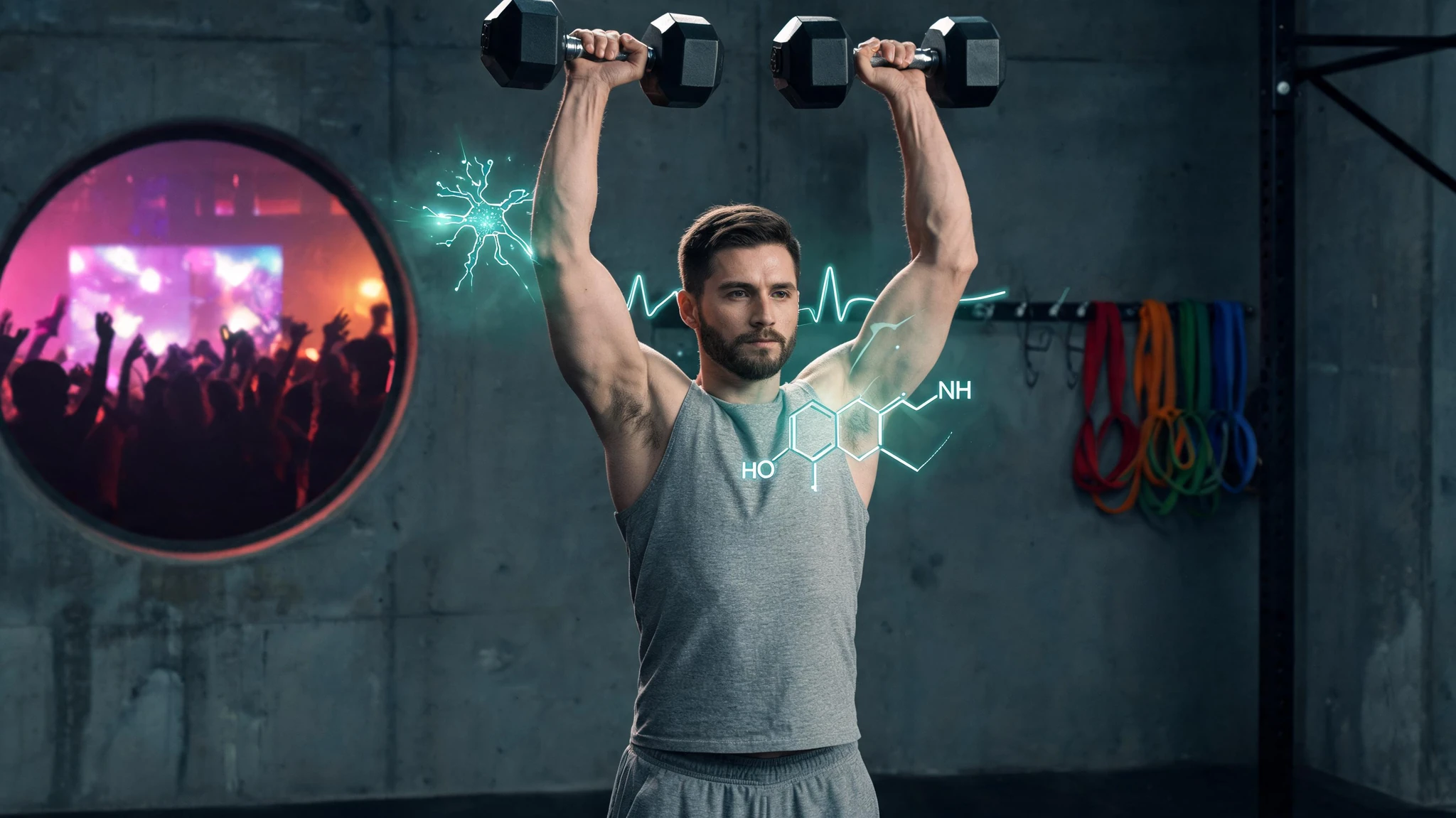
About 81% of Gen Z gym-goers regularly train in groups, and 42% say they have made new friends through fitness, according to recent survey data on Gen Z spending and behavior. The same data shows roughly 44% of Gen Z rank fitness as their first or second discretionary spending priority, ahead of streaming and dining out. The picture that emerges is not just about biceps. It is about where this generation is choosing to spend its evenings.
That reframing matters because it sits on top of a real research base. Large studies have linked regular movement to better mental health, and decades of work on social ties have linked connection to longer, healthier lives.1,5 When a generation moves its social life from the bar stool to the squat rack, it is touching both levers at once.
What the survey actually says
The headline numbers from the 2024 Gen Z fitness behavior data are worth slowing down on. Around 37% of young adults in this generation say they view working out as a way to connect with others. About 42% report forming new friendships through fitness activities. And 81% of Gen Z gym-goers participate in group workouts on a regular basis, which is the figure that separates this cohort from older generations who tended to lift in solitude with headphones in.
On spending, 44% of Gen Z place fitness in their top two discretionary categories. That puts gyms, classes, and gear above streaming services at 36% and dining or drinking out at 36%. Gen Z now accounts for roughly 40% of total gym memberships in the surveyed market, a notable share for a cohort still early in its earning years.
None of this means every 22-year-old is suddenly a marathon runner. Survey data captures patterns, not universal truths. Access, geography, work schedules, and money all shape who shows up to a class and who never will. The interesting story is the direction of travel.
Why the gym keeps pulling them in
Two threads run through almost every interview, ethnographic write-up, and survey on this shift. The first is mental health. The second is the search for in-person community after years of group chats and dating apps that did not deliver.
On the mental health side, the strongest single piece of population-level evidence is the cross-sectional study by Chekroud and colleagues that examined data from 1.2 million American adults between 2011 and 2015.1 People who exercised reported about 1.5 fewer days of poor mental health per month than non-exercisers with similar physical health and demographics. The effect was largest for team sports, cycling, and aerobic and gym activities, and held across age, gender, and income brackets. It is a cross-sectional design, so it cannot prove causation on its own. But the size and consistency of the association is hard to wave away.
Prospective work backs that signal up. A 2018 meta-analysis in the American Journal of Psychiatry pooled data from 49 prospective cohort studies and 266,939 people followed for an average of 7.4 years.2 People who were physically active had roughly 17% lower odds of developing depression than sedentary peers. The effect appeared across age groups and across continents, which is exactly the kind of robustness public health researchers look for before they start to trust a finding.
Anxiety shows a similar pattern. A 2017 meta-analysis by Stubbs and colleagues looked at randomized trials of exercise in people with diagnosed anxiety and stress-related disorders.3 Pooled across studies, exercise produced a moderate reduction in anxiety symptoms compared with control conditions, with larger effects when the exercise was vigorous rather than light. For a generation that names anxiety as one of its defining health concerns, that is a meaningful number.

The social dose hiding inside a workout
If a treadmill alone can lift mood, a treadmill next to a friend appears to do something extra. Researchers who study loneliness have spent the past 15 years documenting what most people already suspect at a gut level: chronic social disconnection is bad for the body, not just the spirit.
Holt-Lunstad and colleagues published a meta-analysis in 2010 that synthesized 148 studies covering more than 308,000 participants. Stronger social relationships were associated with a 50% increased likelihood of survival across follow-up periods averaging 7.5 years, an effect size comparable to quitting smoking and larger than the effect of obesity or physical inactivity in many of the included studies.5 A follow-up review in 2015 by the same group looked specifically at loneliness, social isolation, and living alone, pooling 70 studies with more than 3.4 million participants.4 All three exposures predicted higher mortality, with effect sizes that did not depend much on age, sex, or initial health status.
That body of work does not say a Tuesday spin class will add years to your life. It says the soil matters. Generations that grow up with rich, frequent in-person contact tend to do better on a long list of health outcomes than generations that do not, and Gen Z came of age in a moment when in-person contact got disrupted at exactly the wrong developmental window. The pandemic year sharpened that. Many of the young adults filling boutique studios today are people who finished high school or started college on a screen.
So when 42% of Gen Z gym-goers report forming new friendships through fitness, the right way to read that number is not as a marketing curiosity. It is a behavioral workaround. A class is a recurring time, place, and activity with the same faces showing up every Wednesday. That is, almost by accident, the structure of how older generations made friends in churches, bowling leagues, and union halls.
Why group workouts in particular
Group exercise has a few features that do quiet psychological work. There is a fixed start time, which removes the negotiation that kills so many adult plans. There is a shared physical effort, which builds the easy intimacy of having struggled together. And there is repetition, which turns strangers into familiar faces over a few weeks without anyone having to schedule a coffee.
The mental health benefits of exercise also seem to scale with the social dimension, at least in some studies. The Chekroud team’s 2018 paper found the largest reductions in poor mental health days among people who reported team sports, more than for solo cardio of similar duration.1 The authors were careful not to overclaim, since a person who plays on a softball team is different from a person who runs alone in dozens of ways the survey could not measure. Still, the pattern is consistent with what coaches and class instructors have said for years: showing up for other people is more durable than showing up for yourself.
It also helps that modern group workouts have lowered the social cost of being a beginner. Most franchised classes are designed to be entered cold by someone with no experience and no friends in the room. The instructor calls names. The format repeats. After a few weeks, the regulars know who you are. That is a small thing and a large thing at the same time.

What this means for the third place
Sociologists used to talk about the third place, a phrase the urban scholar Ray Oldenburg coined in 1989 for the spaces that are neither home nor work. Coffee shops, bars, barbershops, libraries, the post office line. The third place is where casual community happens when nobody is being especially intentional about it.
Many of the classic third places have eroded for younger adults. Bars are expensive. Coffee shops are full of laptops. Religious attendance has dropped sharply across cohorts. The mall, where late millennials used to drift on a Saturday, mostly is not there anymore. What the Gen Z fitness survey suggests is that gyms, run clubs, climbing gyms, and martial arts studios have quietly absorbed some of that role.
You can see it in product design. Newer gym brands sell themselves on community first and equipment second. Run clubs that started as four friends meeting at a coffee shop now run organized routes through dozens of cities. Climbing gyms have couches and laptops near the wall, the way coffee shops used to.
That said, the gym-as-third-place model has limits. It costs money, which excludes plenty of young adults. It rewards a particular kind of body confidence that not everyone has on a Wednesday at 7 p.m. And it can recreate the same social pressures it claims to escape, with curated outfits and curated conversations. Worth watching, not romanticizing.
How to read this if you are over 30
Older generations sometimes hear these numbers as evidence that Gen Z has invented something new, or as evidence that bars are dying. Neither is quite right. People in their 50s who go to the same yoga class for a decade have been doing this for years. The shift is one of intensity and timing. Gen Z is leaning on movement-based community earlier in adult life, and at higher participation rates, than the cohorts immediately before them.
For a parent or a clinician, the practical read is simple. If a young person in your life is struggling with mood, finding a recurring physical activity with other people is one of the best-supported interventions in the literature, with effect sizes in the same ballpark as some medications for mild to moderate depression and anxiety.2,3 It does not have to be a gym. A weekly hike, a beginner climbing class, a community soccer league, a low-pressure dance group. The mechanism is the same: regular movement plus reliable human contact.

Common questions about Gen Z and the gym shift
Is this only an American trend?
The cited survey data is mostly from US samples, but parallel reporting from the United Kingdom, Australia, and parts of Western Europe shows similar patterns: rising Gen Z gym memberships, growth in group fitness formats, and declining alcohol consumption among young adults. The cultural details vary; the direction is consistent.
Are young people drinking less because they are working out more, or working out more because they are drinking less?
Probably both, and probably neither alone explains it. Surveys consistently show Gen Z drinks less than millennials did at the same age, and that trend predates the fitness boom. The gym does not appear to be replacing alcohol so much as filling the social slot that drinking used to occupy on a Thursday night.
Does any exercise count, or do you have to be intense?
The mental health literature suggests benefits across a range of intensities, but moderate to vigorous activity tends to show the largest effects on depression and anxiety symptoms.2,3 Walking still helps. So does gardening. The dose-response is not linear, and more is not always better, especially at high training volumes.
What if you cannot afford a gym membership?
Free run clubs, parkrun events, public outdoor gym equipment, calisthenics groups in city parks, and YouTube workout communities all reproduce most of the social structure of a paid class. The active ingredient is consistency and other people, not the price tag.
Is the friendship effect real, or are people just being polite to a survey?
Self-reported friendship is hard to verify, but the structural setup of group exercise (recurring time, repeated faces, shared effort) is exactly the recipe friendship researchers identify as predictive of new ties forming in adulthood. The 42% number is plausible, even if some of it is acquaintance more than deep friendship.
Worth watching, carefully
It is tempting to wrap this trend in a tidy ribbon. Generation finds connection at the squat rack. Mental health saved by deadlifts. The reality is messier and more interesting. A meaningful slice of Gen Z is using fitness as a vehicle for community and mood regulation, and the underlying biology and sociology say that is a reasonable bet. The same trend can also leave behind young people who cannot afford it, do not feel safe in those spaces, or for whom intense exercise makes existing problems worse rather than better.

What this article does not want to do is sell anyone a membership. The fact that movement and people are good for mood is not new. The fact that a generation is rebuilding social infrastructure around it, in plain view, with their wallets, is. If that holds, the small concrete decisions of millions of 22-year-olds are doing a quiet experiment on what a third place looks like in the late 2020s. The early data is encouraging. The next ten years will tell whether it lasts.
Sources
- Chekroud SR, Gueorguieva R, Zheutlin AB, Paulus M, Krumholz HM, Krystal JH, Chekroud AM. Association between physical exercise and mental health in 1.2 million individuals in the USA between 2011 and 2015: a cross-sectional study. The Lancet Psychiatry. 2018. PubMed: 30099000
- Schuch FB, Vancampfort D, Firth J, Rosenbaum S, Ward PB, Silva ES, et al. Physical Activity and Incident Depression: A Meta-Analysis of Prospective Cohort Studies. The American Journal of Psychiatry. 2018. PubMed: 29690792
- Stubbs B, Vancampfort D, Rosenbaum S, Firth J, Cosco T, Veronese N, et al. An examination of the anxiolytic effects of exercise for people with anxiety and stress-related disorders: A meta-analysis. Psychiatry Research. 2017. PubMed: 28088704
- Holt-Lunstad J, Smith TB, Baker M, Harris T, Stephenson D. Loneliness and social isolation as risk factors for mortality: a meta-analytic review. Perspectives on Psychological Science. 2015. PubMed: 25910392
- Holt-Lunstad J, Smith TB, Layton JB. Social relationships and mortality risk: a meta-analytic review. PLoS Medicine. 2010. PubMed: 20668659