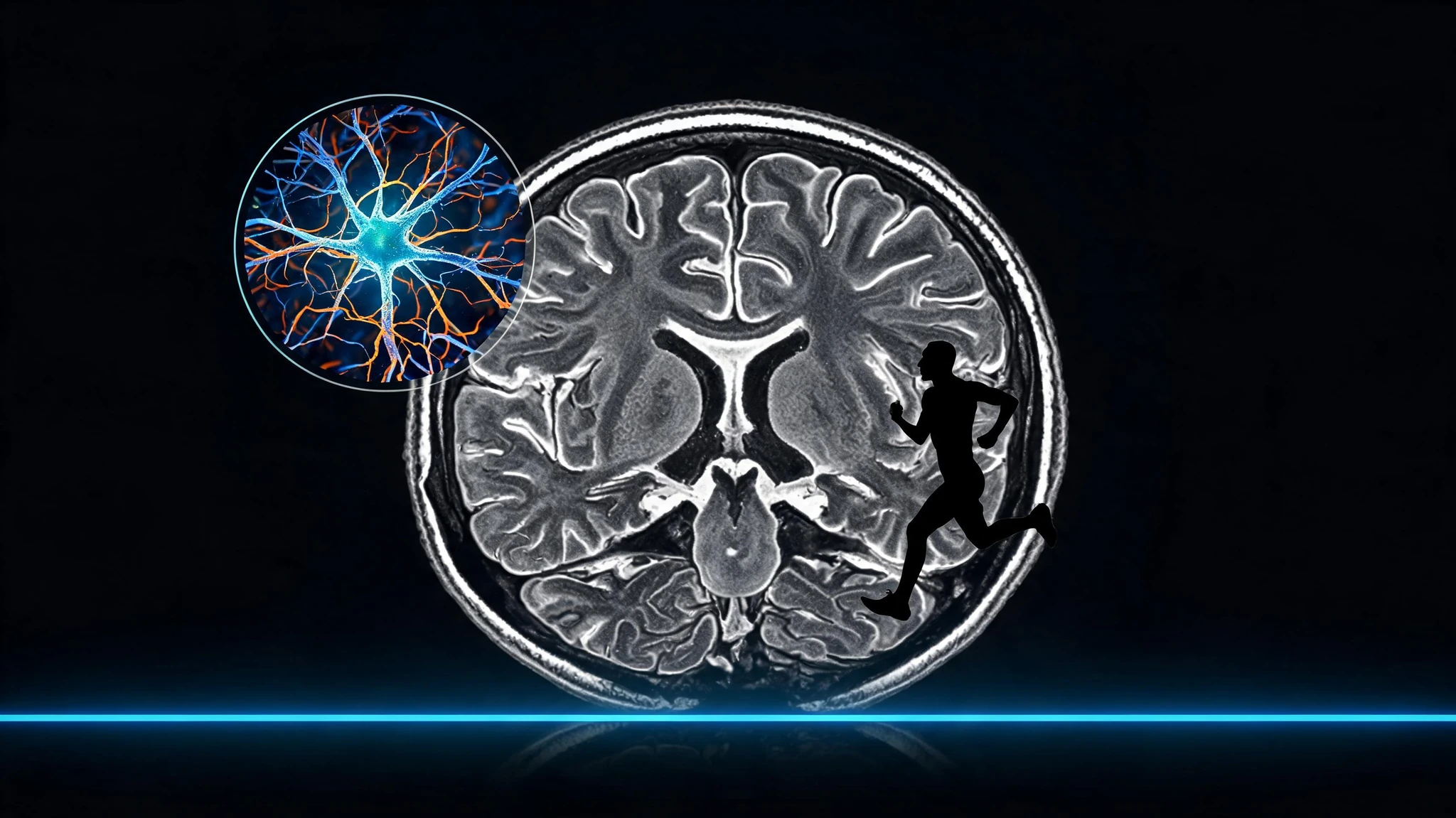
Every workout you finish appears to leave a small deposit in your brain. A 2023 scientific review in Frontiers in Aging Neuroscience by Pahlavani and colleagues concluded that physical activity, including aerobic, strength, and balance training, may help delay the onset and slow the progression of Alzheimer’s disease in older adults.1 The authors are careful with their language. They do not call exercise a cure. They call it one of the few interventions where the human and animal data point in roughly the same direction.
That distinction matters because the field has been burned before. Drugs that looked promising in mice have repeatedly failed in people. Exercise is the awkward exception. It is cheap, it has decades of trial data behind it, and the biological mechanisms that connect a brisk walk to a healthier hippocampus are no longer mysterious. They are just under-discussed.3
What does exercise actually do inside the brain?
Start with blood flow. When you move at a moderate pace, your heart pushes more oxygenated blood through cerebral arteries that, in a sedentary adult, would otherwise be running on a thin trickle. Neurons are metabolically expensive cells. They need a steady delivery of glucose and oxygen, and they degrade quickly when supply drops. Hillman and colleagues, writing in Nature Reviews Neuroscience, traced the chain from a single bout of aerobic exercise to measurable changes in cerebral perfusion and downstream cognitive performance.3
Then there is BDNF. Brain-derived neurotrophic factor is a small protein that, in plain terms, helps existing neurons survive and helps new ones form connections. Levels rise during and shortly after aerobic exercise in healthy adults, and the rise is not trivial. The Pahlavani review pulls together work showing that this BDNF surge is one of the strongest candidate mechanisms for exercise’s protective effect against neurodegeneration.1 Strength training appears to push the same lever, though through partially different pathways. A 2026 dose-response meta-analysis by Qipo and colleagues in Ageing Research Reviews found that resistance training in older adults shifts circulating biomarkers of inflammation and neuroplasticity in a favorable direction, with effects that scale with training volume up to a point.4
The third piece is amyloid. Sticky clumps of amyloid-beta protein build up between neurons in Alzheimer’s brains, and the prevailing theory is that this buildup, along with tangles of tau protein, drives the disease forward. In animal models, exercised mice tend to accumulate fewer amyloid plaques than their sedentary counterparts. The human evidence is harder to gather because you cannot easily peer into a living brain to count plaques, but PET imaging studies and cerebrospinal-fluid markers in active older adults broadly support the same direction of effect.1

The hippocampus story is the one most people miss
The hippocampus is a curled, seahorse-shaped structure deep inside each temporal lobe. It does a lot of jobs, but its starring role is binding new experiences into long-term memory. It also happens to be one of the first regions Alzheimer’s disease damages, which is why early symptoms so often look like misplaced keys and forgotten conversations rather than dramatic personality change.
In 2011, Kirk Erickson and a team at the University of Pittsburgh ran a randomized controlled trial that has since become a touchstone in this field. They took 120 sedentary older adults and assigned them to either a year of moderate aerobic walking, three days a week, or a stretching-and-toning control program. After twelve months, the walkers had a 2 percent increase in hippocampal volume. The stretching group lost about 1.4 percent, which is roughly the rate you would expect from normal aging. Memory performance improved alongside the volume change in the walking group, and rising BDNF levels tracked the gains.2
Two percent does not sound like much. In hippocampal-volume terms, it is the equivalent of reversing one to two years of age-related shrinkage. Doing that with a walking program that costs nothing and requires no prescription is the kind of result you would expect to see on every primary-care wall poster, and yet it rarely appears.
Why moderate intensity, not maximum effort?
The Pahlavani review highlights a specific intensity zone for the aerobic piece: roughly 50 to 75 percent of your maximum capacity, which corresponds to about 50 to 75 percent of your estimated maximum heart rate.1 Practically, that is brisk walking that leaves you slightly breathless but still able to talk in short sentences, easy cycling on flat ground, or relaxed swimming. It is not interval training pushed to redline.
The reason for the moderate target is not that harder is worse. It is that harder is harder to sustain, and the protective effects on the brain seem to depend most on consistency over months and years. A 30-minute walk five days a week, repeated for a decade, is more useful than a punishing six-week boot camp followed by quitting. The studies that show hippocampal growth and BDNF elevation are dosed across many months, not many weeks.2
Strength and balance work then layer on top. Two short resistance sessions a week, focused on big compound movements like squats, rows, presses, and farmer carries, appear to be enough to drive the inflammatory and neuroplasticity biomarker shifts that Qipo and colleagues described.4 Balance work, often the piece that gets cut, matters for two reasons. It reduces falls, which prevent the head injuries that sometimes accelerate cognitive decline, and it forces the brain to keep updating its sense of where the body is in space, which is itself a cognitive workout.

It is not just one study
The temptation, when reading any single trial, is to either over-trust it or to wave it away as too small. Neither response is right for this topic. The exercise-and-brain literature has accumulated enough trials, observational cohorts, and animal mechanism studies that several systematic reviews now converge on a similar conclusion. A 2026 meta-analysis by Choe and colleagues in Scientific Reports, looking specifically at older adults with existing cognitive impairment, found that combined exercise programs produced reliable improvements in both cognitive scores and muscle function.5 Multimodal training, in their analysis, beat single-mode training for cognition.
That last point is worth sitting with. The temptation, especially after midlife, is to pick one thing and grind it out. People become “the runner” or “the yoga person” or “the lifter.” The data, awkwardly, suggests the brain prefers a buffet. Aerobic for blood flow and BDNF, resistance for the neuroplasticity-and-inflammation lever, and balance and coordination for the spatial and proprioceptive work that keeps the cerebellum and hippocampus talking. None of the three on its own appears to do quite as much as all three together.5
This does not mean the dose has to be large. In the Choe review, the programs that produced cognitive gains were not extreme. They were the kind of routines a moderately disciplined 65-year-old could follow without joining a special gym, and most of them ran in the range of three to five sessions a week, totaling 150 to 200 minutes of movement.5
What about the inflammation and the mitochondria?
Two mechanisms tend to get glossed over because they are less photogenic than a bigger hippocampus. The first is chronic low-grade inflammation. Aging tissues, including brain tissue, drift toward a slightly inflamed baseline state that researchers sometimes call inflammaging. This baseline appears to damage the blood-brain barrier, the selective filter that decides which molecules in your bloodstream are allowed near your neurons. When that barrier weakens, more inflammatory signaling reaches the brain, and the cycle reinforces itself.
Regular exercise nudges the inflammatory dial in the other direction. The Qipo meta-analysis specifically tracked C-reactive protein, interleukin-6, and tumor necrosis factor alpha across resistance-training studies and found dose-dependent reductions in older adults.4 These are blood markers, not brain markers, but the connection between systemic inflammation and brain inflammation is well enough established that the inference is not a stretch.1
The second underdiscussed mechanism is mitochondrial. Mitochondria are the small structures inside cells that turn food and oxygen into usable energy. Brain cells are demanding clients, and mitochondrial dysfunction is one of the early features of Alzheimer’s disease in animal models. Endurance exercise drives mitochondrial biogenesis, the creation of new mitochondria, in muscle and, to a smaller but measurable degree, in brain tissue.1 A neuron with healthier energy supply is, all else equal, a neuron with more reserve when other things go wrong.
How long does it take to feel different?
If you start tomorrow, your brain begins benefiting tomorrow. A single bout of moderate aerobic exercise produces measurable BDNF elevations within hours, and small short-term improvements in attention and processing speed show up almost as fast.3 The structural changes, the ones that show up on MRI scans, take longer. The Erickson trial saw measurable hippocampal volume change at six and twelve months, not at six weeks.2
For someone in their 50s or 60s starting from a sedentary baseline, a reasonable expectation is that the easy wins, mood, sleep, and short-term cognitive sharpness, arrive in the first month, and the slower wins, the structural and biomarker changes, build over the following year. The disappointment people often feel at the eight-week mark, when they have done the work but not yet been transformed, comes from expecting fast biology where the biology is slow.
Common questions about exercise and brain health
Is it too late to start at 70?
No. Most of the trials cited above enrolled adults in their 60s and 70s, and several included participants with mild cognitive impairment. Benefits showed up. The window does not slam shut at any specific age, though earlier and more consistent is better than later and intermittent.5
What if I have bad knees and cannot walk briskly?
Swimming, water aerobics, recumbent cycling, and rowing all hit the same aerobic targets without the joint impact. The mechanism that matters is sustained moderate cardiovascular load, not the specific movement pattern.1
Does intensity matter or just minutes?
Both. The Pahlavani review and the Hillman review both point to the 50 to 75 percent of maximum capacity zone as the most consistently studied dose for cognitive benefit. Lower intensities still help. Just less per minute spent.1,3
If I already have a family history of Alzheimer’s, will exercise still help?
The evidence so far suggests yes, with caveats. Carriers of the APOE epsilon-4 risk allele appear to benefit from regular activity, and some analyses suggest the relative benefit may be larger in higher-risk individuals. Genetics is not destiny here, but it is also not erased.1
Is one type of exercise clearly best?
No. Combined programs that include aerobic, resistance, and balance work outperform single-mode programs for cognition in older adults with mild impairment.5

What this means in practice
If you are reading this and looking for a takeaway your future self will thank you for, it is not a complicated one. Three to five sessions a week of moderate aerobic work, somewhere between 30 and 50 minutes per session. Two short resistance sessions, even bodyweight or a single pair of dumbbells, hitting legs, hips, back, and chest. A few minutes of balance work on most days, even just standing on one leg while you brush your teeth. Done across years, this is the dose that the current evidence supports.
None of this is a cure for Alzheimer’s, and the researchers who study it are the first to say so. Brain health is shaped by sleep, by diet, by social engagement, by hearing loss, by vascular risk factors, by genetics, and by a long list of factors no single intervention controls. But of the pieces that are in your hands, regular movement is the one with the deepest evidence base. Pahlavani and colleagues, summarizing the field in 2023, called it one of the most promising non-pharmacological strategies available.1 Anyone who has spent a year quietly walking five days a week and noticed their mind sharpening already knew.
Sources
- Pahlavani HA et al. Exercise therapy to prevent and treat Alzheimer’s disease. Frontiers in Aging Neuroscience (2023). PubMed: 37600508
- Erickson KI et al. Exercise training increases size of hippocampus and improves memory. Proceedings of the National Academy of Sciences (2011). PubMed: 21282661
- Hillman CH et al. Be smart, exercise your heart: exercise effects on brain and cognition. Nature Reviews Neuroscience (2008). PubMed: 18094706
- Qipo O et al. Dose-response relationship of resistance training and the effects on circulating biomarkers of inflammation or neuroplasticity in older adults: a systematic review and meta-analysis. Ageing Research Reviews (2026). PubMed: 41086999
- Choe YH et al. Effects of exercise modalities on cognitive and muscle function in older adults with cognitive impairment: a systematic review and meta-analysis. Scientific Reports (2026). PubMed: 42045298