Five minutes of sniffing a 1% eucalyptol solution before a medical procedure lowered patients’ anxiety scores in a 2014 randomized trial out of South Korea1. The study, led by Kim KY and published in Evidence-Based Complementary and Alternative Medicine, was small, but the protocol was specific enough to take seriously, and it has been quietly cited ever since by people trying to figure out why a hot shower with a eucalyptus bundle hanging from the head feels so good.
The viral Facebook post that pushed this idea back into people’s feeds put it well: “The calming power of eucalyptus might be more than just a spa day vibe.” That is roughly where the evidence sits. Real, but narrower than the marketing.
What the anxiety study actually measured
The Kim trial enrolled patients waiting for a urological procedure under spinal anesthesia. One group inhaled a 1% solution of 1,8-cineole, the main aromatic compound in eucalyptus oil, from a pad held near the face for five minutes. The control group got almond oil instead. Anxiety was scored using the State-Trait Anxiety Inventory, a standard questionnaire, along with blood pressure and heart rate readings1.
State anxiety, the “right now” component, fell more in the eucalyptol group than in controls. Vital signs trended in the same direction. The authors did not claim eucalyptol could replace anti-anxiety medication, and they did not test it outside the operating-room setting. They tested a defined dose, a defined exposure, a defined population. That is how clinical trials work, and it is also why “five minutes before surgery” is the part you should keep in mind when extrapolating to your bathroom.
Why the brain seems to respond at all
Smell is the only sense that bypasses the thalamus. Olfactory nerve signals travel through the olfactory bulb and connect almost directly with the amygdala and hippocampus, the same regions that handle threat detection and memory. That is the proposed mechanism for why a familiar scent can shift mood within a breath or two. Eucalyptol, technically called 1,8-cineole, is a small lipophilic molecule that crosses mucous membranes easily and reaches those circuits without much delay.
What the molecule does once it gets there is less settled. Animal studies suggest it modulates GABA signaling, the same pathway that benzodiazepines act on, but the effect is weaker and the human work is thin. Kim’s group framed it as an autonomic effect: the scent shifted the balance from sympathetic to parasympathetic activity, which is the technical way of saying the body relaxed a notch1. Other groups have proposed a separate route through the trigeminal nerve, which also sits in the nasal mucosa and is sensitive to terpene molecules. The nice thing about a multi-pathway model is that it does not depend on any one mechanism being right. The frustrating thing is that nobody has nailed down which pathway dominates in awake, anxious humans.
The shower question
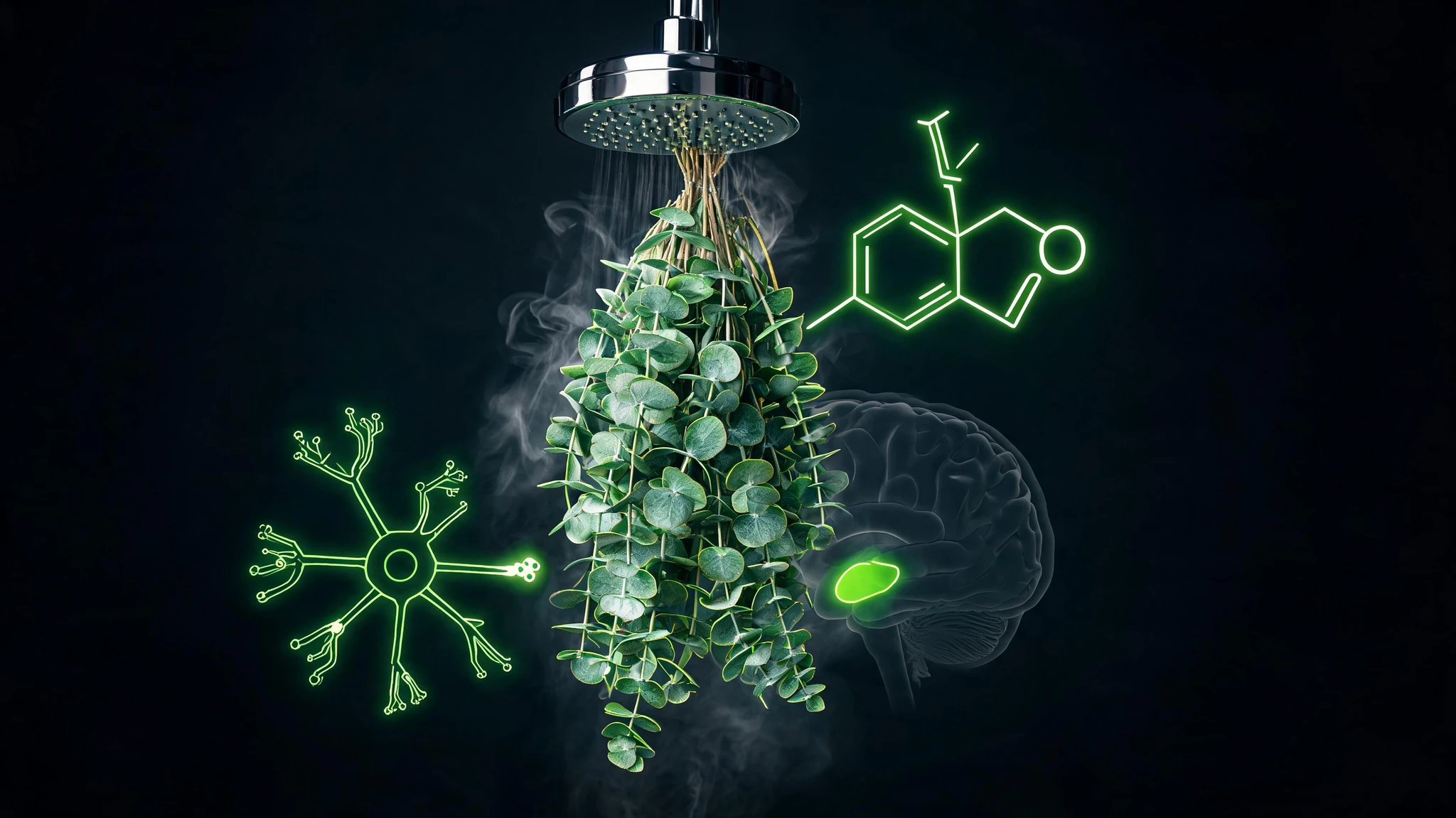
This is the part that gets lost on social media. The anxiety trial used a 1% eucalyptol solution dripped onto an aroma pad, held about 10 cm from the patient’s face, for exactly five minutes in a controlled clinical room. Your shower is not that. The steam pulls some of the volatile oils out of fresh eucalyptus leaves, but the concentration drifts, the duration drifts, and a lot of the oil stays bound up in the leaf if it is not bruised or warmed enough.
That does not mean the practice is useless. Hot water plus a humid bathroom plus the smell of menthol-adjacent terpenes plus ten minutes of standing still without a phone is, on its own, a passable nervous-system reset. Whether the eucalyptus is doing the heavy lifting or whether the shower would have done most of the work anyway is genuinely hard to separate. The honest answer is that the controlled-trial dose and the shower dose are not the same thing, and people who tell you otherwise are guessing.

What about the airways
Eucalyptol’s evidence base is actually stronger for breathing than for mood, and it is the older of the two stories. A 2003 study by Juergens UR and colleagues in Respiratory Medicine tested oral 1,8-cineole capsules at 200 mg three times a day in patients with steroid-dependent bronchial asthma. After 12 weeks, 12 of 16 patients on cineole tolerated steroid reductions, compared with 4 of 16 on placebo2. That is not a small effect, and it is one of the cleanest pieces of evidence for cineole as an actual anti-inflammatory in airways.
A separate 2004 randomized trial led by Kehrl W in The Laryngoscope tested cineole capsules in acute nonpurulent rhinosinusitis. Symptom scores improved faster on cineole than on placebo over a one-week course3. And a 2003 study by Hasani A and colleagues, published in the Journal of Alternative and Complementary Medicine, looked at lung mucociliary clearance, the rate at which the cilia in your airways move mucus out, in patients with chronic airway obstruction. Inhaling aromatic vapors that included cineole moved clearance in the right direction5.
So the source post got the biology mostly right. Cineole appears to thin mucus, reduce airway swelling, and help cilia push debris out. But notice the dosing: most of these trials used oral capsules, not steam, and the ones that used inhalation used standardized vapors, not whatever wafts up from a leaf bundle. Sadlon AE and Lamson DW, writing in Alternative Medicine Review in 2010, reviewed the literature and made the same point. Eucalyptus oil has real antimicrobial and immune-modulating effects, and simple inhalation devices can deliver useful doses, but the format matters more than wellness writing tends to admit4.

How long does the calm last
Nobody really knows. The Kim trial measured anxiety at one timepoint, right before the procedure, after five minutes of exposure1. Aromatherapy effects on mood, in the broader literature, tend to be acute and short. Half an hour, maybe an hour. They do not seem to compound the way an exercise habit does. So the smart use is situational. Before a stressful meeting, a flight, or a procedure, a controlled five-to-ten-minute exposure to a known concentration is a reasonable bet. As a daily anti-anxiety strategy on its own, the evidence is not there.
The other honest thing to say is that the placebo effect on subjective anxiety scales is large. In some aromatherapy trials, the lavender or eucalyptus group beats inert oil, but inert oil also beats no-treatment by a meaningful margin. None of that is fake. Lowered anxiety is lowered anxiety. It just means “is the molecule itself doing the work” is a harder question than “did the patient feel better.”
Safety, briefly and without panic
Eucalyptus essential oil should not be swallowed undiluted. Even small amounts of pure oil have caused serious poisoning, especially in children. Topical use should always be diluted in a carrier oil. Do not apply it to the face of an infant or young child. The American Lung Association has been consistent on that point for years. Fresh leaves in a shower, a few drops in a diffuser, or a properly formulated balm are different stories. Whole-leaf and steam exposure delivers small amounts of the volatiles. Concentrated oil is a real chemical at a real dose.
People with asthma should be careful with strong scents in general, including eucalyptus. The same compound that helps some asthmatic airways in trials, dosed orally, can trigger bronchospasm in others when inhaled at higher concentrations. If you have a history of reacting to fragrance, start with a faint exposure and watch for tightness or coughing.

It is not just one study
Beauty journalism has a habit of pinning a whole claim to one paper. The eucalyptus story is sturdier than that, but only in the right places. For airway effects, you have at least three randomized human trials and a handful of mechanistic papers from the Juergens lab going back to the early 2000s2,3,5. For mood, you have Kim 2014 plus a scattering of small aromatherapy trials, most of them too short and too underpowered to settle anything1. The headline you keep seeing online, that eucalyptus reduces anxiety, is roughly true at the level of a single 5-minute exposure in a clinical setting. It is not a license to throw away your therapist or your prescription.
That is also the kind of nuance the source post on Facebook actually got right. The author wrote, “Think of eucalyptus as one supportive tool in your wellness approach, not a magic solution.” Worth quoting because it is unusually honest for a wellness caption. Most do not bother with the qualifier.
How to use it sensibly
If you want to test eucalyptus for yourself, three formats work. A few drops of essential oil in a diffuser for fifteen to twenty minutes before bed or before a stressful event. A bundle of fresh leaves hung close to the shower head, where the hot water actually hits or splashes them. Or a balm with a small percentage of eucalyptus oil rubbed on the chest or temples. Pick one, do it for two weeks, and decide based on how you feel. That is more rigorous than the average wellness routine and more honest than pretending the trial data tell you a single right way.
What you should not do: chase higher doses. The dose-response relationship for aromatic terpenes is not linear. A faint, pleasant smell tends to do more for the autonomic system than an aggressive, overpowering one, which can tip into headache and irritation. The shower bundle works because it is gentle. Keep it that way.
Common questions about eucalyptus and anxiety
Does eucalyptus actually reduce anxiety, or is it a placebo?
A 2014 randomized trial found a real reduction in preoperative anxiety after five minutes of inhaling 1% 1,8-cineole, the main compound in eucalyptus oil. The effect was modest, the trial was small, and placebo effects on anxiety scales are always present. Both things can be true at once.
Is hanging eucalyptus in the shower as effective as the studies?
No. The clinical studies used standardized doses on aroma pads or capsules. Shower steam delivers an unpredictable, smaller amount. The shower may still help, but not at the trial dose.
Can I swallow eucalyptus oil?
Not without medical guidance. Pure essential oil is toxic when ingested in even small amounts, and pediatric poisonings are well documented. The asthma trials used pharmaceutical-grade cineole capsules at controlled doses, which is not the same product.
Does it help with congestion and breathing?
The respiratory evidence is stronger than the anxiety evidence. Trials in asthma, sinusitis, and chronic airway obstruction all show modest benefits, though most used oral capsules rather than steam.
How often can I use a diffuser with eucalyptus?
Short sessions of fifteen to twenty minutes a couple of times a day are well tolerated by most adults. Avoid continuous use in small rooms or around infants and pets, since some animals, especially cats, are sensitive to the oil.
What to take away
Eucalyptus is one of the better-studied aromatic plants in the wellness aisle, which sets a low bar but is still meaningful. The mood data is one good trial, useful in a specific context. The airway data is older, broader, and more convincing. Either way, the practical version is the same: a small, regular, low-dose exposure when you actually want to slow down. Expect a small, real effect. Do not expect more.
If your anxiety is interfering with your life, the eucalyptus in your shower is not the intervention you need, and pretending otherwise is the kind of self-care marketing that has mostly stopped helping people. Talk to a clinician. Use the leaves anyway, because they smell good and the steam is nice.
Sources
- Kim KY, Seo HJ, Min SS, Park M, Seol GH. The effect of 1,8-cineole inhalation on preoperative anxiety: a randomized clinical trial. Evidence-Based Complementary and Alternative Medicine, 2014. PubMed: 25028591
- Juergens UR, Dethlefsen U, Steinkamp G, Gillissen A, Repges R, Vetter H. Anti-inflammatory activity of 1.8-cineol (eucalyptol) in bronchial asthma: a double-blind placebo-controlled trial. Respiratory Medicine, 2003. PubMed: 12645832
- Kehrl W, Sonnemann U, Dethlefsen U. Therapy for acute nonpurulent rhinosinusitis with cineole: results of a double-blind, randomized, placebo-controlled trial. The Laryngoscope, 2004. PubMed: 15064633
- Sadlon AE, Lamson DW. Immune-modifying and antimicrobial effects of Eucalyptus oil and simple inhalation devices. Alternative Medicine Review, 2010. PubMed: 20359267
- Hasani A, Pavia D, Toms N, Dilworth P, Agnew JE. Effect of aromatics on lung mucociliary clearance in patients with chronic airways obstruction. Journal of Alternative and Complementary Medicine, 2003. PubMed: 12804077