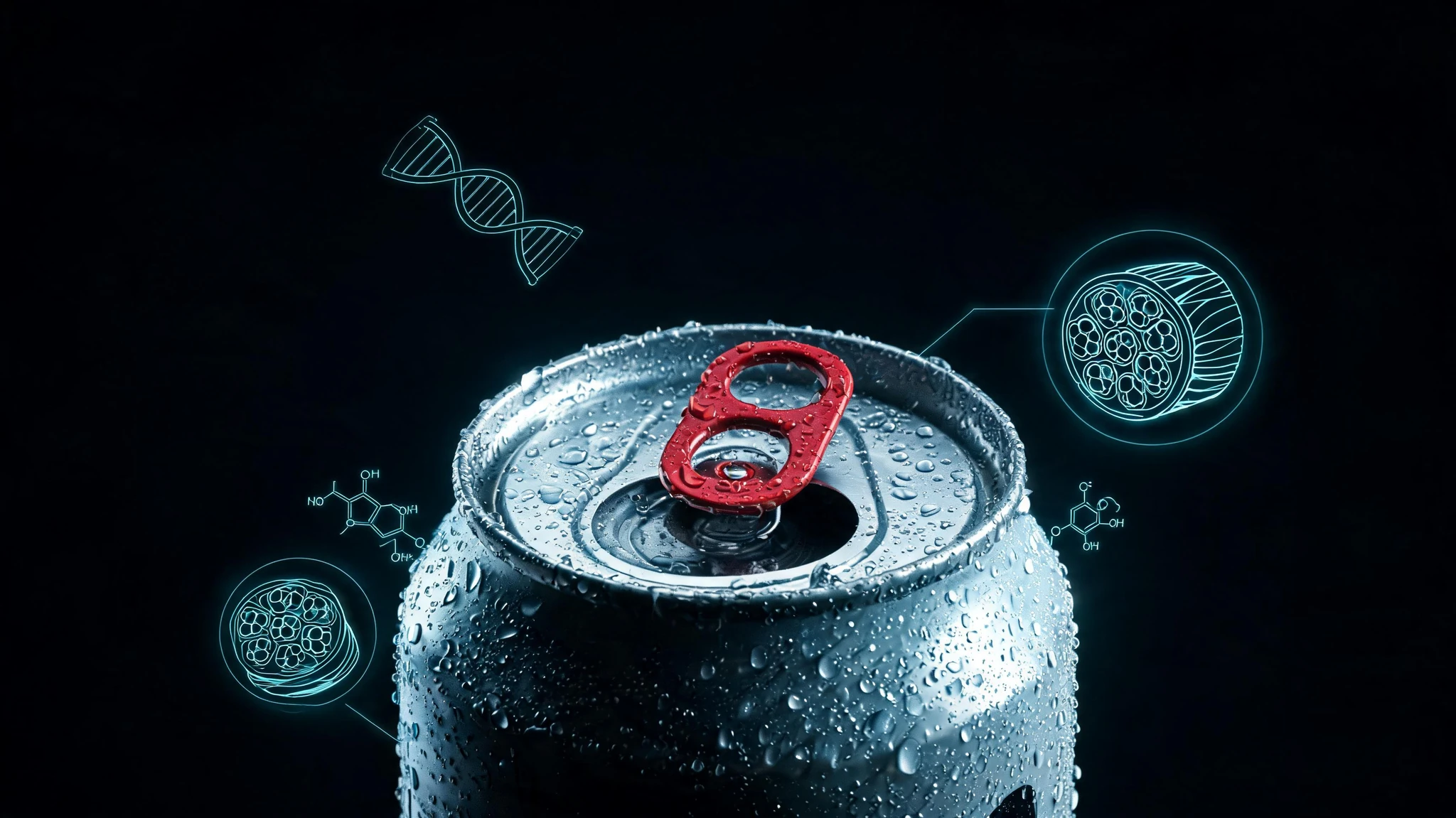
A 2023 paper in Scientific Reports tested eight commercial energy drinks on cultured mouse muscle cells and found something the headline writers had a field day with. At higher concentrations, the drinks suppressed muscle cell growth by up to 90 percent and reduced protein synthesis by roughly 30 to 70 percent.1 The study fingered caffeine as the main culprit, with double-caffeine formulas hitting muscle cells the hardest.
That number, 90 percent, is real. It is also a lab-dish number, from concentrations no one’s bloodstream is going to see after one tall can. The interesting question is what a healthy adult who lifts three times a week and drinks a Monster on Fridays should actually do about it.
What the 2023 study actually did
The researchers, led by Park and colleagues at Sookmyung Women’s University in Seoul, were not testing humans. They worked with C2C12 cells, a line of mouse skeletal-muscle precursor cells (myoblasts) that biologists have been using since the 1970s as a stand-in for muscle tissue. C2C12s do something useful: in a dish, they can be coaxed into fusing together to form little tubular muscle fibers, the same general process your body runs every time you damage and rebuild muscle.1
The team picked eight off-the-shelf energy drinks, including “double caffeine” versions, diluted each to a range of concentrations and dripped it onto the cells. They measured three things: how many cells were still alive, how much new protein the cells were making, and whether the cells could still fuse into muscle fibers.1
At the highest dilutions tested, viability dropped sharply, protein synthesis fell by 30 to 70 percent depending on the brand, and myogenic differentiation, the moment of becoming muscle, was almost completely blocked. The double-caffeine drinks were the worst offenders, which is what pointed the authors at caffeine as the active ingredient. They confirmed it by testing isolated caffeine on its own and seeing the same pattern.
Why “90 percent” sounds scarier than it is
Cell-culture work answers a precise question: what does this molecule do when you put it directly on a cell in a dish? It does not answer the question lifters actually care about, which is what one can does to the human body that drank it. There are at least three reasons those two questions can have different answers.
First, dose. The concentrations that produced the dramatic suppression were not the levels that show up in your bloodstream after a normal can. A typical 250 mL can has somewhere around 80 mg of caffeine, and a 500 mL “double” closer to 160 mg. After ingestion, that caffeine spreads through roughly 40 liters of body water, gets metabolized by the liver, and reaches a peak plasma concentration of maybe 5 to 10 micromolar in most adults. Lab studies consistently need much higher concentrations, often 1 to 10 millimolar, to suppress protein synthesis the way Park’s team observed.2 That is one to three orders of magnitude above what your muscles see.
Second, cells in your body do not float naked in caffeine. They sit inside tissue with blood flow, hormones, and feedback loops a dish cannot reproduce. No insulin response, no leucine spike from a protein shake, no growth-hormone pulse from last night’s sleep. Cell models are useful because they strip those things away, but the price of that clarity is that the result may not survive contact with a whole organism.
Third, you do not live in a permanent state of caffeine exposure. The half-life of caffeine in most adults is around five hours. By bedtime, even an afternoon energy drink is mostly cleared. Muscle protein synthesis runs on a much slower timescale, with a major anabolic window that lasts hours after a hard set. A transient dip in synthesis caused by a transient caffeine peak is not the same thing as chronic suppression.

What the human evidence says about caffeine and lifting
Here is where it gets interesting. If energy drinks were really blocking muscle growth in real lifters, we would expect to see it in the dozens of human trials that have looked at caffeine and resistance training. We do not. We see roughly the opposite.
A 2021 meta-analysis in the International Journal of Environmental Research and Public Health by Grgic and Del Coso pooled trials on women and found a small but reliable boost to both muscular endurance and one-rep-max strength after acute caffeine doses, typically in the range of 3 to 6 mg per kg of body weight.4 A separate 2021 systematic review in Critical Reviews in Food Science and Nutrition by Ferreira and colleagues looked at trials in adults of both sexes doing strength training and reached the same conclusion: caffeine modestly increases muscle endurance and reduces perceived exertion.5 Lifters, on average, do more work in the gym after caffeine, not less.
That does not contradict the dish study. It just points to where the dish study lives in the bigger picture. At supraphysiological doses, caffeine can dial down the cellular machinery that builds muscle. At the doses you actually drink, it makes you do harder sets, which is the input that drives muscle growth in the first place. The acute, short-term protein-synthesis dip seen in cell work, even when something like it shows up in animals, appears to be more than offset by the extra training stimulus.3
What about chronic, heavy intake?
The picture changes if you stop talking about a pre-workout can and start talking about four cans a day, every day, for years. Almost no one has run that experiment cleanly in humans, and for ethical reasons no one is going to. But there are signals worth taking seriously.
Hughes and colleagues, in a 2017 paper in the Journal of Muscle Research and Cell Motility, found that acute high-caffeine exposure in mouse muscle cells increased autophagy, a kind of cellular self-cleaning process, and reduced protein synthesis at the same time.2 Brief activation of autophagy is healthy. Persistent activation, layered on top of inadequate sleep, low protein intake, and chronic underrecovery, is not. If your routine is two energy drinks before training, a third in the afternoon, six hours of sleep, and a protein intake under 1.4 g per kg, the energy drinks are not the biggest problem you have, but they are not helping either.
Moore and colleagues looked at caffeine’s effect on the anabolic signaling pathway, mTOR, in rat muscle.3 Very high doses blunted the mTOR response to leucine, an amino-acid trigger for protein synthesis. Moderate doses did not. The dose-response curve here is not linear, and the threshold for harm seems to sit well above what most people drink.

So what should a lifter do?
If you train seriously and you sometimes use an energy drink as a pre-workout, the 2023 paper is not a reason to throw the can away. It is a reason to keep an eye on a few practical things, none of which are exotic.
Keep the dose in the ergogenic range. The human trials that show a strength benefit cluster around 3 to 6 mg of caffeine per kilogram of body weight, taken roughly 30 to 60 minutes before training.4,5 For a 75 kg lifter, that is 225 to 450 mg, which is one strong cup of coffee on the low end and roughly two standard energy drinks on the high end. Stacking a pre-workout powder on top of a double-caffeine energy drink is where you start drifting toward the dose territory the cell-culture authors were warning about.
Watch the second and third can. The supplement that helps your eight a.m. squat session does not help your two p.m. inbox triage. By the late afternoon, you are likely just paying interest on sleep debt, and the trade is rarely worth it. Caffeine intake spread across the day at consistent moderate levels almost certainly behaves more kindly to muscle than a single huge dose.
Mind the rest of the can. Energy drinks also carry sugar, taurine, B vitamins, sometimes ginseng, and a level of acidity rough on tooth enamel. The metabolic cost of a daily 200-calorie sugary can is its own conversation, not a small one if you are trying to lean out.
Cover the boring fundamentals. Three things move the needle on muscle growth far more than your beverage choice: progressive overload in your training, around 1.6 to 2.2 g of protein per kg of body weight per day, and seven to nine hours of sleep most nights. If those are dialed in, an occasional energy drink is a footnote. If they are not, no caffeine strategy is going to rescue your gains.
How worried should the average drinker be?
Honestly? Not very, if you are healthy, drink one or two cans on training days, and otherwise eat and sleep like a person who wants to add muscle. The 2023 lab finding is a piece of mechanistic biology, not a verdict on real-world consumption. Park and her co-authors say so themselves in the paper’s discussion: their goal was to flag a possible mechanism worth investigating in animals and humans, not to issue a clinical warning.1
The honest worry is not the can on Friday. It is the lifestyle pattern that often comes packaged with heavy energy-drink use: poor sleep, skipped meals, training in a half-rested state, treating caffeine as a substitute for recovery. Pull on that thread and the energy drink itself is the smallest piece.

Common questions about energy drinks and muscle growth
Will one energy drink before my workout ruin my gains?
No. The 90 percent suppression number comes from concentrations far above what reaches your bloodstream after a single can. Human trials of caffeine in normal pre-workout doses tend to show a small benefit to strength and endurance, not a deficit.4,5
Are double-caffeine energy drinks more risky for muscle?
The cell-culture data say yes at the dish level, where double-caffeine formulas suppressed muscle markers more strongly.1 Whether that translates to humans at normal serving sizes is unproven. A simple rule: if you are routinely drinking more than about 400 mg of caffeine a day from any combination of sources, you are above the FDA’s daily comfort threshold and probably not gaining anything by going higher.
Is coffee any better than an energy drink?
For the muscle-protein-synthesis question, the relevant ingredient in both is caffeine, so on that axis there is no clear advantage. Coffee wins on calories, sugar load, and additives. Energy drinks win on convenience and predictability of dose. Pick whichever you tolerate better.
What about taurine? Does it offset the caffeine effect?
Taurine has its own small body of muscle-related evidence, mostly suggesting modest effects on endurance performance. The 2023 study did test some taurine-containing formulas, and the suppression effect still tracked with caffeine concentration, not taurine.1 Do not count on taurine to “cancel out” caffeine.
Can teenagers drink them safely?
Pediatric guidelines recommend no caffeine for children under 12 and tight limits for adolescents (around 100 mg per day), so a typical energy drink already pushes that ceiling. Whether muscle growth is the right thing to be worried about for a 14-year-old is a separate conversation; the cardiovascular and sleep concerns are the bigger ones.
The bottom line
The 2023 paper out of Sookmyung is good science telling a real story about what happens to isolated muscle cells when you flood them with caffeine. The viral version of that story, the one where a single energy drink “blocks 90 percent” of your gains, mistakes the lab dish for the human body. The actual evidence in lifters points the other way: moderate caffeine use, taken near training, modestly helps you work harder, and working harder is what builds muscle.
If you want to use energy drinks as part of your training, the science gives you permission and a few sensible guardrails. Keep daily caffeine under about 400 mg, do not stack pre-workout powders on top of double-caffeine cans, treat the second and third can of the day as a tax on your sleep, and remember that the dose-response curve for caffeine is not flat. More is not more, past a point. The boring rules still beat the dramatic ones.
Sources
- Park SY et al. (2023). Effects of energy drinks on myogenic differentiation of murine C2C12 myoblasts. Scientific Reports. PubMed: 37231025
- Hughes MA et al. (2017). Acute high-caffeine exposure increases autophagic flux and reduces protein synthesis in C2C12 skeletal myotubes. Journal of Muscle Research and Cell Motility. PubMed: 28634643
- Moore TM et al. (2017). The effect of caffeine on skeletal muscle anabolic signaling and hypertrophy. Applied Physiology, Nutrition, and Metabolism. PubMed: 28177708
- Grgic J, Del Coso J (2021). Ergogenic Effects of Acute Caffeine Intake on Muscular Endurance and Muscular Strength in Women: A Meta-Analysis. International Journal of Environmental Research and Public Health. PubMed: 34072182
- Ferreira TT et al. (2021). Effects of caffeine supplementation on muscle endurance, maximum strength, and perceived exertion in adults submitted to strength training: a systematic review and meta-analyses. Critical Reviews in Food Science and Nutrition. PubMed: 32551869